When I brought up FireFox to check my e-mail this afternoon, I was greeted with a Yahoo video on the collapse of a part of the Wilkens Ice Shelf on the Western Peninsula of Antarctica of an ice area the size of Manhattan. It was said that at least one scientist said this is further proof of Global Warming. Well, there has long been a focus on this peninsular region of Antarctica due to loss of ice and, indeed, this part of Antarctica has lost ice for years. However, this area is a very small part of Antarctica and the vast majority of Antarctica has been increasing its ice mass for many years!
A couple of interesting commentaries have just surfaced which I would direct your attention to. In the first, Lorne Gunter wrote in the National Post in Canada, about the ocean temperature readings made in great proliferation by 3,000 Argo buoys since they were first deployed in 2003. They drift in the oceans at a depth of 2,000 meters and then about every 10 days they spend 6 hours rising to the surface, taking temperature data in each layer of the sea, and they broadcast their data to satellites, before sinking back to a 2000 meter depth. What have these ocean monitors found since 2003? There has been a slight cooling of the average ocean temperature! Given that CO2 levels in the atmosphere have continued to rise, this is a bit of a problem for the Man-is-wrecking-the-Earth-with-greenhouse-gases crowd. Apparently, 80 to 90% of the global warming due to CO2 is supposed to be warming of the oceans, which are then supposed to heat the atmosphere. This article also notes that NASA has 8 weather satellites that take 300,000 temperature readings every day all over the earth, compared to a mere 7,000 measurements by Earth ground stations, [too often located near population centers.] The satellites over 30 years have found only a 0.14 degree Centigrade per decade temperature increase on average.
Christopher Pearson wrote an interview with Jennifer Marohasy, a biologist and senior fellow of the Institute of Public Affairs in Melbourne, Australia published in The Australian. Marohasy notes that referenced to 1998, the earths average temperature has since fallen and if you take 2002 as your reference point, the temperature has been about constant since then. Then she notes that the NASA Aqua satellite launched in 2002 has provided data on temperature, cloud cover, and water vapor which contradicts a key assumption of the global warming computer models. The models have all thought that increasing CO2 would produce warming, which would produce more water vapor, [and since 95% of all greenhouse gas in the atmosphere is water vapor,] this would lead to accelerated heating of the atmosphere. WRONG! The Aqua satellite data shows that the increase in water vapor leads to a counteracting cooling. Thus, in engineering terms, the assumed positive feedback is really a negative feedback. [This reduction of the CO2 greenhouse effect is presumably due to increased cloud cover with increased water vapor and the reflection of considerable radiation of the sun back into space by the clouds.]
[These brackets indicate my additional comments relative to the information in these articles.]
Thanks to Robert Tracinski who pointed these two articles out in his TIA Daily.
It will be fascinating to watch the process of many of the careless, and often immoral, scientists backing away from their errors and this emotional declaration that man is ruining the earth by using fuels that create CO2. The response of the politicians will be even more interesting and more important. They have so many plans to ride roughshod over the rights of the individual in the name of saving the planet and thereby some elite portion of the animal kingdom, which will largely not include the human part. Should cooling continue, we will hear that we must prepare for the coming Ice Age and that this will require fascist socialist control of all human activity by an international government! Scaremongers are very resourceful and they will not hesitate to convince the People to give up their rights as the only way to prevent one crisis or another. The fascist have long used the fears induced by crises, often made up, to mobilize the people in one common effort, while minimizing their tendency to use reason. This technique has been taught in fascist and socialist circles for more than 100 years and used by Teddy Roosevelt, Woodrow Wilson, Mussolini, Lenin, FDR, Hitler, Kennedy (The Missile Gap, etc.), LBJ, and Clinton (Its the economy, stupid!, even as the economy was improving already from a much smaller dip than I Feel Your Pain Clinton made it out to be.)
26 March 2008


24 March 2008
Corn for Real Food or Energy Myth?
The ethanol scam, con, fraud, boondoggle, looting, tax, myth, price inflater is a study in governmental willingness to set obviously wrongheaded policies in law in the name of the General Welfare. Ethanol is being sold as a route to energy independence and as a way to reduce pollution. Its consequences for food production and costs are too rarely discussed among Americans. Its cost is too little understood. There are glaring problems with the mandated requirements for present and further ethanol use, which must be known to the politicians who have given us the ethanol laws. A shocking immorality is revealed in this story. This story is rich in the lesson that politicians cannot be entrusted with the Public Interest or the General Welfare without the most severe limitations of their power, such as are imposed by the Constitution, but whose provisions they ignore. This is not surprising, since Teddy Roosevelt and Woodrow Wilson began a long history of blatantly ignoring the limits of their power and trained Congress to do the same.
Let us follow the story of Congress and their mandates for ethanol use and their subsidies to encourage its production and use. Archer Daniels Midland began pushing for the use of ethanol as a fuel additive to reduce pollution in the 1970s. In the early 1980s, they were producing 175 million gallons of ethanol a year. ADM established a close working relationship with Sen. Bob Dole (Rep., Kansas) and gave the Republicans more than $1 million in the 1992 election and Democrats about $455,000. Bob Dole then helped ADM and corn farmers to line up billions of dollars in subsidies and tax breaks. The Cato Institute estimated that almost half of the profits of ADM were the result of product sales protected by or or subsidized by government in 1995. The 10% ethanol and 90% gasoline mixture E10 was required, especially in the winter months, in areas deemed to have a smog problem, under the rationale that the ethanol additive burned more cleanly.
The 2005 Energy Policy Act requires refiners to use 7.5 billion gallons of biofuels and specifically 250 million gallons of cellulosic ethanol in 2012. This cellulosic ethanol is ethanol made from plants or plant parts other than the corn fruit and the sugar of sugar cane. In 2006, ADM produced more than 1 billion gallons of ethanol. 200 subsidies and tax breaks were providing between $5.1 and $6.8 billion to make sales of ethanol possible. In June, Congress passed The American Fuels Act of 2007, which had been introduced by Barack Obama (Dem., IL), Tom Harkin (Dem., IA), and Richard Lugar (Rep., IN) to mandate increased use of biodiesel and provides tax credits for the production of cellulosic ethanol. This law requires the production of 36 billion gallons of ethanol by 2022. Of this amount only 15 billion gallons of ethanol are expected to come from corn, since that will be a bit more than half the present corn crop. The remaining 21 billion gallons of ethanol and biodiesel must come from other sources, which have not been developed. When introduced, the proposed bill was even more outrageous: it called for a mandate of 60 billion gallons of biofuels by 2030! Former Sen. Edwards called for 65 billion gallons of biofuels by 2025. Sen. Clinton voted against ethanol 17 times before she began her presidential campaign and turned into a supporter. Sen. McCain, who had been a doubter, became more positive when his campaign was well underway. Obama, Edwards, Clinton, and McCain were driven by the desire for votes in the Iowa caucuses. President Bush has been an enthusiastic supporter since his 2006 State of the Union address.
None of the sources of ethanol or biodiesel are even close to being economical and competitive with fossil fuels and nuclear power. The least subsidized source is ethanol from sugar cane, but we grow little sugar cane in the U.S. Brazil grows more than any other country and produces the cheapest ethanol, but it is nonetheless heavily subsidized in Brazil where a dictator first established the ethanol use requirement in 1975. There they directly subsidize hydrous-ethanol (5% water), ban diesel-powered cars, put a 21.5% import duty on foreign ethanol, and provide an alcohol storage program. They also provided subsidies to car manufacturers who made cars capable of running on ethanol concentrations which started at 10% and grew to numbers as high as 26%, though this number varies through the 20 to 26% range under democratically elected governments. Because of this commitment to ethanol, Brazil has found that ethanol made from corn in the U.S. is cheaper than ethanol made from sugar cane in more marginal land brought under production for the purpose in Brazil. They import American ethanol, despite the protective tariff!
So where does ethanol production, essentially that from corn, stand in the U.S.? About 5.4 billion gallons per year (bgy) was produced in 2006. Most of this went into the E10 gasoline fuel mix, which is 90% gasoline. The Congressional mandate is for 9 bgy in 2008, 15.2 bgy in 2012, and finally 36 bgy in 2022. This is a hugely ambitious program and yet the 36 bgy will provide the energy equivalent of 7% of current oil use. And that figure is a figment of the imagination for a number of reasons which we will examine.
Ethanol from corn requires energy to produce it. This energy needs to be measured to understand what part of the enormous effort to create 36 bgy of ethanol will actually result in a net energy gain. What fraction of the 7% substituted for gasoline in cars can really be realized as new energy? Corn requires plowing, fertilizing, and harvesting, which commonly uses diesel fuel on the farm. The fertilizer requires that large amounts of natural gas be used to make it. This fertilizer then has to be transported to the farm. Further fuel is often used to irrigate the corn fields. The corn when harvested has to be delivered to the fermentation plants where it will be converted into ethanol and that process requires fuel to generate heat and energy to handle and move materials. Waste water has to be disposed of and cleaned up. Once the ethanol is made, it cannot be transported in relatively efficient gas pipelines because its water content makes it incompatible with the seals and other materials of pipelines. So, more expensive transport by truck and train is required.
Studies of the net gain in energy from ethanol vary, but the highest estimates are that it produces 1.3 times as much energy as it takes to obtain it. More realistic and recent estimates have tended to conclude that one gets about an equal amount of energy, so there is no net gain at all. A recent study by researchers at Cornell University and the University of California - Berkeley found that it took 29% more energy to produce ethanol from corn than it gave back! What is more, as more and more land is devoted to corn production for ethanol, more and more of the land will be less and less suitable and productive. The amounts of fertilizer and irrigation water needed will increase. The distance to markets may also increase. So more and more energy will be required and the process of producing net energy will become tougher and improbable. So the idea that ethanol is renewable energy is entirely wrongheaded. There is always an exchange of used coal, gasoline, diesel, and electric power for an approximately equal amount of energy in the form of ethanol.
In order to achieve this magnificent goal of zero net energy, we will soon be subsidizing the manufacture of ethanol and other biofuels to the tune of $8.6 billion per year. These subsidizes are further supplemented by tax-exempt bonds to finance ethanol plant construction, loan guarantees, state vehicle fleet purchases of biofuel-using vehicles, irrigation water subsidized by government, and the benefit of the state and federal mandates that require the use of ethanol whether it is economical or not.
This failure to create net additional energy using ethanol, makes a lie of the idea that ethanol will help to make the U.S. more independent of unreliable and unfriendly governments with control of oil resources. There are still more problems with this argument. First, if the object is to have more options for energy, then we clearly should not exclude Brazilian ethanol from the U.S. market by imposing a $.54 per gallon tariff on it. Second, corn-derived ethanol depends mostly on the corn crop output of the Midwest, which is generally a more risky outcome than is the international supply of oil. Based on data from 1960 to 2005, corn yields may readily decline by 11.9% in a given year, while the corresponding year to year equally likely decline for oil from the Middle East is 6.8%. In one out of every 20 years, corn yields can be expected to decline by 31.8%, while the corresponding oil decline would only be 14.9%. A further problem is that corn yields tend to fall if it is too hot in August. Such heat calls for more total energy use to cool homes and cars, which may result in more ethanol use when less future ethanol can be produced due to lower corn yields.
This same failure to create net additional energy also places limits on the argument that we can reduce the amount of money going to oil-rich Muslim countries where that money is used against us by Muslim terrorists and despotic governments by using more ethanol instead of oil. There may be some substitution of coal and natural gas for oil in the making of the ethanol, but these are often substitutes in other of our energy needs anyway. That is, coal and natural gas are used in many industrial processes and in generating electric power in competition with oil. If we use coal and natural gas to create ethanol, we increase their demand and their prices, which then makes oil look more attractive where it can be used as an alternative.
Ethanol has been touted as a means to reduce smog and pollution, as mentioned above. However, a 2006 study by Robert Niven of the Australian Defense Force Academy shows that E10 increases the total emissions of hydrocarbons and toxic compounds relative to gasoline, when evaporative emissions are fully accounted for. E85 is even worse. There is a slight advantage to using E10 with respect to greenhouse gas emissions, if you ignore the energy used to produce it in the first place, but it is microscopic at about a 1 to 5% level. This apparent low level advantage means that it costs about $250/ton to decrease greenhouse gases, according to the International Energy Agency. This is ridiculously expensive, and it actually is much more expensive given that this neglects the greenhouse gases emitted when using the other energy sources used to produce the ethanol. In fact, taking that into account will mean that the use of ethanol will create almost two times as much greenhouse gases as gasoline does.
A given volume of ethanol will produce about 66% as much energy as an equal volume of gasoline. This means that when ethanol is mixed with gasoline, a driver on the road must stop more often to refill his vehicle's tank. In the workplace, this is a cause of decreased productivity. For already busy people, this is a waste of time. For a given amount of transportation need, there must then be more fuel tankers on the road and on the rails and larger fuel storage facilities at refineries, shipping centers, and at the local gas stations to handle the larger volumes of fuel. There must also be more pumps and gas stations to pump it into vehicle tanks. Our time and scarce resources must be devoted to satisfying these requirements.
So, in the interest of a zero-sum game with respect to energy and an increase in greenhouse gases, we are converting valuable foods into vapors. What are the consequences of doing this?
Corn production for food purposes and for ethanol production use was subsidized, according to the Environmental Working Group, to the tune of $9.4 billion dollars in 2005. Note that this is larger than the ethanol subsidy numbers given above because it includes the normal subsidies for corn food production which does not go into ethanol. Corn for food is the most heavily subsidized of the major crops. This money is provided by heavier taxes and earns the taxpayer higher food prices in the grocery store, since some of it is in the form of price supports and it discourages productivity improvements. Corn costs more there as a result and so does corn syrup, corn oil, and meats such as beef, pork, and chicken which depend upon corn feed products very heavily. All the products with these as ingredients cost more because of these subsidies.
Distillers can produce 2.7 gallons of ethanol from one bushel of corn. American farmers produced 10.5 billion bushels of corn in 2006. If the entire corn crop of 2006 were turned into ethanol, only 28.3 billion gallons of ethanol would result. This would leave us short of the 36 bgy requirement for 2022. Of course, corn will still need to be used for food purposes in 2022 and the thought is that only 15 bgy of the required 36 bgy of ethanol will come from corn. Assuming that other ethanol sources are developed, this requires that the capacity to produce another 9.6 bgy of corn ethanol be developed by 2022. This requires an increase in corn production by 34% relative to 2006, while falsely assuming that our food needs will not increase also between now and 2022. This in turn means that huge tracts of farmland will either have to be diverted from growing other crops or from ranching or that much of the land once farmed long ago in the U.S. and now returned to forests will have to become farmland again.
Much of the land in the U.S. no longer farmed went out of production because it was less suitable for farming than the more efficient lands now being farmed. The loss of forests, which have increased greatly since the early 1900s, will be very substantial. These forests help to remove CO2 from the atmosphere as they grow and remove much more than does land planted in corn. So, those who believe that an increasing CO2 concentration in the atmosphere is a terrible thing, will see some negative effect here. The less suitable farm lands which will be returned to production will require larger amounts of fertilizer, pesticides, and water in general than does the land presently under till for corn. This means that the ethanol produced from this corn will cost more, that more pollution from fertilizer and pesticides will occur, and that more precious water will be used and contaminated. Even on optimal corn-growing farmland, it takes 1700 gallons of water to produce one gallon of ethanol. Another effect has already been observed: land will be planted in corn and rather than rotating with soybeans or another legume, it will be planted in corn again. This will mean that presently good farmland will either need more fertilizer or it will wear out. Meanwhile, the price of farmland suitable for growing corn has increased dramatically, which has increased the costs for those newcomers who would buy farmland to put to use in growing corn either for food or ethanol. The value of farmland in Iowa increased 18% in 2007.
From 2001 to 2006, the percentage of the U.S. corn crop used for ethanol production rose from 3% to 20%. As a result of limited increases in total corn production, the futures price of corn rose by 80% in 2006 alone. University of Minnesota economists C. Ford Runge and Benjamin Senauer wrote an article for Foreign Affairs entitled "How Biofuels Could Starve the Poor." They note that filling the gas tank of a SUV with pure ethanol made from corn takes 450 pounds of corn. This is enough calories to feed a person for a year. The price of beef, pork, and poultry rose more than 3% in the first 5 months of 2007. Tortilla prices rose 60% in Mexico, causing food riots. Butter prices increased 40% in Europe. Pork prices rose 20% in China. All this because the U.S. is the biggest exporter of food in the world. Much of our corn crop has always been exported, but now that it draws higher prices as future ethanol, it is boosting the cost of foods dependent upon corn around the world. Runge and Senauer believe 600 million additional people may go hungry by 2025 due to the increased use of corn to produce ethanol.
Dennis T. Avery, director of global food issues at the Hudson Institute, says "We would effectively be burning food as auto fuel in a world that is not fully well-fed now, and whose food demand will more than double in the next 40 years." Because of the recent advances in many Third World countries, 2 billion people are making the transition from grain diets to meat diets. It takes a lot of corn to feed livestock and to produce the meat they are seeking. The U.S. has been the biggest exporter of this meat and has the potential to profit greatly from the further growth of this market. That cannot happen if we shoot ourselves in the foot by making our meat prices too high due to our escalating corn costs. The market for exported corn products such as corn, corn oil, and high-fructose corn syrup and the products made from them (Coca-Cola, etc.) is also a large one. This is not good for either us or the rest of the world.
On top of this, we tax ourselves heavily to provide for the ethanol subsidies and protections, we endure higher car fuel prices, pay higher food prices, and we have to build new kinds of cars, new kinds of refineries, new storage tanks, new tanker trucks, new rail cars, we use more water, we cause more pollution, and we create more greenhouse gases. So, why do we do this when none of the widely claimed energy advantages hold water when examined? It is because the governments and the politicians who run them always want more power and are eager to hand out goodies to special interests such as ADM and the corn farmers in this case, as long as they can get away with selling a myth to the public.
The mandate for increased ethanol use is adding to the present forces pushing us toward a possible recession. It adds to fuel and food costs and causes much economic uncertainty about the future, which causes less business investment and encourages consumers to spend less on goods and services other than food and fuel. We must kill this ethanol myth. That a representative republic can fall for such a scam is disgraceful. We must prove that we can be fooled only sometimes and for awhile, but then we come awake and exercise our rational faculties and finally Stand Sure against the con artists.
Let us follow the story of Congress and their mandates for ethanol use and their subsidies to encourage its production and use. Archer Daniels Midland began pushing for the use of ethanol as a fuel additive to reduce pollution in the 1970s. In the early 1980s, they were producing 175 million gallons of ethanol a year. ADM established a close working relationship with Sen. Bob Dole (Rep., Kansas) and gave the Republicans more than $1 million in the 1992 election and Democrats about $455,000. Bob Dole then helped ADM and corn farmers to line up billions of dollars in subsidies and tax breaks. The Cato Institute estimated that almost half of the profits of ADM were the result of product sales protected by or or subsidized by government in 1995. The 10% ethanol and 90% gasoline mixture E10 was required, especially in the winter months, in areas deemed to have a smog problem, under the rationale that the ethanol additive burned more cleanly.
The 2005 Energy Policy Act requires refiners to use 7.5 billion gallons of biofuels and specifically 250 million gallons of cellulosic ethanol in 2012. This cellulosic ethanol is ethanol made from plants or plant parts other than the corn fruit and the sugar of sugar cane. In 2006, ADM produced more than 1 billion gallons of ethanol. 200 subsidies and tax breaks were providing between $5.1 and $6.8 billion to make sales of ethanol possible. In June, Congress passed The American Fuels Act of 2007, which had been introduced by Barack Obama (Dem., IL), Tom Harkin (Dem., IA), and Richard Lugar (Rep., IN) to mandate increased use of biodiesel and provides tax credits for the production of cellulosic ethanol. This law requires the production of 36 billion gallons of ethanol by 2022. Of this amount only 15 billion gallons of ethanol are expected to come from corn, since that will be a bit more than half the present corn crop. The remaining 21 billion gallons of ethanol and biodiesel must come from other sources, which have not been developed. When introduced, the proposed bill was even more outrageous: it called for a mandate of 60 billion gallons of biofuels by 2030! Former Sen. Edwards called for 65 billion gallons of biofuels by 2025. Sen. Clinton voted against ethanol 17 times before she began her presidential campaign and turned into a supporter. Sen. McCain, who had been a doubter, became more positive when his campaign was well underway. Obama, Edwards, Clinton, and McCain were driven by the desire for votes in the Iowa caucuses. President Bush has been an enthusiastic supporter since his 2006 State of the Union address.
None of the sources of ethanol or biodiesel are even close to being economical and competitive with fossil fuels and nuclear power. The least subsidized source is ethanol from sugar cane, but we grow little sugar cane in the U.S. Brazil grows more than any other country and produces the cheapest ethanol, but it is nonetheless heavily subsidized in Brazil where a dictator first established the ethanol use requirement in 1975. There they directly subsidize hydrous-ethanol (5% water), ban diesel-powered cars, put a 21.5% import duty on foreign ethanol, and provide an alcohol storage program. They also provided subsidies to car manufacturers who made cars capable of running on ethanol concentrations which started at 10% and grew to numbers as high as 26%, though this number varies through the 20 to 26% range under democratically elected governments. Because of this commitment to ethanol, Brazil has found that ethanol made from corn in the U.S. is cheaper than ethanol made from sugar cane in more marginal land brought under production for the purpose in Brazil. They import American ethanol, despite the protective tariff!
So where does ethanol production, essentially that from corn, stand in the U.S.? About 5.4 billion gallons per year (bgy) was produced in 2006. Most of this went into the E10 gasoline fuel mix, which is 90% gasoline. The Congressional mandate is for 9 bgy in 2008, 15.2 bgy in 2012, and finally 36 bgy in 2022. This is a hugely ambitious program and yet the 36 bgy will provide the energy equivalent of 7% of current oil use. And that figure is a figment of the imagination for a number of reasons which we will examine.
Ethanol from corn requires energy to produce it. This energy needs to be measured to understand what part of the enormous effort to create 36 bgy of ethanol will actually result in a net energy gain. What fraction of the 7% substituted for gasoline in cars can really be realized as new energy? Corn requires plowing, fertilizing, and harvesting, which commonly uses diesel fuel on the farm. The fertilizer requires that large amounts of natural gas be used to make it. This fertilizer then has to be transported to the farm. Further fuel is often used to irrigate the corn fields. The corn when harvested has to be delivered to the fermentation plants where it will be converted into ethanol and that process requires fuel to generate heat and energy to handle and move materials. Waste water has to be disposed of and cleaned up. Once the ethanol is made, it cannot be transported in relatively efficient gas pipelines because its water content makes it incompatible with the seals and other materials of pipelines. So, more expensive transport by truck and train is required.
Studies of the net gain in energy from ethanol vary, but the highest estimates are that it produces 1.3 times as much energy as it takes to obtain it. More realistic and recent estimates have tended to conclude that one gets about an equal amount of energy, so there is no net gain at all. A recent study by researchers at Cornell University and the University of California - Berkeley found that it took 29% more energy to produce ethanol from corn than it gave back! What is more, as more and more land is devoted to corn production for ethanol, more and more of the land will be less and less suitable and productive. The amounts of fertilizer and irrigation water needed will increase. The distance to markets may also increase. So more and more energy will be required and the process of producing net energy will become tougher and improbable. So the idea that ethanol is renewable energy is entirely wrongheaded. There is always an exchange of used coal, gasoline, diesel, and electric power for an approximately equal amount of energy in the form of ethanol.
In order to achieve this magnificent goal of zero net energy, we will soon be subsidizing the manufacture of ethanol and other biofuels to the tune of $8.6 billion per year. These subsidizes are further supplemented by tax-exempt bonds to finance ethanol plant construction, loan guarantees, state vehicle fleet purchases of biofuel-using vehicles, irrigation water subsidized by government, and the benefit of the state and federal mandates that require the use of ethanol whether it is economical or not.
This failure to create net additional energy using ethanol, makes a lie of the idea that ethanol will help to make the U.S. more independent of unreliable and unfriendly governments with control of oil resources. There are still more problems with this argument. First, if the object is to have more options for energy, then we clearly should not exclude Brazilian ethanol from the U.S. market by imposing a $.54 per gallon tariff on it. Second, corn-derived ethanol depends mostly on the corn crop output of the Midwest, which is generally a more risky outcome than is the international supply of oil. Based on data from 1960 to 2005, corn yields may readily decline by 11.9% in a given year, while the corresponding year to year equally likely decline for oil from the Middle East is 6.8%. In one out of every 20 years, corn yields can be expected to decline by 31.8%, while the corresponding oil decline would only be 14.9%. A further problem is that corn yields tend to fall if it is too hot in August. Such heat calls for more total energy use to cool homes and cars, which may result in more ethanol use when less future ethanol can be produced due to lower corn yields.
This same failure to create net additional energy also places limits on the argument that we can reduce the amount of money going to oil-rich Muslim countries where that money is used against us by Muslim terrorists and despotic governments by using more ethanol instead of oil. There may be some substitution of coal and natural gas for oil in the making of the ethanol, but these are often substitutes in other of our energy needs anyway. That is, coal and natural gas are used in many industrial processes and in generating electric power in competition with oil. If we use coal and natural gas to create ethanol, we increase their demand and their prices, which then makes oil look more attractive where it can be used as an alternative.
Ethanol has been touted as a means to reduce smog and pollution, as mentioned above. However, a 2006 study by Robert Niven of the Australian Defense Force Academy shows that E10 increases the total emissions of hydrocarbons and toxic compounds relative to gasoline, when evaporative emissions are fully accounted for. E85 is even worse. There is a slight advantage to using E10 with respect to greenhouse gas emissions, if you ignore the energy used to produce it in the first place, but it is microscopic at about a 1 to 5% level. This apparent low level advantage means that it costs about $250/ton to decrease greenhouse gases, according to the International Energy Agency. This is ridiculously expensive, and it actually is much more expensive given that this neglects the greenhouse gases emitted when using the other energy sources used to produce the ethanol. In fact, taking that into account will mean that the use of ethanol will create almost two times as much greenhouse gases as gasoline does.
A given volume of ethanol will produce about 66% as much energy as an equal volume of gasoline. This means that when ethanol is mixed with gasoline, a driver on the road must stop more often to refill his vehicle's tank. In the workplace, this is a cause of decreased productivity. For already busy people, this is a waste of time. For a given amount of transportation need, there must then be more fuel tankers on the road and on the rails and larger fuel storage facilities at refineries, shipping centers, and at the local gas stations to handle the larger volumes of fuel. There must also be more pumps and gas stations to pump it into vehicle tanks. Our time and scarce resources must be devoted to satisfying these requirements.
So, in the interest of a zero-sum game with respect to energy and an increase in greenhouse gases, we are converting valuable foods into vapors. What are the consequences of doing this?
Corn production for food purposes and for ethanol production use was subsidized, according to the Environmental Working Group, to the tune of $9.4 billion dollars in 2005. Note that this is larger than the ethanol subsidy numbers given above because it includes the normal subsidies for corn food production which does not go into ethanol. Corn for food is the most heavily subsidized of the major crops. This money is provided by heavier taxes and earns the taxpayer higher food prices in the grocery store, since some of it is in the form of price supports and it discourages productivity improvements. Corn costs more there as a result and so does corn syrup, corn oil, and meats such as beef, pork, and chicken which depend upon corn feed products very heavily. All the products with these as ingredients cost more because of these subsidies.
Distillers can produce 2.7 gallons of ethanol from one bushel of corn. American farmers produced 10.5 billion bushels of corn in 2006. If the entire corn crop of 2006 were turned into ethanol, only 28.3 billion gallons of ethanol would result. This would leave us short of the 36 bgy requirement for 2022. Of course, corn will still need to be used for food purposes in 2022 and the thought is that only 15 bgy of the required 36 bgy of ethanol will come from corn. Assuming that other ethanol sources are developed, this requires that the capacity to produce another 9.6 bgy of corn ethanol be developed by 2022. This requires an increase in corn production by 34% relative to 2006, while falsely assuming that our food needs will not increase also between now and 2022. This in turn means that huge tracts of farmland will either have to be diverted from growing other crops or from ranching or that much of the land once farmed long ago in the U.S. and now returned to forests will have to become farmland again.
Much of the land in the U.S. no longer farmed went out of production because it was less suitable for farming than the more efficient lands now being farmed. The loss of forests, which have increased greatly since the early 1900s, will be very substantial. These forests help to remove CO2 from the atmosphere as they grow and remove much more than does land planted in corn. So, those who believe that an increasing CO2 concentration in the atmosphere is a terrible thing, will see some negative effect here. The less suitable farm lands which will be returned to production will require larger amounts of fertilizer, pesticides, and water in general than does the land presently under till for corn. This means that the ethanol produced from this corn will cost more, that more pollution from fertilizer and pesticides will occur, and that more precious water will be used and contaminated. Even on optimal corn-growing farmland, it takes 1700 gallons of water to produce one gallon of ethanol. Another effect has already been observed: land will be planted in corn and rather than rotating with soybeans or another legume, it will be planted in corn again. This will mean that presently good farmland will either need more fertilizer or it will wear out. Meanwhile, the price of farmland suitable for growing corn has increased dramatically, which has increased the costs for those newcomers who would buy farmland to put to use in growing corn either for food or ethanol. The value of farmland in Iowa increased 18% in 2007.
From 2001 to 2006, the percentage of the U.S. corn crop used for ethanol production rose from 3% to 20%. As a result of limited increases in total corn production, the futures price of corn rose by 80% in 2006 alone. University of Minnesota economists C. Ford Runge and Benjamin Senauer wrote an article for Foreign Affairs entitled "How Biofuels Could Starve the Poor." They note that filling the gas tank of a SUV with pure ethanol made from corn takes 450 pounds of corn. This is enough calories to feed a person for a year. The price of beef, pork, and poultry rose more than 3% in the first 5 months of 2007. Tortilla prices rose 60% in Mexico, causing food riots. Butter prices increased 40% in Europe. Pork prices rose 20% in China. All this because the U.S. is the biggest exporter of food in the world. Much of our corn crop has always been exported, but now that it draws higher prices as future ethanol, it is boosting the cost of foods dependent upon corn around the world. Runge and Senauer believe 600 million additional people may go hungry by 2025 due to the increased use of corn to produce ethanol.
Dennis T. Avery, director of global food issues at the Hudson Institute, says "We would effectively be burning food as auto fuel in a world that is not fully well-fed now, and whose food demand will more than double in the next 40 years." Because of the recent advances in many Third World countries, 2 billion people are making the transition from grain diets to meat diets. It takes a lot of corn to feed livestock and to produce the meat they are seeking. The U.S. has been the biggest exporter of this meat and has the potential to profit greatly from the further growth of this market. That cannot happen if we shoot ourselves in the foot by making our meat prices too high due to our escalating corn costs. The market for exported corn products such as corn, corn oil, and high-fructose corn syrup and the products made from them (Coca-Cola, etc.) is also a large one. This is not good for either us or the rest of the world.
On top of this, we tax ourselves heavily to provide for the ethanol subsidies and protections, we endure higher car fuel prices, pay higher food prices, and we have to build new kinds of cars, new kinds of refineries, new storage tanks, new tanker trucks, new rail cars, we use more water, we cause more pollution, and we create more greenhouse gases. So, why do we do this when none of the widely claimed energy advantages hold water when examined? It is because the governments and the politicians who run them always want more power and are eager to hand out goodies to special interests such as ADM and the corn farmers in this case, as long as they can get away with selling a myth to the public.
The mandate for increased ethanol use is adding to the present forces pushing us toward a possible recession. It adds to fuel and food costs and causes much economic uncertainty about the future, which causes less business investment and encourages consumers to spend less on goods and services other than food and fuel. We must kill this ethanol myth. That a representative republic can fall for such a scam is disgraceful. We must prove that we can be fooled only sometimes and for awhile, but then we come awake and exercise our rational faculties and finally Stand Sure against the con artists.
16 March 2008
Walter E. Williams
Walter E. Williams, Professor of Economics at George Mason University in Fairfax, Virginia, is one of my heroes. He is a brilliant, cunning, and lucid defender of the rights of the individual to life, liberty, and the pursuit of happiness and of the critical need to limit the powers of government in order to secure those rights. He is an effective defender of free markets and of the Capitalist system as the means to provide for a society without the use of force in most areas of our lives. He argues his case clearly and with great moral passion. He also has a passion for economics and thinking in a very rational and analytical manner. He is an acute observer of the facts of reality and he checks his evaluations of the consequences of all sorts of economic, marketplace, and government actions carefully and through many layers of consequences. Walter Williams is a very well-grounded man. He is a friend of Thomas Sowell, another economist of remarkable intellect and a fascinating historian. Walter Williams has a website here which usually has a number of interesting articles or the text of talks. His thoughts on a wide range of political, economic, and cultural issues are a pleasure to read. He will enlighten you, both through his effective teaching and as in lighting a fire under you!
Some may know that Prof. Williams sometimes substitutes for Rush Limbaugh on his talk radio show. I came to know him through his newspaper column, which is fortunately frequently published in the Washington Times. For six years he was the department head of the Economics Dept. at George Mason University which produced a couple of good Noble prize winners in economics. On his web page there is a link lower down to a TNI interview, which makes for interesting reading on his general thoughts and his background as an black individualist. TNI is The New Individualist, a magazine published by The Atlas Society, whose editor-in-chief is a friend, Robert Bidinotto. There was a movement to draft him to run for President, which he scotched, saying that his wife threatened to assassinate him if he consented to do so. He loves his wife dearly, so he has refused to be drafted. I suspect that he is only too aware that the job is an impossible one as well. But, if he were somehow to run and to escape all assassination attempts, voting for him would be the proudest vote of my life. Walter Williams is a good man.
Some may know that Prof. Williams sometimes substitutes for Rush Limbaugh on his talk radio show. I came to know him through his newspaper column, which is fortunately frequently published in the Washington Times. For six years he was the department head of the Economics Dept. at George Mason University which produced a couple of good Noble prize winners in economics. On his web page there is a link lower down to a TNI interview, which makes for interesting reading on his general thoughts and his background as an black individualist. TNI is The New Individualist, a magazine published by The Atlas Society, whose editor-in-chief is a friend, Robert Bidinotto. There was a movement to draft him to run for President, which he scotched, saying that his wife threatened to assassinate him if he consented to do so. He loves his wife dearly, so he has refused to be drafted. I suspect that he is only too aware that the job is an impossible one as well. But, if he were somehow to run and to escape all assassination attempts, voting for him would be the proudest vote of my life. Walter Williams is a good man.
15 March 2008
The Kyoto Protocol on Global Warming
Internet Al Gore told the climate jamboree held last year in Bali, "My own country the United States is principally responsible for obstructing progress here." Let us examine what the rest of the world has actually done and what the US has done between the signing in Kyoto in 1997 and 2004.
If we look at the data between 2000 and 2004, we see a trend looking forward for the US vs. the European Union:
Apparently, the Kyoto Protocol, which actually will do very little to change the world's temperature, serves as a holier-than-thou cover for nations who are adding to greenhouse gas emissions much faster than the US is. Just about everywhere you look in this Global Warming Scare, you find dishonesty. You also find that it is a tool used to belittle the US and for other nations and the UN to try to gain control of the US.
- Non-water vapor greenhouse gas emissions world-wide increased 18%.
- Treaty signing nations increased emissions 21.1%.
- Emissions from non-signing nations increased 10%.
- Emissions of the European Union nations increased 8.0%.
- Emissions in the US increased 6.6%.
If we look at the data between 2000 and 2004, we see a trend looking forward for the US vs. the European Union:
- Emissions increase in the European Union of 5.8%.
- Emissions increase in the US of 1.7%.
Apparently, the Kyoto Protocol, which actually will do very little to change the world's temperature, serves as a holier-than-thou cover for nations who are adding to greenhouse gas emissions much faster than the US is. Just about everywhere you look in this Global Warming Scare, you find dishonesty. You also find that it is a tool used to belittle the US and for other nations and the UN to try to gain control of the US.
13 March 2008
Another Call for Energy Cut-off
Once again a couple of computer climate modeling groups have reached a Sky Is Falling conclusion that the generation of further carbon dioxide will have drastic long-term warming effects on the environment. A modeler named Schmittner, the lead author of a 14 February article in the journal Global Biogeochemical Cycles and an Oregon State University professor, said that the Earth will warm by 7.2 degrees Fahrenheit by 2100 if we do nothing to greatly limit carbon dioxide emissions. He says that if we do not limit them to zero until 2300, the temperature will rise by 15 degrees Fahrenheit. Wow!!!! This would be alarming.
This computer model was run to make predictions 2,000 years into the future. However, did this same model receive the obvious test that should be made on any such model? Did they apply it to a starting time of 2,000 years ago and see if it accurately predicted the climate from then until now? Well, no. None of the models we hear so much about are ever tested in this way, or if they are, the results are not reported. This tells us all these modelers are playing games, rather than trying to seriously address reality. What is more, many of them are clearly drawn to these games for their ability to gain them attention when the model outcome is some drastic event. This gains them publicity and funding for more playing.
I just read how this work was reported by the Washington Post here. The only word of caution in considering these studies was given by Brian O'Neill of the National Center for Atmospheric Research who allowed that there were some uncertainties about the strength of the natural carbon cycle and the dynamics of ocean warming, which would affect the accuracy of the modeling predictions. Ha!!!! That really takes the cake. With even the smallest uncertainties, 2000 year predictions of climate are extremely dubious. These papers claim that natural cycles remove about 1/2 of the human CO2 emissions within a hundred years. I suspect that this occurs much faster than this. For one thing, as minerals become more hydrated, as they will with warming, they commonly soak up large amounts of CO2. I do not believe any of the computer models include this effect in their algorithms. I also do not think that the issues relating to the huge heat capacity differences between the oceans and the atmosphere are properly dealt with. These modelers are usually much better computer programmers than they are scientists.
There are repeated calls for drastic reductions in carbon output mentioned in the Washington Post article. What they really mean is carbon dioxide output, since all of the carbon was really there ahead of any action by man. The article notes that the U.N. Intergovernmental Panel on Climate Change called on industrialized nations to cut their emissions by 80 to 95% by 2050. The world as a whole was told to cut emissions by 50 to 80%. The Senate is poised to vote in June to reduce U.S. emissions by 70% by 2050. Hillary R. Clinton and Barack H. Obama are calling for an 80% reduction. John McCain wants a 60% reduction. I hope you are thinking about how this will change your lifestyle and that of your children.
Now if the temperature of the Earth actually were to increase by 15 degrees Fahrenheit, this would be a bad thing, but in the last 600 million years, the planet has more often been 15 degrees or more warmer than it has been as cool as it is now. These modelers have made some serious errors. First, adding CO2 to the atmosphere starting at very low concentrations causes the temperature to increase fairly rapidly. But, by the time the concentration is what it is now, which actually is very low compared to the average of the past 550 million years when man made no contributions, the effect of adding more CO2 in increasing the temperature is very low. There is another problem: It is very difficult to cause a temperature increase in the tropics because of the cooling effect of increased water evaporation as the temperature is increased and because of the increased cloud cover that results. For the same reason, it will be very difficult to increase the temperature in the temperate zones by 15 degrees with man's limited means, which would make them much more like the tropical zones. Now, water evaporated in the tropics adds to cloud cover in the other parts of the world. Under the drastic warming conditions predicted in these computer models, the whole world would be producing much more water vapor and cloud cover. The surface of the earth would see much less direct sunlight and the cooling will be great.
The modelers commonly think that the addition of CO2 to the atmosphere caused the temperature increase from 1975 to 2001, but most of that increase was really caused by an increase in radiation from the sun. Richard Willson of Columbia University and NASA, reported that the sun's radiation increased by 0.05% each decade from 1978 to 2003. The research I discussed in my last note further shows that the temperature of the earth is dominated by the sun. Yet groups such as these modelers believe the temperature increase from 1975 to 2001 was caused by CO2 increases, so they are overestimating the effects of CO2. The amount of CO2 in the atmosphere has increased smoothly since 1850 and some of that is because the earth is warming after the Little Ice Age ended. CO2 is emitted by the oceans, which hold vast amounts of dissolved CO2, as the oceans warm. Some of additional CO2 increase is due to man. However, we must not forget that in some Ice Ages, the CO2 concentration in the atmosphere was 16 times what it is now! One would think that would stop an Ice Age in its tracks if CO2 has the ability to increase temperature as these computer models predict! There is much evidence that these computer modelers overestimate the effects of CO2 in the atmosphere over and over. They have a long history now of having to reduce the size of earlier predicted temperature increases.
This brings up another interesting issue. We might actually want to warm the planet with CO2 emissions if that could be done without too much effort! Why??? The last major Ice Age ended about 11,000 years ago. All of human civilization and almost all of our development of knowledge has occurred in the more human-friendly conditions since then. There are now 6.8 billion people on Earth. How many of these people would survive even 100s of years into the next Ice Age? Why should you think about that? Because in the last 400,000 years the human-friendly warm periods commonly last about 10,000 years and the Ice Ages last about 70,000 to 90,000 years. Since we are at 11,000 years and the 2,000 year prediction of the computer model discussed above would put us at 13,000 years, we might very well be looking for all the warmth we can find then.
The climate of the Earth is critically important to man and his future. We should make a very concerted effort to understand it. That starts by being willing to critically observe the earth's history of climate change. It also means that we examine theories effecting the climate with an objective evaluation, rather than a religious zeal often borne of a bias against man's activities. We need to remember that the reason the Earth's climate is important is because the quality of man's life is dependent upon it. If we act in a panic to lower the quality of man's life without a sound knowledge of the complex issues affecting the climate, we are actually more likely to do harm than to do good.
This computer model was run to make predictions 2,000 years into the future. However, did this same model receive the obvious test that should be made on any such model? Did they apply it to a starting time of 2,000 years ago and see if it accurately predicted the climate from then until now? Well, no. None of the models we hear so much about are ever tested in this way, or if they are, the results are not reported. This tells us all these modelers are playing games, rather than trying to seriously address reality. What is more, many of them are clearly drawn to these games for their ability to gain them attention when the model outcome is some drastic event. This gains them publicity and funding for more playing.
I just read how this work was reported by the Washington Post here. The only word of caution in considering these studies was given by Brian O'Neill of the National Center for Atmospheric Research who allowed that there were some uncertainties about the strength of the natural carbon cycle and the dynamics of ocean warming, which would affect the accuracy of the modeling predictions. Ha!!!! That really takes the cake. With even the smallest uncertainties, 2000 year predictions of climate are extremely dubious. These papers claim that natural cycles remove about 1/2 of the human CO2 emissions within a hundred years. I suspect that this occurs much faster than this. For one thing, as minerals become more hydrated, as they will with warming, they commonly soak up large amounts of CO2. I do not believe any of the computer models include this effect in their algorithms. I also do not think that the issues relating to the huge heat capacity differences between the oceans and the atmosphere are properly dealt with. These modelers are usually much better computer programmers than they are scientists.
There are repeated calls for drastic reductions in carbon output mentioned in the Washington Post article. What they really mean is carbon dioxide output, since all of the carbon was really there ahead of any action by man. The article notes that the U.N. Intergovernmental Panel on Climate Change called on industrialized nations to cut their emissions by 80 to 95% by 2050. The world as a whole was told to cut emissions by 50 to 80%. The Senate is poised to vote in June to reduce U.S. emissions by 70% by 2050. Hillary R. Clinton and Barack H. Obama are calling for an 80% reduction. John McCain wants a 60% reduction. I hope you are thinking about how this will change your lifestyle and that of your children.
Now if the temperature of the Earth actually were to increase by 15 degrees Fahrenheit, this would be a bad thing, but in the last 600 million years, the planet has more often been 15 degrees or more warmer than it has been as cool as it is now. These modelers have made some serious errors. First, adding CO2 to the atmosphere starting at very low concentrations causes the temperature to increase fairly rapidly. But, by the time the concentration is what it is now, which actually is very low compared to the average of the past 550 million years when man made no contributions, the effect of adding more CO2 in increasing the temperature is very low. There is another problem: It is very difficult to cause a temperature increase in the tropics because of the cooling effect of increased water evaporation as the temperature is increased and because of the increased cloud cover that results. For the same reason, it will be very difficult to increase the temperature in the temperate zones by 15 degrees with man's limited means, which would make them much more like the tropical zones. Now, water evaporated in the tropics adds to cloud cover in the other parts of the world. Under the drastic warming conditions predicted in these computer models, the whole world would be producing much more water vapor and cloud cover. The surface of the earth would see much less direct sunlight and the cooling will be great.
The modelers commonly think that the addition of CO2 to the atmosphere caused the temperature increase from 1975 to 2001, but most of that increase was really caused by an increase in radiation from the sun. Richard Willson of Columbia University and NASA, reported that the sun's radiation increased by 0.05% each decade from 1978 to 2003. The research I discussed in my last note further shows that the temperature of the earth is dominated by the sun. Yet groups such as these modelers believe the temperature increase from 1975 to 2001 was caused by CO2 increases, so they are overestimating the effects of CO2. The amount of CO2 in the atmosphere has increased smoothly since 1850 and some of that is because the earth is warming after the Little Ice Age ended. CO2 is emitted by the oceans, which hold vast amounts of dissolved CO2, as the oceans warm. Some of additional CO2 increase is due to man. However, we must not forget that in some Ice Ages, the CO2 concentration in the atmosphere was 16 times what it is now! One would think that would stop an Ice Age in its tracks if CO2 has the ability to increase temperature as these computer models predict! There is much evidence that these computer modelers overestimate the effects of CO2 in the atmosphere over and over. They have a long history now of having to reduce the size of earlier predicted temperature increases.
This brings up another interesting issue. We might actually want to warm the planet with CO2 emissions if that could be done without too much effort! Why??? The last major Ice Age ended about 11,000 years ago. All of human civilization and almost all of our development of knowledge has occurred in the more human-friendly conditions since then. There are now 6.8 billion people on Earth. How many of these people would survive even 100s of years into the next Ice Age? Why should you think about that? Because in the last 400,000 years the human-friendly warm periods commonly last about 10,000 years and the Ice Ages last about 70,000 to 90,000 years. Since we are at 11,000 years and the 2,000 year prediction of the computer model discussed above would put us at 13,000 years, we might very well be looking for all the warmth we can find then.
The climate of the Earth is critically important to man and his future. We should make a very concerted effort to understand it. That starts by being willing to critically observe the earth's history of climate change. It also means that we examine theories effecting the climate with an objective evaluation, rather than a religious zeal often borne of a bias against man's activities. We need to remember that the reason the Earth's climate is important is because the quality of man's life is dependent upon it. If we act in a panic to lower the quality of man's life without a sound knowledge of the complex issues affecting the climate, we are actually more likely to do harm than to do good.
12 March 2008
Climate Sensitivity to Solar Radiation Variability
Nicola Scafetta, a research associate at Duke University in the Physics Department, and Bruce West, chief scientist in the mathematical and information science directorate in the US Army Research Office, Research Triangle Park, NC wrote an opinion piece in the March 2008 issue of Physics Today entitled "Is climate sensitive to solar variability?" The results of their research into the coupling of variations in the radiation of the sun to temperature changes near the surface of the earth show that there is a strong coupling from 1950 to the present.
From 1950 to 1977, the principal variation with a minimal smoothing of the data appears to be due to variations in solar radiation and clearly shows the 11-year cycle of the Sun's radiation. The data they use shows a very small temperature increase over that time, though other data sets I have seen show a temperature decrease then. This probably means that the surface temperature data sets they are using have not been properly corrected for the fact that far too many temperature measuring stations are affected more and more by urban growth and the change from white washing stations to painting them with latex paints. From 1977 to the present, it is clear that the cycles in the solar radiation are seen in the earth's surface temperatures also, so the solar contribution is clearly significant. Then depending on which data sets are used, the Sun may account for up to 69% of the temperature increase since 1977. A part of the difference is again probably just error due to the influence of urban settings to bias temperatures upward.
Once again scientists who dispute the idea that the global warming since the 1970s has been primarily caused by man's emission of greenhouse gases, especially carbon dioxide, into the atmosphere are unlikely to receive either much media attention or the attention of politicians. Meanwhile calls for drastic governmental controls on the economy and on how we live our lives are justified on this largely unexamined myth that man is baking and killing the planet Earth. These government activities and the fright of future such actions is part of what is preventing new business investment. It is primarily a slowdown in business investment which is causing the marked slowdown of the economy recently. The increase in food prices is also hurting and a large part of the recent increases in food prices are brought on by the ridiculous subsidies to encourage the use of corn to make ethanol and legal requirements to use more and more of it in fuel for our vehicles. A future essay will be on that subject.
From 1950 to 1977, the principal variation with a minimal smoothing of the data appears to be due to variations in solar radiation and clearly shows the 11-year cycle of the Sun's radiation. The data they use shows a very small temperature increase over that time, though other data sets I have seen show a temperature decrease then. This probably means that the surface temperature data sets they are using have not been properly corrected for the fact that far too many temperature measuring stations are affected more and more by urban growth and the change from white washing stations to painting them with latex paints. From 1977 to the present, it is clear that the cycles in the solar radiation are seen in the earth's surface temperatures also, so the solar contribution is clearly significant. Then depending on which data sets are used, the Sun may account for up to 69% of the temperature increase since 1977. A part of the difference is again probably just error due to the influence of urban settings to bias temperatures upward.
Once again scientists who dispute the idea that the global warming since the 1970s has been primarily caused by man's emission of greenhouse gases, especially carbon dioxide, into the atmosphere are unlikely to receive either much media attention or the attention of politicians. Meanwhile calls for drastic governmental controls on the economy and on how we live our lives are justified on this largely unexamined myth that man is baking and killing the planet Earth. These government activities and the fright of future such actions is part of what is preventing new business investment. It is primarily a slowdown in business investment which is causing the marked slowdown of the economy recently. The increase in food prices is also hurting and a large part of the recent increases in food prices are brought on by the ridiculous subsidies to encourage the use of corn to make ethanol and legal requirements to use more and more of it in fuel for our vehicles. A future essay will be on that subject.
09 March 2008
Politics -- The Big Picture
Basically, politics concerns itself primarily about when to use the government monopoly on the use of force to make people take one action or another or to refrain from taking one action or another. George Washington put the matter clearly: "Government is not reason; it is not eloquent; it is force. Like fire, it is a dangerous servant and a fearful master."
So, why do we even need such a dangerous servant as is government? Our Declaration of Independence says, "We hold these truths to be self-evident, that all Men are created equal, that they are endowed by their Creator with certain unalienable Rights, that among these are Life, Liberty, and the Pursuit of Happiness -- That to secure these Rights, Governments are instituted among Men, deriving their just Powers from the Consent of the Governed, that whenever any Form of Government becomes destructive of these Ends, it is the Right of the People to alter or abolish it, and to institute new Government, laying its Foundation on such Principles, and organizing its Powers in such Form, as to them shall seem most likely to effect their Safety and Happiness." Essentially, the Declaration of Independence says that government deserves only to exist for the purpose of securing (both protecting and fostering) the right of the individual to his life, his liberty, and to pursue what he deems to be those goals which will give him happiness. When government errs from these Principles, it is to be altered or abolished. This is very strong and clear language.
The government designed to accomplish the principle of securing the rights of the individual to life, liberty, and the pursuit of happiness was described in The Constitution of The United States of America. That document describes a government of strictly limited powers so that it could not evolve as most governments do to add more and more powers until it looms threateningly over the interests of the people and fails to protect their lives, their liberty, and their pursuit of happiness. The Framers of the Constitution largely objected to adding a Bill of Rights, because they feared they could not list all of the particular rights of the people and any omission might be viewed as giving the government the power to abridge the right of the people which was omitted. They argued that there was no need to assert that the individual had freedom of speech, because it was clear that the government had not been explicitly given the power to limit the freedom of speech. Therefore, it could not do so. These objectors to a Bill of Rights proved right in this argument, but they also proved wrong in thinking that the people would continue to understand why it was a critically important principle that the government powers be very rigorously held to those explicitly listed in The Constitution. Amendment IX of the Bill of Rights was included for the purpose of upholding the principle that "The enumeration in the Constitution of certain rights shall not be construed to deny or disparage others retained by the people." This is never cited in defense of our liberties, however.
So, we started with a government of strictly limited powers which was formed to secure the life, liberty, and the pursuit of happiness of the individual. This was a government to be confined in its actions and its use of force to this principle. This was a government of strict principle and to be judged, as a man is, on how well it lived up to its principles. All men were to judge it on this basis. All men were empowered to alter it or abolish it if it failed to live up to this principle.
What disaster befell our great experiment in limited government? How did it come to fail to live up to its principle that its sole purpose was to secure the life, liberty, and pursuit of happiness of the individual? Almost immediately, unprincipled men sought to use the government to deliver special favors to them, provided by the government use of force. Pork barrel projects were put before the very first session of Congress and some were approved. Government tried, as government always does, to expand its powers. There was great temptation to ignore The Constitution from the beginning. Indeed, there were soon those who argued that the "Elastic Clause", now about the only aspect of the Constitution taught in our government-run public schools, gave the government the power to do anything that it claimed was in the Public Welfare. If this were the case, the Founders of our country and the Framers of the Constitution argued, then why had they worked so hard to enumerate the powers of the government? Many, many of them denied that the interpretation now given by voracious government was ever intended by the Framers. Indeed, it is transparently clear from the structure and the purpose clearly designed in The Constitution, that there is no such thing as an "Elastic Clause". But, when Congress today justifies any bill they pass, it is almost always said simply that it is deemed to be for the Public Welfare.
The fatal error in the language of The Constitution occurs in Article. 1., Section. 8. "The Congress shall have Power To lay and collect Taxes, Duties, Imposts and Excises, to pay the Debts and provide for the common Defense and general Welfare of the United States; but all Duties, Imposts and Excises shall be uniform throughout the United States;" and the section continues with the enumerated list of powers. Now, if one chooses to take this clause out-of-context, then it is plausible that this is an elastic clause. But an in-context reading causes one to understand that the Framers held that the general Welfare was served and only served by a government of very strictly delimited powers. It was intended that the enumerated powers would be further constrained by a requirement that they be exercised in a manner consistent with the public welfare. This phrase was never intended to open the floodgates and to allow government to do whatever it wished to do. One has no need for a constitution at all, if one once decides to interpret this clause as giving the power to use force against the people with nothing more than the claim that it is for their own good, in the aggregate. It is clear that when only the general Welfare limits the power of government, then it is free to become a fascist government, which governments always claim that they act for the people, even as they ignore the right of any given individual to life, liberty, and the pursuit of happiness.
When government is on longer limited by principles widely held and proclaimed by most every individual, then it is no longer restrained in its use of force. Such government is especially not reason. It is free to be dangerous and it requires a constant watchful vigilance. It grows ever bigger and more intrusive as law after law is proposed by pragmatic men lacking principles. Many of these laws are turned down, but since there are always special interests seeking their special interest, the pressure is always applied for the passage of laws injurious to the life, liberty, and pursuit of happiness of the individuals who cannot afford the time from their lives to be ever vigilant of the serpent now in their workplace, on the roads, in the fields, in their yards and homes, and sometimes in their bedrooms and bathrooms. The more the scale of government grows, the less able the voter is to maintain even a semblance of vigilance. He cannot keep track of the many laws proposed or even those that are approved. In recognition of the hopelessness of his situation, he simply stops caring about politics. It is too demanding and too depressing.
There is more to how this came to be and much of what I am about to describe can be learned in greater detail from Liberal Fascism (Doubleday, 2007) by Jonah Goldberg. Beginning with the French Revolution, much influenced by the socialist and nationalist Rousseau, fascist socialism reared it ugly head in human affairs. That revolution was widely admired even in the United States, though less and less as the horrific bloodlust continued, until even the French turned to Napoleon to save themselves from it. He was not much of a savior as it turned out, but he was to be preferred to Robespierre. Both were examples of the fascist admiration for strong, enlightened leaders who would show the ignorant masses the way by giving voice to the "general will." This admiration for such leaders is actually very widespread through the Progressives (Teddy Roosevelt & Woodrow Wilson), the Liberals (Franklin Delano Roosevelt & Harry Truman), the Communists (Lenin, Stalin, Krushchev, Mao, Pol Pot), and the Fascists (Mussolini, General Franco, Hitler [Nazi really]), socialists all.
Bismarck, of Prussia, was much admired in the latter 1800s in the US. Many young men went to Prussia for a college education and learned of his socialist government and public schools. They returned to the United States and often worked hard to copy his social programs and his public schools. In general, socialists of almost all variations worked hard to force compulsory public schools upon communities and states. They viewed this as the ideal way to mold citizens who would be amenable to socialism and to separate them from their parents who were too conservative for the Progressives. Some people favored public schools as a way to counter the influence of the Catholics and almost everyone thought them a good means to provide Americans with common characteristics. Among those characteristics was a weakening of moral principles and a substitution of pragmatism. William James and John Dewey worked hard for public schools and John Dewey is worshiped in most teacher's education colleges to this day.
William James taught that living in accordance with principles was stultifying. It was proper to be a pragmatist and whatever actually worked was the thing to do. Or, even whatever one believed worked was the thing to do. The will to believe was elevated over reality and pragmatism over principles. Dewey followed in his footsteps and especially pushed this vision forward in public education.
William James wrote the popular essay "The Moral Equivalent of War", which we hear repeated as a socialist phrase all the time, as in the War on Drugs, the War Against Obesity, the War Against Poverty, and the War Against Cancer. James, however, was advocating militarism as a pragmatic expedient to organize societies with a single, desirable purpose. His Will to Believe was meshed with Friedrich Nietzsche's Will to Power by Sorel, who much influenced Mussolini. Sorel transformed socialist revolutionary politics into a religion in which myth was used to capture the emotions of the ignorant masses to get them to join in the socialist revolution. Mussolini, following William James and Sorel, was called the "Prophet of the Pragmatic Era in Politics", the title of a 1926 article in Political Science Quarterly. James was very interested in the development of pragmatic theory in Italy which led to Mussolini's development of fascism. He also taught Herbert Croly at Harvard University, who went on to become the editor of the New Republic, which was to promote and develop the ideas of Teddy Roosevelt when he was the leader of the Progressive Party.
The New Republic was a cornerstone publication of the Progressives and then the Liberals in the United States. Croly was a pragmatist who believed in a socialist aristocracy and national spiritual rebirth, the use of national myths to motivate the people, contempt for parliamentary democracy, hatred of individualism, the need to treat society like an army and to make politics a religion, military expansion, and great revolutionaries. Like Teddy Roosevelt and Woodrow Wilson, he argued that national life should be like a school with severe coercive measures. Like Roosevelt, he welcomed wars, many of them, as a means of progress; meaning an easy way to gain the implementation of socialist programs.
Croly made John Dewey the resident philosopher of the New Republic. Dewey publicized pragmatism and pushed for interventionist wars. Dewey also pushed for kindergartens (note the German for child in kinder) in order to remove children from their parents as early as possible to shape them into compliant social organs, a part of the people without being individuals. Child welfare agencies sprung up to further lessen the influence of parents. Dewey and President Wilson agreed that the purpose of education was to make children as unlike their fathers as possible. Dewey pushed for governmental experimentation on the people, as did Wilson and FDR.
President Wilson was quite the Progressive Leader, a real piece of work. Prussian chancellor Otto von Bismarck was one of Wilson's early heroes. Though he believed that giving blacks the right to vote was a terrible mistake, he also admired Abraham Lincoln because he centralized the government, implemented a draft, suspended habeas corpus, and sort of let loose the radical Republicans after the war. Wilson was fascinated with power, just as modern Liberals are. Power was God's instrument on earth, so it was to be admired. Wilson wrote Congressional Government when a student at the heavily Prussian-influenced Johns Hopkins University. He wanted the US to change to a parliamentary democracy so the legislature would have fewer checks to its power. He changed his mind when he was impressed by Teddy Roosevelt's being able to develop the power of the Presidency with his oratory. He became one of a long line of Progressives/Liberals who firmly believed in the Imperial Presidency. George Washington had to be spining in his grave. Wilson believed that society was one organic whole without room for those who would not behave. The government's purpose was to control your private thoughts, your home, and everything else about the organic whole of society. The Constitution either had to adapt to the organic redeemer state or be cast aside. He demanded that artificial barriers in our antiquated system of checks and balances be dropped and mocked the Founding Fathers. He said that "living political constitutions must be Darwinian in structure and practice. Society is a living organism and must obey the laws of Life .... it must develop." In his essay Leaders of Men, Wilson said the true leader uses the masses like tools, whose passions must govern their actions, not their minds, so he must be a great demagogue. "Men are as clay in the hands of the consummate leader." Only very concrete concepts can impress their dull minds. When President, Wilson, as Roosevelt had before him, greatly expanded the role of government and of the Presidency, far beyond the bounds of the Constitution.
FDR continued this progression, but the later story will be developed later.
By this time in history, America is already well down the road to a "pragmatic" abrogation of the Constitution as the defining document of government and its powers. We no longer had a government of principle and principle was waning everywhere. Shortsighted pragmatism ruled the affairs of Americans in politics and government.
Our politicians sometimes led the ignorant masses to new socialist programs and sometimes they simply took advantage of the propaganda widely taught in the public government schools with their conflict of interest with respect to the expansion of government power. As education became weaker and weaker and individuals of strength became more rare, the masses were more easily duped and controlled by the leaders. Fancy, pleasant sounding names were put on bills passed in the legislature, which only the lobbyists had read and which accomplished nothing like what the name of the bill suggested. The people were so overwhelmed with a mass of bills and new laws that it became hopeless for them to keep up with what was going on. In time, it was also hopeless for the full-time politicians to keep up with what they were passing. The Congress and the President gave up one of the most important tasks they had in checks and balances by refusing to even consider if a bill was Constitutional. They left that task entirely to the Supreme Court. In the early days of the Republic, the usual reason a President vetoed a bill was because he thought it unconstitutional. But how else could he uphold his pledge to "faithfully execute the Office of the President of the United States, and will to the best of my Ability preserve, protect and defend the Constitution of the United States."
When the people had principles from the Constitution to judge whether a proposed law was within the bounds of government power, it was possible to relatively easily glean out those laws that did not match the very limited powers of government. As the general welfare became the only criterion used to determine the range of laws and powers, the socialist concept of the organic whole displaced the interests of the individual. Pragmatism made politics a game that people played for power and privilege. Public schools were designed to promote big government, to dumb down the population, and make its graduates part of the organic whole, while lacking individuality. This is how the people of the United States came to be ignorant, overwhelmed with new and old laws, pandered to by politicians, bilked by special interests, and generally clay in the hands of its pragmatic, unprincipled, demagogic leaders.
There is only one way out: A return to the clear principles of our Constitution which was designed to protect the life, liberty, and pursuit of happiness of the individual by carefully limiting the power of government to a few enumerated powers. Everything else can be managed within the free enterprise, free market system of voluntary action by many, many specialized and individualized Americans. Then we will have to review all of our laws and straighten them out.
So, why do we even need such a dangerous servant as is government? Our Declaration of Independence says, "We hold these truths to be self-evident, that all Men are created equal, that they are endowed by their Creator with certain unalienable Rights, that among these are Life, Liberty, and the Pursuit of Happiness -- That to secure these Rights, Governments are instituted among Men, deriving their just Powers from the Consent of the Governed, that whenever any Form of Government becomes destructive of these Ends, it is the Right of the People to alter or abolish it, and to institute new Government, laying its Foundation on such Principles, and organizing its Powers in such Form, as to them shall seem most likely to effect their Safety and Happiness." Essentially, the Declaration of Independence says that government deserves only to exist for the purpose of securing (both protecting and fostering) the right of the individual to his life, his liberty, and to pursue what he deems to be those goals which will give him happiness. When government errs from these Principles, it is to be altered or abolished. This is very strong and clear language.
The government designed to accomplish the principle of securing the rights of the individual to life, liberty, and the pursuit of happiness was described in The Constitution of The United States of America. That document describes a government of strictly limited powers so that it could not evolve as most governments do to add more and more powers until it looms threateningly over the interests of the people and fails to protect their lives, their liberty, and their pursuit of happiness. The Framers of the Constitution largely objected to adding a Bill of Rights, because they feared they could not list all of the particular rights of the people and any omission might be viewed as giving the government the power to abridge the right of the people which was omitted. They argued that there was no need to assert that the individual had freedom of speech, because it was clear that the government had not been explicitly given the power to limit the freedom of speech. Therefore, it could not do so. These objectors to a Bill of Rights proved right in this argument, but they also proved wrong in thinking that the people would continue to understand why it was a critically important principle that the government powers be very rigorously held to those explicitly listed in The Constitution. Amendment IX of the Bill of Rights was included for the purpose of upholding the principle that "The enumeration in the Constitution of certain rights shall not be construed to deny or disparage others retained by the people." This is never cited in defense of our liberties, however.
So, we started with a government of strictly limited powers which was formed to secure the life, liberty, and the pursuit of happiness of the individual. This was a government to be confined in its actions and its use of force to this principle. This was a government of strict principle and to be judged, as a man is, on how well it lived up to its principles. All men were to judge it on this basis. All men were empowered to alter it or abolish it if it failed to live up to this principle.
What disaster befell our great experiment in limited government? How did it come to fail to live up to its principle that its sole purpose was to secure the life, liberty, and pursuit of happiness of the individual? Almost immediately, unprincipled men sought to use the government to deliver special favors to them, provided by the government use of force. Pork barrel projects were put before the very first session of Congress and some were approved. Government tried, as government always does, to expand its powers. There was great temptation to ignore The Constitution from the beginning. Indeed, there were soon those who argued that the "Elastic Clause", now about the only aspect of the Constitution taught in our government-run public schools, gave the government the power to do anything that it claimed was in the Public Welfare. If this were the case, the Founders of our country and the Framers of the Constitution argued, then why had they worked so hard to enumerate the powers of the government? Many, many of them denied that the interpretation now given by voracious government was ever intended by the Framers. Indeed, it is transparently clear from the structure and the purpose clearly designed in The Constitution, that there is no such thing as an "Elastic Clause". But, when Congress today justifies any bill they pass, it is almost always said simply that it is deemed to be for the Public Welfare.
The fatal error in the language of The Constitution occurs in Article. 1., Section. 8. "The Congress shall have Power To lay and collect Taxes, Duties, Imposts and Excises, to pay the Debts and provide for the common Defense and general Welfare of the United States; but all Duties, Imposts and Excises shall be uniform throughout the United States;" and the section continues with the enumerated list of powers. Now, if one chooses to take this clause out-of-context, then it is plausible that this is an elastic clause. But an in-context reading causes one to understand that the Framers held that the general Welfare was served and only served by a government of very strictly delimited powers. It was intended that the enumerated powers would be further constrained by a requirement that they be exercised in a manner consistent with the public welfare. This phrase was never intended to open the floodgates and to allow government to do whatever it wished to do. One has no need for a constitution at all, if one once decides to interpret this clause as giving the power to use force against the people with nothing more than the claim that it is for their own good, in the aggregate. It is clear that when only the general Welfare limits the power of government, then it is free to become a fascist government, which governments always claim that they act for the people, even as they ignore the right of any given individual to life, liberty, and the pursuit of happiness.
When government is on longer limited by principles widely held and proclaimed by most every individual, then it is no longer restrained in its use of force. Such government is especially not reason. It is free to be dangerous and it requires a constant watchful vigilance. It grows ever bigger and more intrusive as law after law is proposed by pragmatic men lacking principles. Many of these laws are turned down, but since there are always special interests seeking their special interest, the pressure is always applied for the passage of laws injurious to the life, liberty, and pursuit of happiness of the individuals who cannot afford the time from their lives to be ever vigilant of the serpent now in their workplace, on the roads, in the fields, in their yards and homes, and sometimes in their bedrooms and bathrooms. The more the scale of government grows, the less able the voter is to maintain even a semblance of vigilance. He cannot keep track of the many laws proposed or even those that are approved. In recognition of the hopelessness of his situation, he simply stops caring about politics. It is too demanding and too depressing.
There is more to how this came to be and much of what I am about to describe can be learned in greater detail from Liberal Fascism (Doubleday, 2007) by Jonah Goldberg. Beginning with the French Revolution, much influenced by the socialist and nationalist Rousseau, fascist socialism reared it ugly head in human affairs. That revolution was widely admired even in the United States, though less and less as the horrific bloodlust continued, until even the French turned to Napoleon to save themselves from it. He was not much of a savior as it turned out, but he was to be preferred to Robespierre. Both were examples of the fascist admiration for strong, enlightened leaders who would show the ignorant masses the way by giving voice to the "general will." This admiration for such leaders is actually very widespread through the Progressives (Teddy Roosevelt & Woodrow Wilson), the Liberals (Franklin Delano Roosevelt & Harry Truman), the Communists (Lenin, Stalin, Krushchev, Mao, Pol Pot), and the Fascists (Mussolini, General Franco, Hitler [Nazi really]), socialists all.
Bismarck, of Prussia, was much admired in the latter 1800s in the US. Many young men went to Prussia for a college education and learned of his socialist government and public schools. They returned to the United States and often worked hard to copy his social programs and his public schools. In general, socialists of almost all variations worked hard to force compulsory public schools upon communities and states. They viewed this as the ideal way to mold citizens who would be amenable to socialism and to separate them from their parents who were too conservative for the Progressives. Some people favored public schools as a way to counter the influence of the Catholics and almost everyone thought them a good means to provide Americans with common characteristics. Among those characteristics was a weakening of moral principles and a substitution of pragmatism. William James and John Dewey worked hard for public schools and John Dewey is worshiped in most teacher's education colleges to this day.
William James taught that living in accordance with principles was stultifying. It was proper to be a pragmatist and whatever actually worked was the thing to do. Or, even whatever one believed worked was the thing to do. The will to believe was elevated over reality and pragmatism over principles. Dewey followed in his footsteps and especially pushed this vision forward in public education.
William James wrote the popular essay "The Moral Equivalent of War", which we hear repeated as a socialist phrase all the time, as in the War on Drugs, the War Against Obesity, the War Against Poverty, and the War Against Cancer. James, however, was advocating militarism as a pragmatic expedient to organize societies with a single, desirable purpose. His Will to Believe was meshed with Friedrich Nietzsche's Will to Power by Sorel, who much influenced Mussolini. Sorel transformed socialist revolutionary politics into a religion in which myth was used to capture the emotions of the ignorant masses to get them to join in the socialist revolution. Mussolini, following William James and Sorel, was called the "Prophet of the Pragmatic Era in Politics", the title of a 1926 article in Political Science Quarterly. James was very interested in the development of pragmatic theory in Italy which led to Mussolini's development of fascism. He also taught Herbert Croly at Harvard University, who went on to become the editor of the New Republic, which was to promote and develop the ideas of Teddy Roosevelt when he was the leader of the Progressive Party.
The New Republic was a cornerstone publication of the Progressives and then the Liberals in the United States. Croly was a pragmatist who believed in a socialist aristocracy and national spiritual rebirth, the use of national myths to motivate the people, contempt for parliamentary democracy, hatred of individualism, the need to treat society like an army and to make politics a religion, military expansion, and great revolutionaries. Like Teddy Roosevelt and Woodrow Wilson, he argued that national life should be like a school with severe coercive measures. Like Roosevelt, he welcomed wars, many of them, as a means of progress; meaning an easy way to gain the implementation of socialist programs.
Croly made John Dewey the resident philosopher of the New Republic. Dewey publicized pragmatism and pushed for interventionist wars. Dewey also pushed for kindergartens (note the German for child in kinder) in order to remove children from their parents as early as possible to shape them into compliant social organs, a part of the people without being individuals. Child welfare agencies sprung up to further lessen the influence of parents. Dewey and President Wilson agreed that the purpose of education was to make children as unlike their fathers as possible. Dewey pushed for governmental experimentation on the people, as did Wilson and FDR.
President Wilson was quite the Progressive Leader, a real piece of work. Prussian chancellor Otto von Bismarck was one of Wilson's early heroes. Though he believed that giving blacks the right to vote was a terrible mistake, he also admired Abraham Lincoln because he centralized the government, implemented a draft, suspended habeas corpus, and sort of let loose the radical Republicans after the war. Wilson was fascinated with power, just as modern Liberals are. Power was God's instrument on earth, so it was to be admired. Wilson wrote Congressional Government when a student at the heavily Prussian-influenced Johns Hopkins University. He wanted the US to change to a parliamentary democracy so the legislature would have fewer checks to its power. He changed his mind when he was impressed by Teddy Roosevelt's being able to develop the power of the Presidency with his oratory. He became one of a long line of Progressives/Liberals who firmly believed in the Imperial Presidency. George Washington had to be spining in his grave. Wilson believed that society was one organic whole without room for those who would not behave. The government's purpose was to control your private thoughts, your home, and everything else about the organic whole of society. The Constitution either had to adapt to the organic redeemer state or be cast aside. He demanded that artificial barriers in our antiquated system of checks and balances be dropped and mocked the Founding Fathers. He said that "living political constitutions must be Darwinian in structure and practice. Society is a living organism and must obey the laws of Life .... it must develop." In his essay Leaders of Men, Wilson said the true leader uses the masses like tools, whose passions must govern their actions, not their minds, so he must be a great demagogue. "Men are as clay in the hands of the consummate leader." Only very concrete concepts can impress their dull minds. When President, Wilson, as Roosevelt had before him, greatly expanded the role of government and of the Presidency, far beyond the bounds of the Constitution.
FDR continued this progression, but the later story will be developed later.
By this time in history, America is already well down the road to a "pragmatic" abrogation of the Constitution as the defining document of government and its powers. We no longer had a government of principle and principle was waning everywhere. Shortsighted pragmatism ruled the affairs of Americans in politics and government.
Our politicians sometimes led the ignorant masses to new socialist programs and sometimes they simply took advantage of the propaganda widely taught in the public government schools with their conflict of interest with respect to the expansion of government power. As education became weaker and weaker and individuals of strength became more rare, the masses were more easily duped and controlled by the leaders. Fancy, pleasant sounding names were put on bills passed in the legislature, which only the lobbyists had read and which accomplished nothing like what the name of the bill suggested. The people were so overwhelmed with a mass of bills and new laws that it became hopeless for them to keep up with what was going on. In time, it was also hopeless for the full-time politicians to keep up with what they were passing. The Congress and the President gave up one of the most important tasks they had in checks and balances by refusing to even consider if a bill was Constitutional. They left that task entirely to the Supreme Court. In the early days of the Republic, the usual reason a President vetoed a bill was because he thought it unconstitutional. But how else could he uphold his pledge to "faithfully execute the Office of the President of the United States, and will to the best of my Ability preserve, protect and defend the Constitution of the United States."
When the people had principles from the Constitution to judge whether a proposed law was within the bounds of government power, it was possible to relatively easily glean out those laws that did not match the very limited powers of government. As the general welfare became the only criterion used to determine the range of laws and powers, the socialist concept of the organic whole displaced the interests of the individual. Pragmatism made politics a game that people played for power and privilege. Public schools were designed to promote big government, to dumb down the population, and make its graduates part of the organic whole, while lacking individuality. This is how the people of the United States came to be ignorant, overwhelmed with new and old laws, pandered to by politicians, bilked by special interests, and generally clay in the hands of its pragmatic, unprincipled, demagogic leaders.
There is only one way out: A return to the clear principles of our Constitution which was designed to protect the life, liberty, and pursuit of happiness of the individual by carefully limiting the power of government to a few enumerated powers. Everything else can be managed within the free enterprise, free market system of voluntary action by many, many specialized and individualized Americans. Then we will have to review all of our laws and straighten them out.
23 February 2008
The Convenience of Not Thinking in Politics
Thomas Sowell, in Applied Economics, points out that people generally think only about the immediate intended result of any political issue they think about. When thinking that it would be nice if there were less violence, it seems so easy to wish that the elimination of gun ownership will eliminate violence. The fact that criminals will still acquire guns, while law-abiding citizens will be the ones disarmed, does not come to mind unless one takes the thought process a step further. Certainly thinking about the studies that show that there is more violence and that more homes are robbed when occupied when gun ownership is limited to the criminals, is still another step down the road of thought that is not followed.
Here in Maryland, the electric utilities have not been allowed to charge residential home owners enough for their power that the electric utilities could properly maintain and modernize their power distribution systems. In the BG&E area, residential owners were paying one-third less for power than were commercial users. In effect, commercial users were subsidizing the residential power users, since their additional payments were providing a disproportionate share of the power system maintenance costs and for the upgrades to the system. These commercial users were getting only a portion of the benefits in reliable power that they should have been getting. There is a very unreliable transformer near my laboratory which has long needed to be replaced and it has not been. This is likely a direct result of the residential home power subsidy. In addition to the many power failures experienced at my lab, we have nightly brown-outs, which I suspect are due to BG&E intentionally reducing the line voltage in the middle of the night in a desperate attempt to reduce their operational costs a bit. This may not affect many residential users of power, but my laboratory often runs experiments through the night. These brown-outs only rarely kill the computers, but they add to uncertainty about the quality of some of the data acquired by our spectrometers. Of course, those businesses which place a premium value on reliable power do not have as many concerned voters on their side as does the side which wishes for lower home power costs. It is simply assumed that we commercial users will be able to continue to provide jobs whether we have reliable power or not. It is not rocket science to understand what the effects of state power commission interference in rational power rates will be, but most of the voters will not allow themselves to think past the idea that it would be nice if the state government arranged for their power costs to be lower.
I talked to my mother tonight and she remarked that many of her elderly friends refuse to think about the effects of social programs such as Medicare, Social Security, and further proposed socialized medicine schemes. My Mom points out that medical care will suffer and that the costs of Medicare are too high because it is in no one's immediate interest to control costs. My Mom has often questioned why she or my Dad were charged so much for a procedure, a doctor walking through and asking "How are you?", or the cost of a medical product. The reply is usually, "Why do you care? You are not paying for it." Commonly, this response is an angry one. She asks her elderly friends why they do not care that the programs they want come at the expense of higher taxes on their children and grandchildren. They respond that that is depressing to think about, so why think about it? It seems to me that this is a clear case of parental and grandparental abuse of children and grandchildren, but it is apparently widely accepted practice. The AARP institutionalizes it and works mightily to lobby for this abuse. For this reason, I immediately throw away their invitations to join their organization. I love my three daughters and my nieces and nephews. I do not want to smother their life options in oppressive taxes. I will not join AARP in their crusade of intergenerational warfare. But most elderly people apparently do. They are only too happy to hurt their children. It is good not to think about this painful consequence of thinking only about their immediate convenience.
In the Maryland suburbs of Washington, DC such as Montgomery County and Howard County, about half of each county has been set aside to remain farmland or to be developed in 3 acre lots. The cost of land is so great in these counties that hardly anyone can afford to buy 3 acres and put a home on them. These land-use restrictions are intended to provide plenty of open green areas. This is the wished for result and it works. This is the claimed sole intent. However, a great many of the voters have an ulterior motive. Their monetary stake in their homes is great, so they do think a bit further down the road on this issue. They are generally very aware that they are choosing a course of action here which will drive up the cost of housing in their area and increase the value of their home in particular. On this kind of political issue they have an incentive to think about the consequences of their green area restrictions and they like the result. Yes, given a money incentive, people will think about what they are doing politically, at least a bit further down the road. But, do they admit that this is the real reason they are so green? No, never. They are very happy to pull the mantle of being an environmentally friendly good guy over their shoulders. But, that is not their primary reason for wanting land-use restrictions. The primary reason is to make housing more expensive. There is little remorse that this hurts others.
So, what do the politicians think of these usually unthinking voters? That it is very easy to present ideas for legislation which have wished for intentions. This legislation always gives the politicians more power. It improves their chances of re-election. By the time the problems come home to roost, they will be in a higher office or already retired from politics. If they serve in the US House of Representatives or the Senate, they will be enjoying a retirement with more than $1,000,000 a year income from a Fedeal government pension and further income for lobbying. Far from wishing to provide leadership in the quest for good government, our politicians see only gravy in the micro-thoughts of their electors. They are intelligent enough to manipulate the voters into giving them power, but never intelligent enough to think about the consequences of their actions on future generations of Americans. You see, they do their own wishing. They wish for power and a conscience free of concern for the ill they have done the country. In my correspondence with Maryland Senators and Representatives, I have found them all to be simple-minded in their espoused thinking, but very nimble in manipulating the voters. They are clearly practiced at selective thinking. They specialize in only that thought directed at being re-elected and increasing their own power over others.
Here in Maryland, the electric utilities have not been allowed to charge residential home owners enough for their power that the electric utilities could properly maintain and modernize their power distribution systems. In the BG&E area, residential owners were paying one-third less for power than were commercial users. In effect, commercial users were subsidizing the residential power users, since their additional payments were providing a disproportionate share of the power system maintenance costs and for the upgrades to the system. These commercial users were getting only a portion of the benefits in reliable power that they should have been getting. There is a very unreliable transformer near my laboratory which has long needed to be replaced and it has not been. This is likely a direct result of the residential home power subsidy. In addition to the many power failures experienced at my lab, we have nightly brown-outs, which I suspect are due to BG&E intentionally reducing the line voltage in the middle of the night in a desperate attempt to reduce their operational costs a bit. This may not affect many residential users of power, but my laboratory often runs experiments through the night. These brown-outs only rarely kill the computers, but they add to uncertainty about the quality of some of the data acquired by our spectrometers. Of course, those businesses which place a premium value on reliable power do not have as many concerned voters on their side as does the side which wishes for lower home power costs. It is simply assumed that we commercial users will be able to continue to provide jobs whether we have reliable power or not. It is not rocket science to understand what the effects of state power commission interference in rational power rates will be, but most of the voters will not allow themselves to think past the idea that it would be nice if the state government arranged for their power costs to be lower.
I talked to my mother tonight and she remarked that many of her elderly friends refuse to think about the effects of social programs such as Medicare, Social Security, and further proposed socialized medicine schemes. My Mom points out that medical care will suffer and that the costs of Medicare are too high because it is in no one's immediate interest to control costs. My Mom has often questioned why she or my Dad were charged so much for a procedure, a doctor walking through and asking "How are you?", or the cost of a medical product. The reply is usually, "Why do you care? You are not paying for it." Commonly, this response is an angry one. She asks her elderly friends why they do not care that the programs they want come at the expense of higher taxes on their children and grandchildren. They respond that that is depressing to think about, so why think about it? It seems to me that this is a clear case of parental and grandparental abuse of children and grandchildren, but it is apparently widely accepted practice. The AARP institutionalizes it and works mightily to lobby for this abuse. For this reason, I immediately throw away their invitations to join their organization. I love my three daughters and my nieces and nephews. I do not want to smother their life options in oppressive taxes. I will not join AARP in their crusade of intergenerational warfare. But most elderly people apparently do. They are only too happy to hurt their children. It is good not to think about this painful consequence of thinking only about their immediate convenience.
In the Maryland suburbs of Washington, DC such as Montgomery County and Howard County, about half of each county has been set aside to remain farmland or to be developed in 3 acre lots. The cost of land is so great in these counties that hardly anyone can afford to buy 3 acres and put a home on them. These land-use restrictions are intended to provide plenty of open green areas. This is the wished for result and it works. This is the claimed sole intent. However, a great many of the voters have an ulterior motive. Their monetary stake in their homes is great, so they do think a bit further down the road on this issue. They are generally very aware that they are choosing a course of action here which will drive up the cost of housing in their area and increase the value of their home in particular. On this kind of political issue they have an incentive to think about the consequences of their green area restrictions and they like the result. Yes, given a money incentive, people will think about what they are doing politically, at least a bit further down the road. But, do they admit that this is the real reason they are so green? No, never. They are very happy to pull the mantle of being an environmentally friendly good guy over their shoulders. But, that is not their primary reason for wanting land-use restrictions. The primary reason is to make housing more expensive. There is little remorse that this hurts others.
So, what do the politicians think of these usually unthinking voters? That it is very easy to present ideas for legislation which have wished for intentions. This legislation always gives the politicians more power. It improves their chances of re-election. By the time the problems come home to roost, they will be in a higher office or already retired from politics. If they serve in the US House of Representatives or the Senate, they will be enjoying a retirement with more than $1,000,000 a year income from a Fedeal government pension and further income for lobbying. Far from wishing to provide leadership in the quest for good government, our politicians see only gravy in the micro-thoughts of their electors. They are intelligent enough to manipulate the voters into giving them power, but never intelligent enough to think about the consequences of their actions on future generations of Americans. You see, they do their own wishing. They wish for power and a conscience free of concern for the ill they have done the country. In my correspondence with Maryland Senators and Representatives, I have found them all to be simple-minded in their espoused thinking, but very nimble in manipulating the voters. They are clearly practiced at selective thinking. They specialize in only that thought directed at being re-elected and increasing their own power over others.
25 January 2008
Global Warmer's Attack on Science
Those who claim that man is responsible for the global warming between about 1970 and 2000 are fond of claiming that this theory has been proven beyond any reasonable scientific doubt. Despite this, there are hundreds of climatologists and other scientists interested in the science of the atmosphere, the seas, the sun, the flora and fauna, and the history of climate both in recorded history and during prehistoric periods who are unconvinced. The world has generally warmed since the last Ice Age, but there have been many back and forth temperature movements. There have been ice ages with carbon dioxide concentrations in the atmosphere many times what it is now. There was the Roman Warming, then the cooling that helped to bring on the end of the Roman Empire, then the Medieval Warming, then the Mini-Ice Age that ended about 1850. While warming has generally dominated since, there was a cooling period from 1940 until about 1970. Indeed, in the late sixties, there was alarm in the media about the coming Ice Age. Indeed, such a cooling as would accompany an on-coming Ice Age would be a human disaster, while the general warming after the last Ice Age, the Roman Warming, the Medieval Warming, and the present post-Mini-Ice Age have all been very kind to man.
Despite these well-known facts, some computer modelers have determined that an increase of carbon dioxide due to the use of organic fuels must lead to great temperature increases. This despite the high carbon dioxide levels of previous Ice Ages. Despite the fact that the models cannot make predictions consistent with the known history back to the pre-Roman historical periods. Despite the fact that the models predict that the temperature should increase with altitude in the lower atmosphere, while in fact it falls. There is a problem in that carbon dioxide increases seem more often to follow than precede global temperature increases. This makes sense, since as the temperature increases, then the seas will evaporate off dissolved carbon dioxide. No matter how little truth is revealed by these models of carbon dioxide induced warming, they have many eager believers.
The fact is that variations in the sun's radiance accounts for most of the variations in the earth's temperature. There are also effects due to cosmic radiation and to cycles in the ocean currents which seem to be of importance. What is missing is evidence that man has significantly changed the world temperature.
These eager believers are largely socialists who have become somewhat weary of directly supporting socialism with its many known failures. They have turned to other arguments for essentially the same ends. They seek power over their fellowman, though always in the name of a paternalistic, or now an increasingly maternalistic, concern. There is always the pretense that the would-be thug-hirers have only the interest of the people at heart even as they threaten constantly to use force to get those many who are full of Original Sin to do their bidding.
Science draws men to pay attention to reality. This is not at all what those who seek power wish. It is much easier to control men who do not understand reality. So, the claim that science supports the idea that man has caused global warming, has two purposes. It may give those who claim this power in the short-run. If, however, there is a failure in time to convince men that man is destroying the world by using organic fuels, then the unconvinced will turn against science. This too suits the purpose of the power seekers.
The anti-man environmentalists seem to be on the road to the power to squeeze the economy and to deny men the advantages of inexpensive and sufficient power. They have shut down the construction of further nuclear power plants and brought on so much uncertainty about the future of coal-burning power plants that many projects to build them have been canceled. They supposedly support wind power, geothermal power, and photovoltaic power plants, except in their backyard or anywhere where some living animal might be inconvenienced or at least they might make a case that it might be. It is impossible to believe that the proposal in the January 2008 issue of Scientific American to cover 46,000 sq. mi. of the American Southwest with solar arrays will ever be allowed to happen. The environmentalists themselves will surely turn against any such project. Only projects to starve Americans of power are ever fully embraced for the long haul.
Despite these well-known facts, some computer modelers have determined that an increase of carbon dioxide due to the use of organic fuels must lead to great temperature increases. This despite the high carbon dioxide levels of previous Ice Ages. Despite the fact that the models cannot make predictions consistent with the known history back to the pre-Roman historical periods. Despite the fact that the models predict that the temperature should increase with altitude in the lower atmosphere, while in fact it falls. There is a problem in that carbon dioxide increases seem more often to follow than precede global temperature increases. This makes sense, since as the temperature increases, then the seas will evaporate off dissolved carbon dioxide. No matter how little truth is revealed by these models of carbon dioxide induced warming, they have many eager believers.
The fact is that variations in the sun's radiance accounts for most of the variations in the earth's temperature. There are also effects due to cosmic radiation and to cycles in the ocean currents which seem to be of importance. What is missing is evidence that man has significantly changed the world temperature.
These eager believers are largely socialists who have become somewhat weary of directly supporting socialism with its many known failures. They have turned to other arguments for essentially the same ends. They seek power over their fellowman, though always in the name of a paternalistic, or now an increasingly maternalistic, concern. There is always the pretense that the would-be thug-hirers have only the interest of the people at heart even as they threaten constantly to use force to get those many who are full of Original Sin to do their bidding.
Science draws men to pay attention to reality. This is not at all what those who seek power wish. It is much easier to control men who do not understand reality. So, the claim that science supports the idea that man has caused global warming, has two purposes. It may give those who claim this power in the short-run. If, however, there is a failure in time to convince men that man is destroying the world by using organic fuels, then the unconvinced will turn against science. This too suits the purpose of the power seekers.
The anti-man environmentalists seem to be on the road to the power to squeeze the economy and to deny men the advantages of inexpensive and sufficient power. They have shut down the construction of further nuclear power plants and brought on so much uncertainty about the future of coal-burning power plants that many projects to build them have been canceled. They supposedly support wind power, geothermal power, and photovoltaic power plants, except in their backyard or anywhere where some living animal might be inconvenienced or at least they might make a case that it might be. It is impossible to believe that the proposal in the January 2008 issue of Scientific American to cover 46,000 sq. mi. of the American Southwest with solar arrays will ever be allowed to happen. The environmentalists themselves will surely turn against any such project. Only projects to starve Americans of power are ever fully embraced for the long haul.
16 January 2008
God is Man-Made
When people start talking about God, I sometimes ask them what they know about God. The answers I get most commonly are 1) "God is personal to me and I will not tell you who God is." and 2) God is good, powerful, the creator of the universe, all-knowing, and omnipresent. The first tells me nothing. The second leads to myriad questions, none of which the God-believer is prepared to answer. So, having a conversation about God with a believer is extremely difficult for one who is accustomed to the precision and the reality of science. God is not nearly as substantial as a fog. God is not as substantial as a field theory, since that can readily be known by observations of reality. No, God is a vanishing act. God is unknowable. Over and over, I am told that one simply has to choose to believe.
OK, so if I must simply choose to believe and then I have religion, why should I not choose to believe that the fate of the universe and the human race is determined by three gnomes living in a cave on the dark side of the moon. I could exercise my creative urges by thinking up a religion of my own creation. I could emulate Moses, Paul of Tarsus, Mohammad, and Joseph Smith Jr., except I could readily invent a much better religion, one which held human life in much higher regard than do the religions of the past. However, my arbitrary belief in the three gnomes would already undermine what man needs most to live his life well. What he most needs is a respect for reality, for the power of his own mind to know reality, and for his ability to live his life better because he understands reality and the requirements of the well-lived life. Rather than consign his fate to the three gnomes, it is critical that he assume the responsibility for knowing reality and for managing his own life. If man truly wishes to achieve his happiness, then he must assume these personal responsibilities.
This man has no need for a vanishing God. He understands that if God comes into existence only to the extent that he arbitrary chooses to believe in God, then God is man-made. In effect, man is God. Man has the means to know reality and man's good is the Good. For something to be good, it must be good for that being who can act to gain or to keep that good. Something can be good for a man. It is not at all clear that anything is good for a God, given the usual vague ways in which God is defined or left as a very vacuous concept. But, if we believe that God is Good, then perhaps we should see what is good for man and call that God. Then, if we can determine what is good for a man, we could come to know what his God should be. But, it is really better if we simply cut off all of this God and religion tradition and start with a cleaner and clearer way of thinking about ethics and what is good for man. These issues are complex enough without all of this prehistoric and ancient baggage. Indeed, the contents of that baggage are a disorganized, contradictory, and irrational mess. Modern man should be better able to think out the issues of ethics and value better than a bunch of ignorant ancients or medieval flim-flam artists.
The god that most people believe in now is not really a universal God. No, he is a local God. There are the gods of the Hindus, the God of the Christians, the God of the Jews, the God of Islam, the God of the Mormons, etc. Most believers, who have chosen to believe in God, have somehow chosen that God who was believed in by their parents or who is believed in by most of the people in their local community. Is it not a wonder that God who is omni-present, all-knowing, all-powerful, and the creator of the universe, is of such a different character in Arabia, India, Israel, and North America? God is apparently not very universal! But, as a man-made idea, this makes sense. Those who choose to believe, choose to belong to the local club. Why choose to be an outcast in one's home town? So, there is very little tendency to stray from the local dogma. Of course, a few hundred years ago, any straying was likely to result in one's death as a heretic in Christian regions. Today, any straying in the Islamic regions is still cause for one's execution. The clubs have not always been voluntary.
This fact that the clubs are local and have often not been kind to dissenters, makes it very reasonable to wonder if they are filled with cultists. In fact, the arbitrary nature of the belief and the fact that the beliefs have little regard for reality, makes it clear that the world's many religions are of the nature of cults. I do not think I will choose to add to these cults by adding one which believes in the three gnomes living in a cave on the dark side of the moon. I am just not enough motivated by a desire to exercise power over those who might join my cult.
There is a reason little publicized that I have heard from a number of men for being a Christian in the United States. It turns out that many men do not in fact believe in God or in Christianity. They simply find it convenient to pretend to believe. One of the reasons they regard as the most compelling for this pretense is that they think that they will be cut off from most women if they do not pretend to believe. It is usually not that they would not be able to win election to be President of the United States, no, it is that few women would ever choose to love them. I have heard this over and over again from intelligent men. They are right. Very many women will not love a man who has not made the arbitrary leap of faith to believe in the Christian version of God in these United States. You can be the best man possible and they will refuse you their love.
How odd that the religions, which are so commonly more supportive of men than women in their traditional beliefs, enjoy as their strongest advocates the loyalty of the vast majority of women in their local regions of practice? Modern Christianity has been under the primary influence of women so long now, that it has evolved into a rather feminized belief system. For instance, the Christians are now reluctant to believe in the existence of bullies, who must be opposed with force. Peace is a primary value, for which all freedoms can be traded. The Christians more and more believe that one must provide care for everyone through the medium of government. This is the maternal instinct writ large on the national scale. So, we have the Nanny State, more and more supported by Christians and women. More and more, the churches wish to be non-confrontational, which is always popular with women, who as they have taken over the public education system, have also made that a primary concern in the dogmas of public education. There is the commitment to not hurting anyone's feelings, which has materialized as political correctness restrictions on free speech, and widely practiced in the Christian churches and the public education system. The belief that everyone means to be nice, that no conflict can be allowed to occur, that peace is achieved when one party refuses to fight, that everyone's feelings are to be respected, except one's own feelings, and everyone must be mothered as an adolescent is becoming the rule wherever women rule. More and more they rule the churches and public education, making it difficult for a masculine, reality-first man to find a home in either.
OK, so if I must simply choose to believe and then I have religion, why should I not choose to believe that the fate of the universe and the human race is determined by three gnomes living in a cave on the dark side of the moon. I could exercise my creative urges by thinking up a religion of my own creation. I could emulate Moses, Paul of Tarsus, Mohammad, and Joseph Smith Jr., except I could readily invent a much better religion, one which held human life in much higher regard than do the religions of the past. However, my arbitrary belief in the three gnomes would already undermine what man needs most to live his life well. What he most needs is a respect for reality, for the power of his own mind to know reality, and for his ability to live his life better because he understands reality and the requirements of the well-lived life. Rather than consign his fate to the three gnomes, it is critical that he assume the responsibility for knowing reality and for managing his own life. If man truly wishes to achieve his happiness, then he must assume these personal responsibilities.
This man has no need for a vanishing God. He understands that if God comes into existence only to the extent that he arbitrary chooses to believe in God, then God is man-made. In effect, man is God. Man has the means to know reality and man's good is the Good. For something to be good, it must be good for that being who can act to gain or to keep that good. Something can be good for a man. It is not at all clear that anything is good for a God, given the usual vague ways in which God is defined or left as a very vacuous concept. But, if we believe that God is Good, then perhaps we should see what is good for man and call that God. Then, if we can determine what is good for a man, we could come to know what his God should be. But, it is really better if we simply cut off all of this God and religion tradition and start with a cleaner and clearer way of thinking about ethics and what is good for man. These issues are complex enough without all of this prehistoric and ancient baggage. Indeed, the contents of that baggage are a disorganized, contradictory, and irrational mess. Modern man should be better able to think out the issues of ethics and value better than a bunch of ignorant ancients or medieval flim-flam artists.
The god that most people believe in now is not really a universal God. No, he is a local God. There are the gods of the Hindus, the God of the Christians, the God of the Jews, the God of Islam, the God of the Mormons, etc. Most believers, who have chosen to believe in God, have somehow chosen that God who was believed in by their parents or who is believed in by most of the people in their local community. Is it not a wonder that God who is omni-present, all-knowing, all-powerful, and the creator of the universe, is of such a different character in Arabia, India, Israel, and North America? God is apparently not very universal! But, as a man-made idea, this makes sense. Those who choose to believe, choose to belong to the local club. Why choose to be an outcast in one's home town? So, there is very little tendency to stray from the local dogma. Of course, a few hundred years ago, any straying was likely to result in one's death as a heretic in Christian regions. Today, any straying in the Islamic regions is still cause for one's execution. The clubs have not always been voluntary.
This fact that the clubs are local and have often not been kind to dissenters, makes it very reasonable to wonder if they are filled with cultists. In fact, the arbitrary nature of the belief and the fact that the beliefs have little regard for reality, makes it clear that the world's many religions are of the nature of cults. I do not think I will choose to add to these cults by adding one which believes in the three gnomes living in a cave on the dark side of the moon. I am just not enough motivated by a desire to exercise power over those who might join my cult.
There is a reason little publicized that I have heard from a number of men for being a Christian in the United States. It turns out that many men do not in fact believe in God or in Christianity. They simply find it convenient to pretend to believe. One of the reasons they regard as the most compelling for this pretense is that they think that they will be cut off from most women if they do not pretend to believe. It is usually not that they would not be able to win election to be President of the United States, no, it is that few women would ever choose to love them. I have heard this over and over again from intelligent men. They are right. Very many women will not love a man who has not made the arbitrary leap of faith to believe in the Christian version of God in these United States. You can be the best man possible and they will refuse you their love.
How odd that the religions, which are so commonly more supportive of men than women in their traditional beliefs, enjoy as their strongest advocates the loyalty of the vast majority of women in their local regions of practice? Modern Christianity has been under the primary influence of women so long now, that it has evolved into a rather feminized belief system. For instance, the Christians are now reluctant to believe in the existence of bullies, who must be opposed with force. Peace is a primary value, for which all freedoms can be traded. The Christians more and more believe that one must provide care for everyone through the medium of government. This is the maternal instinct writ large on the national scale. So, we have the Nanny State, more and more supported by Christians and women. More and more, the churches wish to be non-confrontational, which is always popular with women, who as they have taken over the public education system, have also made that a primary concern in the dogmas of public education. There is the commitment to not hurting anyone's feelings, which has materialized as political correctness restrictions on free speech, and widely practiced in the Christian churches and the public education system. The belief that everyone means to be nice, that no conflict can be allowed to occur, that peace is achieved when one party refuses to fight, that everyone's feelings are to be respected, except one's own feelings, and everyone must be mothered as an adolescent is becoming the rule wherever women rule. More and more they rule the churches and public education, making it difficult for a masculine, reality-first man to find a home in either.
25 November 2007
The Misunderstood 47 Million Uninsured
Over and over again, we are told that there are 47 million uninsured Americans. My own simple-minded Senator, Ben Cardin of Maryland, just wrote me an e-mail note attempting to justify the Children's Health Insurance Program with the opening sentence of "Currently, more than 47 million Americans lack insurance coverage and approximately 9 million of the uninsured are children." Then he and many others claim that health care is too expensive for Americans. We are to uncritically assume, and it appears that most of us do, that the 47 million uninsured Americans are uninsured because they cannot afford adequate or even inadequate health insurance. But, worst of all, this is a play upon our good nature and our concern for the welfare of other Americans, which is supposed to imply that if we wish to be a good person, we must be willing to consent to a partial enslavement of all of us and an extensive enslavement of health care professionals so that 47 million desperately poor Americans will have health care.
So, if you actually do care about your fellow man, instead of making fraudulent claims about 47 million uninsured, do something to allow doctors and other medical professionals to really provide medical care without being totally paralyzed by fear of lawsuits. If you really care, let us change the tax code so that Americans will buy their own healthcare plans, be the guardians of their own costs, and be able to choose from many more treatment options which will be made available to them in a timely way.
16 October 2007
50th Anniversary of the Publication of Atlas Shrugged
In October of 1957, Ayn Rand's great novel Atlas Shrugged was published. I was not aware of it, being 10 years old. Much of the rest of the world was not aware of it for some time either, much to Rand's disappointment. Not even the truly creative builders of the world, for whom she fought so hard to bring admiration, seemed to take notice of the valiant and revolutionary defense of reason, egoism, happiness, production, and of Capitalism and free trade which she had provided in the 14 years she had labored since the publication of The Fountainhead in 1943. At the recent Atlas Society celebration of Atlas Shrugged in Washington, DC (yes, the heart of the brutal anti-individualist beast itself) on the 6th of October, Barbara Branden made very heartfelt comments on how America's businessmen had failed Ayn Rand and a rational Capitalist society when they failed to rally to the defense of Atlas Shrugged, as most of academia and the media attacked it or ignored it. Fortunately, many admirers of her work came eventually to discover Atlas Shrugged, making it the book most cited after the Bible as the work which has most influenced people's lives in America. It continues to this day to be a best-seller year after year, selling 140,000 copies a year.
While large numbers of people who have read Atlas Shrugged love it, very many of them do not make that love known to many of their acquaintances and family. Her novel clearly rejected socialism in all of its variants and it was clearly not consistent with religious conservativism either. Consequently, both the left and the right rejected it, usually with considerable hatred. Another good fraction in the middle of the political spectrum ignored it because many of them are apathetic about philosophy, history, and politics.
The socialists hate individualism, since no collective, communitarian scheme can accommodate the complex individuality of man. When the individualist claims that the right to his life implies that he has the right to his own body, he must exercise personal responsibility in his own health and its care. This means that he has the right to provide himself with the best medical care he chooses and to either have or not to have medical insurance. Individualists who choose not to use their money for medical insurance, but can certainly afford it, number about 18 million of those 47 million who are said to live in the United States without medical insurance. The socialists want their audience to assume the 47 million to be poor Americans in need of governmentally assured medical insurance. Other individualists want better medical care than the government will provide and they want it when they want it, not 6 months or a year later as is common in the socialized medicine nations. Still others want to smoke or drink without having to pay punitive taxes to a Nanny state. Then we individualists think we know better how to spend our hard-earned income than a democratic mob listening to demagogues lusting for power. We view the use of our earnings as an essential manifestation of our liberty and our pursuit of happiness, as did the Framers of The Constitution. If our earnings and our property are not truly ours to dispose of, then we are not free to manage our own lives. We think the socialist is utterly presumptuous in believing he can manage our lives better than we ourselves can. But, the socialist is a brute who not only thinks he knows what our values should be better than we ourselves do, but that he has the right to hire government thugs to beat us brutally until we give into his vision of what each and every individual life should be. The socialist wants to design a cookie-cutter life for each of us and does his best to use the public schools as his propaganda tool to this end. Commonly, she or he feels very maternal or paternal in helping the great unwashed masses to make the right decisions. This view holds that most people are incapable of managing their own lives and requires that every adult be continuously treated like a child, with no prospect of ever growing up.
The religious conservative is often thought to be essentially the opposing force in our society. However, the religious conservative often shares a substantial part of the vision of the socialist. He holds that every man is a sinner and that every man needs God to help him manage his life. Man is the equivalent of a sheep, a very dumb animal, which requires the constant supervision of the shepherd. Of course, the priesthood is happy to provide the earthly portion of this shepherd function and it is their route to power and paternal presumptions. Again, the ordinary man is a child at best. Now, the government is to enforce seemly behavior according to the Bible, or the Koran, or Jewish or Hindu teachings. So, here again the individual who does not accept the authority of the Bible, the Koran or the dominant religious teachings of his region, is allowed little opportunity to manage his own life. He is thwarted in many ways from exercising his sovereign right to life, liberty, and the pursuit of happiness. The religions almost always frown upon earthly pleasures to a substantial degree. Commonly, they hold prejudices against wealth and property, many aspects of free trade, many of the many joys of sex, and any vision of man as heroic. Commonly, one's sovereignty of body is crimped sexually and a woman's right to make decisions about that part of her body which is a fetus is denied. Commonly, freedom of conscience is limited when such freedom is not consistent with the regional religious teachings. So much for the right to life which must start with the right to manage one's own body and mind. Should one be homosexual, then the freedom to enjoy an equivalent partnering contract to that offered man and wife is denied. Forget about being bisexual, a bigamist, or polyamorous if one expects equal treatment before the law. Such expressions of individuality are denied by old books. No, wait, being a bigamist or more, is actually endorsed by many of the same old books invoked to deny other freedoms, but still the modern religion holds this evil. Go figure.
So, along came Ayn Rand. While very spiritual, it was the spirit of an earthly, rational, productive, and happiness-seeking man that she worshiped. She recognized that man lived by his rational faculty, which was his sole source for understanding reality. She reveled in the accomplishments of mind that many people contributed in their professional careers and thought that the system which most enabled these accomplishments was the Capitalist system of free trade in goods, services, and ideas. Religious tribalism or feudalism and socialism, whether of the fascist or communist varieties, squelched the mind and inhibited man's quest to thrive on this earth. She unabashedly identified the source of man's progress in the fruits of individual minds. She endorsed rationality, individuality, ethical egoism, productive achievement, and the quest for personal happiness.
Politically, a highly limited government, such as the framer's of The Constitution attempted to give us, was necessary if man were to be able to exercise his individual right to life, liberty, and the pursuit of happiness. Unfortunately, Americans have always been ambivalent about endorsing rationality, individuality, ethical egoism, productive achievement, and the quest for personal happiness. More than any other country on earth, we tolerated, and sometimes encouraged these human pursuits, but in early times, ancient religious belief interfered and now, more and more, a cheap desire to escape personal responsibility manifests itself in socialist evasions. Along the way, our Constitution has been reinterpreted to turn a requirement that the government behave consistent with the general welfare into an opening to allow almost any government action restricting the rights of the individual if only it was claimed to be in the name of the general welfare. If this had been the intention of the Framers, why would they try so hard to enumerate the few powers that government had? If this broadening of power was not enough, many others, such as a huge broadening of the mandate to regulate interstate trade has been added. It is difficult to make an argument so convoluted and trivial that it is not held that the government has a power to restrict many human activities based upon the commerce clause. As Judge Narragansett says in Galt's Gulch in Atlas Shrugged, an amendment must be added to the Constitution saying that Congress shall make no law abridging trade and depriving the people of their property. Of course now, we must even buttress our right to free speech, which is cruelly abridged by the McCain-Feingold Act, claimed to be an election reform.
Because of American misconceptions of political freedom, we have a society in which the members are pitted against one another on the basis of the industries they work for, the size of the companies they work for, whether they are management or labor, which quintile of income they fall into, whether they own a home or not, whether they have children in the public schools or not, whether they are man or woman, whether they are heterosexual or otherwise, whether they have bought medical insurance or not, whether they are old or young, and based upon their ethnicity. Because government uses its monopoly on the use of force to take up the part of these various groups against the interests of the opposing group, there are constant battles involving those who seek the unearned and those who seek to defend themselves. These are commonly very messy battles, since they have degenerated into very complex mixtures of the legitimate desire to protect oneself and the dastardly desire to take advantage of others. What could be uglier than parents taking advantage of their children by maintaining a Ponzi scheme social security system? What could be more disgusting than one ethnic group claiming special favors from government and discriminating against other ethnic groups. Shouldn't men be judged by their individual character rather than the color of their skin? The politicians and the media by and large encourage this constant factionalization. It gives them more power and brings them more attention and money. The philosophy is clearly to create conflict and to divide and conquer.
If the individual is ever to recover and then to fully realize his right to life, liberty, and the pursuit of happiness, it will be critical that he understand that man can live in harmony with others only by adapting Ayn Rand's philosophy of Objectivism. If the individual is to be respected, it must be understood that he lives by the product of his rational mind. When no man provides for himself by using force to appropriate the means of their living from others who have produced wealth, income, goods, and services by using their minds, then we can earn the shear joy of living as harmoniously as do the great producers of Galt's Gulch in Atlas Shrugged. By giving us such a life-affirming and inspirational view of the possibility of so much joy in living one's own life and sharing it with worthy friends and neighbors, Ayn Rand has given us a book for the ages. Atlas Shrugged should endure as has Homer's Iliad and Odyssey for showing us man as an heroic and joyous being.
While large numbers of people who have read Atlas Shrugged love it, very many of them do not make that love known to many of their acquaintances and family. Her novel clearly rejected socialism in all of its variants and it was clearly not consistent with religious conservativism either. Consequently, both the left and the right rejected it, usually with considerable hatred. Another good fraction in the middle of the political spectrum ignored it because many of them are apathetic about philosophy, history, and politics.
The socialists hate individualism, since no collective, communitarian scheme can accommodate the complex individuality of man. When the individualist claims that the right to his life implies that he has the right to his own body, he must exercise personal responsibility in his own health and its care. This means that he has the right to provide himself with the best medical care he chooses and to either have or not to have medical insurance. Individualists who choose not to use their money for medical insurance, but can certainly afford it, number about 18 million of those 47 million who are said to live in the United States without medical insurance. The socialists want their audience to assume the 47 million to be poor Americans in need of governmentally assured medical insurance. Other individualists want better medical care than the government will provide and they want it when they want it, not 6 months or a year later as is common in the socialized medicine nations. Still others want to smoke or drink without having to pay punitive taxes to a Nanny state. Then we individualists think we know better how to spend our hard-earned income than a democratic mob listening to demagogues lusting for power. We view the use of our earnings as an essential manifestation of our liberty and our pursuit of happiness, as did the Framers of The Constitution. If our earnings and our property are not truly ours to dispose of, then we are not free to manage our own lives. We think the socialist is utterly presumptuous in believing he can manage our lives better than we ourselves can. But, the socialist is a brute who not only thinks he knows what our values should be better than we ourselves do, but that he has the right to hire government thugs to beat us brutally until we give into his vision of what each and every individual life should be. The socialist wants to design a cookie-cutter life for each of us and does his best to use the public schools as his propaganda tool to this end. Commonly, she or he feels very maternal or paternal in helping the great unwashed masses to make the right decisions. This view holds that most people are incapable of managing their own lives and requires that every adult be continuously treated like a child, with no prospect of ever growing up.
The religious conservative is often thought to be essentially the opposing force in our society. However, the religious conservative often shares a substantial part of the vision of the socialist. He holds that every man is a sinner and that every man needs God to help him manage his life. Man is the equivalent of a sheep, a very dumb animal, which requires the constant supervision of the shepherd. Of course, the priesthood is happy to provide the earthly portion of this shepherd function and it is their route to power and paternal presumptions. Again, the ordinary man is a child at best. Now, the government is to enforce seemly behavior according to the Bible, or the Koran, or Jewish or Hindu teachings. So, here again the individual who does not accept the authority of the Bible, the Koran or the dominant religious teachings of his region, is allowed little opportunity to manage his own life. He is thwarted in many ways from exercising his sovereign right to life, liberty, and the pursuit of happiness. The religions almost always frown upon earthly pleasures to a substantial degree. Commonly, they hold prejudices against wealth and property, many aspects of free trade, many of the many joys of sex, and any vision of man as heroic. Commonly, one's sovereignty of body is crimped sexually and a woman's right to make decisions about that part of her body which is a fetus is denied. Commonly, freedom of conscience is limited when such freedom is not consistent with the regional religious teachings. So much for the right to life which must start with the right to manage one's own body and mind. Should one be homosexual, then the freedom to enjoy an equivalent partnering contract to that offered man and wife is denied. Forget about being bisexual, a bigamist, or polyamorous if one expects equal treatment before the law. Such expressions of individuality are denied by old books. No, wait, being a bigamist or more, is actually endorsed by many of the same old books invoked to deny other freedoms, but still the modern religion holds this evil. Go figure.
So, along came Ayn Rand. While very spiritual, it was the spirit of an earthly, rational, productive, and happiness-seeking man that she worshiped. She recognized that man lived by his rational faculty, which was his sole source for understanding reality. She reveled in the accomplishments of mind that many people contributed in their professional careers and thought that the system which most enabled these accomplishments was the Capitalist system of free trade in goods, services, and ideas. Religious tribalism or feudalism and socialism, whether of the fascist or communist varieties, squelched the mind and inhibited man's quest to thrive on this earth. She unabashedly identified the source of man's progress in the fruits of individual minds. She endorsed rationality, individuality, ethical egoism, productive achievement, and the quest for personal happiness.
Politically, a highly limited government, such as the framer's of The Constitution attempted to give us, was necessary if man were to be able to exercise his individual right to life, liberty, and the pursuit of happiness. Unfortunately, Americans have always been ambivalent about endorsing rationality, individuality, ethical egoism, productive achievement, and the quest for personal happiness. More than any other country on earth, we tolerated, and sometimes encouraged these human pursuits, but in early times, ancient religious belief interfered and now, more and more, a cheap desire to escape personal responsibility manifests itself in socialist evasions. Along the way, our Constitution has been reinterpreted to turn a requirement that the government behave consistent with the general welfare into an opening to allow almost any government action restricting the rights of the individual if only it was claimed to be in the name of the general welfare. If this had been the intention of the Framers, why would they try so hard to enumerate the few powers that government had? If this broadening of power was not enough, many others, such as a huge broadening of the mandate to regulate interstate trade has been added. It is difficult to make an argument so convoluted and trivial that it is not held that the government has a power to restrict many human activities based upon the commerce clause. As Judge Narragansett says in Galt's Gulch in Atlas Shrugged, an amendment must be added to the Constitution saying that Congress shall make no law abridging trade and depriving the people of their property. Of course now, we must even buttress our right to free speech, which is cruelly abridged by the McCain-Feingold Act, claimed to be an election reform.
Because of American misconceptions of political freedom, we have a society in which the members are pitted against one another on the basis of the industries they work for, the size of the companies they work for, whether they are management or labor, which quintile of income they fall into, whether they own a home or not, whether they have children in the public schools or not, whether they are man or woman, whether they are heterosexual or otherwise, whether they have bought medical insurance or not, whether they are old or young, and based upon their ethnicity. Because government uses its monopoly on the use of force to take up the part of these various groups against the interests of the opposing group, there are constant battles involving those who seek the unearned and those who seek to defend themselves. These are commonly very messy battles, since they have degenerated into very complex mixtures of the legitimate desire to protect oneself and the dastardly desire to take advantage of others. What could be uglier than parents taking advantage of their children by maintaining a Ponzi scheme social security system? What could be more disgusting than one ethnic group claiming special favors from government and discriminating against other ethnic groups. Shouldn't men be judged by their individual character rather than the color of their skin? The politicians and the media by and large encourage this constant factionalization. It gives them more power and brings them more attention and money. The philosophy is clearly to create conflict and to divide and conquer.
If the individual is ever to recover and then to fully realize his right to life, liberty, and the pursuit of happiness, it will be critical that he understand that man can live in harmony with others only by adapting Ayn Rand's philosophy of Objectivism. If the individual is to be respected, it must be understood that he lives by the product of his rational mind. When no man provides for himself by using force to appropriate the means of their living from others who have produced wealth, income, goods, and services by using their minds, then we can earn the shear joy of living as harmoniously as do the great producers of Galt's Gulch in Atlas Shrugged. By giving us such a life-affirming and inspirational view of the possibility of so much joy in living one's own life and sharing it with worthy friends and neighbors, Ayn Rand has given us a book for the ages. Atlas Shrugged should endure as has Homer's Iliad and Odyssey for showing us man as an heroic and joyous being.
Subscribe to:
Comments (Atom)

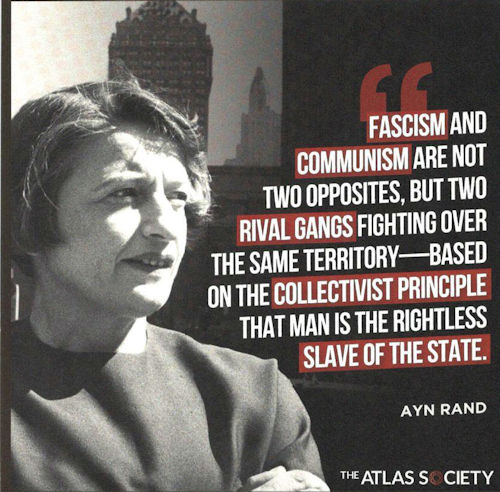





 Posts
Posts