Hillary Clinton is claiming that she lost the election because FBI Director Comey re-opened the investigation of her criminal e-mail activities days before the election. In reality, her speculation and that of many others claiming a single reason for her loss, or for that matter a loss in any close presidential race, is simply silly. It was a close contest and the loser was the loser for many, many reasons. Yes, changing one or two choices the candidate made might have made the difference and brought victory instead of defeat. But, almost always there are many choices any one of which might have changed the outcome of the election.
Broadly speaking, Hillary might have had a more positive attitude toward allowing businesses to grow, and she would have won the election. In fact, she might well have won the election had she simply not been a threat to those who earn a living in whole or in part due to the coal industry and due to the fracking of oil and gas. She very barely lost Pennsylvania with its 20 electoral votes and while she lost Ohio rather more decisively, it was still an obtainable state. Hillary especially lost votes in western PA and in eastern and southern OH, relative to Obama's results. See the US map on the front page of The Wall Street Journal of 10 November 2016, which color codes the degree of the Democrat vote loss relative to the 2012 election. These are areas in which coal was long a mainstay to the economy and in which the recent booms due to oil and gas from fracking operations have produced an economic revival.
So, did Hillary lose the 38 electoral votes of OH and PA because she was threatening the fossil fuels and all the service providers of these areas? Had she won those votes and still lost Michigan, she would have had 270 electoral college votes to Trump's 268 electoral votes, assuming his win in MI holds up. Her completely bogus and irrational vendetta against these industries may well have cost her the election. Irrational choices often have direful consequences. As hard as I have fought to argue against the false catastrophic man-made global warming hypothesis and such additional bogus claims such as measurable harm from mercury emissions from coal-fired power plants, Hillary's loss of the election due to her desire to destroy the fossil fuel industries is sweet indeed.
Of course, Obama had himself threatened the coal industry, but many people did not take that so seriously back then. Whatever his predilections, they may have thought that Congress would keep him from destroying the industry. As it happened, Obama used the regulatory agencies to do that destruction, so a Hillary following him and using the same strategies had to be taken as a more serious threat in this election. In addition, the growth of the oil and gas production in eastern and southern Ohio and in western Pennsylvania was remarkable in the four years straddling Obama's re-election, with the realization of the importance of fracking to the benefiting areas of OH and PA taking some time to occur to much of the population in those areas. Try as hard as Obama's EPA did to find an excuse to attack the fracking practice, they had limited success in doing so, though pressure among the "environmental" Democrats continues to mount for doing so. Some unnecessary and wrongheaded regulations based on the catastrophic man-made global warming fraud are in the pipeline now.
Some Democrats like to make a big deal about Hillary Clinton winning the popular vote by about 798,000 votes. Of course the rules are that one has to win the electoral vote, which requires the candidates to try to appeal to people across the nation. This requirement helps to minimize factions in politics, which we surely have more than enough of as it is. It helps to keep candidates from just favoring those who live in high population density areas. It helps to keep them from stomping on the interests of those who live in low cost of living areas too much. In other words, it penalizes those who want to exterminate the industries that some people depend upon for a living if they do not live in those high population areas. It means that if you promote a minimum wage of $15 an hour for the entire nation, you might incur a political cost for the concerns that many people living in low cost of living areas, almost always outside high population density areas, will have about losing their jobs or their businesses. It even serves as a bit of protection against those who would discriminate against people based on their ethnicity, since ethnicity is not evenly distributed across the country or between low and high population density areas.
Hillary needs to grow up and realize that she lost the election according to its rules. Of course, it is too late for her to ever grow up. But others may still have that within their grasp. The claim that those extra 798,000 votes mean much is diminished by a number of additional factors. For one, the Democrats rack up a few hundred thousand illegal votes in presidential elections. In addition, because the most populous state of California, which is heavily Democratic, had a Senate election in which both candidates on the ballot were very leftist Democrats, the Republicans of that state had much less incentive to go to the polls than did Democrats. As a result, Trump did not get many votes in California that he would have had if a Republican had been allowed on the ballot in that Senate seat contest. The Democrats of California have found an interesting way to diminish the meaning of the popular vote for the presidential elections.
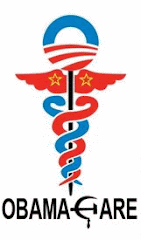
It is interesting to note that Republicans in the elections for the House of Representatives received 3.1 million more votes than did the Democrats running for House seats. The Republicans won 238 House seats to the Democrats 193 seats. Republicans won 22 Senate seats (counting LA which is not technically decided until December) and the Democrats won only 12. Trump won 30 (counting MI) of the 50 state popular vote contests. Even with a Republican presidential candidate who was not all that popular, the Republicans trounced the Democrats. Nonetheless, such a beating can be reversed in the next election cycle if the Republicans do not keep enough of their promises, such as finally repealing ObamaCare and allowing the economy to grow.
Showing posts with label electoral vote. Show all posts
Showing posts with label electoral vote. Show all posts
15 November 2016


05 November 2012
Last Electoral College Result Prediction on Presidential Election
I believe the most likely outcome of the Presidential election will be:
 Of the generally recognized swing states, the only one that I believe is foolish enough to vote for Obama is Nevada. Nevada showed its perfidy by voting for Senator Harry Reid, who has refused to allow the Senate to obey the law and produce a budget ever since Obama occupied the White House. Harry Reid is wily, but a very wrongheaded man. The state that could send him over and over to the Senate has the good judgment of a Las Vegas labor union. In other words, Nevada is too much like California now, with which state it shares both an astronomical unemployment rate and home foreclosure rate. Sometimes, no oftentimes, the people of a given area suffer mass delusions. I know, I live in the Baltimore - Washington corridor, where mass delusion reigns supreme. I do think there is about a 40% chance that Nevada will vote for the much superior candidate, Romney.
There is about a 20% likelihood that one of the three states, Pennsylvania, Michigan, and Minnesota will vote for Romney. I believe Romney will win the election with a differential in the percentage total vote of between 2 and 4%. If I am wrong, I think a win by 5% is more likely than one by 1%. A win by 5% will mean that Romney will likely carry at least two of the states Pennsylvania, Michigan, and Minnesota. Both Pennsylvania and Michigan will be very hard hit by Obama's plans to shut down the coal-fired electric power plants and both will be hurt by his plans to discourage hydraulic fracturing to release shale oil and gas.
Most of the polls are underestimating the turnout of Republicans and those Independents who have had more than enough of Obama. They are overestimating the turnout of Democrats. This is even true of Rasmussen polls, which are among the best of the polls. The fact that Romney has a normal Republican lead with men and Obama has much less than the normal Democrat lead with women figures very big in my understanding of how this election will turn out. Another key factor is the fact that Independents are decidedly favoring Romney over Obama. There will also be substantially more crossover Democrats voting for Romney than Republicans voting for Obama in this election. These factors have to generally push all of the swing states, most of which are now mostly Republican at the state level, into the Romney column. The work of the Tea Party Americans in ensuring this is also underestimated. The Evangelicals have also become aroused.
Obama is left only with substantial majorities among young people, blacks, and Hispanic Americans. Each of these groups has suffered just unbelievably high unemployment. Falling incomes and rising prices, such as energy prices, have hit blacks and Hispanic Americans especially hard. The fraction of young Americans who favor Obama is high, but usually these young Americans do not vote in large numbers. We will see that many fewer of them will vote in this election than in 2008 and of those who vote, a very substantially larger fraction will vote Republican. The turnout of black and Hispanic Americans will also be lower. The decrease in the fraction who vote for Obama this time as compared to 2008 will be much smaller than that among the young, though it will be greater for Hispanics than blacks.
Now that Americans have had so much time to get to know Obama and to be angered so many times by his lies and deceptions, I am very disappointed that we are still in a situation in which nearly half of all Americans will vote for this con man and failed President. How anyone could want four years of constant attacks on our individual rights and the resulting economic stagnation, is very much beyond my understanding. Romney should have easily surpassed Obama with well over 300 electoral votes. It appears more likely that there are too many very foolish Americans for that to happen. At this point, it looks to me that Romney will get 295 electoral votes.
I will be heartened if Romney comes very close in Minnesota, my birth state, Michigan, and Pennsylvania, however. Coupling that with wins in Iowa, Wisconsin, Indiana, and Ohio and the continued shift of the Midwest into the Republican column may be a good sign of things to come. We have already seen these states send more Republicans to their state houses and to the House of Representatives. They have been electing Republican governors as well. The private sector unions have been losing power as they have lost membership. More and more Mid-westerners are learning that if they are to have well-paying jobs, it is good that the governments not be anti-business. As Mid-westerners show more respect for economic freedoms, they will align more with the more reality-interested Republican Party than with the socialist Democratic Party. This re-alignment may take a couple more election cycles to be complete, but it sure is important to America's future freedom and prosperity.

There is about a 20% likelihood that one of the three states, Pennsylvania, Michigan, and Minnesota will vote for Romney. I believe Romney will win the election with a differential in the percentage total vote of between 2 and 4%. If I am wrong, I think a win by 5% is more likely than one by 1%. A win by 5% will mean that Romney will likely carry at least two of the states Pennsylvania, Michigan, and Minnesota. Both Pennsylvania and Michigan will be very hard hit by Obama's plans to shut down the coal-fired electric power plants and both will be hurt by his plans to discourage hydraulic fracturing to release shale oil and gas.
Most of the polls are underestimating the turnout of Republicans and those Independents who have had more than enough of Obama. They are overestimating the turnout of Democrats. This is even true of Rasmussen polls, which are among the best of the polls. The fact that Romney has a normal Republican lead with men and Obama has much less than the normal Democrat lead with women figures very big in my understanding of how this election will turn out. Another key factor is the fact that Independents are decidedly favoring Romney over Obama. There will also be substantially more crossover Democrats voting for Romney than Republicans voting for Obama in this election. These factors have to generally push all of the swing states, most of which are now mostly Republican at the state level, into the Romney column. The work of the Tea Party Americans in ensuring this is also underestimated. The Evangelicals have also become aroused.
Obama is left only with substantial majorities among young people, blacks, and Hispanic Americans. Each of these groups has suffered just unbelievably high unemployment. Falling incomes and rising prices, such as energy prices, have hit blacks and Hispanic Americans especially hard. The fraction of young Americans who favor Obama is high, but usually these young Americans do not vote in large numbers. We will see that many fewer of them will vote in this election than in 2008 and of those who vote, a very substantially larger fraction will vote Republican. The turnout of black and Hispanic Americans will also be lower. The decrease in the fraction who vote for Obama this time as compared to 2008 will be much smaller than that among the young, though it will be greater for Hispanics than blacks.
Now that Americans have had so much time to get to know Obama and to be angered so many times by his lies and deceptions, I am very disappointed that we are still in a situation in which nearly half of all Americans will vote for this con man and failed President. How anyone could want four years of constant attacks on our individual rights and the resulting economic stagnation, is very much beyond my understanding. Romney should have easily surpassed Obama with well over 300 electoral votes. It appears more likely that there are too many very foolish Americans for that to happen. At this point, it looks to me that Romney will get 295 electoral votes.
I will be heartened if Romney comes very close in Minnesota, my birth state, Michigan, and Pennsylvania, however. Coupling that with wins in Iowa, Wisconsin, Indiana, and Ohio and the continued shift of the Midwest into the Republican column may be a good sign of things to come. We have already seen these states send more Republicans to their state houses and to the House of Representatives. They have been electing Republican governors as well. The private sector unions have been losing power as they have lost membership. More and more Mid-westerners are learning that if they are to have well-paying jobs, it is good that the governments not be anti-business. As Mid-westerners show more respect for economic freedoms, they will align more with the more reality-interested Republican Party than with the socialist Democratic Party. This re-alignment may take a couple more election cycles to be complete, but it sure is important to America's future freedom and prosperity.
30 October 2012
Romney is Going to Win the Election
The outcome of the 2012 Presidential election will be decided in the six swing states in light gray in the electoral map below. It is interesting that four of them are in the Midwest.

Romney only needs 8 more electoral votes to win, since a tie of 269 votes each will be decided by the Republican House of Representatives. I believe that Romney will win at least four of these six swing states. If so, Romney will add between 38 and 64 electoral votes depending on which combination of four states he wins. But Romney needs to win only one of Ohio, Wisconsin, Pennsylvania, and Michigan or both Iowa and Nevada to win the election. There is even a possibility that Minnesota is in play with its 10 electoral votes enough for Romney to win.
If Romney sweeps all of these swing states, which is not highly likely, but is also not out of reach, the situation would be:

This would be a most wonderful reassurance that the American People might occasionally lose their marbles, but they have a tendency to relocate them eventually. The amount of red in the county by county results will then be startling.
As I have noted before, the polls have weighted their results much too heavily toward Democrats by assuming there are either many more of them than Republicans or by assuming they are more likely to go to the polls to vote. I believe that the Rasmussen and more recent Gallup attempts to identify the relative numbers of Democrats, Republicans, and Independent voters are very close to the actual case and the 2008 breakdown of voter affiliations are not applicable. There are more Republicans than Democrats now and they will go to the polls in larger numbers than the Democrats will.
Romney still has a large, typical Republican advantage with male voters and Obama's 2008 advantage with female voters has almost disappeared. Romney has a large advantage with Independent voters. Obama is hoping for more black and Hispanic voters in this election than in 2008. This is not going to happen. In fact, there will be fewer black and Hispanic voters in this election. They have been hit much harder by unemployment and some are concerned with Obama's stances on issues of religious belief. His percentage of black voters voting will be lower. Also, more Democrats than last time and more than usual will crossover and vote for Romney. Republicans have a tradition of less crossover voting for Democrats and fewer than usual will do so this time. 18 - 29 year olds still favor Obama heavily by 55% to 36% of likely voters, but 9% of likely voters in that group are undecided. Only 48% of these young voters say they will definitely vote and those voting for Romney are more likely to vote.
While the economy, ObamaCare, energy policies, the level of government spending, and the deficit will all cost Obama most heavily, the last of the undecided voters are being well pushed toward Romney by the Obama disgrace in failing to protect the Ambassador and others in the Benghazi consulate and then lying about the situation. Those still undecided will almost all vote for Romney. Consequently, it now appears that Romney will win 4 to 6% more of the popular vote than Obama. That will translate into a substantial win in the Electoral College vote.

Romney only needs 8 more electoral votes to win, since a tie of 269 votes each will be decided by the Republican House of Representatives. I believe that Romney will win at least four of these six swing states. If so, Romney will add between 38 and 64 electoral votes depending on which combination of four states he wins. But Romney needs to win only one of Ohio, Wisconsin, Pennsylvania, and Michigan or both Iowa and Nevada to win the election. There is even a possibility that Minnesota is in play with its 10 electoral votes enough for Romney to win.
If Romney sweeps all of these swing states, which is not highly likely, but is also not out of reach, the situation would be:

This would be a most wonderful reassurance that the American People might occasionally lose their marbles, but they have a tendency to relocate them eventually. The amount of red in the county by county results will then be startling.
As I have noted before, the polls have weighted their results much too heavily toward Democrats by assuming there are either many more of them than Republicans or by assuming they are more likely to go to the polls to vote. I believe that the Rasmussen and more recent Gallup attempts to identify the relative numbers of Democrats, Republicans, and Independent voters are very close to the actual case and the 2008 breakdown of voter affiliations are not applicable. There are more Republicans than Democrats now and they will go to the polls in larger numbers than the Democrats will.
Romney still has a large, typical Republican advantage with male voters and Obama's 2008 advantage with female voters has almost disappeared. Romney has a large advantage with Independent voters. Obama is hoping for more black and Hispanic voters in this election than in 2008. This is not going to happen. In fact, there will be fewer black and Hispanic voters in this election. They have been hit much harder by unemployment and some are concerned with Obama's stances on issues of religious belief. His percentage of black voters voting will be lower. Also, more Democrats than last time and more than usual will crossover and vote for Romney. Republicans have a tradition of less crossover voting for Democrats and fewer than usual will do so this time. 18 - 29 year olds still favor Obama heavily by 55% to 36% of likely voters, but 9% of likely voters in that group are undecided. Only 48% of these young voters say they will definitely vote and those voting for Romney are more likely to vote.
While the economy, ObamaCare, energy policies, the level of government spending, and the deficit will all cost Obama most heavily, the last of the undecided voters are being well pushed toward Romney by the Obama disgrace in failing to protect the Ambassador and others in the Benghazi consulate and then lying about the situation. Those still undecided will almost all vote for Romney. Consequently, it now appears that Romney will win 4 to 6% more of the popular vote than Obama. That will translate into a substantial win in the Electoral College vote.
07 October 2012
Making Sense of the Rasmussen Presidential Tracking Poll
According to a three-day average over 3 - 5 October, the daily Rasmussen Presidential Poll reports that Romney was leading by 49% to 47%. However, Rasmussen also says that Romney has the vote of 89% of Republicans and Obama has the vote of 88% of Democrats, while Romney is up 16% on Obama among those not affiliated with the Republican or Democrat Parties. The report I have seen does not say how many Republicans are planning to vote for Obama or how many Democrats plan to vote for Romney. The report also does not say what percentage of Republicans, Democrats, and unaffiliated voters were sampled.
The Rasmussen party affiliation survey for September is now available. According to it party affiliation is as follows:
Republicans, 36.8%
Democrats, 34.2%
Other, 29.0%
Democrats have increased by 0.9% since August, Republicans have decreased by 0.6%, and Others have decreased by 0.2%. I expect the media claims that the Romney campaign was losing and Romney did nothing but make gaffes had pushed down the Republican affiliations and boosted the Democrat affiliation. Romney's debate performance may reverse that trend in October.
I will assume that 4% of the 29.0% may vote for the micro-parties such as Libertarian, Green, Constitution, and Socialist Workers. This leaves 25.0% of non-affiliated voters to pick either Romney or Obama and Romney is up by +16, so this implies that 58% will vote for Romney and 42% will vote for Obama. The last two Washington Post/ABC News polls I adjusted for party affiliation had about 7% of each party voting for the candidate of the other party, so I will assume that here, to the advantage of Obama. So, how does the adjusted vote turn out then:
Romney: (0.89)(36.8%) + (0.07)(34.2%) + (0.58)(25.0%) = 49.6%
Obama: (0.07)(36.8%) + (0.88)(34.2%) + (0.42)(25.0%) = 43.2%
Thus, Romney had a 6.4% advantage in a poll including the day of the debate and the two days after the debate. How on Earth Rasmussen manages to reduce this to a 2% Romney advantage, I have no idea.
If the pollsters are thinking that Republicans and anti-Obama unaffiliated voters are not going to vote in this election, I think they are out of their minds. What is more, Rasmussen reported that this poll gave Romney a double-digit advantage with voters over 40 years of age and these voters do turn up at the polls. Obama on the other hand had a double-digit advantage with voters under 40. That part of his pool under 25 are represented among the unemployed in large numbers. Many of them cannot afford the high Obama gasoline costs to fuel their overly expensive clunkers (thanks to the Cash for Clunkers Obama program that made old cars scarce) to get to the polling places. In general, the younger voters do not vote in the same percentages as older voters, so my adjusted results probably understate the extent of the Romney advantage.
In my lifetime, no presidential candidate has won the electoral vote when behind in the popular vote by more than a few tenths of a percent. Even before the debate, there was considerable evidence that the polls of the swing states were heavily over-sampling Democrats and the reported leads by Obama in many of those states were fallacious. An evaluation of polls for the states of Florida, Ohio, and Virginia made before the debate indicated that they were highly misleading and that Romney was really ahead in each of them. I think Romney is going to win the election despite the best efforts of most of the media to throw the election to Obama.
I am quite disappointed in Scott Rasmussen and his polls. I thought he usually did a good job polling, but the evidence here is that he is not doing so now.
The Rasmussen party affiliation survey for September is now available. According to it party affiliation is as follows:
Republicans, 36.8%
Democrats, 34.2%
Other, 29.0%
Democrats have increased by 0.9% since August, Republicans have decreased by 0.6%, and Others have decreased by 0.2%. I expect the media claims that the Romney campaign was losing and Romney did nothing but make gaffes had pushed down the Republican affiliations and boosted the Democrat affiliation. Romney's debate performance may reverse that trend in October.
I will assume that 4% of the 29.0% may vote for the micro-parties such as Libertarian, Green, Constitution, and Socialist Workers. This leaves 25.0% of non-affiliated voters to pick either Romney or Obama and Romney is up by +16, so this implies that 58% will vote for Romney and 42% will vote for Obama. The last two Washington Post/ABC News polls I adjusted for party affiliation had about 7% of each party voting for the candidate of the other party, so I will assume that here, to the advantage of Obama. So, how does the adjusted vote turn out then:
Romney: (0.89)(36.8%) + (0.07)(34.2%) + (0.58)(25.0%) = 49.6%
Obama: (0.07)(36.8%) + (0.88)(34.2%) + (0.42)(25.0%) = 43.2%
Thus, Romney had a 6.4% advantage in a poll including the day of the debate and the two days after the debate. How on Earth Rasmussen manages to reduce this to a 2% Romney advantage, I have no idea.
If the pollsters are thinking that Republicans and anti-Obama unaffiliated voters are not going to vote in this election, I think they are out of their minds. What is more, Rasmussen reported that this poll gave Romney a double-digit advantage with voters over 40 years of age and these voters do turn up at the polls. Obama on the other hand had a double-digit advantage with voters under 40. That part of his pool under 25 are represented among the unemployed in large numbers. Many of them cannot afford the high Obama gasoline costs to fuel their overly expensive clunkers (thanks to the Cash for Clunkers Obama program that made old cars scarce) to get to the polling places. In general, the younger voters do not vote in the same percentages as older voters, so my adjusted results probably understate the extent of the Romney advantage.
In my lifetime, no presidential candidate has won the electoral vote when behind in the popular vote by more than a few tenths of a percent. Even before the debate, there was considerable evidence that the polls of the swing states were heavily over-sampling Democrats and the reported leads by Obama in many of those states were fallacious. An evaluation of polls for the states of Florida, Ohio, and Virginia made before the debate indicated that they were highly misleading and that Romney was really ahead in each of them. I think Romney is going to win the election despite the best efforts of most of the media to throw the election to Obama.
I am quite disappointed in Scott Rasmussen and his polls. I thought he usually did a good job polling, but the evidence here is that he is not doing so now.
22 August 2012
State Unemployment and Election Consequences
Looking at state unemployment percentages and their changes over the last year for the purpose of trying to envision the effect upon the November presidential election is difficult. This is because the unemployment percentages become meaningless due to people dropping out of the workforce in this interminable Great Socialist Recession. We also know the seasonal adjustments are suspect due to unusual effects in this very long jobs recession. Fortunately, the one really useful table for dealing with election effects in the Bureau of Labor Statistics State Unemployment Report based on July 2012 data is Table 4. This table provides Labor Force Data without Seasonal Adjustment. Unfortunately real employment numbers are not given, but the workforce number is very important in its own right.
Clearly, the people of a state whose civilian labor force is shrinking are likely to feel as their state economy is hurting and are likely by now to hold this against Obama. A shrinking workforce means that the sum of the people employed or considered by the BLS to be actively seeking work has become smaller in the time from July 2011 to July 2012 in Table 4. If the number is shrinking, then employment is not growing and/or discouraged people have given up looking for work. Even when a workforce is growing, this is not necessarily adequate growth for a growing population. We have to remember that from 2000 to 2010, the Census told us that the population grew by 1.0% a year. In normal times, this would mean that unless employment grew by 1% a year, unemployment would go up.
From July 2011 to July 2012, the workforce actually contracted in the following states:
New Mexico, leaning to Obama
Ohio
Oregon, leaning to Obama
The people of these states should be furious at what Obama and the Democrats have done to the economy to keep it from recovering from the recession. Of course the people of Connecticut and Hawaii do not have nearly enough sense to be furious, but there should be numerous people in the other states who will be as they think more and more about how miserable they are in this never-ending recession. The states in red are pretty certain for Romney, while those in blue are certain for Obama. The other states in black should be feeling a substantial desire to turn to Romney to help end their woes as the people of those states think more a and more about who they will vote for in November. Iowa, Ohio, and Nevada are generally thought to be swing states in the election, while New Mexico and Oregon are thought to be leaning to Obama, but may prove unstable with time and may require Obama to spend some time campaigning in them so he will not lose them.
Among the swing states and those which may not be solid for either candidate presently which failed to increase their workforce by 1% to keep up with the average national population growth are these states with the percentage increase in the workforce in the last year:
Colorado, 0.4%
Florida, 0.5%
Maine, leaning to Obama, 0.9%
Michigan, 0.3%
Minnesota, leaning to Obama, 0.1%
New Hampshire, 0.3%
North Carolina, 0.2%
Virginia, 0.9%
Wisconsin, 0.3%
Only Maine and Virginia managed to generate workforce growth above 0.5%. The average workforce growth for these critical electoral vote states was only 0.43%.
We find that every one of the swing states or states that are tenuous now for Obama is on one of these two lists. This presents a strong opportunity for the Romney-Ryan ticket to build its electoral vote count enough to win the election. In fact, the people of these states will have to be very disappointingly unobservant if they do not turn strongly toward the pro-private sector Republican ticket with its interest in strong businesses, many more jobs, and a lower cost of living. Romney could well win Iowa, Nevada, Ohio, Colorado, Florida, Michigan, New Hampshire, North Carolina, Virginia, and Wisconsin based on their workforce weakness over the last year. This would give Romney a 317 to 221 electoral vote win over Obama. This is close to my 25 June prediction here.
Clearly, the people of a state whose civilian labor force is shrinking are likely to feel as their state economy is hurting and are likely by now to hold this against Obama. A shrinking workforce means that the sum of the people employed or considered by the BLS to be actively seeking work has become smaller in the time from July 2011 to July 2012 in Table 4. If the number is shrinking, then employment is not growing and/or discouraged people have given up looking for work. Even when a workforce is growing, this is not necessarily adequate growth for a growing population. We have to remember that from 2000 to 2010, the Census told us that the population grew by 1.0% a year. In normal times, this would mean that unless employment grew by 1% a year, unemployment would go up.
From July 2011 to July 2012, the workforce actually contracted in the following states:
Alabama
Arizona
Connecticut
Hawaii
Indiana
Iowa
Kansas
Missouri
NevadaNew Mexico, leaning to Obama
Ohio
Oregon, leaning to Obama
South Carolina
South Dakota
Tennessee
The people of these states should be furious at what Obama and the Democrats have done to the economy to keep it from recovering from the recession. Of course the people of Connecticut and Hawaii do not have nearly enough sense to be furious, but there should be numerous people in the other states who will be as they think more and more about how miserable they are in this never-ending recession. The states in red are pretty certain for Romney, while those in blue are certain for Obama. The other states in black should be feeling a substantial desire to turn to Romney to help end their woes as the people of those states think more a and more about who they will vote for in November. Iowa, Ohio, and Nevada are generally thought to be swing states in the election, while New Mexico and Oregon are thought to be leaning to Obama, but may prove unstable with time and may require Obama to spend some time campaigning in them so he will not lose them.
Among the swing states and those which may not be solid for either candidate presently which failed to increase their workforce by 1% to keep up with the average national population growth are these states with the percentage increase in the workforce in the last year:
Colorado, 0.4%
Florida, 0.5%
Maine, leaning to Obama, 0.9%
Michigan, 0.3%
Minnesota, leaning to Obama, 0.1%
New Hampshire, 0.3%
North Carolina, 0.2%
Virginia, 0.9%
Wisconsin, 0.3%
Only Maine and Virginia managed to generate workforce growth above 0.5%. The average workforce growth for these critical electoral vote states was only 0.43%.
We find that every one of the swing states or states that are tenuous now for Obama is on one of these two lists. This presents a strong opportunity for the Romney-Ryan ticket to build its electoral vote count enough to win the election. In fact, the people of these states will have to be very disappointingly unobservant if they do not turn strongly toward the pro-private sector Republican ticket with its interest in strong businesses, many more jobs, and a lower cost of living. Romney could well win Iowa, Nevada, Ohio, Colorado, Florida, Michigan, New Hampshire, North Carolina, Virginia, and Wisconsin based on their workforce weakness over the last year. This would give Romney a 317 to 221 electoral vote win over Obama. This is close to my 25 June prediction here.
Subscribe to:
Posts (Atom)






 Posts
Posts