A debate is underway on the Economist website in which the proposal has been made that it is more important to pursue fair trade than to pursue free trade. You can read the initial pro argument by Ngaire Woods, International Political Economy Prof. and Director, Global Economic Governance, Oxford University and con argument of Jagdish Bhagwati, Economics and Law Professor, Columbia University and Senior Fellow, Council on Foreign Relations, here.
My comment was:
Ngaire Woods sometimes uses the word fair to indicate that trade was really not free trade when the restrictions in the "free trade" agreements actually belied free trade. At other times, unfair seems to mean that we simply do not like it when unskilled workers or some industries with particularly heavy regulatory or labor union burdens or old technology lose out to competitors in less developed nations.
People in the less developed countries may have a trade advantage in being paid less and a particular industry there may have fewer operational expenses for pollution controls, but they almost always have a great many disadvantages that their competitors in the developed countries do not have. We conveniently forget these when we talk about fairness, which it is extremely unfair for us to do. For instance, most underdeveloped countries have workforce educational, health, property rights infringement, unstable and capricious governments, transportation, supporting industry, telephone system, and computer system disadvantages. Pollution may cause sickness and even impose some production costs of its own. In China, the one-party system is a disadvantage. In India, such issues as the untouchables, the criminal tribes, and some discrimination against women are disadvantages. In the Muslim nations, the discrimination against women and their frequent lack of education is a disadvantage. So, when we push for fair trade, are we actually pushing to change all of these disadvantages in the less developed countries or is the push for fair trade only one to increase the costs of business in these less developed nations? It generally seems to be the latter.
It is a myth that there is any universal agreement on what is fair. But, the concept of free trade is clear, though it is heavily abused in politics. Free trade is one of the equal rights of each individual to life, liberty, and the pursuit of happiness. Each of us has the right to enter into free associations and contracts with others and legitimate government does not impose barriers to our doing so, except perhaps in war. Freedom of trade is essential to each of us in securing our lives, exercising our freedom of action, and because each trade we make is generally done to add to our happiness. Living by this principle that government is legitimate to the extent that it protects our sovereign, equal individual rights is what made the USA and generally Great Britain, at least within their own countries, as wealthy and secure as they are today. But, we can do better by more fully protecting such individual rights as the right to trade freely between all nations. If we will do this, then the living standards of many other nations will rise and wage differentials will diminish, as will pollution differentials. There is no way to really invert this development process.
Some people may not have sufficient on-the-job value to be up to living well in the well-to-do countries where more highly skilled workers are needed to sustain that level of productivity that makes the country well-to-do. This fact is not unfair of itself, but we may add elements of unfairness if we almost force workers into labor unions that destroy the companies they work for, or we impose regulations and costs by governments which are irrational upon their company or industry, [we impose tax burdens that prevent his company from making needed equipment purchases, providing training, or doing R&D,] or we put them out of their job with a minimum wage increase. But if he loses his job because a worker in Kenya can make the same widget as well and for less even after the transportation costs from there to here are paid, well, I see no unfairness in that.
[While there are some Americans who have or will lose their jobs to international competitors, free trade has helped many industries by reducing their costs and it has helped many workers to stretch their income further by being able to buy less expensive goods. In addition, U.S. companies often make considerable income from supplying their subsidiaries abroad with goods and services, allowing them to hire more American employees. Prof. Bhagwati discusses some aspects of this in a paper on his website (the link is above) called The Critiques of Capitalism After the Crisis: Myths and Fallacies.]
Showing posts with label free trade. Show all posts
Showing posts with label free trade. Show all posts
05 May 2010


12 March 2010
Obama's Plan to Increase Exports
Today's Washington Post had a front page article on Obama's plan to double American exports in the next 5 years as a way to increase the number of American jobs. This central planning scheme consists of two efforts:
The second Obama effort to provide government funds to finance company exports, is clearly symptomatic of the perverse Washington central planning disease in which it is imagined a few elite central planners can pick the winners better than the free marketplace can. This pretense of knowledge, as Friedrich Hayek put it, has always soon been revealed in market chaos and distortions which the free market would not long allow. Such programs as this government financing money through the Export-Import Bank just favor certain large companies with a great deal of influence in Washington. They are a redistribution of income from individuals, small businesses, and companies who concentrate on providing a great product or services while trying to ignore Washington as much as possible to the Washington-savvy influence-peddling companies. They are a bad idea, but they are loved by those who lust for power. The companies that want this money know that their PACs must provide certain key politicians with money for their re-election campaigns.
Obama has no clue on how to create jobs and it would appear he has no interest in learning what he might actually do as President not to create jobs, but to allow companies and the private sector to create jobs. The private sector is very good at creating jobs without government central planning interference. Your job Obama is simply to get the hell out of the way!
- Try to restart some free trade agreements stalled by the Democrat Congress by their insistence that other countries maintain policies favorable to labor unions and the environment.
- Provide $2 billion of government funds to provide financing of the sales of American goods abroad.
- Sharing the dishonors for the highest corporate taxes in the world with Japan, while such taxes in many, many other countries are less than half what they are in the U.S.
- Policies which provide many means for labor unions to intimidate employees into selecting them as their labor negotiators and promoting labor union leaders into effective company managers. Particularly strong and disturbing cases of these policies are the current situations at GM and Chrysler.
- Energy policies which drive up the cost of energy, such as mandates to use more expensive alternative fuels and restrictions on exploration and drilling in government-owned land and offshore. Taxes on energy use are another foolishly expensive policy.
- Causing delays and added expense in the construction of new energy plants and refineries with ridiculous environmental regulatory and litigation delays.
- Raising questions about the cost of future CO2 emissions penalties, making it impossible for many companies to expand or modernize present facilities in the U.S.
- Attempts to continue pursuing a health care insurance plan which will raise the cost of health care insurance premiums, which is a significant business expense.
- The U.S. Postal Service monopoly increases mailing costs.
- Excessive safety regulation and expenses tied to those regulations.
- Excessive accounting regulations and tax record keeping obligations.
- Regulations requiring companies to hire women and certain favored minority groups.
- Foolish antitrust policies and the equivalent of class-warfare they cause between American companies.
- Subsidies or special interest tax considerations which favor some companies and industries over others without allowing the free market to decide which are the stronger companies and industries.
The second Obama effort to provide government funds to finance company exports, is clearly symptomatic of the perverse Washington central planning disease in which it is imagined a few elite central planners can pick the winners better than the free marketplace can. This pretense of knowledge, as Friedrich Hayek put it, has always soon been revealed in market chaos and distortions which the free market would not long allow. Such programs as this government financing money through the Export-Import Bank just favor certain large companies with a great deal of influence in Washington. They are a redistribution of income from individuals, small businesses, and companies who concentrate on providing a great product or services while trying to ignore Washington as much as possible to the Washington-savvy influence-peddling companies. They are a bad idea, but they are loved by those who lust for power. The companies that want this money know that their PACs must provide certain key politicians with money for their re-election campaigns.
Obama has no clue on how to create jobs and it would appear he has no interest in learning what he might actually do as President not to create jobs, but to allow companies and the private sector to create jobs. The private sector is very good at creating jobs without government central planning interference. Your job Obama is simply to get the hell out of the way!
16 October 2007
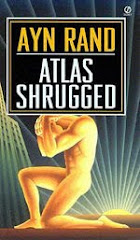
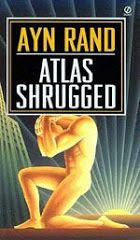
50th Anniversary of the Publication of Atlas Shrugged
In October of 1957, Ayn Rand's great novel Atlas Shrugged was published. I was not aware of it, being 10 years old. Much of the rest of the world was not aware of it for some time either, much to Rand's disappointment. Not even the truly creative builders of the world, for whom she fought so hard to bring admiration, seemed to take notice of the valiant and revolutionary defense of reason, egoism, happiness, production, and of Capitalism and free trade which she had provided in the 14 years she had labored since the publication of The Fountainhead in 1943. At the recent Atlas Society celebration of Atlas Shrugged in Washington, DC (yes, the heart of the brutal anti-individualist beast itself) on the 6th of October, Barbara Branden made very heartfelt comments on how America's businessmen had failed Ayn Rand and a rational Capitalist society when they failed to rally to the defense of Atlas Shrugged, as most of academia and the media attacked it or ignored it. Fortunately, many admirers of her work came eventually to discover Atlas Shrugged, making it the book most cited after the Bible as the work which has most influenced people's lives in America. It continues to this day to be a best-seller year after year, selling 140,000 copies a year.
While large numbers of people who have read Atlas Shrugged love it, very many of them do not make that love known to many of their acquaintances and family. Her novel clearly rejected socialism in all of its variants and it was clearly not consistent with religious conservativism either. Consequently, both the left and the right rejected it, usually with considerable hatred. Another good fraction in the middle of the political spectrum ignored it because many of them are apathetic about philosophy, history, and politics.
The socialists hate individualism, since no collective, communitarian scheme can accommodate the complex individuality of man. When the individualist claims that the right to his life implies that he has the right to his own body, he must exercise personal responsibility in his own health and its care. This means that he has the right to provide himself with the best medical care he chooses and to either have or not to have medical insurance. Individualists who choose not to use their money for medical insurance, but can certainly afford it, number about 18 million of those 47 million who are said to live in the United States without medical insurance. The socialists want their audience to assume the 47 million to be poor Americans in need of governmentally assured medical insurance. Other individualists want better medical care than the government will provide and they want it when they want it, not 6 months or a year later as is common in the socialized medicine nations. Still others want to smoke or drink without having to pay punitive taxes to a Nanny state. Then we individualists think we know better how to spend our hard-earned income than a democratic mob listening to demagogues lusting for power. We view the use of our earnings as an essential manifestation of our liberty and our pursuit of happiness, as did the Framers of The Constitution. If our earnings and our property are not truly ours to dispose of, then we are not free to manage our own lives. We think the socialist is utterly presumptuous in believing he can manage our lives better than we ourselves can. But, the socialist is a brute who not only thinks he knows what our values should be better than we ourselves do, but that he has the right to hire government thugs to beat us brutally until we give into his vision of what each and every individual life should be. The socialist wants to design a cookie-cutter life for each of us and does his best to use the public schools as his propaganda tool to this end. Commonly, she or he feels very maternal or paternal in helping the great unwashed masses to make the right decisions. This view holds that most people are incapable of managing their own lives and requires that every adult be continuously treated like a child, with no prospect of ever growing up.
The religious conservative is often thought to be essentially the opposing force in our society. However, the religious conservative often shares a substantial part of the vision of the socialist. He holds that every man is a sinner and that every man needs God to help him manage his life. Man is the equivalent of a sheep, a very dumb animal, which requires the constant supervision of the shepherd. Of course, the priesthood is happy to provide the earthly portion of this shepherd function and it is their route to power and paternal presumptions. Again, the ordinary man is a child at best. Now, the government is to enforce seemly behavior according to the Bible, or the Koran, or Jewish or Hindu teachings. So, here again the individual who does not accept the authority of the Bible, the Koran or the dominant religious teachings of his region, is allowed little opportunity to manage his own life. He is thwarted in many ways from exercising his sovereign right to life, liberty, and the pursuit of happiness. The religions almost always frown upon earthly pleasures to a substantial degree. Commonly, they hold prejudices against wealth and property, many aspects of free trade, many of the many joys of sex, and any vision of man as heroic. Commonly, one's sovereignty of body is crimped sexually and a woman's right to make decisions about that part of her body which is a fetus is denied. Commonly, freedom of conscience is limited when such freedom is not consistent with the regional religious teachings. So much for the right to life which must start with the right to manage one's own body and mind. Should one be homosexual, then the freedom to enjoy an equivalent partnering contract to that offered man and wife is denied. Forget about being bisexual, a bigamist, or polyamorous if one expects equal treatment before the law. Such expressions of individuality are denied by old books. No, wait, being a bigamist or more, is actually endorsed by many of the same old books invoked to deny other freedoms, but still the modern religion holds this evil. Go figure.
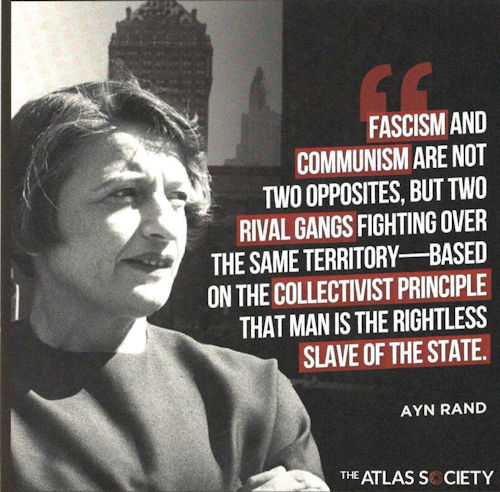
So, along came Ayn Rand. While very spiritual, it was the spirit of an earthly, rational, productive, and happiness-seeking man that she worshiped. She recognized that man lived by his rational faculty, which was his sole source for understanding reality. She reveled in the accomplishments of mind that many people contributed in their professional careers and thought that the system which most enabled these accomplishments was the Capitalist system of free trade in goods, services, and ideas. Religious tribalism or feudalism and socialism, whether of the fascist or communist varieties, squelched the mind and inhibited man's quest to thrive on this earth. She unabashedly identified the source of man's progress in the fruits of individual minds. She endorsed rationality, individuality, ethical egoism, productive achievement, and the quest for personal happiness.
Politically, a highly limited government, such as the framer's of The Constitution attempted to give us, was necessary if man were to be able to exercise his individual right to life, liberty, and the pursuit of happiness. Unfortunately, Americans have always been ambivalent about endorsing rationality, individuality, ethical egoism, productive achievement, and the quest for personal happiness. More than any other country on earth, we tolerated, and sometimes encouraged these human pursuits, but in early times, ancient religious belief interfered and now, more and more, a cheap desire to escape personal responsibility manifests itself in socialist evasions. Along the way, our Constitution has been reinterpreted to turn a requirement that the government behave consistent with the general welfare into an opening to allow almost any government action restricting the rights of the individual if only it was claimed to be in the name of the general welfare. If this had been the intention of the Framers, why would they try so hard to enumerate the few powers that government had? If this broadening of power was not enough, many others, such as a huge broadening of the mandate to regulate interstate trade has been added. It is difficult to make an argument so convoluted and trivial that it is not held that the government has a power to restrict many human activities based upon the commerce clause. As Judge Narragansett says in Galt's Gulch in Atlas Shrugged, an amendment must be added to the Constitution saying that Congress shall make no law abridging trade and depriving the people of their property. Of course now, we must even buttress our right to free speech, which is cruelly abridged by the McCain-Feingold Act, claimed to be an election reform.
Because of American misconceptions of political freedom, we have a society in which the members are pitted against one another on the basis of the industries they work for, the size of the companies they work for, whether they are management or labor, which quintile of income they fall into, whether they own a home or not, whether they have children in the public schools or not, whether they are man or woman, whether they are heterosexual or otherwise, whether they have bought medical insurance or not, whether they are old or young, and based upon their ethnicity. Because government uses its monopoly on the use of force to take up the part of these various groups against the interests of the opposing group, there are constant battles involving those who seek the unearned and those who seek to defend themselves. These are commonly very messy battles, since they have degenerated into very complex mixtures of the legitimate desire to protect oneself and the dastardly desire to take advantage of others. What could be uglier than parents taking advantage of their children by maintaining a Ponzi scheme social security system? What could be more disgusting than one ethnic group claiming special favors from government and discriminating against other ethnic groups. Shouldn't men be judged by their individual character rather than the color of their skin? The politicians and the media by and large encourage this constant factionalization. It gives them more power and brings them more attention and money. The philosophy is clearly to create conflict and to divide and conquer.
If the individual is ever to recover and then to fully realize his right to life, liberty, and the pursuit of happiness, it will be critical that he understand that man can live in harmony with others only by adapting Ayn Rand's philosophy of Objectivism. If the individual is to be respected, it must be understood that he lives by the product of his rational mind. When no man provides for himself by using force to appropriate the means of their living from others who have produced wealth, income, goods, and services by using their minds, then we can earn the shear joy of living as harmoniously as do the great producers of Galt's Gulch in Atlas Shrugged. By giving us such a life-affirming and inspirational view of the possibility of so much joy in living one's own life and sharing it with worthy friends and neighbors, Ayn Rand has given us a book for the ages. Atlas Shrugged should endure as has Homer's Iliad and Odyssey for showing us man as an heroic and joyous being.
Subscribe to:
Posts (Atom)







 Posts