Among the issues most commonly discussed are individuality, the rights of the individual, the limits of legitimate government, morality, history, economics, government policy, science, business, education, health care, energy, and man-made global warming evaluations. My posts are aimed at intelligent and rational individuals, whose comments are very welcome.

"No matter how vast your knowledge or how modest, it is your own mind that has to acquire it." Ayn Rand

"Observe that the 'haves' are those who have freedom, and that it is freedom that the 'have-nots' have not." Ayn Rand

"The virtue involved in helping those one loves is not 'selflessness' or 'sacrifice', but integrity." Ayn Rand

For "a human being, the question 'to be or not to be,' is the question 'to think or not to think.'" Ayn Rand
Showing posts with label hurricanes. Show all posts

30 September 2022

Washington Post: Climate Change is Fueling Super Hurricanes -- Is it really?

The Washington Post on 30 September 2022, claimed that "climate change is fueling the creation of super hurricanes."  The article says that "as waters warm, 7 super storms have lashed the U.S. since 2017."

The article argues that ocean water is warming, apparently due to global warming, not either warming or cooling climate change.  It argues that hurricanes draw their energy from warm water and therefore become stronger and more frequent.  Yes, hurricanes do draw their energy from warm water, but they also require wind shear to form as hurricanes.  Since global warming does not much affect the temperature of oceans in tropical regions due to the moderating effects of the water cycle, while it does increase temperatures in the mid-latitudes, the wind shear cause of hurricanes is actually reduced.  So what is the historic data on hurricanes?  Let us look at the record for hurricanes that had landfalls on Florida:


Maybe you can see the catastrophic increase if the data is plotted as curves rather than as bars?


I must confess that the frequency of major landfalling hurricanes does not appear to have increased, unless you only look at the timeline beginning about 1980.  It seems undeniable that the frequency of all hurricanes since the 1870s has decreased.  But, perhaps the focus on Florida is the problem.  Let us look at the data for hurricanes landing anywhere on the U.S.
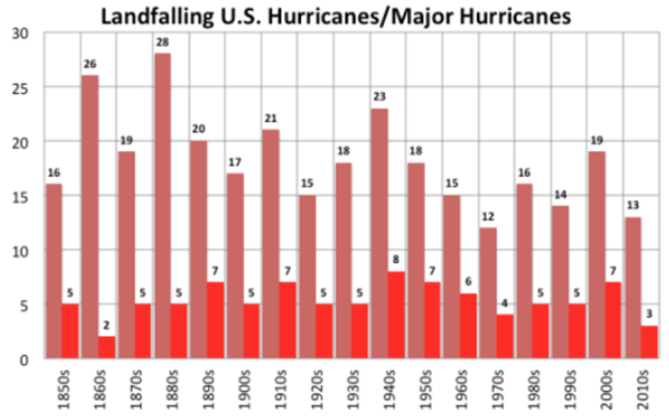

Do you see a dramatic increase in hurricanes or in major hurricanes in this data?  Once again, it seems clear that the total hurricane frequency is actually decreasing.  The major hurricanes do not seem to be changing much at all.

Almost anyone at all serious about climate issues agrees that a five-year span of time is still just weather, while it takes a minimum of 30 years to be considered climate.  Note that the Washington Post article was claiming that a 5-year span of hurricane history was proof of man-made global warming, which they ridiculously call climate change.  Actually, 30 years is just enough to cover the shortest of the climate cycles, so any real climate argument ought to cover a period of quite a few 30-year cycles.

Let us examine the historic data on ocean surface temperatures, since the Washington Post argument says hurricane strength and frequency are just a function of ocean surface temperatures.
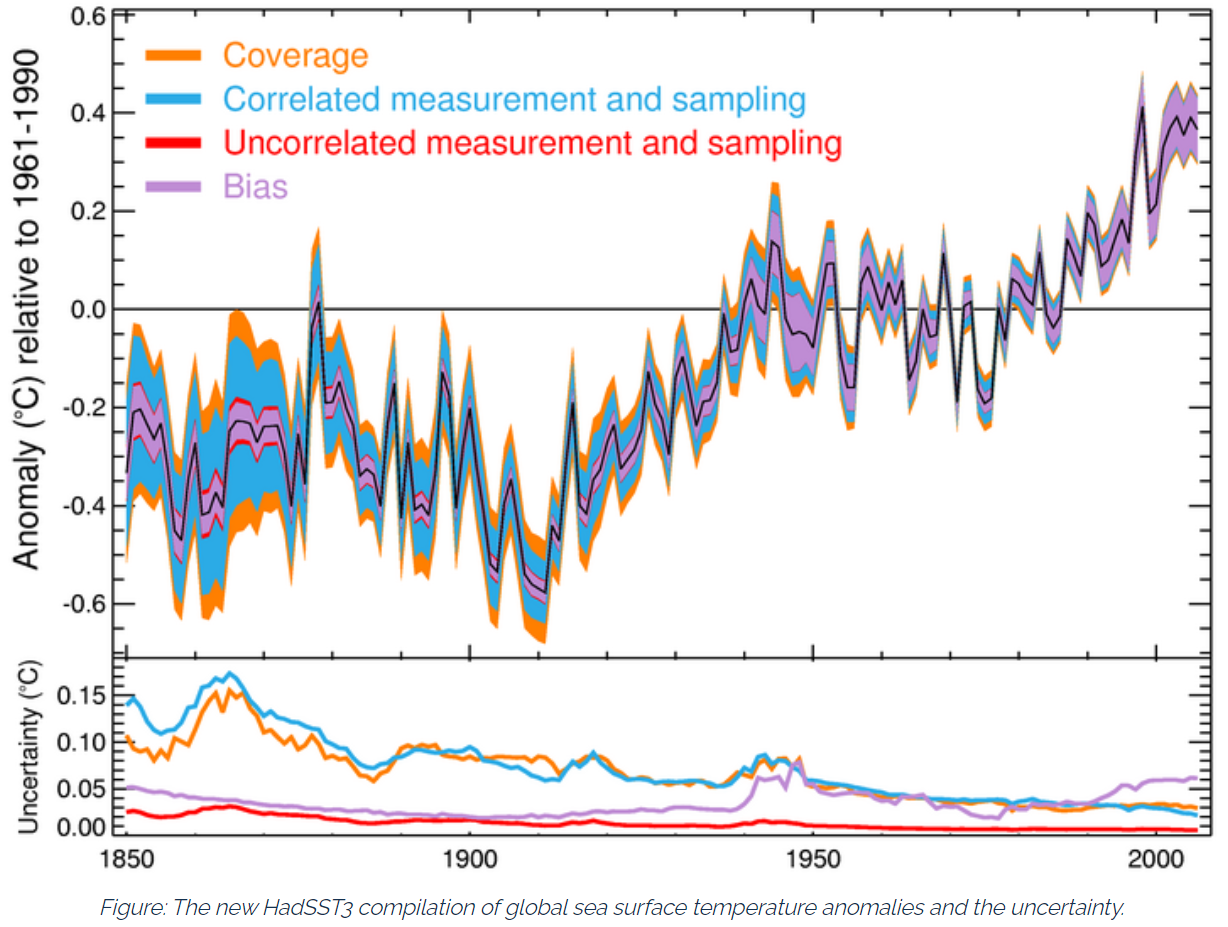

According to this data, the ocean temperatures have increased.  They did not change much from 1850 to about 1900.  There was a decrease in temperatures from 1900 to 1910, then an increase in temperature from then until the mid-1940s, then was nearly constant from then until the late 1970s, with another increase from then until about 2010.  Based on the Washington Post's claim that warmer water fuels hurricanes, the increase in water temperature from 1910 to the mid-1940s should have caused a significant increase in hurricanes.  Do you see that in the landfall hurricane charts above?  If the effect is there, it sure is small.  Then again, where is the major increase in landfalling hurricanes from the late 1970s through 2010 compared to earlier periods?

If mankind's use of carbon-based fuels is the cause of warming oceans, what huge increase in fossil fuels caused the warming from 1910 to the mid-1940s?  Europe was not producing very much for several years following WWI and then no one was during the 1930s.  Most of the world's population was not much more industrial than it had been in the 1800s.  So, how did this rapid ocean warming occur during this period?  I cannot see a good argument for it being due to man's use of carbon-based fuels.

Let us look at the concentration of CO2 in the atmosphere since 1958 and see if we can see a correlation between the CO2 concentration and the ocean surface temperatures.


The catastrophic man-made global warming argument is that carbon dioxide is the thermostat for the Earth's temperature, presumably including the 71% of the Earth's surface covered by water.  Any claim that CO2 in the atmosphere causes an increase in the temperature has to acknowledge that the warming effect requires more and more carbon dioxide for a given temperature increase.  The actual increase in CO2 in this record is a bit faster than linear, but it is not exponential or at all close to it.  So, all ocean temperature increases ought to be gradual and constant (or even dropping off) from 1958 to the present.  Yet for much of this time, there was no increase in ocean water temperature.  Then in the late 1970s the temperature takes off a bit in the ocean temperature record, but where was the acceleration in CO2 concentration in the atmosphere?

One can only conclude that there is no scientific evidence that CO2 controls the temperature of the oceans and there is none that warming oceans are enough to cause an increase in the frequency and intensity of hurricanes.  Therefore, there is no reason to claim that man's use of carbon-based fuels is causing an increase in the frequency and intensity of hurricanes.

It is very strange that so many people claim to be scientific experts who yet believe in this nonsense.  It is also very strange that so many people who have no knowledge about such matters are nonetheless strong believers in the adamant claims of those who claim to know the science, without themselves believing they have any need to understand the science themselves.


21 January 2019

Climate hysterics skyrocket by Paul Driessen

Increasingly absurd disaster rhetoric is consistently contradicted by climate and weather reality 

Call it climate one-upmanship. It seems everyone has to outdo previous climate chaos rhetoric.

The “climate crisis” is the “existential threat of our time,” Speaker Nancy Pelosi told her House colleagues. We must “end the inaction and denial of science that threaten the planet and the future.”

Former California Governor Jerry Brown solemnly intoned that America has “an enemy, though different, but perhaps very much devastating in a similar way” as the Nazis in World War II.

Not to be outdone, two PhDs writing in Psychology Today declared that “the human race faces extinction” if we don’t stop burning fossil fuels. And yet “even people who experience extreme weather events often still refuse to report the experiences as a manifestation of climate change.” Psychologists, they lament, “have never had to face denial on this scale before.”

Then there’s Oxford University doctoral candidate Samuel Miller-McDonald. He’s convinced the only thing that could save people and planet from cataclysmic climate change is cataclysmic nuclear war that “shuts down the global economy but stops short of human extinction.”

All this headline-grabbing gloom and doom, however, is backed up by little more than computer models, obstinate assertions that the science is settled, and a steady litany of claims that temperatures, tornadoes, hurricanes, droughts et cetera are unprecedented, worse than ever before, and due to fossil fuels.

And on the basis of these hysterics, we are supposed to give up the carbon-based fuels that provide over 80% of US and global energy, gladly reduce our living standards – and put our jobs and economy at the mercy of expensive, unreliable, weather dependent, pseudo-renewable wind, solar and biofuel energy.

As in any civil or criminal trial, the burden of proof is on the accusers and prosecutors who want to sentence fossil fuels to oblivion. They need to provide more than blood-curdling charges, opening statements and summations. They need to provideconvincing real-world evidence to prove their case.

They have refused to do so. They ignore the way rising atmospheric carbon-dioxide is spurring plant growth and greening the planet. They blame every extreme weather event on fossil fuel emissions, but cannot explain the Medieval Warm Period, Little Ice Age or extreme weather events decades or centuries ago – or why we have had fewer extreme weather events in recent decades. They simply resort to trial in media and other forums where they can exclude exculpatory evidence, bar any case for the fossil fuel defense, and prevent any cross-examination of their witnesses, assertions and make-believe evidence.

Climate models are not evidence. At best, they offer scenarios of what might happen if the assumptions on which they are based turn out to be correct. However, the average prediction by 102 models is now a full degree F (0.55 C) above what satellites are actually measuring. Models that cannot be confirmed by actual observations are of little value and certainly should not be a basis for vital energy policy making.

The alarmist mantra seems to be: If models and reality don’t agree, reality must be wrong.
In fact, even as atmospheric carbon dioxide levels climbed to 405 parts per million (0.0405% of Earth’s atmosphere), except for short-term temperature spikes during El NiƱo ocean warming events, there has been very little planetary warming since 1998; nothing to suggest chaos or runaway temperatures.

Claims that tornadoes have gotten more frequent and intense are obliterated by actual evidence. NOAA records show that from 1954 to 1985 an average of 56 F3 to F5 tornadoes struck the USA each year – but from 1985 to 2017 there were only 34 per year on average. And in 2018, for the first time in modern history, not a single “violent” twister touched down in the United States. 

Harvey was the first major (category 3-5) hurricane to make US landfall in a record twelve years. The previous record was nine years, set in the 1860s. (If rising CO2 levels are to blame for Harvey, Irma and other extreme weather events, shouldn’t they also be credited for this hurricane drought?)

Droughts differ little from historic trends and cycles – and the Dust Bowl, Anasazi and Mayan droughts, and other ancient dry spells were long and destructive. Moreover, modern agricultural and drip irrigation technologies enable farmers to deal with droughts far better than they ever could in the past.

Forest fires are fewer than in the recent past – and largely due to failure to remove hundreds of millions of dead and diseased trees that provide ready tinder for massive conflagrations.

Arctic and Antarctic ice are largely within “normal” or “cyclical” levels for the past several centuries – and snow surface temperatures in the East Antarctic Plateau regularly reach  -90 °C (-130 F) or lower. Average Antarctic temperatures would have to rise some 20-85 degrees F year-round for all its land ice to melt and cause oceans to rise at faster than their current 7-12 inches per century pace.

In fact, the world’s oceans have risen over 400 feet since the last Pleistocene glaciers melted. (That’s how much water those mile-high Ice Age glaciers took out of the oceans!) Sea level rise paused during the Little Ice Age but kicked in again the past century or so. Meanwhile, retreating glaciers reveal long-lost forests, coins, corpses and other artifacts – proving those glaciers have come and gone many times.

Pacific islands will not be covered by rising seas anytime soon, at 7-12 inches per century, and because corals and atolls grow as seas rise. Land subsidence also plays a big role in perceived sea level rise – and US naval bases are safe from sea level rise, though maybe not from local land subsidence.

The Washington Post did report that “the Arctic Ocean is warming up, icebergs are growing scarcer, and in some places the seals are finding the water too hot.” But that was in 1922.
Moreover, explorers wrote about the cyclical absence of Arctic ice long before that. “We were astonished by the total absence of ice in Barrow Strait,” Sir Francis McClintock wrote in 1860. “I was here at this time in [mid] 1854 – still frozen up – and doubts were entertained as to the possibility of escape.”

Coral bleaching? That too has many causes – few having anything to do with manmade global warming – and the reefs generally return quickly to their former glory as corals adopt new zooxanthellae. 

On and on it goes – with more scare stories daily, more attempts to blame humans and fossil fuels for nearly every interesting or as-yet-unexplained natural phenomenon, weather event or climate fluctuation. And yet countering the manmade climate apocalypse narrative is increasingly difficult – in large part because the $2-trillion-per-year climate “science” and “renewable” energy industry works vigorously to suppress such evidence and discussion … and is aided and abetted by its media and political allies.

Thus we have Chuck Todd, who brought an entire panel of alarmist climate “experts” to a recent episode of Meet the Press. He helped them expound ad nauseam on the alleged “existential threat of our time” – but made it clear that he was not going to give even one minute to experts on the other side.

“We’re not going to debate climate change, the existence of it,” Todd proclaimed. “The Earth is getting hotter. And human activity is a major cause, period. We’re not going to give time to climate deniers. The science is settled, even if political opinion is not.” The only thing left to discuss, from their perspective was “solutions” – most of which would hugely benefit them and their cohorts, politically and financially.

Regular folks in developed and developing countries alike see this politicized, money-driven kangaroo court process for what it is. They also know that unproven, exaggerated and fabricated climate scares must be balanced against their having to give up (or never having) reliable, affordable fossil fuel energy. That is why we have “dangerous manmade climate change” denial on this scale.

That is why we must get the facts out by other means. It is why we must confront Congress, media people and the Trump Administration, and demand that they address these realities, hold debates, revisit the CO2 Endangerment Finding – and stop calling for an end to fossil fuels and modern living standards before we actually have an honest, robust assessment of supposedly “settled” climate science.

Paul Driessen is senior policy advisor for the Committee For A Constructive Tomorrow (CFACT) and author of articles and books on energy, environmental and human rights issues.


Charles R. Anderson Comment:
"On and on it goes – with more scare stories daily, more attempts to blame humans and fossil fuels for nearly every interesting or as-yet-unexplained natural phenomenon, weather event or climate fluctuation."
In the pre-science era of mankind's history, every unexplained natural phenomena was attributed to the will of God and man had no need to understand that phenomena because it was sufficient that God understood it.  In the post-science era every unexplained phenomena is attributed to the Climate Change God and no one is supposed to question that god either.

I still aim to actually use science to understand reality, which is why I have written so often about the many huge errors and the inconsistencies in the physics which is claimed to provide the basis for the alarmist catastrophic man-made global warming hypothesis.  Because of these errors, there is no reason to be surprised that the climate models supposedly based on this erroneous science have been making wrong predictions.

However, in the post-science era an hypothesis that makes wrong predictions is held to be unquestionable, when in the science era it would have been obvious that wrong predictions invalidate the hypothesis.  This is the difference between science and theology.

19 April 2010

Galveston - The Hurricane Damaged City We Do Not Hear About

Hurricane Ike struck Galveston, Texas on 13 September 2008 in the waning days of the Bush presidency with a Democrat Congress.  Tens of thousands of people evacuated Galveston, which is on a coastal island.  Dozens of people died.  Parts of Houston, which is not far away, went without power for weeks.

Before the storm, Galveston had a population of 57,000 people.  It now has a population of about 48,000, putting it below the important federal threshold for many benefits at 50,000.  For the next ten years, the Census will proclaim Galveston a city of fewer than 50,000 people.  Yes, the equal individual rights of Americans living in towns and cities with populations of less than 50,000 people are less equal than those of people living in the larger cities exceeding that threshold.

The people of Galveston have long been waiting for promised federal aid.  The aid is aimed at rehabilitation of the heavily damaged areas rather than compensation.  The resulting barrier of paperwork between the state government and the federal government has created long delays.  A first round of $1.3 billion of federal money is partially still held in state coffers.  In November 2009, the Department of Housing and Urban Development said it was holding up disbursing a second round of $1.7 billion requested by Texas because the state had not solicited enough community input and had not updated its fair-housing practices.

After the Katrina and Rita Hurricanes in 2005, the city of Galveston set up an emergency hurricane fund of $14 million and built caches of food and fuel.  The local banks made short-term, low-interest loans totaling $65 million to local businesses to help them reopen.  The city and the city's private sector pulled together to work on rebuilding Galveston.

Can you imagine the blame game Washington would be playing now if a Republican were President?  But, with a leftist-favored Obama presidency, the delays are completely without interest.

This post is based upon a story in The Economist of 17-23 April 2010.

15 February 2010

UN IPCC 2007 Report Hurricane Claims Wrong

Les Hatton has worked on weather models at the Meteorology Office of the United Kingdom, studied mathematics at Cambridge, and earned a Ph.D. in meteorology.  He is a fellow of the Royal Meteorology Society, teaches at the University of Kingston, and an expert in critical systems analysis.  He has examined the raw data on severe storms from NOAA in order to test several statements made in the IPCC AR4 report of 2007.  He performed a z-test statistical analysis of the 1999-2009 period for comparison to the entire 1946 - 2009 period.  He found no significant change in the number of storms or their severity.

The more detailed results were:
  • North Atlantic hurricane activity increased significantly, mostly due to an especially active year in 2005.
  • Hurricane-strength storms in the East Pacific diminished.  There are 50% more such storms there commonly than in the North Atlantic.
  • There was no difference in storms of the West Pacific.
  • There was no net difference in severe storms globally.
Interestingly enough, the IPCC report did say "there is no clear trend in the annual numbers of tropical cyclones."  Yet it goes on to say "There are also suggestions of increased intense tropical cyclone activity in some other regions where concerns over data quality are greater."  Hatton claims the data from those areas is of similar quality to all the other data.  The IPCC makes the claim that "It is more likely than not (> 50%) that there has been some human contribution to the increases in hurricane intensity."  Hatton says they concluded this from computer models, which were at variance with the observational data!

Hatton is not the first scientist with expertise in severe storms to refute the UN IPCC AR4 report claims of 2007.  Dr. Chris Landsea, the chief scientist of the National Hurricane Center in the U.S., resigned in 2005 from his activities as a contributor to the UN IPCC reports in protest to the poor science of Dr. Kevin Trenberth who was a Lead Author for the AR4 of 2007.  Landsea claimed publicly that the Dr. Kevin Trenberth's claims that severe storms were more intense and frequent due to man-made global warming were wrong, since they were not more intense and more frequent.  Dr. Kevin Trenberth is one of the inner circle of global warming alarmists whose unethical advocacy activities were made more public by the recent ClimateGate e-mail and document dump from the CRU of the University of East Anglia.

Some global warming alarmists note that there has been an increase in low-intensity storms in the record.  This, however, appears to be because radar and satellites are observing these storms now, which often went unobserved before.