Among the issues most commonly discussed are individuality, the rights of the individual, the limits of legitimate government, morality, history, economics, government policy, science, business, education, health care, energy, and man-made global warming evaluations. My posts are aimed at intelligent and rational individuals, whose comments are very welcome.

"No matter how vast your knowledge or how modest, it is your own mind that has to acquire it." Ayn Rand

"Observe that the 'haves' are those who have freedom, and that it is freedom that the 'have-nots' have not." Ayn Rand

"The virtue involved in helping those one loves is not 'selflessness' or 'sacrifice', but integrity." Ayn Rand

For "a human being, the question 'to be or not to be,' is the question 'to think or not to think.'" Ayn Rand
Showing posts with label money. Show all posts

30 March 2016

Krugman Demonstrates Lack of Focus Once Again

Paul Krugman has once again demonstrated his lack of focus and poor reasoning skills.  His column criticizes Ayn Rand, Paul Ryan, and Ted Cruz.

He claims that Ted Cruz's tax reform plan will increase taxes on the poor and he references this analysis by the Tax Policy Center of the Urban Institute and Brookings Institute, for a very socialist viewpoint on Cruz's tax plan.  So what does that report say:
In 2017, the proposal would cut taxes at every income level, but high-income taxpayers would receive the biggest cuts, both in dollar terms and as a percentage of income.
This is not a tax increase for the poor as Krugman claims.  Of course the poorest, who pay virtually no taxes now, will not get as big a tax reduction as will high-income taxpayers.  The report does go on to make a prediction based upon a leftist view of the economy that by 2025, the lowest income quintile will be paying $116 more a year in taxes than they would under the present income tax scheme.  Of course, they also assume that Cruz will not succeed in reducing the size of the government relative to the size of the economy and who knows what other assumptions based on a dismal growth of businesses and a failure to count the value of welfare payments to the poorest quintile.  This economic model is likely no more sound than are the computer models that supposedly buttress the catastrophic man-made global warming hypothesis.

Krugman also seeks to discredit Paul Ryan by claiming that Ryan has said he returns over and over to read Francisco D'Anconia's Money Speech from Atlas Shrugged.  According to Krugman the Money Speech is:
one of the interminable monologs in Rand's "Atlas Shrugged"
A monolog less than four and a half pages long is too much for Paul Krugman's ability to focus and think.  He, though supposedly an economist, has little interest in the morality of Capitalism and needs escapist novels to pander to his inability to focus and reason.

22 September 2012

17 Countries Now Have More Economic Freedom than the USA

The Economic Freedom of the World: 2012 Annual Report published by the Fraser Institute measured the economic freedom of countries using the data of 2010.  The principal authors of the report are James Gwartney of  Florida State University, Robert Lawson of Southern Methodist University, and Joshua Hall of Beloit College with contributions from eight other academics.

The economic freedom evaluation of the USA continued its nearly monotonic decline since the year 2000.  In 2000 we had a rating of 8.65 on a scale of 10.00, but we have sunk to a rating of 7.70 now.  Since the year 2000, the rest of the world has seen a small increase in rating from 6.71 to 6.83.  In 2010, our 8.65 rating of the year 2000 would have made the USA a close third to Singapore, with Hong Kong number one.  But in our state of degradation as of 2010, the USA is now disgracefully 18th in the world in economic freedom.  When the evaluation is made for 2012, we will find that we have slid much further down the list.

Here is what the world looks like color coded by quartile in economic freedom:


You can see why Mexicans have been coming across the border illegally to work in the USA from this map.  I was not surprised to see Venezuela and maybe even Argentina in the least free quartile, but I was surprised to see India there.

Here are the ratings and the rankings of the upper two quartiles:


These economic freedom ratings are made based on the following criteria with the individual USA ratings and rankings following each:

1) Size of government (6.43, 73rd, our worst major category ranking)

2) Legal system and property rights (7.14, 28th)

3) Sound money (9.68, 7th)

4) Freedom to trade internationally (7.46, 57th)

5) Regulation (7.76, 31st)

Regulation is further broken down into the following subcategories:

a) Credit market regulations (6.95, 121st, our worst regulatory ranking)

b) Labor market regulations (9.06, 3rd)

c) Business regulations (7.26, 30th)

If we evaluate which areas of economic freedom are most pulling our ranking down in order, they are:

Size of government, 73rd
Freedom to trade internationally, 57th
Regulation, 31st
Legal system and property rights, 28th

in which areas our ranking was worse than our overall ranking. Note that our size of government ranking of 73rd puts us at the top of the list of nations in the third quartile.  That is in the lower half of the 144 nations evaluated.  Does that hurt your pride?  It should.  It should be excruciating pain.  Personally, I find each of these rankings to be disgraceful and a source of great anger.

Our economic freedoms are as basic as any other freedoms.  To sustain our lives, we need to be free to earn a living.  We also need to be free to enjoy earning our living without having burdens constantly loaded on our backs such as heavy taxes and unnecessary regulations and paperwork requirements.  The American businessman sees his business drained by excessive taxes, is forced to be an unpaid tax collector, is forced to divulge much too much private information, is forced to assume responsibilities and risks that are properly either those of his employees or his customers, is kept from doing things according to his own judgment by laws that are often irrational, and is forced to comply with unintelligible and excessively voluminous rules and regulations.

The American businessman is treated like a slave of the state and generally forced into being a criminal by laws and regulations he cannot even read, cannot understand, and in many cases could not abide by if he understood them.  This is exactly what a great many politicians want.  They want to extort tax money, favors, and campaign contributions at will from businessmen.  They use the overly complex and voluminous law and the threat of still more laws and regulations to make most businessmen cower before them.

There are very practical consequences for our economy.  As our economic freedoms are lost, our ability to grow our real per capita GDP decreases.  See the graph I have prepared from World Bank data for the years from 1980 to 2011:


Note that the post-2000 performance is clearly much worse than that of 2000 and earlier.  A loss of economic freedom is a loss of opportunity and an increase in uncertainty.  With less opportunity and more uncertainty, fewer people will start start-up companies and fewer people will be hired by such companies:

George W. Bush grew government and added many regulations, but Obama has grown government even more and added slightly more regulations and many more very expensive regulations.  With many more regulations awaiting a second term and hopes for many tax increases, Obama intends to further degrade our economic freedoms in the name of redistribution and a wrongheaded claim that catastrophic man-made global warming will result if he does not drastically cut our fossil fuel energy use.  If he is re-elected, he will attempt to greatly further decrease our economic freedoms.


02 September 2010

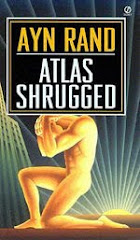
September 2 is Atlas Shrugged Day!

On September 2, 1946, Ayn Rand began writing Atlas Shrugged and she finished her great novel in time for publication in 1957.  Throughout the novel, September 2 is the date of a number of events:
  • In the opening scene of the novel, a bum asking Eddie Willers for a handout, asks "Who is John Galt?"  This and the way it was asked bother Eddie.  As he walks through NYC he is also bothered by the gigantic calendar hanging from a public tower and announcing the date as September 2.    
  • On that date, Hank Rearden and Dagny Taggart decide to take a vacation together.  On that vacation they discover an abandoned motor that should have revolutionized the use of energy in the world.
  • Francisco D'Anconia makes his speech on money on September 2.  He proclaims money to be the tool of free trade and the result of noble effort, not the root of evil.  Those who call money evil choose to replace its use with the force of the gun.

  • D'Anconia Copper is nationalized on 2 September, but the date on the calendar is replaced by "Brother, you asked for it!"
So, on this day of 2 September 2010, let us give thanks to Ayn Rand for her incredibly dedicated effort in writing this path-breaking novel we are finding so important in our lives 53 years after its publication date and 64 years after she started it on 2 September 1946.  This should be a day celebrated much as Thanksgiving Day is celebrated, but without any religious overtones, as a day to respect the creativity and productivity of all the heroic men and women that Ayn Rand's heroic novel commemorates.  At the top of our list of respected heroes and heroines, we should recognize Ayn Rand herself.

28 May 2010

A Measure of the Government Wealth-Taking

In May 2008, M2, a measure of the money supply, stood at $7,733.5 billion.  In April 2010 it was up to $8,595.5 billion.  The government had added $862 billion to the M2 money supply.  This is an 11.15% increase in about 2 years.  One consequence of this is that everything you own, when given a dollar value, was devalued by 11.15%.  This does not mean that the dollar value as given dropped, but it does mean that other things being equal, your assets lost 11.15% of their value.  Measuring their value in terms of other currencies than the dollar may not indicate this, since most other currencies have also been similarly inflated during this time.  But, when measured against a holdable and valuable commodity such as gold, platinum, and silver, it is only reasonable that this would mean that your asset lost value in terms of those valuable commodities.

The stock market in this period fell from 1409.34 on 1 May 2008 to 1186.69 on 30 April 2010.  This was a drop of 15.80%.  Of course other things are not equal, so a drop of 11.15% was exceeded.  Among other unequal factors, the U.S. GDP fell by 2.33% from 2008 to 2009, so that might simply be added to the 11.15% drop to create a drop of 13.48%.  Of course, if productivity is increasing fast enough, an increase in M2 may not result in a drop of stock prices, but during the recession with more money chasing few goods, it is not surprising that our stock market investments have lost value.  For the many Baby Boomers approaching normal retirement ages, this has been a disaster.  We can largely thank the federal government for this and attribute it to its influence on Fanny Mae, Freddy Mac, AIG, the Federal Reserve, and its many efforts to push financial institutions to provide sub-prime mortgages to people who could not afford them.

08 July 2008

Chapman -- Pursue (and seize) happiness

Steve Chapman's commentary in the 7 July 2008 Washington Times by that title is about a global survey that shows that people are happier in countries with a greater measure of freedom and money. He notes that "There is no such thing as a rich totalitarian country, as even the onetime totalitarians in Beijing finally realized. So in a very real sense, freedom is the key to happiness." The survey was conducted by the Institute for Social Research at the University of Michigan. People in 97 countries were asked just two questions:
  • "Taking all things together, would you say you are very happy, rather happy, not very happy, or not at all happy?"
  • "All things considered, how satisfied are you with your life as a whole these days?"
Of the 97 countries, the poll has been previously taken in 52 countries for the last couple of decades. The percentage of people giving upbeat answers rose in 40 of these 52 countries. As China and India have grown freer, their peoples have become happier. This was also the trend in the advanced world, with the exceptions of Great Britain, Germany, Austria, and Belgium. The people of the United States, France, Canada, Denmark, and Japan became happier.

Chapman notes that only America was founded on a right that sounds rather eccentric even today: the right to the pursuit of happiness. But this perception of the writers of the Declaration of Independence has served as a very good model for countries who want their people to be happy.