Among the issues most commonly discussed are individuality, the rights of the individual, the limits of legitimate government, morality, history, economics, government policy, science, business, education, health care, energy, and man-made global warming evaluations. My posts are aimed at intelligent and rational individuals, whose comments are very welcome.

"No matter how vast your knowledge or how modest, it is your own mind that has to acquire it." Ayn Rand

"Observe that the 'haves' are those who have freedom, and that it is freedom that the 'have-nots' have not." Ayn Rand

"The virtue involved in helping those one loves is not 'selflessness' or 'sacrifice', but integrity." Ayn Rand

For "a human being, the question 'to be or not to be,' is the question 'to think or not to think.'" Ayn Rand
Showing posts with label entitlements. Show all posts

05 July 2016

Independence Day Thoughts on Freedom

When Americans declared their independence from Great Britain 240 years ago, they were a people who were largely self-employed and proud to manage their own lives.  They believed they had no need for a government to choose their values for them and to micromanage their lives.  Their principal need for a government was to prevent individuals from initiating the use of force against one another and to protect them from outlaw gangs, warring Indians, and attacks by other nations. Most of those needs they were quite willing to fulfill in large part at the very local level, including a local militia. They certainly did not need a government dominated by special interests and aristocrats a long distance away from them dictating numerous laws and taxing them.

But what is the American condition today?  Relatively few people are self-employed.  The result is that relatively few people believe that they are capable of controlling their own lives.  For the ease of being an employee, most people have given up the ability to earn their own living under their own management.  Most people have consequently lost a key ingredient to their independence and their self-confidence.  This is a loss partly brought on by political decisions in which a people more and more frequently employed by others came to be in greater and greater numbers in the electorate. Frustrated with their lack of control and holding a great political power in their numbers, but lacking self-direction, these Americans became susceptible to special interests who wanted to gain power and wealth at the expense of the less numerous employers who had made their wealth in a largely free market.  More and more legislation came to regulate employers and to transfer their wealth to groups politically favored by government.  This further weakened the spirit of self-sufficiency, independent mindedness, and encouraged the creation of huge barriers to starting and operating businesses. Americans became more and more dependent upon their government and the whims of the special interests that came to control that ever more powerful government.

Today, government and the education system it dominates insist that we are not really individuals at all.  No, we are simply members in some identity group.  White males are only capable of thinking like a stereotypical white male does.  Black males are only capable of thinking as a stereotypical black male does.  Those exceptions, such as Justice Clarence Thomas, Dr. Thomas Sowell, and Professor Walter E. Williams are simply abominations abhorrent to nature and traitors to their group identity.  In an interesting twist, it is fine however for a white male to think outside his abhorred group, provided he thinks like one of the approved identity groups.  Well, that is true to a fair degree, though there are increasing numbers who now resent such a person's theft of their identity.  Overall, our special interest serving government found it very convenient to lump Americans into a few groups so that we might be divided and controlled more readily.  This also serves the critically important function of obscuring the fact that the government cannot know us as individuals and cannot do anything but suppress our individuality with its ever-increasing legislation and regulations. People will be less aware of the suppression of their individuality if they have been taught that they only have a group identity.  This is a fundamentally collectivist idea.

Americans are a self-contradictory group these days.  They want less government, but they rarely want to give up any program that currently exists, except for ObamaCare, maybe.  They want the government to spend less, except on a few new programs that they want.  They are not infrequently willing to break a law they think the government will not notice, but they are eager to create new laws to prevent others from doing anything that might aggravate them.  Indeed, Congress is held in super-low regard because it is so often in gridlock, though the last time it was not in gridlock it passed the hated ObamaCare act.  Generally, the people believe that a legislature is not doing its job unless it is passing loads of new laws.

Now, because I view the only legitimate function of government, as did the Declaration of Independence, as being the protection of the rights of each and every individual to life, liberty, property, and the pursuit of personal happiness, I see little need for new laws doing what most new laws have done in recent decades.  Most new laws further restrict the freedom of action of at least some Americans, though most laws are aimed at a minority subset of Americans if great harm is to be done to them.  Those laws restricting most Americans are usually designed to cause them only a small and largely unnoticed loss, but which in the aggregate allows a substantial transfer of wealth or power to a small, politically favored special interest group.  After many decades of following such a "practical" and unprincipled political course, we now have a government that does most Americans far more harm than it does us good.

We do presently have a need for much new legislation.  We need to repeal decades of laws that have interfered with our natural individual rights.  We have far too many laws providing for the theft of the value of the hours many put into productive work.  We have far too many restrictions on our freedom of association.  We have far too many prohibitions against our exercise of freedom of conscience, which includes, but is not limited to, our freedom of religion.  We have ever more constraints on freedom of speech and of the press.  Our property rights are in frequent jeopardy, whether it be to use our property for production or to keep it from being confiscated because some law enforcement arm of government imagines that it might have been used in a crime or even only that some action involving it fits a pattern of some organized crime or terrorist action, however implausibly that may apply to this particular property owner.

It is an interesting phenomena, though only one among many contradictions, that those who favor ever-larger government are constantly making claims that human activities cannot be sustained by the environment, yet ever-increasing spending based on the confiscation of the fruits of productive work can be sustained without limit.  So let us review a few charts on government growth provided by the Cato Institute:


Since 1900, Federal spending went from 2.8% of GDP to 21.4% of GDP in 2016, which is a 7.6-fold increase.  Total state and local government spending increased by only 2.2 times in comparison.  The more local government is, it would appear, the more solid the constraints on its spending.  Now that government spending is such a large part of the economy, it is critical that we stop using GDP as the measure since that government spending is actually counted as GDP.  Yet that money has to be produced outside government, while only a fraction of government spending is returned to the government for spending from taxes on money earned by doing the governments' bidding.  Total government spending here is 32.4% of GDP.  The Non-Government GDP (NG GDP) is then 67.6%. If government taxed the functions it spends money on at the same rate it taxes the general private sector economic activities then one could estimate that 32.4% of the money spent by governments is returned to government in taxes of the money spent by governments.  So, 0.324 times 32.4% is 10.5%.  The reality is that government actually taxes these activities at much lower rates.  It is probably generous to assume that taxes return 5% of the government money spent.  So let us subtract 5% from total government spending to find the drag that government spending itself puts on the private sector economy.  Net total government spending of (32.4 - 5.0)% /  67.6% = 40.5%, which is substantially more than the 32.4% the presentation of the data against the GDP provides us.  Let us bear this in mind as we look at some more charts of our unsustainable government growth.


The national defense is certainly a legitimate function of the government and it has a constitutional validation in the enumerated powers of the government.  This represents 15% of federal spending and it certainly includes some waste and abuse and suffers from the greatly diverted attention of our hired managers in Congress.  Interest payments are justified by the Constitution, but there is no legitimate reason for those payments to have grown to be 6% of the budget.  That is a percentage which would rise rapidly if we did not have an economy suppressed by government requirements that have greatly reduced the velocity of money in the economy.  The All Other Activities covers a few constitutionally valid functions, such as some of the foreign affairs activities, the post offices and post roads, the minting of money, immigration controls, the maintenance of weight and measure standards, the operation of the Patent Office, and the operation of the federal courts at a level appropriate for a nation of many fewer laws and regulations.  Had a proper philosophy of government prevailed, as stated in the Declaration of Independence and mandated by the Constitution, the spending of our present federal government would be closer to 20% of its present spending than to 25% of present spending.
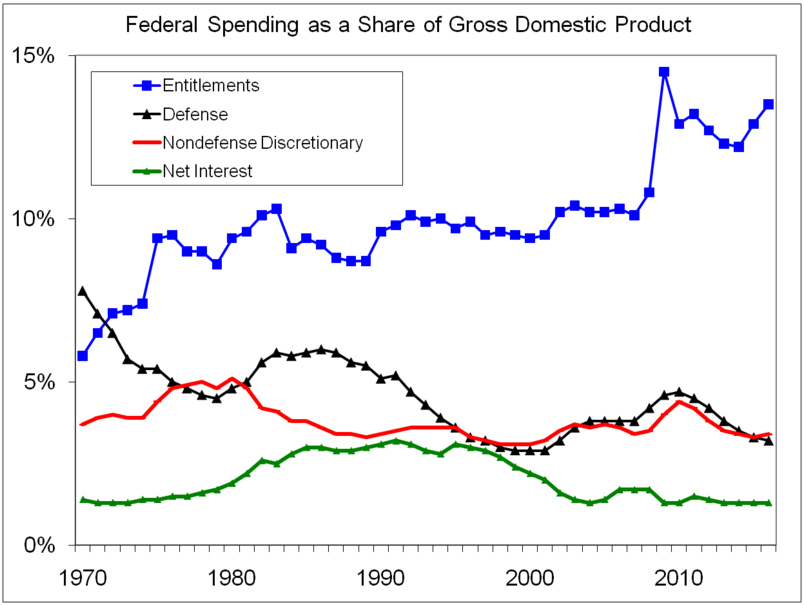

Since 1970, it sure is a good thing that defense spending as a percentage of the GDP has trended down substantially and that non-defense discretionary spending has come down a bit, because entitlement spending has climbed prodigiously.  Entitlement spending has no constitutional basis and no basis in the legitimate function of government as defined in the Declaration of Independence.  It is generally funded by the theft of the fruits of the productive work of Americans so that it can be rerouted to those favored politically by those who lust for the power to distribute the money.  This huge expansion of entitlement spending makes the so-called beneficiaries dependent upon the government, which suits the government just fine.


An appreciation of the degree to which our government has become one dominated by special interests would not be realistic if we did not acknowledge the huge increase in federal subsidy programs shown above.


This final graph is the number of pages in the Federal Register from Wayne Crews' Ten Thousand Commandments 2016 report from the Competitive Enterprise Institute. In the 1940s and the 1950s the total number of pages of final regulations in the Federal Register for the decade were running at about 110,00 pages a decade.  In the decade from 2001 -2010 the number of pages had grown to 730,176.  Presumably, the government considers it our duty to have read all of these regulations so that we might abide by them.  Did you do your government mandated duty?  Remember, ignorance is no defense for violating the law or any regulation.  More and more of the binding regulations or the interpretation of the regulations can only be found in court proceedings or in website announcements of the thousands of government regulatory agencies, which the government itself cannot enumerate. Good luck you lost, ignorant soul if the government decides to come after you.  Do you trust the likes of Obama, Hillary, or The Donald not to do so?

Oh that we might be free!  It would be incredibly wonderful to celebrate the 4th of July as a free man.
It would be a joy to be among free men who had maintained the principles of freedom set forth in the Declaration of Independence and then largely implemented in the Constitution of 1787 and the Bill of Rights in 1791.  To live in a society based on the free trade of values in a rich and robust private sector rather than one dominated by the forceful taking of wealth and service by governments would be to live in a genuinely life-sustaining society.  It is not possible to imagine how much our standard of living would be improved with the flowering of productivity, creativity, justice, and benevolence one would find in such a society.


02 March 2014

Either - Or: Big Government or Children

Big Government is often partly justified as necessary to provide services to children, but rarely do people think about the effect that Big Government has on whether people decide to have and raise children at all.  The USDA estimated in 2013 that a child born in 2011 to a US couple with a middle income will cost the parents $241,080 to raise to the age of 18.  This does not even include any costs for a college education or a failure to launch with 36% of 18 -31 year olds living in their parents homes in 2012.  Both of those costs have been increasing rapidly in recent years, while the median inflation-adjusted family income has fallen by $4,000 a year since 2000.

Now, we know that fertility rates are sensitive to a couples' economic security and their available resources.  Fertility rates dropped sharply in the US during the Great Depression.  Fertility rates dropped due to the back to back 1958 and 1960-1961 recessions.  They dropped substantially during the economic malaise of the late Nixon, the Ford, and the Carter years.  The fertility rate has dropped since 2008 as well.  We know that recent efforts of France and Sweden to decrease the cost of raising children have resulted in an increase in the fertility rates.  In December 2011, the Pew Research Center found that 22% of 18 -34 year olds said they were delaying having children for economic reasons.

So what do you think the effect of the great increase in government spending relative to the size of the economy has been on the fertility rate given that the increased spending came at the expense of transferring wealth from the private sector that pays child-raising expenses to the government sector?  The plot of the sum of federal, state, and local government spending from 1950 to 2013 as a percentage of the Gross Domestic Product (GDP) is shown below:


In 1950, the birthrate per 1000 people was 24.1, in 1970 it was 18.4/1000 people, in 1990 it was 16.7/ 1000 people, and in 2009 it was 13.8/1000 Americans.  Total government spending in 1970 was much higher than in 1950, then again increased greatly by 1990 and still more in 2009.  The fertility rate fell substantially with each of those jumps in total government spending.  Now, I am not claiming this is the only effect on fertility rates, but it is a very logical one and the evidence is that it is a substantial effect.

But, the median household income in 2012 according to the Bureau of the Census was $51,371 a year.  At a 38% total tax on this income, the governments are taking $351,378 from this household over the course of 18 years.  To be sure, the family with the median income is paying less in taxes than the average tax rate, but this is probably made up by increased costs they pay for goods and services as tax costs are transferred to them and inflation caused by the government deficits over the years.  Supporting Big Government is the equivalent of raising about 1.5 children for 18 years.  This has to affect the calculation on how many children to have.

Big Government also saps the ability of the private sector to increase worker productivity by reducing private investment in productive equipment, new facilities, and worker training.  It reduces the number of new start-up companies.  The result is an economy which instead of growing in real per capita terms of 4% per year, stagnates to zero growth in real per capita terms as we have seen for the last 5 years.  The governments largely caused the recession and have kept the private sector from growing us out of the recession.  It helps tremendously when a married couple can have confidence that their income will exceed an average per capita increase of 4% compounded over 20 years as they add their own increasing experience and skills by the time the child they might choose to have is in the middle of his college education.  It is much, much easier to undertake having a child with economic growth than if there is no growth due to government-induced stagnation.

In 2012, the average American woman was giving birth to 1.88 children in her lifetime.  This is well below the replacement rate of 2.1 children per woman.  This means that minus immigration into the US, the population would be decreasing over the long run at this birthrate.  That means a lowered number of future productive workers in the US and an increasing number of retired people and people on major entitlements per worker in the US.  This means very wrenching problems of sustainability for the many Big Government entitlement programs.

It also means that many people who otherwise would be enjoying raising children cannot do so because so much of their income is being diverted to Big Government.  That impact on families is not spread evenly across the country.  Couples earning more than $105,360 in the urban northeastern US will spend $446,100 per child.  This is also an area of the country with a particularly high cost of state and local governments.  Imagine the effect on the decision whether to have children or not?  On the other hand, families earning less than $61,590 per year in rural areas will spend less than $143,160 on the first 18 years of raising a child.  These rural areas usually have a lower tax expense.  All of these factors make for interesting calculations on whether to become parents.

Anna and I raised three children and sent one to college for 4.5 years, one to college for 4 years, and one to college for 1.5 years, while living in the Northeast.  It was a hugely expensive proposition which many people will not attempt.

Though many Malthusians are very happy to see low birthrates, the rising population of the world has been consistently combined with an increased standard of living around the world.  The USA is a particularly sparsely settled land, most of which has been reverting to wild lands as our agricultural prowess has increased so that less land was needed for farmland.  The foolish government mandate requiring ethanol additions to gasoline has recently interfered with that trend toward using less and less land for farming.  Of course, the trend of less and less land for food production has continued.  The innovations of the developed countries have also led to fewer and fewer problems with polluted air and water.  What we are losing with low birthrates is many keen, productive minds which would otherwise enrich our lives and advance civilization.

16 February 2013

Obama Wants Bigger Government on Top of This?

From his State of the Union address, it could not be more clear that Obama wants a much bigger government with much more spending and much more control over our lives.  He wants to impose this further growth upon the already unbelievable increases in government spending since 2002 as shown in this great graphic from the current issue of the magazine of the National Federation of Independent Businesses:

Of course there is no limit to the extraction of money, time, and other resources from the private sector for the use of the government sector in this fool's mind.  All of these programs have grown much faster than real, per capita income has in that time.  This has been especially true during the four years Obama has occupied the White House.  This is a huge problem he simply does not recognize, which means he is either incredibly dumb or incredibly evil.

23 August 2012

17 August 2011

Socialized Medicine and a Doctor's Moral Obligation

A friend asked this question:
One of the arguments I have heard from proponents of socialized medicine is that it is immoral to stand by while someone dies, and therefore society is obligated to help when someone is facing a life threatening illness but can't afford the treatment. Although there is much to refute in this type of statement, I am wondering about the more difficult refutation. As a personal decision of each doctor, is it rational to make the decision to deny treatment based upon the fact of a patient's inability to pay?
The moral argument against socialized medicine, or ObamaCare in particular, is based on our equal, sovereign individual rights. It is not dependent upon whether a particular doctor decides that he must act to save a life independent of remuneration or not. It is an important moral principle that he is free to either be benevolent or not be benevolent. Now, I do believe benevolence is an important virtue, but benevolence is virtuous in the context that the person helped has value to the doctor.  Benevolence is not about self-sacrifice, since that would hardly be benevolent to oneself. 

If the person has an entitlement mentality, then the doctor generally has no rational reason to help that person without remuneration. It is perfectly moral for him to walk away. In the context of a society of largely productive and benevolent people, a doctor may be rationally inclined to provide help to those who cannot afford to pay for their care, especially if they have become ill or hurt through no great fault of their own. But, even that depends on context, such as the expense the doctor will have in helping him and whether his helping the unfortunate person means that he is not able to help someone else who can pay. He is not obliged to save the poor man, while letting the financially prepared man die! If he gives too much of his time to helping the poor, he may not be able to generate enough income to buy the medical equipment that will enable him to save many lives in the future or he may simply go out of business. The doctor must make difficult moral decisions based on a very complex context. Some may appear to make a greater effort in benevolent acts than others, but still may not be saving the most lives possible.

Rational men are going to balance these difficult decisions differently and we should be careful in our appraisals of their morality.  A doctor may be willing to give his services free in a given case, but he may be unable to convince a nurse and other assistants to give their time free.  Or the hospital may be unwilling to make an operating room available.  Now the proponent of socialized medicine will want to use force to make all of these needed experts and facilities available, but this is a violation of everyone's rights and cannot be tolerated in a civilized society.

My grandfather was a physician in the Great Depression. He was a surgeon who operated in the Mayo Clinic and all of the hospitals of Minneapolis and St. Paul. He did a very unusual number of operations on people who could not pay for them. But, people were different back then. A farmer might not have any money, but he would give Harry Christianson a chicken, which to the farmer was his fortune. Then very likely for 20 years after, when he could, he would stop by grandpa's home and leave a bag of potatoes or a bushel of corn. This was very welcome when rationing was going on in WWII for instance. Harry and his wife Bess always had free food and there was so much that Bess and her daughter Betty organized ways to get it into the hands of those in need in the city. One man decided he would paint grandpa's house in payment for an operation, but while he was painting the upper part of the exterior, union thugs knocked him off the ladder and shattered his leg. The man was not a union painter. He was just a farmer who wanted to pay a debt he believed he had. Harry and Bess put him up in one of their rooms until he was healed. The union later burned down their home because they did this.

So this is another important issue of context. There is value in helping people who put value on the help they receive. There is value in helping people who fundamentally believe that one should trade values for value.

There is little value in helping the ungrateful, however. Any deserving person, any person whose welfare one has reason to care about, will recognize the value they have received and will not presume that they have the rights of a master, while the doctor who worked so hard to develop his healing skills and knowledge is treated as his slave.  A doctor or any other service provider has the right to choose his own values and to pursue his own happiness in terms of his values.

The need of a poor person does not deprive him of this equal individual right to pursue his happiness.  Every man, whether poor or rich, whether a professional or a low-skilled worker, has this magnificent right to pursue his happiness.  No one has the right to dictate the values or the moral code which will define what his happiness will be.  All that can be required of another is that they are not allowed to initiate the use of force as a means to pursue their happiness.

This is very adequate for each of us when we exercise our freedoms and act within the private sector of our society.  In the private sector we have a wealth of potential opportunities to cooperate with others whose values are sufficiently similar to ours or in some way complementary so that each of us can pursue our goals defined by our individually chosen values.  When our values are not approved of by others, they are free to choose not to associate with us.  This is the realm of the voluntary and is relished by those who want rich choices and who abhor being forced to bend to the will of others.

In contrast to this natural realm of freedom, we have the realm of the government.  The principal property of government is its monopoly on the use of force in a society.  Because a wise society seeks to minimize the use of force and seeks to maximize individual freedom of choice and association with others, such a society has a minimal government.  Such a limited and legitimate government uses force only for the purpose of protecting the equal, sovereign rights of the individual to life, liberty, and the pursuit of happiness.

When government attempts to do more, it must necessarily do violence to the rights of the individual as it imposes values and moral codes upon the People.  With this loss of freedom to choose one's values, one loses many of the freedoms to use one's own mind.  One loses the choice of one's own goals.  With the loss of one's own goals, one loses all hope.  It is no accident that unfree societies become depressed societies with large increases in drug use, excessive alcohol use, and increased numbers of suicides.  Big governments do much harm to individuals and are notable in the brutally of their violence against their people should any insist on exercising their sovereign rights.  We see the party of biggest government verging close to a desire to let loose the hounds of hell upon the Tea Party people for just this reason.  Over and over they have tried to label the Tea Party people who simply want to preserve some of their individual rights as terrorists and subversives.  This makes the brutal nature of unlimited government all the more clear in our time.

05 October 2009

Our Unsustainable Federal Spending

Democrats love to talk about sustainable energy policy, sustainable agriculture, sustainable environmental policies, sustainable cities, and sustainable housing.  But, they never give a fig about sustainable government, sustainable public sector spending, sustainable health care, and sustainable deficits.  Indeed, they almost seem to court governmental catastrophes as just an excuse for more government and a still bigger catastrophe.

Richard W. Rahn wrote an article in the Washington Times on 22 September about the growing problem of sustainability in the federal government.  He notes that the Congressional Budget Office (CBO) has estimated the additional federal debt grew by $4 trillion for the 2010-19 period in the last 8 months.  In the same 8 months, the amount of taxpayer debt grew from $5.9 to $7.5 trillion.

The taxpayers now own or insure about 80% of the $14.6 trillion of home mortgages outstanding debt in the United States.  This was not enough for the Democrat Congress, so it passed a bill outlawing bank student loans and requiring that all student loans be from the federal government.  Social Security, Medicare, Medicaid, and other entitlement programs are growing faster than the economy.  They will take more than 100% of federal tax revenues this year.  All other federal spending, including defense and interest payments on our debt, will be funded by government borrowing.

There is no way to tax ourselves out of this dilemma, especially not by only taxing the rich.  The only thing that can happen is that the entitlement programs will have to be cut back.  The growing Medicare, Medicaid, and Social Security entitlements will have to be cut.  In other words, rationed retirement and health care are coming.

Planned increased taxes and anti-trade policies such as the tariff on Chinese tires and the failure of Congress to approve the trade treaties with South Korea, Colombia, and Panama will make it harder to grow the economy to produce more tax revenues for the federal government.  The Chinese, who have bought a large part of our debt, are looking to diversify their investments.  We are driving other debt buyers away also, so we will have to offer higher interest rates to attract more bond and debt buyers.  This will make business investment less attractive, further retarding growth of the economy.

Rahn concludes:
What is particularly frightening is that neither political party has offered a serious plan to defuse the debt bomb. The Democrats are just piling up more debt as if there were no limit, and the Republicans, to date, are only proposing measures to reduce the increase, rather than reverse it. When the debt bomb explodes — within the next one to three years — expect to see record high real interest rates and/or inflation, coupled with a collapse of many "entitlements." It will be like the neutron bomb, the buildings will be left standing, but the people will not.
So much for the Democrat commitment to sustainability.

06 June 2009

Slavery in the Free State

Maryland was once called the Free State, mostly due to its long ago history of relative religious tolerance. Maryland also had the distinction of providing some of the best units of Washington's Continental Army. These units fought bravely under General Washington and then fought equally well under Major General Greene in the very important Southern Campaign that ended at Yorktown. Of course, one then had to turn a blind eye to Maryland also being a Slave State, so even then Maryland should have been ashamed to call itself the Free State. Maryland practices a different form of slavery now.

What is the situation now in Maryland? Marta Mossburg writing in the Washington Examiner has given us an update. State and local government employees grew by 20% from 1997 to 2007. I have looked up the overall population growth of the state in that time for comparison and find it to be only 10.3%. Now the amount of mischief that government's can do is likely to go up as the fraction of the population working for government goes up. We would be very lucky if it only went up in strict proportion, but these government workers are actually very "productive" in two tasks: increasing their power through spending and their own benefits!

Unfortunately, Mossburg only gives us the state budget for 2010, when what we need to find is the growth in the sum of the state and local government expenditures in Maryland to compare to the population growth rate and to the government employee growth rates. After some searching (Do the governments want these figures to be hard to find?), the sum of the state and local government expenditures in FY 2000 was $27,446,000 and it is $57,600,000 in FY 2009. This is a growth in government expenditures in Maryland of 210%. Seems the burden of government is getting worse in Maryland at about a rate of 20.4 times faster than the population to bear the expense is growing! Thus, Marylanders are working ever longer hours to pay this burden, which is the equivalent of spending many more hours as slaves to the state and local governments.

Mossburg points out that the state budget for the health insurance of state government employees is going up 17.4% from 2009 to 2010. The 2010 budget includes a 22.1% increase in money for teacher retirement benefits. This represents a 207% increase since 2001! Of course, Democrats are in control of the governorship and the state assembly in Maryland, so they have to pay off the teacher's unions for their critical political support and for indoctrinating Maryland children in the thesis that every problem has its solution in an additional government program.

Overall entitlement spending in Maryland is increasing rapidly also. In 2001 it was 16.2% of the budget, but in 2010 it is 20.8%. At this rate of growth, entitlements will be 40% of the budget by 2050. State retirees just received a 3.8% cost-of-living increase. Meanwhile, unemployment in Maryland is the highest it has been in 17 years.

What effect is this tax and government burden having on Maryland's population? For five years running, Maryland has suffered a net domestic out-migration. Marylanders are seeing other states as better places to live. Its overall population growth in each of the last two years was 0.3%, pretty similar to that of most of the states of the Northeast which also have oppressive government burdens. From 1 July 2007 to 30 June 2008, its growth rate was 44th lowest of the 50 states. In the earlier part of the last 10-year period, Maryland did somewhat better. Its growth rate since 1 April 2000 has been 6.4% compared to the U.S. growth rate of 8.0% in that time. This ranks it 24th among the states. Its position has worsened since a comparatively good Republican governor, Robert Erhlich, was replaced by the present governor, Martin O'Folley. The Democrat legislature is no longer somewhat frustrated and is instead being encouraged to cause mischief and harm. As we have seen, it and the local governments are very effective in this effort.