Among the issues most commonly discussed are individuality, the rights of the individual, the limits of legitimate government, morality, history, economics, government policy, science, business, education, health care, energy, and man-made global warming evaluations. My posts are aimed at intelligent and rational individuals, whose comments are very welcome.

"No matter how vast your knowledge or how modest, it is your own mind that has to acquire it." Ayn Rand

"Observe that the 'haves' are those who have freedom, and that it is freedom that the 'have-nots' have not." Ayn Rand

"The virtue involved in helping those one loves is not 'selflessness' or 'sacrifice', but integrity." Ayn Rand

For "a human being, the question 'to be or not to be,' is the question 'to think or not to think.'" Ayn Rand
Showing posts with label productivity. Show all posts

16 November 2025

Do you think Trump is anti-immigration?

Democrats, Marxists, and Social Justice Warriors all claim that Donald Trump is opposed to immigration.  Many libertarians and Objectivists agree.  Many of these people believe that this is obvious because Trump has acted to prevent the flood of illegal aliens from crossing our borders that had taken place during the Biden administration.  Mind you, Congress has created immigration laws which were signed by previous Presidents.  It is the duty of the current President to enforce those laws.

There are good reasons why the immigration laws create a process of evaluation for those we allow to reside in the USA.  Terrorists, murderers, thieves, slavers, rapists, child molesters, and those who would wind up on the welfare rolls of a country already deeply in debt are all very reasonably considered undesirables or even Deplorables.  Many a Democrat believes that most Republicans are Deplorables, so surely the above enumerated undesirable immigrants must qualify as Deplorables.

Wait.  Judgments are made in a context.  Democrats have a different context for their evaluation of immigration.  For Democrats, a Deplorable is someone who is not dependent upon government and therefore not easily controlled.  So these undesirable immigrants are actually quite desirable in the eyes of those who lust for power.  No one lusts for power more than the Democrat, Marxist, Social Justice Warrior elitists.  The quest for power justifies any act.

Is there a basis for people who are not lunatics to believe that Trump is anti-immigration?  On the surface, his implementation of a $100,000 fee for H-1B visas appears to justify a belief that Trump is anti-immigrant.  Let us consider this evaluation with some care.

The H-1B visa program allows people with special skills, generally based on years of education, to reside in the USA for 3 years.  They may renew their H-1B visa for another 3 years.  There is a lottery to apply for an H-1B visa for those who would work for a for-profit company.  Non-profits, universities, and federal laboratory candidates do not have to be filtered and limited by the lottery.  There is a general lottery of 65,000 visa applications for those with a bachelor's degree or higher.  There is a smaller lottery of 20,000 for those applicants with master's degrees or higher which were awarded by U.S. accredited universities.  In Fiscal 2025, there were 343,981 registrations for the opportunity to apply for the H-1B visa.  There were about 120,000 selections.  First off, there are many more nationals of other countries who have master's degrees or higher than 20,000 and there are many more total registrants than there are total slots available.  The $100,000 fee did not apply to these 2025 applicants.  It will apply in 2026, but not to those foreign nationals who are already legally in the USA.  Most of them have graduated from U.S. universities.  One of the main consequences of Trump's changes to the program is that the foreign nationals who are already legally in the USA and who have been educated here, will be much less likely to be forced to leave the USA because someone who is not already here is being brought into the U.S. to work.  About 250,000 international students graduate from U.S. universities each year.  There are almost certain to be more than 120,000 registrants for H-1B visas from these students in 2026.  The number of H-1B visas awarded will not be very different after the Trump changes than before them.

In fact, Trump made it very clear to Laura Ingraham, who hates the H-1B visa program, that he sees a need for the special skills of H-1B visa holders.  I fully agree with Trump on this.  I have sponsored four scientists for H-1B visas over the years to work for my laboratory.  I currently have one Ph.D. scientist on my staff who is awaiting word on his application, which appears to have been delayed by the government "shut-down."

Laura Ingraham, J. D. Vance, and other Republicans who oppose the program commonly cite the idea that there are plenty of American residents who can meet all of our technical and scientific needs without foreign workers.  I have news for you.  Getting a Ph.D. in the hard sciences is a much tougher challenge and much more work than most Americans wish to undertake.  The IQ requirement is very high to begin with and the U.S. population compared to the world population is about 4%.  Laura, this means that there are many more high IQ people in the rest of the world than there are in the USA.  Yes, we more than hold our own on a per capita basis, but we are foolish to not import as much of the intelligence and dedication to professional skill development that the rest of the world can offer us.  The people we keep in the USA under the H-1B visa program have proven to be so productive that they have raised the standard of living for all Americans.  These are people we should welcome with open arms.

There have been abuses in the H-1B program by some companies.  Trump has been addressing some of those abuses.  The $100,000 fee on hires from outside the USA is one way he is addressing the abuses.  There is a claim that companies pay H-1B visa holders less than they pay comparable Americans.  This is not the case for my laboratory.  I am required by the Department of Labor to pay my present applicant more than I pay my American scientists.  In addition to that, I had to pay application fees and lawyer fees and put in tens of hours of my own time to do the voluminous paperwork for his application.  Believe me, if I could find a comparable American citizen scientist, I would find it much easier and more profitable to hire him (or her).

I would like to see the U.S. immigration law be more welcoming of immigrants than it is.  I do believe in a vetting process.  Open borders is not a viable option for a country with concern for the safety of its people and when that country is substantially a welfare state in extreme debt.  We benefit from immigrants who are committed to being productive.  Productivity is a necessary measure of merit. I think Trump realizes this.


17 December 2018

Contrary to the Washington Post, a Company Should Spend its Hard-Earned Income Based on its Own Judgment

The Washington Post's top of the Business Section article on Sunday, 16 December is headlined "How have corporations spent their tax cut windfall?"  Thomas Heath, the author, notes that many experts believe that corporations should spend the money no longer taken from them by force to build new facilities, buy equipment, invest in R&D, hire more employees, and pay their employees more.  Stock buybacks and higher dividends for stockholders are rather immoral and not in the spirit of the tax cut law.

You see, the government taxes a business, forcibly depriving it of the income it worked hard to earn in a competitive global economy.  The government thereby gains the moral right to expect the company upon the government's graciously deciding to take a bit less of the company income to spend that income according to the government's wishes.  Those wishes require that the company creates more and better jobs and does so in a way that is as obvious to the voters as possible.

What has become of the money that companies are now able to keep since the tax cut last year?  Business investment by Standard & Poor's 500 largest public corporations on new equipment and factories is up 19% in the first three quarters of 2018.  Research and development spending increased by 34%.  A Federal Reserve statistic shows that independent businesses in general increased business investment by 16% so far this year, which is the highest increase since 1993.  For years, capital expenditure by business has been very weak and productivity growth has been less than 1% per year.  Private sector employee average earnings are up 2.8% in 2018, after many years of stagnation under the Obama Regime.

The 2018 increases in business capital expenditures, R&D, employee earnings, and the expected increases in productivity should make Americans very happy.  Unless you are a Democrat socialist, in which case you bemoan the fact that stock buybacks cost companies $579 billion in the first 3 quarters of 2018.  This will set a new record for a year, replacing the record of 2007, just prior to the Great Recession.  Wisconsin Senator Tammy Baldwin says "It's just wrong for big corporations to pocket massive, permanent tax breaks and reward the wealth of top executives with more corporate stock buybacks, while workers are given pink slips and face layoffs."  Never mind that unemployment is at a record low, that millions of open positions cannot be filled with qualified workers, and that average employee earnings are up 2.8% this year.  Never, ever allow the facts to get in the way of a very emotional argument for the villainy of businesses.

The left also complains about the fact that dividends to shareholders this year will set a record previously set in 2017. 

There is a very unrealistic expectation in the criticisms of the Democrat socialists which we are not supposed to notice.  The management of a large corporation now able to keep enough of its earnings to contemplate building a new facility first has to evaluate a number of purposes for that facility, where it will be built, design it, get building and environmental permits, find and hire the people to build it, evaluate and purchase the equipment to put into the facility, and find and hire the people to be employed in the facility.  If you have just had a substantial change in the parameters under which your business operates, you are also likely to have to hire more managers to make all of these decisions and kick this whole process into gear.  How much of this process can be accomplished in the first 3 quarters of operations under the new tax conditions?

Consider R&D.  You have long been doing less R&D than your company should have been doing because too much of your company earnings were taxed away and the regulatory environment was too expensive.  During the Great Recession and the numbingly glacial recovery, you released many company scientists and engineers or did not expand their numbers.  Your company did not invest much in analytical equipment, your laboratories, the training of your technical experts, prototyping capabilities, and your forward-looking plans for R&D were scaled to your very modest means to do R&D.  Now conditions have changed.  You want to invest in R&D, but you have to figure out what directions to explore and develop with your greater R&D effort.  You consult with your technical people, make decisions on new directions based on evaluations of markets and technical possibilities, figure out what laboratory equipment is needed, evaluate the instruments available from vendors, prepare facilities for their installation, and hire more people to operate the equipment and to solve the technical problems.  By the way, the people with the brains, the dedication, and the training for these R&D tasks are hard to find.  What fraction of this process is likely to be completed within 9 months of a changed tax environment?

So, while your company is trying to become more productive and to offer new products and services, but is limited on the rate of its spending by these limits of time and resources, what do you do with your suddenly increased available funds?  Rationally, you use it for some combination of paying back debts, buying back stock, and offering improved dividends to your shareholders.

Not only is this rational from the company viewpoint, but it is hardly bad for the economy.  Lower company debt makes companies more able to weather future downturns and to minimize the layoffs of valuable employees when a downturn occurs, as they always will.  The buyback of stock, puts more money in the hands of investors who will then either spend that money or invest it in other firms that need that investment.  The increases in dividends help many investors to be able to spend more money in the economy and helps pension funds to be less unstable, as so many of them are.  To be sure, some of this money will go to foreign investors.  Some of these foreign investors will put their money back into US investments because our economy is about the best in the world.  Some will leave our economy.  But, if we suppose that money had been left in the hands of the government, what fraction of it would have been utterly wasted and gone to not only unproductive use, but to uses that cause our national productivity to have negative components?  Yes, the Democrat socialists believe that government spending is the Gold Standard for the good use of our money.  But you have to be loony to think that is the reality.

02 September 2016

Atlas Shrugged Day!

This is a reprint of a post I wrote on 2 Sep 2010, with some updates on evolved times:

On September 2, 1946, Ayn Rand began writing Atlas Shrugged and she finished her great novel in time for publication in 1957.  Throughout the novel, September 2 is the date of a number of events:
  • In the opening scene of the novel, a bum asking Eddie Willers for a handout, asks "Who is John Galt?"  This and the way it was asked bother Eddie.  As he walks through NYC he is also bothered by the gigantic calendar hanging from a public tower and announcing the date as September 2.    
  • On that date, Hank Rearden and Dagny Taggart decide to take a vacation together.  On that vacation they discover an abandoned motor that should have revolutionized the use of energy in the world.
  • Francisco D'Anconia makes his speech on money on September 2.  He proclaims money to be the tool of free trade and the result of noble effort, not the root of evil.  Those who call money evil choose to replace its use with the force of the gun.
  • D'Anconia Copper is nationalized on 2 September, but the date on the calendar is replaced by "Brother, you asked for it!"
So, on this day of 2 September 2016, let us give thanks to Ayn Rand for her incredibly dedicated effort in writing this path-breaking novel we are finding so important in our lives 59 years after its publication date and 70 years after she started it on 2 September 1946.  This should be a day celebrated much as Thanksgiving Day is celebrated, but without any religious overtones, as a day to respect the creativity and productivity of all the heroic men and women that Ayn Rand's heroic novel commemorates.  At the top of our list of respected heroes and heroines, we should recognize Ayn Rand herself.

05 July 2016

Independence Day Thoughts on Freedom

When Americans declared their independence from Great Britain 240 years ago, they were a people who were largely self-employed and proud to manage their own lives.  They believed they had no need for a government to choose their values for them and to micromanage their lives.  Their principal need for a government was to prevent individuals from initiating the use of force against one another and to protect them from outlaw gangs, warring Indians, and attacks by other nations. Most of those needs they were quite willing to fulfill in large part at the very local level, including a local militia. They certainly did not need a government dominated by special interests and aristocrats a long distance away from them dictating numerous laws and taxing them.

But what is the American condition today?  Relatively few people are self-employed.  The result is that relatively few people believe that they are capable of controlling their own lives.  For the ease of being an employee, most people have given up the ability to earn their own living under their own management.  Most people have consequently lost a key ingredient to their independence and their self-confidence.  This is a loss partly brought on by political decisions in which a people more and more frequently employed by others came to be in greater and greater numbers in the electorate. Frustrated with their lack of control and holding a great political power in their numbers, but lacking self-direction, these Americans became susceptible to special interests who wanted to gain power and wealth at the expense of the less numerous employers who had made their wealth in a largely free market.  More and more legislation came to regulate employers and to transfer their wealth to groups politically favored by government.  This further weakened the spirit of self-sufficiency, independent mindedness, and encouraged the creation of huge barriers to starting and operating businesses. Americans became more and more dependent upon their government and the whims of the special interests that came to control that ever more powerful government.

Today, government and the education system it dominates insist that we are not really individuals at all.  No, we are simply members in some identity group.  White males are only capable of thinking like a stereotypical white male does.  Black males are only capable of thinking as a stereotypical black male does.  Those exceptions, such as Justice Clarence Thomas, Dr. Thomas Sowell, and Professor Walter E. Williams are simply abominations abhorrent to nature and traitors to their group identity.  In an interesting twist, it is fine however for a white male to think outside his abhorred group, provided he thinks like one of the approved identity groups.  Well, that is true to a fair degree, though there are increasing numbers who now resent such a person's theft of their identity.  Overall, our special interest serving government found it very convenient to lump Americans into a few groups so that we might be divided and controlled more readily.  This also serves the critically important function of obscuring the fact that the government cannot know us as individuals and cannot do anything but suppress our individuality with its ever-increasing legislation and regulations. People will be less aware of the suppression of their individuality if they have been taught that they only have a group identity.  This is a fundamentally collectivist idea.

Americans are a self-contradictory group these days.  They want less government, but they rarely want to give up any program that currently exists, except for ObamaCare, maybe.  They want the government to spend less, except on a few new programs that they want.  They are not infrequently willing to break a law they think the government will not notice, but they are eager to create new laws to prevent others from doing anything that might aggravate them.  Indeed, Congress is held in super-low regard because it is so often in gridlock, though the last time it was not in gridlock it passed the hated ObamaCare act.  Generally, the people believe that a legislature is not doing its job unless it is passing loads of new laws.

Now, because I view the only legitimate function of government, as did the Declaration of Independence, as being the protection of the rights of each and every individual to life, liberty, property, and the pursuit of personal happiness, I see little need for new laws doing what most new laws have done in recent decades.  Most new laws further restrict the freedom of action of at least some Americans, though most laws are aimed at a minority subset of Americans if great harm is to be done to them.  Those laws restricting most Americans are usually designed to cause them only a small and largely unnoticed loss, but which in the aggregate allows a substantial transfer of wealth or power to a small, politically favored special interest group.  After many decades of following such a "practical" and unprincipled political course, we now have a government that does most Americans far more harm than it does us good.

We do presently have a need for much new legislation.  We need to repeal decades of laws that have interfered with our natural individual rights.  We have far too many laws providing for the theft of the value of the hours many put into productive work.  We have far too many restrictions on our freedom of association.  We have far too many prohibitions against our exercise of freedom of conscience, which includes, but is not limited to, our freedom of religion.  We have ever more constraints on freedom of speech and of the press.  Our property rights are in frequent jeopardy, whether it be to use our property for production or to keep it from being confiscated because some law enforcement arm of government imagines that it might have been used in a crime or even only that some action involving it fits a pattern of some organized crime or terrorist action, however implausibly that may apply to this particular property owner.

It is an interesting phenomena, though only one among many contradictions, that those who favor ever-larger government are constantly making claims that human activities cannot be sustained by the environment, yet ever-increasing spending based on the confiscation of the fruits of productive work can be sustained without limit.  So let us review a few charts on government growth provided by the Cato Institute:


Since 1900, Federal spending went from 2.8% of GDP to 21.4% of GDP in 2016, which is a 7.6-fold increase.  Total state and local government spending increased by only 2.2 times in comparison.  The more local government is, it would appear, the more solid the constraints on its spending.  Now that government spending is such a large part of the economy, it is critical that we stop using GDP as the measure since that government spending is actually counted as GDP.  Yet that money has to be produced outside government, while only a fraction of government spending is returned to the government for spending from taxes on money earned by doing the governments' bidding.  Total government spending here is 32.4% of GDP.  The Non-Government GDP (NG GDP) is then 67.6%. If government taxed the functions it spends money on at the same rate it taxes the general private sector economic activities then one could estimate that 32.4% of the money spent by governments is returned to government in taxes of the money spent by governments.  So, 0.324 times 32.4% is 10.5%.  The reality is that government actually taxes these activities at much lower rates.  It is probably generous to assume that taxes return 5% of the government money spent.  So let us subtract 5% from total government spending to find the drag that government spending itself puts on the private sector economy.  Net total government spending of (32.4 - 5.0)% /  67.6% = 40.5%, which is substantially more than the 32.4% the presentation of the data against the GDP provides us.  Let us bear this in mind as we look at some more charts of our unsustainable government growth.


The national defense is certainly a legitimate function of the government and it has a constitutional validation in the enumerated powers of the government.  This represents 15% of federal spending and it certainly includes some waste and abuse and suffers from the greatly diverted attention of our hired managers in Congress.  Interest payments are justified by the Constitution, but there is no legitimate reason for those payments to have grown to be 6% of the budget.  That is a percentage which would rise rapidly if we did not have an economy suppressed by government requirements that have greatly reduced the velocity of money in the economy.  The All Other Activities covers a few constitutionally valid functions, such as some of the foreign affairs activities, the post offices and post roads, the minting of money, immigration controls, the maintenance of weight and measure standards, the operation of the Patent Office, and the operation of the federal courts at a level appropriate for a nation of many fewer laws and regulations.  Had a proper philosophy of government prevailed, as stated in the Declaration of Independence and mandated by the Constitution, the spending of our present federal government would be closer to 20% of its present spending than to 25% of present spending.


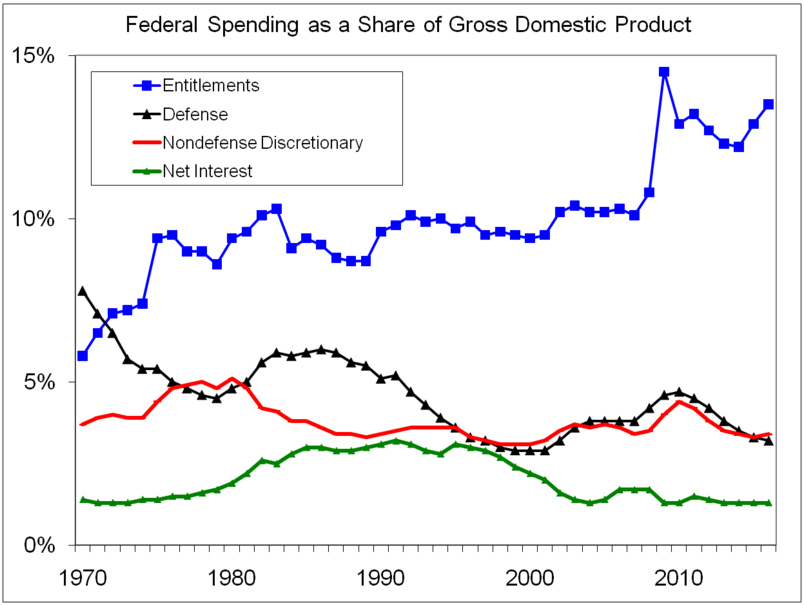
Since 1970, it sure is a good thing that defense spending as a percentage of the GDP has trended down substantially and that non-defense discretionary spending has come down a bit, because entitlement spending has climbed prodigiously.  Entitlement spending has no constitutional basis and no basis in the legitimate function of government as defined in the Declaration of Independence.  It is generally funded by the theft of the fruits of the productive work of Americans so that it can be rerouted to those favored politically by those who lust for the power to distribute the money.  This huge expansion of entitlement spending makes the so-called beneficiaries dependent upon the government, which suits the government just fine.


An appreciation of the degree to which our government has become one dominated by special interests would not be realistic if we did not acknowledge the huge increase in federal subsidy programs shown above.


This final graph is the number of pages in the Federal Register from Wayne Crews' Ten Thousand Commandments 2016 report from the Competitive Enterprise Institute. In the 1940s and the 1950s the total number of pages of final regulations in the Federal Register for the decade were running at about 110,00 pages a decade.  In the decade from 2001 -2010 the number of pages had grown to 730,176.  Presumably, the government considers it our duty to have read all of these regulations so that we might abide by them.  Did you do your government mandated duty?  Remember, ignorance is no defense for violating the law or any regulation.  More and more of the binding regulations or the interpretation of the regulations can only be found in court proceedings or in website announcements of the thousands of government regulatory agencies, which the government itself cannot enumerate. Good luck you lost, ignorant soul if the government decides to come after you.  Do you trust the likes of Obama, Hillary, or The Donald not to do so?

Oh that we might be free!  It would be incredibly wonderful to celebrate the 4th of July as a free man.
It would be a joy to be among free men who had maintained the principles of freedom set forth in the Declaration of Independence and then largely implemented in the Constitution of 1787 and the Bill of Rights in 1791.  To live in a society based on the free trade of values in a rich and robust private sector rather than one dominated by the forceful taking of wealth and service by governments would be to live in a genuinely life-sustaining society.  It is not possible to imagine how much our standard of living would be improved with the flowering of productivity, creativity, justice, and benevolence one would find in such a society.


19 March 2016

Cummins on Ayn Rand's View of Human Nature

Dr. Denise Cummins wrote an article entitled This is what happens when you take Ayn Rand seriously, on which I commented extensively.  She has followed that article up with another in which she takes exception to one of my comments and generally finds fault with Ayn Rand for not embracing altruism.  Her second article is entitled What Ayn Rand got wrong about human nature.  She starts her article by saying that the complaints of Rand's followers "primarily objected to my assertion that Rand celebrated unbridled self-interest."

Her first quote and the only quote of such a "follower" was taken from one of my comments.  This is that quote:
Rand’s good people do care about others. They do not care to be forced to give away the fruits of their invested time to others, but they are delighted to trade what they produce to others and delighted to see those trades improve the lives of others.
To which her only direct comment is "Such objections are without merit." Oddly enough, she then quoted Ayn Rand
Man gains enormous values from dealing with other men; living in a human society is his proper way of life — but only on certain conditions. Man is not a lone wolf and he is not a social animal. He is a contractual animal. He has to plan his life long-range, make his own choices, and deal with other men by voluntary agreement (and he has to be able to rely on their observance of the agreements they entered). The choice is not self-sacrifice or domination.
showing that she also believed in goodwill towards others provided our associations and trades are of a voluntary nature.  She introduces this quote of Rand's by saying that she acknowledged that human beings are social animals who should "look beyond their own immediate self-interest in order to function."  Looking beyond "immediate self-interest" is consistent with Rand's general philosophy and with my comment that Cummins claimed had no merit.  Note the sleight of hand by Cummins in claiming that Rand believed in "unbridled self-interest" in the first paragraph of her article even as she now acknowledges that Rand looks beyond "immediate self-interest."  Actually, Rand and I believe that rational man pursues his rational self-interest, not an "unbridled self-interest."  An unbridled self-interest is an emotion-driven and short-range viewpoint of others and one's relations with them which is not bridled by rational assessment and long-range planning of one's life.

Cummins then claims:
Despite embracing sociality, Rand saw more evil than good in this kind of interdependence between people. As she wrote in “The Fountainhead,” “The choice is independence or dependence. All that which proceeds from man’s independent ego is good. All that which proceeds from man’s dependence upon men is evil.”
Note that in the quote she gives here, Rand is discussing man's independent ego.  She is not discussing an independence from the trade of values with others.  Rand is saying that one's ego should not be dependent upon what others think of you or that you should not let others tell you what to think or whether you have self-value.  The contradiction Cummins claims is not supported by this quote.

Cummins then claims that Ayn Rand somewhat embraces altruism:
Perhaps the key to understanding this contradiction lies in a journal entry in which she writes, “Selfishness does not mean only to do things for one’s self. One may do things, affecting others, for his own pleasure and benefit. This is not immoral, but the highest of morality.”
Seen in this light, altruistic acts are sanctioned insofar as they bring pleasure or other benefit to the giver, who has no moral obligation to offer help to those who are suffering.
 Ayn Rand defines altruism as the act of sacrificing one's own self-interest for the sake of the interest of others.  Cummins appears to believe that any act done for the sake of others is an act of altruism.  There are certainly many situations in which a rational man will act to enhance the interest of others without sacrificing his own interest and indeed by enhancing his own self-interest as well.  Cummins wants to provide legitimacy for altruism by claiming it subsumes both the sacrificial and the self-interested acts that help others.  For strong moral reasons, Ayn Rand wants to separate these very different actions with respect to relations and associations with others.  Cummins wants to muddle them together.

Cummins next takes exception to Rand's claims that socialism does not work.  Cummins says that socialism can lead to abuse and poverty, but it can also lead to wealth, health, and happiness superior to capitalism.  So, she proves this by stating that a certain Prosperity Index lists the United States as the 11th most "prosperous" nation after a number of nations she calls socialist nations.  The criteria for this ranking are not given by her link and that link does not link to the criteria either.  But in any case, one critical assumption in her "proof" is that the USA is an example of an unadulterated capitalist country.  In fact the Cato Institute 2015 Economic Freedom of the World report ranked the USA as only the 16th country in economic freedoms.  The Heritage Foundation Economic Freedom Index of 2016 lists the USA as #11 in economic freedom.  So, it should not be a surprising result of an index of prosperity to rank the USA #11.  According to the Cato Economic Freedom of the World report, New Zealand, Switzerland, Ireland and Canada are economically more free than the USA.  According to the Heritage Foundation Economic Freedom Index, New Zealand, Switzerland, Australia, Canada, and Ireland all have more economic freedom than does the USA.  Apparently, Cummins is unaware of the many socialist programs and economic controls that American governments have saddled our business sector with.

Oddly, Cummins claims that
while a given individual can benefit from cooperating, he or she can usually do better by reneging.  The end result is that altruists go extinct.  But Trivers showed that altruists can survive if one simple condition is satisfied: Those who fail to reciprocate must be punished through exclusion from subsequent cooperative ventures.
Once again, Cummins is implicitly claiming that one who cooperates and does their part is an altruist, while the rational self-interested person will renege.  But, she says the altruist can do well in cooperative transactions if the reneger is not allowed to enter into future cooperative ventures.  So, the long-range rational self-interest of a person is not to renege, which takes us right back to Ayn Rand's self-interest -- one of rational thought and long-range planning!  Cummins then tries to make a strong contrast between future exclusion and the enforcement of contracts.  The enforcement of contracts as advocated by Ayn Rand does help to prevent harm to the partner in a cooperative endeavor who will live up to the spirit of the endeavor.  The one who does not is subject to legal action to recover damages and also to future exclusion from cooperative endeavors.

Cummins claims that Rand's idea of enforceable contracts says Rand expects "government to play a role in maintaining fairness in market transactions."  She may be trying to claim this opens the door to a version of fairness as Cummins would see fairness, not as Rand would see it.  If this is not the case, I do not see why she has brought this up.

Not surprisingly, Cummins claims that laissez-faire capitalism failed in the 2008 financial crisis.  She fails entirely to recognize the many ways in which that crisis was caused by government policies and the many ways that government policies iced a recovery.

Cummins wraps her article up with the Elizabeth Warren quote that every individual has a collectivist debt, which may be extracted by force, because we gain from living in a society in which we exchange values, sometimes voluntarily, sometimes at the point of a gun.  Well, of course, we gain from living in a society in which we are allowed to choose our own values and act, often in cooperation with others, in the pursuit of our values.  That is central to Rand's philosophy.

Warren claims that we gain even from those goods or services delivered by the force of government that provide us some benefit, even if that benefit cost us far more in expense than is the value of the benefit.  We owe the collective for allowing us to use the roads, no matter how badly government builds and maintains roads.  We owe the collective for long-term unemployment insurance, no matter how irresponsible the beneficiary is for not getting another job or creating his own job.  This is Warren's inversion of cause and effect and hers a great way to reduce productive and creative work.  It is also most strange that she is only interested in laying forceful claim to the products of creative and productive work.  There is no compensation to the creative and productive person in the hours others have invested into their entertainments and pleasures of a non-creative and non-productive manner.  Warren is simply a bank-robber, who claims it is moral to be a thief.

Of course we gain by living in a society in which the knowledge gained by others and the produce of others can be freely traded and made available to us.  Most people who act in the private sector do leave a legacy of values behind them which make it easier for others to survive and flourish in the future.  This is a major benefit of a free society.  It is not a benefit if these benefits of a free society are undermined by the claim that the legacy of prior productive people allows a moral right to take by force whatever one wants in the future from that legacy beneficiary.  This claim does nothing but infest with rot the process of productive and creative thinking and the actions needed to turn those thoughts into actual goods and services.  We rightly admire those who have led productive and creative lives, but this does not make us slaves either to them or to others in society who may not be very productive and creative.  To claim that the legacy of other productive and creative people should be a justification for the use of force to steal the fruits of the time and effort that others invest in their productive and creative work is a sacrilege against that legacy and the good people who left it.

02 September 2014

Atlas Shrugged Day Commemorates Human Creativity and Productivity

This is an update of a 2 Sep 2010 post:

On September 2, 1946, Ayn Rand began writing Atlas Shrugged and she finished her great novel in time for publication in 1957.  Throughout the novel, September 2 is the date of a number of events:

  • In the opening scene of the novel, a bum asking Eddie Willers for a handout, asks "Who is John Galt?"  This and the way it was asked bother Eddie.  As he walks through NYC he is also bothered by the gigantic calendar hanging from a public tower and announcing the date as September 2.    
  • On that date, Hank Rearden and Dagny Taggart decide to take a vacation together.  On that vacation they discover an abandoned motor that should have revolutionized the use of energy in the world.
  •  Francisco D'Anconia makes his speech on money on September 2.  He proclaims money to be the tool of free trade and the result of noble effort, not the root of evil.  Those who call money evil choose to replace its use with the force of the gun.
  • D'Anconia Copper is nationalized on 2 September, but the date on the calendar is replaced by "Brother, you asked for it!"
So, on this day of 2 September 2014, let us give thanks to Ayn Rand for her incredibly dedicated effort in writing this path-breaking novel we are finding so important in our lives 57 years after its publication date and 68 years after she started it on 2 September 1946.  This should be a day celebrated much as Thanksgiving Day is celebrated, but without any religious overtones, as a day to respect the creativity and productivity of all the heroic men and women that Ayn Rand's heroic novel commemorates.

At the top of our list of most respected heroes and heroines, we should recognize Ayn Rand herself.  Her great achievement is still a vital inspiration for many an intelligent, hardworking, and creative human being.  Those she has so inspired are among the best among us.


02 March 2014

Either - Or: Big Government or Children

Big Government is often partly justified as necessary to provide services to children, but rarely do people think about the effect that Big Government has on whether people decide to have and raise children at all.  The USDA estimated in 2013 that a child born in 2011 to a US couple with a middle income will cost the parents $241,080 to raise to the age of 18.  This does not even include any costs for a college education or a failure to launch with 36% of 18 -31 year olds living in their parents homes in 2012.  Both of those costs have been increasing rapidly in recent years, while the median inflation-adjusted family income has fallen by $4,000 a year since 2000.

Now, we know that fertility rates are sensitive to a couples' economic security and their available resources.  Fertility rates dropped sharply in the US during the Great Depression.  Fertility rates dropped due to the back to back 1958 and 1960-1961 recessions.  They dropped substantially during the economic malaise of the late Nixon, the Ford, and the Carter years.  The fertility rate has dropped since 2008 as well.  We know that recent efforts of France and Sweden to decrease the cost of raising children have resulted in an increase in the fertility rates.  In December 2011, the Pew Research Center found that 22% of 18 -34 year olds said they were delaying having children for economic reasons.

So what do you think the effect of the great increase in government spending relative to the size of the economy has been on the fertility rate given that the increased spending came at the expense of transferring wealth from the private sector that pays child-raising expenses to the government sector?  The plot of the sum of federal, state, and local government spending from 1950 to 2013 as a percentage of the Gross Domestic Product (GDP) is shown below:


In 1950, the birthrate per 1000 people was 24.1, in 1970 it was 18.4/1000 people, in 1990 it was 16.7/ 1000 people, and in 2009 it was 13.8/1000 Americans.  Total government spending in 1970 was much higher than in 1950, then again increased greatly by 1990 and still more in 2009.  The fertility rate fell substantially with each of those jumps in total government spending.  Now, I am not claiming this is the only effect on fertility rates, but it is a very logical one and the evidence is that it is a substantial effect.

But, the median household income in 2012 according to the Bureau of the Census was $51,371 a year.  At a 38% total tax on this income, the governments are taking $351,378 from this household over the course of 18 years.  To be sure, the family with the median income is paying less in taxes than the average tax rate, but this is probably made up by increased costs they pay for goods and services as tax costs are transferred to them and inflation caused by the government deficits over the years.  Supporting Big Government is the equivalent of raising about 1.5 children for 18 years.  This has to affect the calculation on how many children to have.

Big Government also saps the ability of the private sector to increase worker productivity by reducing private investment in productive equipment, new facilities, and worker training.  It reduces the number of new start-up companies.  The result is an economy which instead of growing in real per capita terms of 4% per year, stagnates to zero growth in real per capita terms as we have seen for the last 5 years.  The governments largely caused the recession and have kept the private sector from growing us out of the recession.  It helps tremendously when a married couple can have confidence that their income will exceed an average per capita increase of 4% compounded over 20 years as they add their own increasing experience and skills by the time the child they might choose to have is in the middle of his college education.  It is much, much easier to undertake having a child with economic growth than if there is no growth due to government-induced stagnation.

In 2012, the average American woman was giving birth to 1.88 children in her lifetime.  This is well below the replacement rate of 2.1 children per woman.  This means that minus immigration into the US, the population would be decreasing over the long run at this birthrate.  That means a lowered number of future productive workers in the US and an increasing number of retired people and people on major entitlements per worker in the US.  This means very wrenching problems of sustainability for the many Big Government entitlement programs.

It also means that many people who otherwise would be enjoying raising children cannot do so because so much of their income is being diverted to Big Government.  That impact on families is not spread evenly across the country.  Couples earning more than $105,360 in the urban northeastern US will spend $446,100 per child.  This is also an area of the country with a particularly high cost of state and local governments.  Imagine the effect on the decision whether to have children or not?  On the other hand, families earning less than $61,590 per year in rural areas will spend less than $143,160 on the first 18 years of raising a child.  These rural areas usually have a lower tax expense.  All of these factors make for interesting calculations on whether to become parents.

Anna and I raised three children and sent one to college for 4.5 years, one to college for 4 years, and one to college for 1.5 years, while living in the Northeast.  It was a hugely expensive proposition which many people will not attempt.

Though many Malthusians are very happy to see low birthrates, the rising population of the world has been consistently combined with an increased standard of living around the world.  The USA is a particularly sparsely settled land, most of which has been reverting to wild lands as our agricultural prowess has increased so that less land was needed for farmland.  The foolish government mandate requiring ethanol additions to gasoline has recently interfered with that trend toward using less and less land for farming.  Of course, the trend of less and less land for food production has continued.  The innovations of the developed countries have also led to fewer and fewer problems with polluted air and water.  What we are losing with low birthrates is many keen, productive minds which would otherwise enrich our lives and advance civilization.

30 November 2013

Did You Know that We Need Big Government to Protect Us from Walmart?

Walmart is the biggest retailer in the world, with $443.85 billion in sales in 2012.  It has 2.2 million employees.  It offers low prices to bring in customers for the goods it efficiently supplies.

The U.S. federal government can only tell us how many employees it had in 2011.  It had 4.403 million employees.  The state governments had 3.779 million full-time employees and 1.534 million part-time employees.  The local governments had 10.786 million full-time employees and 3.202 million part-time employees.  Each of these governments inefficiently supply services for which their customers are forced to pay.  They also produce copious mandates that the People are forced to obey. They command forced labor from employers and businesses for the convenience of government.  Federal, state, and local governments all produce mandates that Walmart must obey.  Federal, state, and local governments spent a mere $6.5 trillion out of the national GDP of $15.0 trillion (43.3%) in 2011. 

Now which of these would a rational person fear, Walmart or Government?  I fear Government, but Progressive Elitists fear Walmart!  Yes, they offer Walmart as a primary reason why we must have Big Government.

Why?  Well the story is that Walmart moves into a town or small city and offers goods at such low prices that they drive all other businesses that used to be in the town out of business.  Walmart pays its employees so poorly that they are in danger of starvation and poverty overtakes the town.  A minimum wage increase mandated by government is required to make Walmart pay a "living wage."  In addition, Walmart is killing American jobs because it brings many of its goods in from other countries.  Walmart is a monster, a very unethical killing machine!  Progressive Elitist after Progressive Elitist will use this story to justify Big Government, including MBAs from the Wharton School of the University of Pennsylvania and the Columbia Business School.

OK, let us ask a few questions about this story. 

When Walmart moves into a town, how does it find the manpower to open its store before it has driven all of the other businesses out of business and taken their employees away?  Does it not have to pay prevailing wages to induce those initial employees to work for them?  It is common for new stores to have tens of applicants for each person they can hire.  Yes, according to studies for every 100 jobs created at the Walmart store, in time about 50 retail jobs in other stores are commonly lost.  Yet this is a sizable net creation of jobs.

It is said that Walmart is evil for putting many other retail businesses out of business.  But all Walmart does is to offer products for sale at good prices.  It is up to the people who used to go to the pre-existing retail stores to actually choose to go to Walmart.  They are the ones who do not go to Joe's Grocery Store and Madeline's Clothing Store.  They have the option to choose to pay higher prices in those stores and support those who have long been in their community.  If anyone made unethical choices, would it not be these customers who had no loyalty for the original shop owners of their towns?

Of course, it is not always the case that these smaller stores were even doing their best to provide the lowest prices they could.  A few of them may have taken advantage of having little competition in the town for the kind of goods they sold.  Some of them morally deserved to go out of business in many cases.  No doubt others did work hard to provide the best service they could, but so surely did many a buggy maker, a stabler, a blacksmith, a wagoner, and a saddler when they were mostly put out of business by the advent of cars and trucks.  Logically, the Progressive Elitist claim would be that all car and truck makers and trucking companies were unethical in putting these older companies out of business.

On Black Friday, there were labor union organized protests at many Walmart stores.  They claimed that 825,000 Walmart employees make less than $25,000 a year.  This may be true, but many of them are likely part-time employees.  The majority of Walmart employees are full-time, which is actually unusual for retail stores.  The average full-time associate earns $12.81/hr. and the average employee (full and part-time) earns $11.83 per hour.  Walmart says that 99% of its employees make more than the minimum wage in their areas, which is highly at variance with the usual story told casually by the usual Progressive Elitist.

Walmart, in a McKinsey & Company study that George Will referred to in 2006, found that Walmart contributed 13% of all of the national productivity increase in the late 1990s, which held down inflation greatly and made Bill Clinton look good as President.  It accounted for $200 billion in savings on the cost of goods each year, which is surely a larger savings now that Walmart is even bigger.  George Will pointed out that the average Walmart shopping household makes less than the national average, so these cost savings go to these poorer households, doing them much more good than food stamps and earned income tax credits did for them then.  But as usual, one can count on the Progressive Elitist, who claims to champion the poor, to actually abhor anything that really helps the poor outside of a government dependency program.  They hate Walmart.

But, Walmart's business model depends upon these less affluent customers and those customers respond in droves by going to Walmart for its convenience and low prices.


24 January 2011

Rational Taxation Policy - The Fundamentals

The rational man obtains the great majority of the goods and services he needs and wants from the private sector where individuals enter into voluntary trades and contracts.  In the private sector each individual chooses his own values and is free to act in accordance with his individual values.  In contrast, in the government sector, the government uses force to supply services and sometimes goods, for which it requires compensation in the form of some combination of taxes, mandated services and expenses, and the acceptance of a devalued currency.  The individual may have some say in what services government will provide and how at the ballot box, but on many an issue he is subject to the will of a majority who will evaluate the given government action differently than he does.  Furthermore, most voters will have but a very limited understanding of the effects of government action, so their decisions are not fully informed and not rational.  Despite this, irrational government policies may be imposed on the individual who disagrees.  Even when most voters agree, we have found that our politicians and still less our bureaucrats will often not listen to the will of the majority.  In other words, government provided services are not responsive to the values and needs of individuals.

Individually, we have little ability to choose the services we will acquire from government, the cost of those services, and the manner in which they will be delivered.  We have also come to understand that government services are provided very inefficiently.  For all of these reasons, it is clear that the People are best served with having the private sector provide them with most of our goods and services.  But, it is also true that some government services are required.  Our Founding Fathers and the Framers of the Constitution acknowledged this in the Constitution which provides for a minimal, but necessary, government with very limited powers.  They were always conscious that government was force and it was to be very carefully controlled.

Let us call the total cost of government, whether actually taxes, or effective taxes such as the devaluation of the currency and regulatory mandates of service and provisions of goods, simply by the name of taxes in the further discussion.  Whether the taxes are levied on income, on the size of trade transactions, profits, or taken as forced labor, they can effectively be said to represent some fraction of the Gross Domestic Product or GDP.  Let us note that the higher taxes are, the more they discourage people from working and the more they discourage reinvestment to increase the productivity of the economy.  But, economic or trade activities do require that violent acts such as thievery, assault, fraud, rape, and property destruction be controlled.  They are also aided essentially by the enforcement of contracts.  A region and the people living there also need to be protected from invasion or assault by other countries, if they are to prosper.  For these minimal desirable services, the government will need to have a baseline level of taxation.  That baseline taxation level I would estimate to be between 0.05 and 0.10 times the GDP.  Government requirements for spending above that level are optional, though I would argue that they are also immoral.  Spending beyond this level is clearly dependent upon one's values and upon one's willingness to use force to obtain what one wants from others.

Whatever size government attains, some of its activities ought to scale with the size of the population and some scale with the size of the GDP.  The cost of protection from personal assault and rape scales with the size of the population.  Some types of robbery and fraud do also.  The enforcement of contracts scales more nearly with the size of the GDP, as do some types of fraud and most aspects of property protection.  I suspect that the components dependent on the size of the population and on the size of the GDP would be similar for a constitutional government.  But, in any case, the effective tax rate can be expressed as a fraction of the GDP and we will call that rate t.

Over time, the GDP of a country will change.  We have a long tradition in the United States of watching it grow in many more years than not.  The GDP grows because our population is growing, though in the last decade, our population growth has been just under 1% per year.  This growth assumes that the People do not feel a reason to change their inclination to work during the period in question.  But clearly one factor affecting GDP is the size of the population.  Another is increases in productivity due to machinery, equipment, management improvements, and worker training.

Let us make a simple model of the effect of taxation on the growth of the GDP.  To be more accurate, on that part of the GDP that will be taxable, since at high tax rates, much of the GDP goes underground.  In this model, p will be a constant annual growth rate for the population.  The baseline GDP will be GDPb.  After n years from the time of the baseline GDP, the growth in population would cause the GDP growth by year n to be (n)(p)(GDPb) assuming that tax rates had no effect upon how hard people worked or how much income they reported.  A simple way to incorporate the effect of how people will react to the tax rate is to add the factor 1-t to the growth of GDP due to the growth in the population.  When the tax rate is 1, no one will work, at least they will not report that produce which they must produce to eke out the barest sustenance.  This says that people will work in proportion to how much of what they produce they get to keep.  The strict proportionality may not be completely accurate, but I suspect it is not far afield from reality.  This component of GDP growth is then (n)(p)(1-t)(GDPb) for GDPn of the nth year.

Increases in productivity also play a role in growing GDP.  If productivity is improving at a fractional rate of e per year in the economy with a very minimal government providing adequate freedom from violence and enforcement of contract that e is at its maximum value, then the GDP in the nth year after the baseline GDP would be about (1+e(1-t))^n (GDPb), since the amount of money available for investment in increasing productivity is proportional to what people have left after taxes.  This formula is akin to the principal owed on a loan at an interest rate i where e(1-t) takes the place of i.  The nth power is due to the compounding nature of the interest, or in this case to the compounding nature of productivity improvements.  To this point we have neglected the fact that no one will make such investments if the tax rate is 1.  So we will add a factor of (1-t) here also.  The net equation for the GDPn in the nth year after the baseline GDPb with a minimal government is then about:

GDPn = [(p)(n) + (1 + e(1-t)^n](1-t) (GDPb)

Admittedly, this is a simple model and it is not going to be a highly accurate replica of a real economy.  But, it will be very hard to have any understanding of a real economy if one does not develop a feel for the growth rates of a GDP predicted with some reasonable disincentive effect attributed to taxes.  Let us learn such lessons as we can from this model.

Let us use the following values to evaluate a family of GDP curves over a period of 30 years.  The tax rate t will be the variable for each curve.  p will be taken as 0.01, which is very close to the U.S. population growth rate over the last 10 years.  e will be taken as 0.08 or an 8% productivity growth rate per year with ideally minimal government.  The graph below then shows us GDPn/GDPb, the ratio of the GDP in year n to the baseline GDP, or the GDP growth factor.


Now I am not sure that the 0.05 tax rate is adequate to meet the assumption that an e of 0.08 is possible, since the government might be too weak to prevent violence and enforce contracts.  I am sure that a tax rate of 0.10 is high enough to meet that assumption, though.  The tax rate of 0.05 is the only rate shown which allows the first year with the tax imposed to actually have growth in the GDP.  The 0.10 tax rate causes the economy to shrink in the first year by 2.62%, but it has grown by 5.2% in the second year.  At a tax rate of 0.05, the GDP in 30 years is 8.84 times as large as in the base year.  At a 0.10 rate, the GDP in year 30 is 7.52 times as large.  Unfortunately, we presently have an effective tax rate of more than 0.45 and maybe 0.5 in the United States, counting taxes, devaluing of the currency, and regulatory mandates.  That GDP in 30 years at t = 0.45 is only 2.17 times the baseline GDP and at t = 0.50 it is only 1.77 times the baseline GDP.  Many socialists want the tax rates to be much higher.  Note that if the tax rate is increased to 0.60, the GDP in year 30 is only 1.15 times its original size.  This is only half the growth rate of the population alone in 30 years, which means the per capita GDP is shrinking.  Only in year 26 does the GDP at this rate become greater than that in the baseline GDP.  At t = 0.45, the economy immediately shrinks to 0.58 times the baseline GDP and it does not exceed that until year 13.

This model says there is every reason to believe that high tax rates stunt an economy.  We do not see the sudden onset of GDP reduction on the scale shown here since our taxes have long been high and they have been increased gradually.  But when we increase taxes from a fractional rate of t = 0.4 to t=0.45, there is some immediate reduction in size of the GDP or its growth rate.  Commonly, that reduction is partially hidden by a devaluation of our currency.  Note also that each reduction in tax rate by 0.05 causes an increase in the 30 year GDP which is larger than the last such reduction in tax rate caused.  The actual amount of the effect on the GDP is surely not what is produced by this model, but the fact that high tax rates greatly suppress the GDP over time is the important lesson.

When the Congressional Budget Office is asked what the effect of doubling the tax rate is, they always respond that the tax revenues will double.  When asked what the 10 year effect on taxes is, they say that the taxes collected over ten years will double.  A realistic model will agree with this one in one very important respect.  It will say that a tax increase from current levels will result in much less revenue than that proportional to the tax increase.  The GDP ten years down the road will be much smaller with a doubling of the tax rate.  This has been observed time after time.  When Coolidge decreased the tax rate in the 1920s, government revenues actually increased and the GDP grew greatly.  When Kennedy did the same in the 1960s, the same result re-occurred.  The same was true for the Reagan tax cuts and for the Bush II tax cuts. 

Let us look at the results here to compare the effects of a 0.20 and a 0.40 rate on taxes in 30 years.  At 30 years with t = 0.20, the tax revenue is (0.20)(5.38) = 1.076 GDPb, while at t = 0.40, the tax revenue is (0.40)(2.63) = 1.052 GDPb, so the tax take is actually less at the higher tax rate.  What is more important, in the lower tax case, the people are keeping 4.308 GDPb, while with the higher tax rate they keep only 1.577 times GDPb!  It has to be perfectly clear that the People are much, much better off with a tax rate of 0.20 compared to one at 0.40.  The tax revenue increase in this model is understated because it does not address the frequency of taxable transactions.  Lower taxes take less per transaction, but if the number of transactions increases because the tax take is modest or minimal, the total tax revenue sum over a longer time may bring in much more money to the government.  The record shows that this is exactly what happens.  People also have less incentive to put their money into tax-free municipal bonds where returns are modest, but there are no tax requirements.

Despite this clearly deleterious effect of high taxes, the Democrats and the Socialists are constantly trying to tell us that high tax rates are an investment in our economy.  Nothing could be more ridiculous and foolish.

05 March 2010

Democrats Eat the Young: Minimum Wage Case in Point

One of the popular political idiocies of our day is the idea that minimum wage laws accomplish something good.  Apparently, many people think that if the minimum wage is raised, then workers with minimal skills or unproven skills will simply be paid more money.  The idea is that employers, who are imagined to have more money than the low skilled workers they might hire, will be happy to transfer some of their wealth to such a low skilled worker because of a government mandate on minimal pay.  Actually, it is apparent if you put yourself in the shoes of the struggling small business owner who hires most people that this will mean that riskier bets that someone is productive enough to justify the higher wage will never be given a job offer.  It is also apparent that if someone is given a chance, they will be fired very quickly if they prove unable to quickly become sufficiently productive. 

The sad thing is that most people making minimum wages are essentially in training so that they can become more productive and justify being paid a higher wage.  When the minimum wage is increased by law, fewer workers are accepted for training.  This is not rocket science.  This is really easy to figure out.  You pretty much have to be a Democrat and a Progressive to be so dense that you cannot figure this out.  Hmm... or is it that even they can figure it out, but they shut their eyes to the evil they do because they are so beholden to the labor union leaders?

The primary unskilled or risky group seeking jobs is teenagers.  So it is reasonable to expect that there will be a strong relationship between teenage unemployment and the minimum wage.  There is:
This plot comes from an article in the Wall Street Journal of 5 March 2010.  The blog CARPE DIEM presents the WSJ comments and discusses the issue further in an intelligent evaluation.

One of the interesting things this plots shows is that while the while each increase in the minimum wage results in an increase in teenage unemployment, that increase does not always shoot up instantaneously with the increase.  The rate of rise in the teenage unemployment rate does go up faster as the wage increase becomes greater relative to the average teenager's productivity.  The first wage increase was followed a bit slowly by the teenage unemployment rate.  Why would this be?  I expect it is because the teenagers already being paid the prior minimum wage amount in your employ have already acquired much of the skill or proven themselves sufficiently that they have already acquired most or all of the skills needed to be productive enough at the new wage level.  Rather than let them go, you will simply be more reluctant to hire the next trainee.  This means that the unemployment rate does not necessarily shoot up immediately.  But, our most recent minimum wage increase to $7.25 per hour does appear to have an immediate response in teenage unemployment.  This many be due the fact that very few teenage workers are productive enough to justify the $7.25/hour wage.  More actual firings took place at this compensation level.  This third increase in only a few years was to a level far too high for many teenage working neophytes to match with their productivity.

09 July 2008

Federal Government Civilian Worker Salaries

According to Will Wilkenson, Cato Institute Research Fellow, the average federal civilian worker in 2005 was compensated at over $106,000. This is double the average compensation of private workers and falls in the top 5% of personal incomes. In 2005, the average wages for a federal employee rose 5.8%. In the private sector, the income increase was only 3.3%.

Isn't it rather miraculous that private sector workers are so productive that the U.S. is the world leader in productivity, despite every effort these well-paid federal employees make to create roadblocks for their creative energies? We should assume that the government pays such high salaries because it wishes to lure the very best roadblockers into its employ.

20 March 2005

Rational Men Must be Tolerant of Others

There are at least three major reasons why a rational man must practice tolerance with other human beings. These are:

  • Tolerance makes it possible to learn from the efforts of other people. Without tolerance, others are not encouraged to put as much effort into thinking, since the fruit of their labor is too often viewed as evil. It becomes less risky not to think about anything prohibited and if they have thought about it, they had best not share the thought. Without tolerance one lives in the Dark Ages in Europe or the Middle East of the present. Tolerance is essential if we do not all wish to enter the world and spend our lives reinventing the wheel. Tolerance is also the great tool that makes it possible for us to challenge our own ideas with those of others. This makes it easier for us to identify our own errors of thought and correct them. Tolerance makes it possible for a group of thinkers to tackle a tough problem and take advantage of each person's different experience, interests, and thinking abilities to understand the whole of it, when each individual could only contribute a part of that understanding. I will call this epistemological tolerance.

  • Individuals are very complex and highly differentiated. We are different biochemically and structurally. We have different experiences. We think in different ways and have a history of myriad unique choices behind us. We have different values. These differences add immensely to the richness of our experience with other people. Similarly, they make each of us a unique experience to others. Some of the value represented by each individual is precisely found in the uniqueness of each of us. As gold is more valuable than iron because it is more rare, each individual has more value because each is unique. But, of course, not all of our differences from one another are valued by others. Some of those differences may be viewed with mistrust, some with disdain, and some with repulsion. When a rational man practices tolerance with respect to the properties and values of others, he does not sign on to vouch for the value of each property or the morality of all of their choices. This form of tolerance recognizes the fact of reality that people are individuals. It recognizes that there is commonly much that is sufficiently good in the differences we find in others that we will generally profit in our interactions with them. I will call this the tolerance of individuality.

  • Throughout the history of man, the political entities that have controlled men around the world have established various balancings of dogma versus individual initiatives in thought. They have also frequently sought to direct what values a man may seek and achieve. They have often favored men of one race, ethnic group, religion, cast, tribe, clan, or profession over others. In Europe, the Hundred Year's War, largely between Catholics and Protestants, caused untold misery until finally Europe realized a more live and let live philosophy held benefits for civilization. In a capitalist republic, the government does not favor one person over another for these reasons. In fact, a capitalist republic finds value in the differences among its people, since the many differences in interests and abilities allow the society the advantages of many specializations and open the door to a wealth of trading among its citizens. It is also recognized that when one group suppresses another group or any individual, the fighting and the discord are distractions at best and very often fatal to the continuance of either the government or the entire society. This form of tolerance is political tolerance.


Each of these forms of tolerance are related to one another. They are each important to us as thinking individuals. Since Objectivists are thinking individuals, they should be foremost among those proclaiming toleration as a great benefit to each of us and to the societies in which we live. Objectivists are also a minority, who are not infrequently viewed as heretics. They are dependent upon others exercising the virtue of tolerance toward them. Taken together, the forms of tolerance allow us to develop and function fully as individuals. They allow us to trade ideas and values that raise the level of our civilization to much greater heights than is possible for a society or group of intolerant individuals.

Dogma and rigid social custom are the enemies of tolerance. Rational thought directed at understanding reality and the celebration of the productive individual are the product of toleration. Toleration allows us to experiment with ideas and test them out. It offers us a rich complexity of theories and choices, while aiding us in our efforts to evaluate those theories and choices. It allows each man to draw on the individual insights of others. It is a major virtue whenever two or more individuals live and work together.

There are dogmatic Objectivists (a contradiction in terms actually) who need very badly to understand these aspects of reality. Because reason is the individual's means of surviving and promoting his life, that which promotes reason is virtuous. Rationality is the most fundamental virtue. Tolerance is a major virtue because it recognizes that every other individual has the right of their own attempt to use reason, just as I have that right. Tolerance recognizes that it is the individual mind that must of its own volition choose to focus upon the creation of concepts and the use of principles to understand reality in all of its complexity. It is to be expected that individuals, even when highly committed to rational thought, will independently arrive at somewhat differing understandings of our complex existence. Tolerance recognizes individuality and allows us to take advantage of it to gain much greater insight of reality by evaluating the ideas generated by other creative and rational minds. What we gain in value makes us much more productive and much less primitive. We gain the advantage of living in a great civilization, provided we can also provide our society with a healthy respect for the rights of the individual. The concept of these rights and their exercise again requires us individually to be committed to tolerance.

Among Objectivists, David Kelley has been the most effective spokesman for the importance of toleration. He has been especially concerned with toleration as a means to increase our knowledge. He has also recognized the virtue of independence in each individual. I highly recommend his book The Contested Legacy of Ayn Rand: Truth and Toleration in Objectivism to anyone interested in how people can work together to greatly improve their understanding of any subject they may have a common interest in. While he especially addresses issues of Objectivism, there is a great deal to think about and use from this book even for a small group of collaborators in a laboratory or in a factory. It is really about being more productive in thought and action than it is possible for a single individual to be acting alone. As I read this book, I kept thinking that it was a marvelously organized and thought out explanation of many principles that I had found essential to the maximization of productive output in the many groups of scientific and engineering collaborators that I had had through the years.

In those groups, I had long worked hard to set such an atmosphere of tolerance in place. As this atmosphere grew, each such group became more productive. I tried to cultivate an atmosphere in which we maintained high standards for our output, but recognized that errors would be made as we sought solutions to the technical problems on which we worked, especially when we tried our hardest to be creative. Working together, we could makes leaps forward by taking advantage of our differing talents and help to correct each other's errors in a constructive way. In fact, we often learned from our errors. When we became comfortable that making an error was not likely to be viewed as evil or a sign of incompetence, ideas poured forth and our rate of solving difficult technical problems increased. It is surprising how often an idea with an error either contains a partial advance or somehow suggests the correct answer. Sometimes the wrong idea led to a test or experiment which proved it a dead end. Yet, that test provided us a clue to the right path to the answer to our problem. The idea that an error is evil is very wrongheaded. In fact, in certain contexts, making an error may actually be considered good. One does not make errors when not thinking. An error is made when one is thinking. Provided that one goes on to thoroughly evaluate the idea and test its validity rationally, the error is not evil and it may be the spur to the final correct identification of reality. In that context, it may be argued that the error served a good function. In that context, we can and should be less afraid of errors. They beat the alternative of stultification hands down.