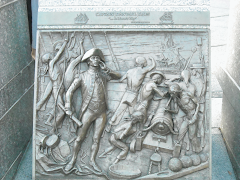
On 19 April 1775, the British army entered Lexington, Massachusetts on its way to Concord, Massachusetts to take weapons and rounds from the militia which Great Britain had come to fear. The Americans were determined to prevent the loss of their ability to defend themselves. The result that day was the battles of Lexington, Concord, and the severe punishment of the British troops as they retreated back to Boston.
Most of the people of Massachusetts outside of Boston were previously in a state of rebellion in that the Americans were no longer obeying many of the commands of the government of Great Britain. The people had had enough of a legislature passing laws that did not have their interests in mind and that did not act to protect the exercise of their individual rights. The British Parliament had too often restricted the means of Americans in earning their living in favor of businesses in Great Britain. Great Britain was too ready to tax Americans, often claiming that Americans needed to pay more for British armed forces protections, which the Americans actually found highly wanting. Great Britain was also acting to prevent Americans from owning huge areas of the continent.
Today, the federal government of the United States of America fails to protect the individual rights of Americans also. Our Congress daily shows its contempt for the interests of most of the American people. Our government too often tramples upon our efforts to exercise our individual rights. The federal government restricts our ability to earn a living in many ways, with a great deal of help in doing this from state and local governments. The governments too often grant privileges at the expense of the People to special interests such as labor unions, green energy companies, large financial institutions, excessively complex laws necessitating the hiring of highly paid lawyers and accountants, favoritism of educators, the fostering of hordes of bureaucrats who eat out the substance of the land, and huge grants to dishonest environmentalists and global warming alarmist scientists. The federal government holds ownership of a huge fraction of the land area of the USA, preventing private ownership and its use in productive enterprises. And the Democrat Socialist Party is an enthusiastic advocate of draconian gun controls and the confiscation of any significant weapon capability on the part of the People.
Few Americans today would stand up to their government if it were to come to Lexington and Concord or anywhere else in the USA and demand that they give up their weapons. It is an amazing thing that 244 years ago, Americans had the strength of their convictions to stand up to the mighty army and navy of Great Britain and buy us a couple of hundred years of comparative freedom. It is important to remember those brave and hardy freedom-loving men on this important anniversary.
Showing posts with label Federal land. Show all posts
Showing posts with label Federal land. Show all posts
19 April 2019


The US-Mexico-Canada Trade Agreement and Compounded Growth
The Associated Press has distributed an article claiming that the International Trade Commission, an independent federal agency, says that Trump's new USMCA trade agreement will only yield an increase to the GDP of 0.35%. To claim that this is a negligible effect is to be ignorant of compounded growth and the many other possibilities that government has for avoiding putting burdens on the private sector that impede economic growth.
If the US private sector economy grows by 2.9% a year or it grows by 3.25% instead, this can make a bigger difference than most people think it will. The average American is going to live another 40 years, so let us project the effects of this difference in annual growth rate over a 40 year period. An economy growing at a rate of 2.9% rate will be 3.138 times larger in 40 years than it was at the start. An economy growing at a rate of 3.25% a year, or a 0.35% higher rate, will be 3.594 times larger. This projected higher growth rate economy is 14.5% larger than the projected slower growth rate economy is. That is a substantial difference.
Now some readers are going to say that the USMCA trade agreement will not increase the economy's growth rate by 0.35% every year over 40 years. That is probably correct. A really good agreement might be able to do that, but the Trump agreement probably will not do that. However, there are a plethora of ways that the federal government can take actions year after year that will allow the economy to grow by an additional 0.35% that year than it would otherwise. The government can roll back expensive regulations with little rational reason to exist. It can desist from instituting new regulations that cost more than they are rationally worth. A decrease in the number of expensive and irrational regulations would give American companies much assurance that investing money in increased production in the USA will be profitable. It is immensely damaging when a President declares that he intends to wipe out an industry he does not like and in so doing hurt supporting companies and the jobs of tens of thousands of Americans, as Obama did to the coal industry and his party threatens to do to the oil and gas industries. It could stop over-withholding income taxes so that money could be circulating in the private sector economy at a higher velocity. It can and should reduce taxes. It should release many government employees so they can do productive work in the private sector. It should release millions of acres of land it holds so that land can be put to much more productive use in the private sector. It could take steps to greatly reduce absurd burdens due to excessive legal actions against companies simply because they may have deep pockets.
There are so many ways the federal government and state and local governments could act to see that future private sector growth rates are 0.35% larger year after year. In fact, when Obama was suppressing the growth rates to levels of about 2%, the 40 year result compared to a 3.25% growth rate result is even more dramatic. After 40 years at a growth rate of 2%, the economy is 2.208 times larger, while at a rate of 3.25% growth it is 3.594 times larger. The higher growth rate economy at 40 years is 1.628 times larger than the Obama normal growth rate economy. Imagine how much of an impact that added growth then has on the every day lives of Americans. That larger society will provide much better medical care, produce much more advanced technology, have a much greater understanding of reality, provide individuals with many more options in life, and will surely allow a massive increase in charitable giving.
It is very foolish to minimize even seemingly small improvements in the economic growth rate. The growth of the private sector is the basis for improvements in the richness and security of our lives. We have the option of allowing the economy to grow at compounded higher growth rates that will make huge differences in the quality of our lives in our lifetimes and in those of our children.
If the US private sector economy grows by 2.9% a year or it grows by 3.25% instead, this can make a bigger difference than most people think it will. The average American is going to live another 40 years, so let us project the effects of this difference in annual growth rate over a 40 year period. An economy growing at a rate of 2.9% rate will be 3.138 times larger in 40 years than it was at the start. An economy growing at a rate of 3.25% a year, or a 0.35% higher rate, will be 3.594 times larger. This projected higher growth rate economy is 14.5% larger than the projected slower growth rate economy is. That is a substantial difference.
Now some readers are going to say that the USMCA trade agreement will not increase the economy's growth rate by 0.35% every year over 40 years. That is probably correct. A really good agreement might be able to do that, but the Trump agreement probably will not do that. However, there are a plethora of ways that the federal government can take actions year after year that will allow the economy to grow by an additional 0.35% that year than it would otherwise. The government can roll back expensive regulations with little rational reason to exist. It can desist from instituting new regulations that cost more than they are rationally worth. A decrease in the number of expensive and irrational regulations would give American companies much assurance that investing money in increased production in the USA will be profitable. It is immensely damaging when a President declares that he intends to wipe out an industry he does not like and in so doing hurt supporting companies and the jobs of tens of thousands of Americans, as Obama did to the coal industry and his party threatens to do to the oil and gas industries. It could stop over-withholding income taxes so that money could be circulating in the private sector economy at a higher velocity. It can and should reduce taxes. It should release many government employees so they can do productive work in the private sector. It should release millions of acres of land it holds so that land can be put to much more productive use in the private sector. It could take steps to greatly reduce absurd burdens due to excessive legal actions against companies simply because they may have deep pockets.
There are so many ways the federal government and state and local governments could act to see that future private sector growth rates are 0.35% larger year after year. In fact, when Obama was suppressing the growth rates to levels of about 2%, the 40 year result compared to a 3.25% growth rate result is even more dramatic. After 40 years at a growth rate of 2%, the economy is 2.208 times larger, while at a rate of 3.25% growth it is 3.594 times larger. The higher growth rate economy at 40 years is 1.628 times larger than the Obama normal growth rate economy. Imagine how much of an impact that added growth then has on the every day lives of Americans. That larger society will provide much better medical care, produce much more advanced technology, have a much greater understanding of reality, provide individuals with many more options in life, and will surely allow a massive increase in charitable giving.
It is very foolish to minimize even seemingly small improvements in the economic growth rate. The growth of the private sector is the basis for improvements in the richness and security of our lives. We have the option of allowing the economy to grow at compounded higher growth rates that will make huge differences in the quality of our lives in our lifetimes and in those of our children.
09 November 2016
Space and Good Fences Make Good Neighbors -- Good Neighbors Make Limited Government
Once again the overcrowded cities have voted for the more authoritarian Presidential candidate, while the people of "flyover country" and the "Racist South," from the viewpoint of presumptuous Progressive Elitists, have chosen a less authoritarian candidate. This again proves that space and good fences make good neighbors, while overcrowded conditions lead to bossy people who want ever so badly to push their values on other people and to micromanage their lives. Somehow, these "educated" Progressive Elitists always manage to presume that they can manage the lives of people they do not know better than said people can do this themselves. They pretend politically that they respect these people whose lives need to be micromanaged by them, but in their private discussions among one another, they actually despise the people they believe to be incapable of choosing their own values properly and managing their own lives.
In the 2016 election, it is clear that not only did a majority of Americans in Flyover Country and in the South reject the rule of the Progressive Elitists, but so too did a majority in the Rust Belt. The Obama years of manufacturing industry suppression and of fossil fuel energy suppression took a big toll on the Rust Belt and led to an upheaval with catastrophic and surprising results for the Democrat Socialist Party. The low percentage of Americans with jobs worth having and the long stagnant wages had finally become too much for many Americans. The ever-increasing expense and inconveniences of ObamaCare played a significant role also in the rebellion. Seeing more businesses go out of business than were created for many years under Obama had its consequences. The loss of jobs due to the vendetta against coal and the threat of a loss of jobs due to the Democrat desire to suppress fracking not only hurt the immediate industries, but hurt those who transported or used the coal, oil, gas, and the products made from them. It would hurt those in the plastics industry, for instance. Meanwhile, many a business and resident either had energy bills higher than necessary already or was facing sharp future increases. Many were sick of the constant stream of Democrat lies and misrepresentations. Many white Americans, especially men, were sick of being discriminated against in hiring and in contracting work. A rebellious upheaval was long overdue.
Donald Trump was the beneficiary of all this and the fact that Hillary Clinton was a very unappealing opponent. Not that Trump himself was an appealing Presidential candidate. He leaves much to be desired as well. But as I have noted, he does have some good policy positions, which if he carries through with them with a Republican House and Senate, might make him a much less undesirable President than Hillary would have been. Trump will now be put to the test.
The actions he badly needs to take are these:
In the 2016 election, it is clear that not only did a majority of Americans in Flyover Country and in the South reject the rule of the Progressive Elitists, but so too did a majority in the Rust Belt. The Obama years of manufacturing industry suppression and of fossil fuel energy suppression took a big toll on the Rust Belt and led to an upheaval with catastrophic and surprising results for the Democrat Socialist Party. The low percentage of Americans with jobs worth having and the long stagnant wages had finally become too much for many Americans. The ever-increasing expense and inconveniences of ObamaCare played a significant role also in the rebellion. Seeing more businesses go out of business than were created for many years under Obama had its consequences. The loss of jobs due to the vendetta against coal and the threat of a loss of jobs due to the Democrat desire to suppress fracking not only hurt the immediate industries, but hurt those who transported or used the coal, oil, gas, and the products made from them. It would hurt those in the plastics industry, for instance. Meanwhile, many a business and resident either had energy bills higher than necessary already or was facing sharp future increases. Many were sick of the constant stream of Democrat lies and misrepresentations. Many white Americans, especially men, were sick of being discriminated against in hiring and in contracting work. A rebellious upheaval was long overdue.
Donald Trump was the beneficiary of all this and the fact that Hillary Clinton was a very unappealing opponent. Not that Trump himself was an appealing Presidential candidate. He leaves much to be desired as well. But as I have noted, he does have some good policy positions, which if he carries through with them with a Republican House and Senate, might make him a much less undesirable President than Hillary would have been. Trump will now be put to the test.
The actions he badly needs to take are these:
- Repeal ObamaCare as pledged.
- Reduce Corporate and Personal Income taxes, as pledged, so American businesses can compete better in the global markets from American plants and facilities and so multinational companies can afford to return $2 trillion of earnings abroad to the states to make a huge investment in America.
- Protect the Right to Work Laws so Americans are not forced to join labor unions they do not want to join. Also deny unions card check and rapid representation elections.
- Nominate a judge for the open Supreme Court position who has a proper understanding of the broad and many individual rights every one of us has.
- End the federal government role in promoting the false catastrophic man-made global warming hypothesis. Fire the many employees of the EPA, NASA, NOAA, and the National Science Foundation who have insidiously supported this false science and wasted huge sums of taxpayer money on it, while forcing up energy costs in the entire nation in its name.
- Follow through on his pledge to have a government employee hiring freeze.
- Hire good managers for the Veterans Administration and its hospitals, while allowing many more options for veterans to use private sector medical care.
- Stop the practice of government favoring some groups based on their ethnicity or sex. Everyone has equal individual rights and it is the function of legitimate government to protect everyone's equal rights.
- The purpose of a smaller Department of Education should be to end the government monopoly on K-12 education by advancing the widespread use of vouchers to allow all students school choice. Trump is on-board to start this process, but should expand its scope.
- Reopen federal lands and offshore areas for the development of fossil fuel mines and drilling.
- Sell off much of the federal land so it can become more productive, provide more jobs, and generate more local and state tax revenue.
- Reduce the number of regulations and their expense, as he has pledged to do.
- Simplify the tax code as pledged.
- End the death tax as pledged.
- End the IRS practice of discriminating against non-profit organizations who support individual rights and limited or constitutional government.
- Limit federal grants to colleges to work with defense potential. This will largely end taxpayer funding to faculty devoted to expanding the role and size of government.
- End requirements that government pay union level wages.
- End the Obama executive action that raised the salary level at which overtime pay had to be paid.
- Reduce the federal minimum wage so that more Americans of low productivity or in low cost of living areas may be employed. This will be very helpful in allowing the under-educated to get their first jobs and in promoting businesses in both poor city neighborhoods and low cost of living areas of the country.
- Repeal Dodd-Frank, which was a deception to make Americans think the government had no responsibility for the Great Recession. It made it difficult for smaller banks to operate, thereby adding to the number of banks too big to fail.
- End the government monopoly on student loans for college.
- Reduce government spending on infra-structure, which seems to be the opposite of what he wants to do.
- Produce a new immigration law which makes it easier to immigrate to the U.S., while insisting that immigrants enter and stay in the U.S. legally.
- Promote senior military officers based on their ability, not based on the political party with which they are registered to vote. Do not discriminate on the basis of sex or ethnicity.
- Review Obama's Executive Orders and change those which are unconstitutional or wrongheaded. Some right-headed orders may need enabling laws by Congress. The Executive Orders of earlier Presidents may also need review. Mind you, Executive Orders can be a proper exercise of presidential management of the Executive Branch of the government, but they should not affect people outside of the Executive Branch.
- Shut down government-run service organizations. Their work belongs in the private sector.
- Shut down many of the government agencies which number so many that the government cannot say how many exist and which have the authority to issue regulations for which purposes. These agencies are often performing no valid function of government, are poorly managed, have overlapping authorities, or are obsolete.
If Trump tackles the job that needs doing, he will need all the energy he has over the next four years. I hope he does take on these tasks and works effectively with Congress to get it largely done. He will also need to communicate well with the American People about what he is doing and why. It is critically important that the U.S. economy return to at least its longtime average growth rate of 3%. It should not be hard to enjoy long-term real growth of 4% actually if the government would only get out of the way. The compound growth of a healthy economy over 40 years will raise the American standard of living vastly more than will any growth restrictive government regulations, laws, or taxes. Americans badly need the hope, change, and opportunities of a reduced government sector and a rich and robust private sector.
27 February 2013
Lowest Cost of Living States -- OK the Best
The great state of Oklahoma is the lowest cost of living state in the union. It barely edged out Tennessee for that prime spot. As of the 4th quarter of 2012, the cost of living by state is indicated in this map provided by the Missouri Economic Research and Information Center.

The ranking is based upon data provided on cities and metropolitan areas on the cost of groceries, housing, utilities, transportation, health care, and a miscellaneous category. Thus, it may not reflect the cost of living in the more rural areas of a given state.
It is worth noticing that the lowest cost of living states are all contiguous, with the exception of Idaho and Utah. The contiguous block stretches from Ohio west to Nebraska, skipping Illinois, from West Virginia and west of the Applachian Mountains to Georgia, the only state on the Atlantic seacoast, and then west to Texas, skipping Louisiana. The southern Great Plains states, the lower Midwest, the interior Southeast states, and the interior Mountain states are the best.
The most variable of the cost factors is the cost of housing. In the 16 lowest cost of living states, housing is the cost with the lowest index rating. In the 13 most expensive states and the District of Columbia, housing is the highest index value, with the exception of Alaska for which it is 2nd highest. In Alaska the utilities index is the highest. Housing costs are affected by the availability of land in relationship to the population. They are affected by real estate taxes, policies to limit development and other land use controls, building codes, rent controls, contractor licensing requirements, labor and wage laws, and other cost of doing business factors. In some areas they are also affected the extent of local federal, state, and local government ownership of land.
Utility costs are the second most variable cost. These are a function of distance from such inexpensive and reliable resources as coal and natural gas or a lack of sufficient natural gas pipeline capacity. Some states discourage coal electric plants or nuclear power plants. They are also very much a function of state mandates for wind generation, solar power use, and biomass use for electricity. In addition, many states like to attach special taxes to utility bills, especially those states so dominated by Progressive Elitists that they believe energy use is a sin. Meanwhile, they require the consumer to subsidize so-called green energy ii obeisance to Gaia, so long as it is not in their backyard. The worst states for utility costs are:
Alaska, index 168.4
Hawaii, index 167.7
New Jersey, index 133.9
Vermont, index 129.0
Rhode Island, index 127.3
New Hampshire, index 125.7
Delaware, index 122.8
Connecticut, index 121.0
Massachusetts, index 120.7
The third biggest variable cost is health care. States dictate the kind and coverage of health insurance policies, restrict the building of new hospitals, license physicians and control the medical schools in their states, license pharmacists, optometrists, and registered nurses, and they meddle with regulations on x-ray equipment and other medical equipment by requiring often wasteful calibration, maintenance, and safety procedures on equipment they know nothing about. States also have great impact on medical malpractice costs, Workman's Compensation insurance, and other medical liability costs in their courts. The most expensive states for health care are:
Alaska, index 140.2
Connecticut, index 119.4
Massachusetts, index 119.0, home of RomneyCare
Hawaii, index 116.5
Rhode Island, index 116.3
Oregon, index 114.8
New Hampshire, index 114.2
Maine, index 113.4
Washington, index 112.9
The least expensive, and closely competitive, states in the overall ratings are:
Oklahoma, #1, index 90.5
Tennessee, #2, index 90.6
Kentucky, #3, index 91.0
Arkansas, #4, index 91.5
Indiana, #5, index 91.7
Kansas, #6, index 91.9
Texas, #7, index 92.0
Nebraska, #8, index 92.0
Idaho, #9, index 92.1
Missouri, #10, index 93.0
Alabama, #11, index 93.2
Utah, #12, index 93.2
Mississippi, #13, index 93.2
West Virginia, #14, index 93.3
Georgia, #15, index 93.7
Ohio, #16, index 93.9
The ignominious last fifteen states are not just last, but have been entirely lapped in the race:
Oregon, #37, index 107.0
Delaware, #38, index 108.2
Maine, #39, index 110.9
New Hampshire, #40, index 119.7
Vermont, #41, index 119.9
Massachusetts, #42, index 122.9
Maryland, #43, index 123.1
Rhode Island, #44, index 123.5
California, #45, index 125.6
New Jersey, #46, index 129.8
New York, #47, index 130.4
Connecticut, #48, index 132.7
Alaska, #49, index 134.5
District of Columbia, #50, index 144.8
Hawaii, #51, index 167.1
All of the 15 most expensive states have long been Democrat Socialist Party controlled with the exception of New Hampshire and Alaska. Much of Alaska costs come from remoteness and the extreme weather. New Hampshire while neither strongly Republican or Democrat does have a strong environmentalist factor contributing to high housing and utilities costs. Government controls come with a big price tag which goes well beyond high taxes alone. They are a major factor in the cost of living in that they raise of cost of many goods and services.
Favorite retirement states of Florida and Arizona fall in the undistinguished middle, but in the lower half of the states. Florida is #28 with an index of 99.0. Arizona is a rather poor #35 with an index of 102.5.
The Oklahoma branch of my family is happily enjoying their lowest in the nation cost of living. I, on the other hand, am most distressed by the cost of living in statist Maryland, ranked #43, with a skyhigh index of 123.1. Earlier in life, I lived in 5 of the 16 best states and in 3 of the ignominious most expensive 8 states.

The ranking is based upon data provided on cities and metropolitan areas on the cost of groceries, housing, utilities, transportation, health care, and a miscellaneous category. Thus, it may not reflect the cost of living in the more rural areas of a given state.
It is worth noticing that the lowest cost of living states are all contiguous, with the exception of Idaho and Utah. The contiguous block stretches from Ohio west to Nebraska, skipping Illinois, from West Virginia and west of the Applachian Mountains to Georgia, the only state on the Atlantic seacoast, and then west to Texas, skipping Louisiana. The southern Great Plains states, the lower Midwest, the interior Southeast states, and the interior Mountain states are the best.
The most variable of the cost factors is the cost of housing. In the 16 lowest cost of living states, housing is the cost with the lowest index rating. In the 13 most expensive states and the District of Columbia, housing is the highest index value, with the exception of Alaska for which it is 2nd highest. In Alaska the utilities index is the highest. Housing costs are affected by the availability of land in relationship to the population. They are affected by real estate taxes, policies to limit development and other land use controls, building codes, rent controls, contractor licensing requirements, labor and wage laws, and other cost of doing business factors. In some areas they are also affected the extent of local federal, state, and local government ownership of land.
Utility costs are the second most variable cost. These are a function of distance from such inexpensive and reliable resources as coal and natural gas or a lack of sufficient natural gas pipeline capacity. Some states discourage coal electric plants or nuclear power plants. They are also very much a function of state mandates for wind generation, solar power use, and biomass use for electricity. In addition, many states like to attach special taxes to utility bills, especially those states so dominated by Progressive Elitists that they believe energy use is a sin. Meanwhile, they require the consumer to subsidize so-called green energy ii obeisance to Gaia, so long as it is not in their backyard. The worst states for utility costs are:
Alaska, index 168.4
Hawaii, index 167.7
New Jersey, index 133.9
Vermont, index 129.0
Rhode Island, index 127.3
New Hampshire, index 125.7
Delaware, index 122.8
Connecticut, index 121.0
Massachusetts, index 120.7
The third biggest variable cost is health care. States dictate the kind and coverage of health insurance policies, restrict the building of new hospitals, license physicians and control the medical schools in their states, license pharmacists, optometrists, and registered nurses, and they meddle with regulations on x-ray equipment and other medical equipment by requiring often wasteful calibration, maintenance, and safety procedures on equipment they know nothing about. States also have great impact on medical malpractice costs, Workman's Compensation insurance, and other medical liability costs in their courts. The most expensive states for health care are:
Alaska, index 140.2
Connecticut, index 119.4
Massachusetts, index 119.0, home of RomneyCare
Hawaii, index 116.5
Rhode Island, index 116.3
Oregon, index 114.8
New Hampshire, index 114.2
Maine, index 113.4
Washington, index 112.9
The least expensive, and closely competitive, states in the overall ratings are:
Oklahoma, #1, index 90.5
Tennessee, #2, index 90.6
Kentucky, #3, index 91.0
Arkansas, #4, index 91.5
Indiana, #5, index 91.7
Kansas, #6, index 91.9
Texas, #7, index 92.0
Nebraska, #8, index 92.0
Idaho, #9, index 92.1
Missouri, #10, index 93.0
Alabama, #11, index 93.2
Utah, #12, index 93.2
Mississippi, #13, index 93.2
West Virginia, #14, index 93.3
Georgia, #15, index 93.7
Ohio, #16, index 93.9
The ignominious last fifteen states are not just last, but have been entirely lapped in the race:
Oregon, #37, index 107.0
Delaware, #38, index 108.2
Maine, #39, index 110.9
New Hampshire, #40, index 119.7
Vermont, #41, index 119.9
Massachusetts, #42, index 122.9
Maryland, #43, index 123.1
Rhode Island, #44, index 123.5
California, #45, index 125.6
New Jersey, #46, index 129.8
New York, #47, index 130.4
Connecticut, #48, index 132.7
Alaska, #49, index 134.5
District of Columbia, #50, index 144.8
Hawaii, #51, index 167.1
All of the 15 most expensive states have long been Democrat Socialist Party controlled with the exception of New Hampshire and Alaska. Much of Alaska costs come from remoteness and the extreme weather. New Hampshire while neither strongly Republican or Democrat does have a strong environmentalist factor contributing to high housing and utilities costs. Government controls come with a big price tag which goes well beyond high taxes alone. They are a major factor in the cost of living in that they raise of cost of many goods and services.
Favorite retirement states of Florida and Arizona fall in the undistinguished middle, but in the lower half of the states. Florida is #28 with an index of 99.0. Arizona is a rather poor #35 with an index of 102.5.
The Oklahoma branch of my family is happily enjoying their lowest in the nation cost of living. I, on the other hand, am most distressed by the cost of living in statist Maryland, ranked #43, with a skyhigh index of 123.1. Earlier in life, I lived in 5 of the 16 best states and in 3 of the ignominious most expensive 8 states.
24 October 2012
Why Obama Did Not Answer Romney's Oil Drilling Permits on Federal Land Question
When Obama claimed that oil production was up due to his policies, Romney pointed out that the Obama administration has been approving many fewer permits than Bush had. Obama evaded a direct response to the number of oil drilling permits he was approving. He was really doing a most obvious bit of squirming to avoid answering the issue. Romney correctly pointed out that oil production was up only because it had gone up greatly on private land while going down on federal land and offshore.
Update of Chart originally posted, since the original chart not only was not plotted with a zero baseline, but also had proportionality problems with the length of the bars. In other words, it was incompetently plotted. This chart, provided by Dr. Francisco Santiago, is accurate:

[The original bad plot of the permit situation from a CFACT report is shown below:

Note that the baseline in this graph is not zero.]
The failure of the Obama administration to approve more oil drilling permits will cause increasing decreases in oil production from federal lands for some time after permits approved rises under Romney. It will take awhile for production to catch up with an increase in permits, so this problem will be with us for awhile. This was a missed opportunity to provide Americans lower gasoline prices, which we know is contrary to the Obama policy that high gasoline prices are desired.
Update of Chart originally posted, since the original chart not only was not plotted with a zero baseline, but also had proportionality problems with the length of the bars. In other words, it was incompetently plotted. This chart, provided by Dr. Francisco Santiago, is accurate:

[The original bad plot of the permit situation from a CFACT report is shown below:

Note that the baseline in this graph is not zero.]
The failure of the Obama administration to approve more oil drilling permits will cause increasing decreases in oil production from federal lands for some time after permits approved rises under Romney. It will take awhile for production to catch up with an increase in permits, so this problem will be with us for awhile. This was a missed opportunity to provide Americans lower gasoline prices, which we know is contrary to the Obama policy that high gasoline prices are desired.
11 June 2010
The Obama Administration Land Grab
Rebekah Rast has written an interesting 10 June 2010 article for the Americans for Limited Government blog on the Obama administration's plans to steal more land from the American People. She notes that the federal government owns about 30% of all the land in the U.S., including land for national parks, national forests, wildlife refuges, military bases, and myriad other purposes. I have written about this problem earlier. Particularly in many heavily federal government owned western states, the federal government has more control over the economy of a state than does the Governor and the the state legislature combined.
A memo of the Department of the Interior on its plans to use the Antiquities Act of 1906 to grab several tracts of land from among 14 listed as desirable was leaked to a Utah congressman, whose state is more than 60% owned by the federal government. The 1906 law gave the President the right to designate any area of land that presents historic or scientific significance as federal land. This is eminent domain gone wild! Some of the planned acquisitions are as big in area as Rhode Island and Delaware combined! It is thought likely that about 2 or 3 of these desired tracts of land will be taken and designated as national monuments. Which tracts of land will be taken will be decided by political cronyism.
The Utah governor is so upset with federal restrictions on land use and the subsequent negative impact on the state economy that he authorized the use of eminent domain to take land back from the federal government. He hopes other states will do the same. I wrote about this earlier.
Rast notes that Harry Reid, despite 13.7% unemployment in Nevada, a state more than 80% owned by the federal government, blocked a pit mining operation on federal land in Sloan Hills which was to have provided sand and rock for 20 years to be used by companies for cement making and other purposes. A great deal of money invested in the project was lost, along with many jobs.
She also notes that many logging jobs have been lost in Washington state. Many small towns have lost the industry that was their lifeblood due to protected forestry laws. Federal control of timber leases and roads for access to the timber has been used to create many ghost towns.
A memo of the Department of the Interior on its plans to use the Antiquities Act of 1906 to grab several tracts of land from among 14 listed as desirable was leaked to a Utah congressman, whose state is more than 60% owned by the federal government. The 1906 law gave the President the right to designate any area of land that presents historic or scientific significance as federal land. This is eminent domain gone wild! Some of the planned acquisitions are as big in area as Rhode Island and Delaware combined! It is thought likely that about 2 or 3 of these desired tracts of land will be taken and designated as national monuments. Which tracts of land will be taken will be decided by political cronyism.
The Utah governor is so upset with federal restrictions on land use and the subsequent negative impact on the state economy that he authorized the use of eminent domain to take land back from the federal government. He hopes other states will do the same. I wrote about this earlier.
Rast notes that Harry Reid, despite 13.7% unemployment in Nevada, a state more than 80% owned by the federal government, blocked a pit mining operation on federal land in Sloan Hills which was to have provided sand and rock for 20 years to be used by companies for cement making and other purposes. A great deal of money invested in the project was lost, along with many jobs.
She also notes that many logging jobs have been lost in Washington state. Many small towns have lost the industry that was their lifeblood due to protected forestry laws. Federal control of timber leases and roads for access to the timber has been used to create many ghost towns.
30 March 2010
Utah Challenges Federal Land Ownership
Utah Republican Gov. Gary Herbert signed a bill on 27 March 2010 authorizing Utah to file eminent domain proceedings against federal land that limits access to state land that may be used for energy development. The federal government holds an outrageous portion of Utah, as it does of most Rocky Mountain and West Coast states. In the case of Utah, the federal government holds 57.4% of the state and that land is generally used not at all or very unproductively. This fact considerably constrains the income earning ability of the people of many of these western states. It also reduces our energy supply, intelligent forestry, mineral extraction, ranching, and who knows what other productive uses of this forever fallow land. In a time of recession and when Washington is controlled by people of a very different political persuasion, this particularly rankles.
There is virtually no chance that this act by Utah will succeed in the courts. The courts have ruled that the Constitution grants the federal government sovereignty over state lands that it acquires. This Utah attempt to condemn federal land is an exercise in frustration, but as such, it is significant. The Governor has said he will first try to negotiate access to state lands across federal lands before going to court. He hopes the eminent domain authorization will at least get the federal government's attention.
The Obama administration announcement that they are declaring the polar bear an endangered species has angered state officials in Alaska. The polar bear population has in fact not been in decline, so this is purely an act of environmental political correctness on the part of the Obama administration. This and other federal interferences are preventing the drilling of oil and gas in many areas in Alaska.
In the late 1970s, the Sagebrush Rebellion attempted to get the federal government to reduce its land holdings in the West. Anger rose during the Clinton years, as the federal government cut back on logging, mining, and ranching on federal lands. George W. Bush opened the lands for more use and the anger receded. After Obama took over, his Interior Secretary canceled 77 drilling leases in Utah in February. The Utah legislature, hard pressed for tax revenues, as most states are, had been hoping to use tax revenue on leases of state land and income of energy-producing companies to help cover education costs.
Heidi McIntosh, associate director of the Southern Utah Wilderness Alliance, chortled that the state was just frustrated that the federal government owned land that blocked the development of state land and that the state could do nothing about it. They probably cannot, but the Sagebrush Rebellion is being given new life.
There is virtually no chance that this act by Utah will succeed in the courts. The courts have ruled that the Constitution grants the federal government sovereignty over state lands that it acquires. This Utah attempt to condemn federal land is an exercise in frustration, but as such, it is significant. The Governor has said he will first try to negotiate access to state lands across federal lands before going to court. He hopes the eminent domain authorization will at least get the federal government's attention.
The Obama administration announcement that they are declaring the polar bear an endangered species has angered state officials in Alaska. The polar bear population has in fact not been in decline, so this is purely an act of environmental political correctness on the part of the Obama administration. This and other federal interferences are preventing the drilling of oil and gas in many areas in Alaska.
In the late 1970s, the Sagebrush Rebellion attempted to get the federal government to reduce its land holdings in the West. Anger rose during the Clinton years, as the federal government cut back on logging, mining, and ranching on federal lands. George W. Bush opened the lands for more use and the anger receded. After Obama took over, his Interior Secretary canceled 77 drilling leases in Utah in February. The Utah legislature, hard pressed for tax revenues, as most states are, had been hoping to use tax revenue on leases of state land and income of energy-producing companies to help cover education costs.
Heidi McIntosh, associate director of the Southern Utah Wilderness Alliance, chortled that the state was just frustrated that the federal government owned land that blocked the development of state land and that the state could do nothing about it. They probably cannot, but the Sagebrush Rebellion is being given new life.
21 November 2008
Coming Federal Land Grab
Harry Reid, Senate Majority Leader, intends to pass the Omnibus Public Land Management Act of 2008 in the lame duck session of Congress. As I recently noted, the federal government already owns ridiculously large amounts of U.S. land. See my post of 17 November 2008. This Omnibus ( I am beginning to associate this word with rampant socialism, as I do the word solidarity.) Public Land Management Act will put further restrictions on property ownership and will make it still harder to explore for oil on American soil. How do they get away with such nonsense?
This lard-filled act will put further controls on privately owned land and property. It will buy up still more land to be added to the more than 650 million acres of land the government already mismanages. The act will put aside land for more wild and scenic rivers, create new heritage areas with property use restrictions, and put more land into wilderness areas, along with about 100 additional land-use restriction programs. It will spend $4 billion on pork-barrel spending projects. Of course, it will also create many jobs for more government bureaucrats and require private citizens to file a blizzard of applications to bureaus and offices simply to use their own land and properties.
Who knows what further attacks upon property are hidden in its more than 1,000 pages? We can be sure that Congress does not know and that the courts will be discovering additional federal powers for decades among its pages.
The removal of more land and resources from productive use and the further empowerment of government is to be dreaded by all who believe in the American concept of the sovereign individual.
This lard-filled act will put further controls on privately owned land and property. It will buy up still more land to be added to the more than 650 million acres of land the government already mismanages. The act will put aside land for more wild and scenic rivers, create new heritage areas with property use restrictions, and put more land into wilderness areas, along with about 100 additional land-use restriction programs. It will spend $4 billion on pork-barrel spending projects. Of course, it will also create many jobs for more government bureaucrats and require private citizens to file a blizzard of applications to bureaus and offices simply to use their own land and properties.
Who knows what further attacks upon property are hidden in its more than 1,000 pages? We can be sure that Congress does not know and that the courts will be discovering additional federal powers for decades among its pages.
The removal of more land and resources from productive use and the further empowerment of government is to be dreaded by all who believe in the American concept of the sovereign individual.
17 November 2008
Excessive Federal Land Ownership

The map above shows the fraction of each state owned by the federal government. It is clear that federal land ownership, especially in the West, is excessive. The federal government owns 84.5% of Nevada. For all intents and purposes, Nevada is really a little state. In fact, so much of the state is owned by the federal government, that people in Reno have difficulty finding land on which to build a home. As a result, home prices are unreasonably high there. Meanwhile, the federal government is under-utilizing the land.
Since the federal government has just taken on more than a trillion dollars of additional debt with the failing bailout, this would be a great opportunity for it to sell most of its land holdings to reduce its debt and as a strong stimulant for the economy. Putting most of the federal lands into private hands would ensure their more productive use. Property owners would also have much greater reason to improve and safeguard their property than the federal government does. A great deal of oil and natural gas field development could then take place. Private individuals would find ways to put land to use better for ranching, farming, housing, retail, and lumbering as it best makes sense. Private investment has always been superior to communist ownership of property in common.
The states listed in the order of the most federal ownership are:
Nevada 84.5%
Alaska 69.1
Utah 57.4
Oregon 53.1
Idaho 50.2
Arizona 48.1
California 45.3
Wyoming 42.3
New Mexico 41.8
Colorado 36.6
Washington 30.3
Montana 29.9
Hawaii 19.4
New Hampshire 13.4
North Carolina 11.8
Michigan 10.0
Virginia 9.9
Florida 8.2
Vermont 7.5
West Virginia 7.4
Mississippi 7.3
Arkansas 7.2
South Dakota 6.2
Wisconsin 5.6
Minnesota 5.6
Kentucky 5.4
Louisiana 5.1
Five states are mostly under communist ownership. Sixteen states are 10% or more owned under the communist system of common land ownership, in which no one really owns anything. Another 11 states are deprived of more than 5% of their land, making a total of 27 states in which the federal government owns 5.1% or more of the land.
The states with the lowest federal land ownership are:
Rhode Island 0.4%
Connecticut 0.4
New York 0.5
Iowa 0.5
Thanks to Paul Cohen for sending this map to me.
Subscribe to:
Posts (Atom)







 Posts
Posts