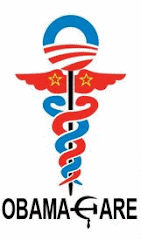
It is a popular belief that current gun laws should be better enforced. Federal law already makes it illegal for any felon or anyone who has illegally used any controlled substance from owning a gun. The penalty is five years of imprisonment, the same draconian punishment leveled at those who refuse to consent to having the ownership of their own bodies taken over by the government under the collectivist ObamaCare law.
Felons are a very broad category which more and more includes people who committed no crime of violence or even no crime against any known individual at all. Federal and state laws have more and more made people felons for violating vague, unknown, and irrational laws and regulations aimed at anyone trying to make a living. Business owners and business managers are particularly likely to be victims of such wrongheaded laws. Those who have have been convicted under such specious laws are not allowed to own guns.
The prohibition of gun ownership to anyone who has illegally used a controlled substance is another draconian act that has the consequence that at least 40 million Americans are likely prohibited from owning guns if it were enforced. Among those who are prohibited by federal law from owning guns are:
Obama
George W. Bush
Bill Clinton
Of course in our lawless land in which many people are deemed too important for the law to be enforced upon them, these people would not actually be denied a gun permit should they request one. Law enforcement would definitely turn its head for them. But, in a nation in which the use of a prohibited substance lands many others in jail, prevents them from holding many jobs, or is the excuse of law enforcement agencies to take their homes, cars, boats, and land from them without the need to get a conviction, this is a giant hypocrisy. It is an act of great injustice.
Far from needing still more gun ownership prohibition and registration laws, we need to repeal some of the wrongheaded laws we already have that unreasonably infringe upon our sovereign and equal right to protect ourselves from harm by others, including tyrannical governments. More of us than are presently allowed should be able to acquire the best in personal protection weapons so that we can protect ourselves, our families, and our friends and neighbors from the violence that the state proves unable and unwilling to prevent. Proposed restrictions against large capacity, actually just reasonable capacity, magazines and semi-automatic fire weapons are clear infringements of our right to protect ourselves.
Before you know it, Obama will dictatorially rule that the Founding Fathers only intended the citizenry to own muzzle-loaded muskets and that will be all we will be allowed to own. Provided of course that we have not become felons for violating some line buried in hundreds of thousands of pages of federal laws and regulations or that we have not ever used a controlled substance illegally.
Showing posts with label George Bush. Show all posts
Showing posts with label George Bush. Show all posts
26 January 2013


22 September 2012
17 Countries Now Have More Economic Freedom than the USA
The Economic Freedom of the World: 2012 Annual Report published by the Fraser Institute measured the economic freedom of countries using the data of 2010. The principal authors of the report are James Gwartney of Florida State University, Robert Lawson of Southern Methodist University, and Joshua Hall of Beloit College with contributions from eight other academics.
The economic freedom evaluation of the USA continued its nearly monotonic decline since the year 2000. In 2000 we had a rating of 8.65 on a scale of 10.00, but we have sunk to a rating of 7.70 now. Since the year 2000, the rest of the world has seen a small increase in rating from 6.71 to 6.83. In 2010, our 8.65 rating of the year 2000 would have made the USA a close third to Singapore, with Hong Kong number one. But in our state of degradation as of 2010, the USA is now disgracefully 18th in the world in economic freedom. When the evaluation is made for 2012, we will find that we have slid much further down the list.
Here is what the world looks like color coded by quartile in economic freedom:

You can see why Mexicans have been coming across the border illegally to work in the USA from this map. I was not surprised to see Venezuela and maybe even Argentina in the least free quartile, but I was surprised to see India there.
Here are the ratings and the rankings of the upper two quartiles:

These economic freedom ratings are made based on the following criteria with the individual USA ratings and rankings following each:
1) Size of government (6.43, 73rd, our worst major category ranking)
2) Legal system and property rights (7.14, 28th)
3) Sound money (9.68, 7th)
4) Freedom to trade internationally (7.46, 57th)
5) Regulation (7.76, 31st)
Regulation is further broken down into the following subcategories:
a) Credit market regulations (6.95, 121st, our worst regulatory ranking)
b) Labor market regulations (9.06, 3rd)
c) Business regulations (7.26, 30th)
If we evaluate which areas of economic freedom are most pulling our ranking down in order, they are:
Size of government, 73rd
Freedom to trade internationally, 57th
Regulation, 31st
Legal system and property rights, 28th
in which areas our ranking was worse than our overall ranking. Note that our size of government ranking of 73rd puts us at the top of the list of nations in the third quartile. That is in the lower half of the 144 nations evaluated. Does that hurt your pride? It should. It should be excruciating pain. Personally, I find each of these rankings to be disgraceful and a source of great anger.
Our economic freedoms are as basic as any other freedoms. To sustain our lives, we need to be free to earn a living. We also need to be free to enjoy earning our living without having burdens constantly loaded on our backs such as heavy taxes and unnecessary regulations and paperwork requirements. The American businessman sees his business drained by excessive taxes, is forced to be an unpaid tax collector, is forced to divulge much too much private information, is forced to assume responsibilities and risks that are properly either those of his employees or his customers, is kept from doing things according to his own judgment by laws that are often irrational, and is forced to comply with unintelligible and excessively voluminous rules and regulations.
The American businessman is treated like a slave of the state and generally forced into being a criminal by laws and regulations he cannot even read, cannot understand, and in many cases could not abide by if he understood them. This is exactly what a great many politicians want. They want to extort tax money, favors, and campaign contributions at will from businessmen. They use the overly complex and voluminous law and the threat of still more laws and regulations to make most businessmen cower before them.
There are very practical consequences for our economy. As our economic freedoms are lost, our ability to grow our real per capita GDP decreases. See the graph I have prepared from World Bank data for the years from 1980 to 2011:

Note that the post-2000 performance is clearly much worse than that of 2000 and earlier. A loss of economic freedom is a loss of opportunity and an increase in uncertainty. With less opportunity and more uncertainty, fewer people will start start-up companies and fewer people will be hired by such companies:
 George W. Bush grew government and added many regulations, but Obama has grown government even more and added slightly more regulations and many more very expensive regulations. With many more regulations awaiting a second term and hopes for many tax increases, Obama intends to further degrade our economic freedoms in the name of redistribution and a wrongheaded claim that catastrophic man-made global warming will result if he does not drastically cut our fossil fuel energy use. If he is re-elected, he will attempt to greatly further decrease our economic freedoms.
The economic freedom evaluation of the USA continued its nearly monotonic decline since the year 2000. In 2000 we had a rating of 8.65 on a scale of 10.00, but we have sunk to a rating of 7.70 now. Since the year 2000, the rest of the world has seen a small increase in rating from 6.71 to 6.83. In 2010, our 8.65 rating of the year 2000 would have made the USA a close third to Singapore, with Hong Kong number one. But in our state of degradation as of 2010, the USA is now disgracefully 18th in the world in economic freedom. When the evaluation is made for 2012, we will find that we have slid much further down the list.
Here is what the world looks like color coded by quartile in economic freedom:

You can see why Mexicans have been coming across the border illegally to work in the USA from this map. I was not surprised to see Venezuela and maybe even Argentina in the least free quartile, but I was surprised to see India there.
Here are the ratings and the rankings of the upper two quartiles:
These economic freedom ratings are made based on the following criteria with the individual USA ratings and rankings following each:
1) Size of government (6.43, 73rd, our worst major category ranking)
2) Legal system and property rights (7.14, 28th)
3) Sound money (9.68, 7th)
4) Freedom to trade internationally (7.46, 57th)
5) Regulation (7.76, 31st)
Regulation is further broken down into the following subcategories:
a) Credit market regulations (6.95, 121st, our worst regulatory ranking)
b) Labor market regulations (9.06, 3rd)
c) Business regulations (7.26, 30th)
If we evaluate which areas of economic freedom are most pulling our ranking down in order, they are:
Size of government, 73rd
Freedom to trade internationally, 57th
Regulation, 31st
Legal system and property rights, 28th
in which areas our ranking was worse than our overall ranking. Note that our size of government ranking of 73rd puts us at the top of the list of nations in the third quartile. That is in the lower half of the 144 nations evaluated. Does that hurt your pride? It should. It should be excruciating pain. Personally, I find each of these rankings to be disgraceful and a source of great anger.
Our economic freedoms are as basic as any other freedoms. To sustain our lives, we need to be free to earn a living. We also need to be free to enjoy earning our living without having burdens constantly loaded on our backs such as heavy taxes and unnecessary regulations and paperwork requirements. The American businessman sees his business drained by excessive taxes, is forced to be an unpaid tax collector, is forced to divulge much too much private information, is forced to assume responsibilities and risks that are properly either those of his employees or his customers, is kept from doing things according to his own judgment by laws that are often irrational, and is forced to comply with unintelligible and excessively voluminous rules and regulations.
The American businessman is treated like a slave of the state and generally forced into being a criminal by laws and regulations he cannot even read, cannot understand, and in many cases could not abide by if he understood them. This is exactly what a great many politicians want. They want to extort tax money, favors, and campaign contributions at will from businessmen. They use the overly complex and voluminous law and the threat of still more laws and regulations to make most businessmen cower before them.
There are very practical consequences for our economy. As our economic freedoms are lost, our ability to grow our real per capita GDP decreases. See the graph I have prepared from World Bank data for the years from 1980 to 2011:
Note that the post-2000 performance is clearly much worse than that of 2000 and earlier. A loss of economic freedom is a loss of opportunity and an increase in uncertainty. With less opportunity and more uncertainty, fewer people will start start-up companies and fewer people will be hired by such companies:

24 April 2010
DDT Opposed for Population Control
An editorial in today's Wall Street Journal noted that both Earth Day and Malaria Day occurred this last week. DDT is highly effective in combating malaria, which kills one million people each year. At the concentrations needed for effective control of mosquitoes in homes and close to them, any environmental effects are now known to be minimal. The World Health Organization and the U.N. still oppose its use, however.
Biologist Paul Ehrlich opposed the use of DDT in his book The Population Bomb because it reduced the death rate from malaria too much and was therefore a contributor to overpopulation. Ecologist Garrett Hardin opposed its use in underdeveloped countries saying "every life saved this year in a poor country diminishes the quality of life for subsequent generations." John Holdren, Obama's Science Czar and Director of the White House Office of Science and Technology Policy; Assistant to the President for Science and Technology; and Co-Chair of the President's Council of Advisors on Science and Technology, joined with Paul Ehrlich in publications in 1969, 1971, and 1973 saying:
Biologist Paul Ehrlich opposed the use of DDT in his book The Population Bomb because it reduced the death rate from malaria too much and was therefore a contributor to overpopulation. Ecologist Garrett Hardin opposed its use in underdeveloped countries saying "every life saved this year in a poor country diminishes the quality of life for subsequent generations." John Holdren, Obama's Science Czar and Director of the White House Office of Science and Technology Policy; Assistant to the President for Science and Technology; and Co-Chair of the President's Council of Advisors on Science and Technology, joined with Paul Ehrlich in publications in 1969, 1971, and 1973 saying:
If … population control measures are not initiated immediately and effectively, all the technology man can bring to bear will not fend off the misery to come.
some form of ecocatastrophe, if not thermonuclear war, seems almost certain to overtake us before the end of the century
a massive campaign … to de-develop the United States” and other Western nations in order to conserve energy and facilitate growth in underdeveloped countries. “De-development means bringing our economic system into line with the realities of ecology and the world resource situation.” “By de-development we mean lower per-capita energy consumption, fewer gadgets, and the abolition of planned obsolescence.” "The need for de-development presents our economists with a major challenge. They must design a stable, low-consumption economy in which there is a much more equitable distribution of wealth than in the present one. Redistribution of wealth both within and among nations is absolutely essential if a decent life is to be provided for every human being."Despite the close ties the Obama administration has with such radical environmental elements, it has, to its credit, continued the Bush administration policy of support for DDT spraying in Zambia, Mozambique, and other countries where the local people want to use DDT. Pressure from the Pesticide Action Network and other groups has been unsuccessful in changing the U.S. policy. Apparently having a President born in Kenya has resulted in a sufficient regard for the welfare of East Africans to give the Obama administration enough backbone not to cave on this issue.
22 January 2010
Supreme Court Defends Free Speech
The Bipartisan Campaign Reform Act (BCRA) of 2002, often called the McCain-Feingold Act, placed severe limits on the free speech of corporations and labor unions for 60 days prior to a general election for ads mentioning the name of candidates for federal office. It also restricted free speech for 30 days before a caucus or a primary election. President George W. Bush signed the legislation into law, despite having reservations about the free speech restrictions. He apparently thought the Supreme Court would strike many of its provisions down, so he abrogated his responsibility to veto the bill. The Supreme Court, in McConnell vs. FEC, upheld most of the provisions of the BCRA of 2002, though it was also clearly its duty to find the restrictions on freedom of speech unconstitutional.
Finally, yesterday, the Supreme Court, in a 5-4 decision, considering Citizens United vs. Federal Election Commission, ruled that the BCRA of 2002 could not restrict the free speech of persons acting through either corporations or labor unions or other groups. Quoting from a press release from Chip Mellor of the Institute for Justice, which helped defend free speech in this case:
Justice Kennedy, writing for the Court, emphasized that the government’s ban on corporate speech was censorship, pure and simple: “When Government seeks to use its full power, including the criminal law, to command where a person may get his or her information or what distrusted source he or she may not hear, it uses censorship to control thought. This is unlawful.” He added, “The First Amendment confirms the freedom to think for ourselves.”
The Court overturned Austin vs. Michigan Chamber of Commerce and parts of McConnell vs. FEC in the process. Chip Mellor says:
In today’s opinion, the Court ruled that everyone, including corporations, has the right to speak out about issues and candidates. The government may not restrict the marketplace of ideas: “The civic discourse belongs to the people, and the Government may not prescribe the means used to conduct it.” In other words, the First Amendment rejects government paternalism, instead “entrusting the people to judge what is true and what is false.”
The Institute for Justice also won a case in Arizona on 20 January on free speech and election issues when, according to the Institute for Justice website:
a federal district court judge declared unconstitutional the challenged “Matching Funds” provision of Arizona’s so-called “Clean Elections Act,” striking a blow for the rights of individuals and groups to speak freely during political campaigns. The Institute for Justice is challenging Arizona’s scheme of publicly financing elections, which drowns out the voices of individuals and groups who wish to support privately financed candidates who run against taxpayer-funded candidates in a misguided effort to “level the playing filed.” If a group makes an independent expenditure in favor a privately funded candidate, the unelected bureaucrats at the Clean Elections Commission dole out dollar-for-dollar “matching funds” to the publicly funded candidate. That means that for every dollar an individual or group spends to support the candidate of their choice, over the publicly funded candidate’s initial government subsidy, the government pays an equal amount of money to the political competition. IJ also seeks to preserve the right of individuals to run for public office without having to accept taxpayer funds. Arizona’s public financing scheme punishes candidates who reject the political welfare of public funding by burying them in red tape and giving extra money to their publicly funded opponents. The case is being appealed to the Ninth Circuit, where IJ will again demonstrate that "clean Elections" doesn't level the playing field, it levels the players on the field.
A couple of other important freedom of speech court cases are being supported by The Institute for Justice. SpeechNow.org vs. FEC will be argued before the D.C. Circuit Court of Appeals on 27 January challenging a federal law that forces people to give up the right to associate in order to use the right to free speech! Both rights are clearly stated in the First Amendment, so where were the minds of Congress when they passed this law! The law limits each person joining together to advertise their beliefs to $5000 in contributions to the cause, but acting individually, they would have no such limit. The Institute for Justice (IJ) is joining the Center for Competitive Politics to represent SpeechNow.org.
In Colorado, a group of neighbors joined together to oppose the annexation of their neighborhood by a nearby town and were sued under a Colorado law which forces any group spending as little as $200 to address a ballot issue to register with the state and disclose all donors making contributions of $20 or more. IJ is representing these neighbors in the 10th Circuit Court of Appeals.
30 August 2009
Obama Eases Union Accounts Reporting
Obama's Secretary of Labor, Hilda Solis, says she will not require labor unions to submit the more detailed accounting forms used by the Bush Administration as reported by Kevin Mooney of The Washington Examiner. These forms required the disclosure of financial information that provided union members some information on how the union was spending their union dues. They also helped to reveal ghost employees of the unions who had "no show jobs."
The Office of Labor Management Standards (OLMS) is supposed to enforce the Labor Management and Reporting Disclosure Act (LMRDA), which requires annual financial reports by unions with receipts of $250,000 or more. A notice appeared this week on the Labor Department website saying:
This would seem to mean that the Department of Labor has no intention of actually requiring unions to comply with the LMRDA. It seems to in effect make it purely voluntary for a union to file either a Form LM-30 or the more detailed 2007 form, because after all the Department will not be enforcing the submission requirement of either!
There is no question that labor unions can do anything they want under the administration of Obama and under the Democrat Congress.
The Office of Labor Management Standards (OLMS) is supposed to enforce the Labor Management and Reporting Disclosure Act (LMRDA), which requires annual financial reports by unions with receipts of $250,000 or more. A notice appeared this week on the Labor Department website saying:
Accordingly, OLMS will refrain from initiating enforcement actions against union officers and union employees based solely on the failure to file the report required by section 202 of the Labor-Management and Reporting Disclosure Act (LMRDA), 29 U.S.C. § 432, using the 2007 form, as long as individuals meet their statutorily-required filing obligation in some manner. OLMS will accept either the old Form LM-30 or the new one for purposes of this non-enforcement policy.The Form LM-30 is the old form, which requires much less information than the Bush-Chao form does. But also notice that this statement announces this as a "non-enforcement policy."
This would seem to mean that the Department of Labor has no intention of actually requiring unions to comply with the LMRDA. It seems to in effect make it purely voluntary for a union to file either a Form LM-30 or the more detailed 2007 form, because after all the Department will not be enforcing the submission requirement of either!
There is no question that labor unions can do anything they want under the administration of Obama and under the Democrat Congress.
08 June 2009
Stimulate the Economy by Deregulation
An Op Ed in the Washington Examiner on 8 June 2009 by Wayne Crews and Ryan Young called To stimulate the economy, let it be free made some very good points. Wayne Crews is the Vice President for Policy at the Competitive Enterprise Institute. Ryan Young is a Fellow in Regulatory Studies at CEI. They note that:
As a small businessman, it is impossible for me to know what the many laws and regulations are which may apply to my laboratory business. There are some I know about and these do impose impressive costs in time and money on my business. Then there are the many I do not know about. These me reason to have to fear that some government bureaucrat hungry to exercise his power will some day become aware that I am not compliant with some one of thousands of regulations about which I know nothing and use it to milk my business dry. This is not the way to encourage businessmen to take the risks of investing their money and time in building a business, hiring employees, and training them to do the job well.
Taking money out of the economy, wasting some of it on bureaucracy, and then putting it back in is not going to spark economic growth. About the only thing that has been sparked is a lobbying feeding frenzy over stimulus funding. Even the Democrat-controlled Congressional Budget Office (CBO) admits that the American Recovery and Reinvestment Act will hurt long-run economic growth.So what would a more rational policy be for stimulating the economy? They first give us this perspective:
With such perspective, it is clear that a great way to stimulate business is to reduce its costs and its frustrations and dangers. Something has to be done to reduce this regulatory nightmare. George Bush sure did not do it. He enacted more than 30,000 new regulations. The President and the Congress must reverse this sorry trend. Crews and Young suggest that unless a regulation is renewed by Congress, it should expire in 5 years. Obsolete or ineffective regulations should be packaged together and sent to Congress for their up-or-down vote. Congress will have to take on far more responsibility in the process. Congress passed 285 bills last year, while government agencies added 3,830 rules.Businesses spent $1.17 trillion in 2008 to comply with federal regulations. The government spent another $49.1 billion to enforce those regulations. The total amount spent on regulation is on par with Canada's entire 2006 gross domestic product of $1.265 trillion.The 2008 Federal Register weighed in at 79,435 pages, an all-time record. More than 60 agencies passed 3,830 new rules last year. The federal regulatory pipeline now has 4,003 rules at various stages of implementation. Of those, 783 affect small businesses.The government calls a regulation “economically significant” if it costs $100 million or more; 180 such rules came onto the books in 2008, costing the economy at least $18 billion. This is an increase of 13 percent over 2007, which in turn was up 14 percent from the year before.Among these $100 million-plus gems are rules for right whale ship strike reduction, reducing open-flame ignition of bedclothes, and at least $600 million worth of energy conservation requirements for everything from pool heaters to battery chargers.
As a small businessman, it is impossible for me to know what the many laws and regulations are which may apply to my laboratory business. There are some I know about and these do impose impressive costs in time and money on my business. Then there are the many I do not know about. These me reason to have to fear that some government bureaucrat hungry to exercise his power will some day become aware that I am not compliant with some one of thousands of regulations about which I know nothing and use it to milk my business dry. This is not the way to encourage businessmen to take the risks of investing their money and time in building a business, hiring employees, and training them to do the job well.
Subscribe to:
Posts (Atom)






 Posts
Posts