Among the issues most commonly discussed are individuality, the rights of the individual, the limits of legitimate government, morality, history, economics, government policy, science, business, education, health care, energy, and man-made global warming evaluations. My posts are aimed at intelligent and rational individuals, whose comments are very welcome.

"No matter how vast your knowledge or how modest, it is your own mind that has to acquire it." Ayn Rand

"Observe that the 'haves' are those who have freedom, and that it is freedom that the 'have-nots' have not." Ayn Rand

"The virtue involved in helping those one loves is not 'selflessness' or 'sacrifice', but integrity." Ayn Rand

For "a human being, the question 'to be or not to be,' is the question 'to think or not to think.'" Ayn Rand
Showing posts with label Keystone XL. Show all posts

08 March 2022

Biden Administration Misdirection on US Oil Production

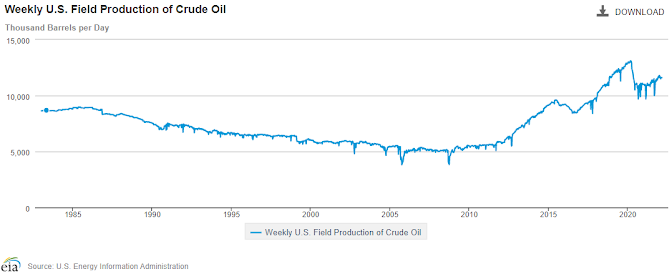
 The Biden administration is making a habit of misdirecting Americans on the causes of the increases in the cost of oil in several respects.  They have repeatedly made the claim that U.S. crude oil production is at an all-time high, for instance.  Here is the actual data on U.S. Crude Oil production per week according to the U.S. Energy Information Administration:


The peak in average daily crude oil production was in the weeks of 28 February and 13 March 2020 when the average daily oil production was 13,100 thousand or 13.1 million barrels of oil.  Oil production was reduced after that due to the Covid-19 pandemic and expected lowering of demand for oil as people stayed home or at least stayed closer to home.  The week of 29 January 2021, Biden's first full week in office, the daily average oil production was 10.9 million barrels of oil per day.  The week of 25 February 2022 the daily average crude oil production was 11.6 million barrels.  This was due to some recovery in oil demand and the price of oil due to the easing of the Covid-19 pandemic.  This is still 1.5 million barrels per day below the U.S. peak oil production.

Another Biden administration misdirection is the claim that 9,000 oil leases for oil production means that any shortfall in oil production is the fault of oil production companies.  The Biden administration has made it abundantly clear that they want the prices of oil and natural gas to skyrocket, which means they want their production to lag the demand for them.  They want this to encourage the massive mistake of a false belief in an existential catastrophe due to man-made global warming.  Oil and gas production has no long-term future according to their belief system.  Twice the Keystone XL pipeline was put on track for construction and twice its construction was halted by the Democrats and the Russian-funded environmentalist special interest groups with whom they collaborate.  This has caused the loss of massive sums of capital to its investors.  Other pipeline projects have also suffered as the Democrats ruined the investment climate.

One cannot make use of a lease to drill oil if one is not allowed to produce on that lease under reasonable environmental rules.  One cannot make use of an oil lease if one cannot build a pipeline to deliver the oil to a refinery.  One commonly cannot drill or build a pipeline if one cannot borrow money from banks and other lending institutions.  The Biden administration has been strongly discouraging banks and other lenders from making loans for purposes tied to oil production, oil transport, and oil product production.  They have discouraged liquification facilities and liquified gas transport capability.  They have also placed a moratorium on further leases on federal land and on offshore oil drilling. 

If the Biden administration were to give you the go ahead to invest a billion dollars into an oil and gas production effort, would you feel comfortable that they would not halt you in the midst of your investment or at a late stage in that investment?  If you were not very cognizant of that risk, you would certainly not be someone who should have any control over the investment of a billion dollars.

The Biden administration is definitely responsible for an unfavorable climate for oil and gas production.  It is extremely dishonest of them to claim that any shortfall in oil and gas production is due to the failure of the oil and gas industries.


29 October 2017

Now it’s a war on pipelines by Paul Driessen


Efforts to block and sabotage pipelines hurt jobs, economic growth, middle class, human safety 

The radical environmentalist war on fossil fuels has opened a new front: a war on pipelines.

For years, activist zealots claimed the world was rapidly depleting its oil and natural gas supplies. The fracking revolution (horizontal drilling and hydraulic fracturing) obliterated that argument, by sending US oil and gas production to new heights. Indeed, it was record gas supplies and plummeting gas prices, combined with the Obama EPA war on coal, that closed down so many coal-fired power plants.

So the battle increasingly shifted to the far more emotional claim that continued reliance on fossil fuels (which provide over 80% of the US and global energy that powers modern civilization and living standards) will cause dangerous manmade global warming and climate change. This gave birth to the climate and renewable energy consortium and the “keep it in the ground” movement. No evidence to the contrary will budge them from their hysteria-laden talking points on looming climate cataclysms.

The journal Nature Geoscience recently published a careful study that found there has been far less planetary warming since 1998 than alarmist scientists and computer models had predicted. Because the models are based on the assumption that carbon dioxide drives climate change, they “run too hot,” resulting in predictions that deviate from actual temperature measurements more and more every year.

But instead of admitting they were wrong, the usual strident suspects in the climate crisis industry doubled down and attacked the study and any news outlet that called attention to it. Britain’s BBC denounced the inconvenient study and displayed not a whit of apology over its climate chaos claims.

Climate campaigners jumped all over Hurricanes Harvey and Irma, insisting without an iota of evidence that manmade greenhouse gases had created or at least intensified them. They’re making the equally absurd claim that shutting down US and Canadian pipelines will somehow reduce atmospheric CO2 levels and prevent climate change and extreme weather – even though China already has 2,363 coal-fired power plants and is adding 1,171 more; India has 589 and is adding another 446; Indonesia and Vietnam are adding 140 to their fleet; and even Germany is burning more coal every year.

Pipelines carry conventional, fracking and oil sands petroleum to markets: natural gas to homes and power plants, oil to refineries, oil and gas to petrochemical plants – and crude oil, refined products and liquefied natural gas to export terminals that send the energy to Europe and Asia. If they can’t prevent companies from producing oil and gas, hydrocarbon haters want to prevent them from shipping it.

“Obviously the best means of transporting oil is none,” said an activist involved in campaigns against the Keystone XL Pipeline. But if there is going to be increased production, “I would rather it go by train.”

Some pipeline protesters somehow think rail or truck transport means the oil will be used domestically, whereas pipelined crude will more likely go to coastal refineries and be shipped overseas. Others claim pipelines are less safe than truck or railroad tanker cars. They cite a 2013 International Energy Agency report that said railroad transport is six times more likely to have an accident than pipelines are – but pipelines spill three times as much oil per-billion-barrel-miles of fuel transported.

However, the study is seriously outdated. It analyzed data from 2004 to 2012 – before the surge in US oil production … and before a monumental increase in rail transportation was necessitated by protests and Obama Administration decisions blocking construction of the Keystone and Dakota Access pipelines. 

In 2014, the USA set a new record for railroad tanker spills: 141 – versus an average of 24 during the years covered by the IEA report. Rail accidents in Colorado, Virginia, West Virginia and other states resulted in significant oil spills, evacuations and even serious explosions, but fortunately no deaths. However, a 2013 disaster in Lac-Mégantic, Quebec burned 47 people to death and left many others seriously injured. The danger of moving oil on rails and highways through populated areas is clearly high.

Better track maintenance, stronger tanker cars, improved train scheduling and other safety practices would reduce rail accidents and spills. However, US State Department studies concluded that the Keystone pipeline would likely result in fewer than 520 barrels of crude being spilled annually, compared to 32,000 barrels in three rail spills that it evaluated. The same holds true for other modern pipelines.

New pipelines are built with state-of-the-art pipe and other components, to the latest design, manufacturing and construction specifications. Warning systems, automatic shutoff valves, 24/7/365 monitoring and other safeguards further minimize the risk of spills. New lines often replace older pipes that carry greater risks of corrosion and rupturing as they age. New lines can often be routed to avoid population centers and sensitive water and wildlife areas. Because they are underground, once they are installed and grasses are planted, pipelines are invisible except for occasional pumping stations, valves and other small facilities.

Environmentalists tend to focus on potential volumes of oil spilled when a major pipeline rupture occurs, and on impacts to waterways and wildlife. While these are important considerations, human safety should always be of paramount concern. Lac-Mégantic underscores that priority.

Light crude oils from North Dakota’s Bakken Field and other shale plays contain more dissolved gases and thus are more flammable than heavier crudes. That makes explosions more likely. On highways and along rail lines through rural or urban communities, the results would be devastating. The sheer volume of oil to be shipped further underscores these dangers.

The 1,172-mile-long Dakota Access Pipe Line alone carries some 470,000 barrels of oil every day. Hauling that quantity overland would require 700 rail tanker cars per day (256,000 per year) or 2,000 semi-trailer tanker trucks per day on our highways (730,000 per year)! All would go through populated areas along parts of their route. Multiply that times the Keystone and other pipelines in planning or under construction, and the rail/truck “alternative” is mind-boggling in its scale and risks.

A new technology transforms heavy crude oil into pill-sized pellets – self-sealing balls of bitumen that can then be moved in coal rail cars or transported in trucks with less risk of spills. That may eventually reduce the need for new pipelines; but the innovative idea is currently only in the testing stage.

Moreover, we cannot ship natural gas by tanker truck or rail car. Pipelines are essential for that – unless the gas is chilled and liquefied, adding major cost and safety considerations. That’s one more reason 2.5 million miles of liquid petroleum, gas transmission and gas distribution lines already crisscross the USA.

Even more important, some activists are now going far beyond mere rhetoric and protests – and engaging in sabotage of pipeline construction equipment and even pipeline safety valves. These intolerable acts should be met with police action, major fines and lengthy jail terms. Free speech and peaceful protests are a constitutional right. Eco-terrorism and threats to public safety cannot be tolerated.

These radical activists would never give up their reliance on – and addiction to – computers, smart phones, synthetic fiber shoes and clothing, affordable heating and air conditioning, cars, skis, kayaks, wind turbines and solar panels, and all the other blessings that petroleum brings. They should not expect the rest of us to give them up, either. Especially based on the flimsy arguments they present.

For all these reasons, it is hard to understand the increasing opposition of some states and communities to new pipelines: from Minnesota to New York and even Virginia and West Virginia.

It is even harder to understand or tolerate the actions of these tax-exempt anti-pipeline organizations – and equally callous and devious tax-exempt outfits that fund the radical groups: from the Rockefeller Brothers Fund to the Sea Change Foundation and its secretive Russian donors, and even to railroad tycoon Warren Buffett’s NoVo Foundation. If they can block pipelines, they will next block rail and truck transport.

If an increasingly divided, partisan, dysfunctional Congress cannot address these problems, let us hope the Trump Administration and some state governors and legislators will do so.

Paul Driessen is senior policy analyst for the Committee For A Constructive Tomorrow (www.CFACT.org), and author of Eco-Imperialism: Green power - Black death and other books on the environment.

Note added by Charles R. Anderson, Ph.D.:  Warren Buffet may not be among those trying next to block the transport of oil and gas by railroad cars.  Now that he is buying a large share of Pilot Flying J, he may not even oppose its movement by truck.
24 November 2016

Pipeline and Coal-Fired Power Plant Alarmism

In view of the recent controversy about the Dakota Access Pipeline and the Paul Driessen post I just recently put up called Pipeline Anarchy, I want to refer back to a post of mine in November 2011 called Democrat Socialism, Energy, and Pipeline Hysteria.  One of the points I made was that the U.S. was already extensively filled with oil and gas pipelines.  Many of them were old and were not nearly as safe as the proposed Keystone XL Pipeline or as the Dakota Access Pipeline.  It makes little sense to prevent the building of these pipelines on safety or environmental grounds, since they are improvements in the system.  I also pointed out that most any aquifer was already crossed by less superior pipelines.  Now we learn from Driessen's article that the Dakota Pipeline in the only area unconstructed is running parallel to an already existing pipeline.

From my earlier post:

In 2009, there were 148,622 miles of oil and oil product pipelines in the U.S.  There were also 1,539,911 miles of natural gas pipeline in the U.S.  The Keystone XL project wanted to add 1,661 miles of oil pipeline to this massive network of pipelines.  Some of the major pipelines now in existence are shown in the map below.


The green-coded pipelines are major oil pipelines, the red lines are major gas pipelines, and the blue lines are product pipelines. 

Returning to the present:

The pipeline case in which a safer pipeline is denied while less safe ones continue in use has an interesting parallel in the case against coal fired power plants.  The Obama EPA established a regulation that required power plants to release much less mercury than they do into the atmosphere.  The claim was that despite the low concentrations of mercury, a pregnant woman eating a constant diet of fish from nearby rivers might suffer some health problem based on cherry-picked studies of islanders who ate nothing but seafood from the ocean with its 200 ppm of mercury.  There have long been recommendations that pregnant women not eat too much seafood, as an abundance of caution.  But, pregnant women are presumably thought incapable of following a similar recommendation for avoiding too much fish from rivers as an abundance of caution.

See my posts Coal-Fired Power Plants Produce Insignificant Mercury and Evaluating the Mercury Emissions Danger from Coal-Fired Power Plants.  It is clear that many areas of the country should be evacuated due to the overwhelming concentrations of mercury from natural sources of mercury, such as the mineral cinnabar if the mercury from coal-fired power plants is a problem.  If it is safe to live in much of the American Southwest and the southern Great Plains states, then it is generally immaterial whether one lives near a coal-fired power plant as far as mercury exposure is concerned.

It is also of no significance that coal-fired power plants produce more carbon dioxide than do natural gas power plants or than wind generators do for reasons described in Why Greenhouse Gas Theory is Wrong -- An Examination of the Theoretical Basis.

But, we must have many horrors, terrors, and alarms from which ever bigger government can pretend to save us.

26 Nov 2016:  10 other fossil fuel pipelines cross the Missouri River upstream from the Dakota Access Pipeline already.


27 December 2014

The Obama Opposition to Pipeline Construction Lowers Our Future Standard of Living

Obama has delayed and opposed the Keystone XL Pipeline section proposed to bring Canadian "oil" from Alberta to Nebraska, where it will be picked up by existing pipelines.  Obama claims that having more oil available in North America is hardly important, since oil is a world market commodity whose price is set in the world market.  He claims that the Keystone XL Pipeline is “not even a nominal benefit for U.S. consumers.”

The Keystone XL pipeline will allow large amounts of Canadian "oil" (really largely bitumen) to reach our many Gulf Coast oil refineries which are expert in refining hard-to-refine oils such as the almost vanishing supply of Venezuela.  The despotic regime there has almost totally destroyed the Venezuelan oil fields and extraction industry.  One of the good results of the Keystone XL Pipeline is to replenish the supply of crude oil for these refineries.  Another is that the pipeline will also pick up oil from the Bakken oil shale formation in North Dakota and Montana.  This in turn might fuel the investment in new oil refineries in Nebraska or nearby states.  It might then give rise to further industrial manufacture of petroleum products in that area of the country.

The Obama administration and those of states with Democrat governors and legislatures are generally negative with respect to the building of other pipelines as well.  For instance, proposed pipelines to serve the gigantic Marcellus Shale Oil and Gas Formation of Pennsylvania, Ohio, West Virginia, Kentucky, and No-Fracking New York have been delayed by government actions.  The result has been that natural gas prices have locally become particularly depressed because the natural gas produced cannot be taken to more lucrative markets in other areas of the US.  This is not optimal market behavior.

While it is true that the price of oil is mostly set by world markets, it is not true that the effects of where oil is found, how it is delivered to refineries, where the refineries are located, and how the refined hydrocarbon products are moved from the refinery to market are insignificant to American consumers or manufacturers.  There are deleterious consequences when government prevents the private sector from optimizing the efficient delivery of petroleum products to American consumers.

Let us consider the product whose price affects all Americans and with which most of us have a considerable experience -- regular gasoline.  If the entire infrastructure I described in the previous paragraph had no effect on the cost of regular gasoline, then after we subtract the sum of the federal and state gasoline taxes from the average cost of a gallon of regular gasoline in each state, the remaining cost would be the same.  Yes, the cost has a component with is related to the cost of the oil, but even that cost has costs of delivery to the refinery built into it.  The cost of operating the refinery is another variable.  Then the cost of transporting the refined product to the market in each state in the US is still another variable.  There are still more retail costs.

So, let us examine how much variation in the cost of the pre-tax regular gasoline there is.  I am using the average state prices from AAA of the early morning hours of 25 December 2014.  The state taxes are those of April 2014 generally.  I have used the rolling month by month tax for Indiana for the month of December 2014.  Upon subtracting the state and federal tax from the current average sale price of gasoline in each state, one finds that the lowest price on delivery for gasoline is in the state of Missouri.  Kansas and Ohio are almost as inexpensive.  Oklahoma produces much oil, has refineries, and has many pipelines, so it is not a surprise that it is the next least expensive.  Kentucky is next, then Alabama, then Texas, Minnesota, Michigan, Iowa, and then Indiana and Illinois.  Texas with its rich supply of oil, its many refineries, and its ports is closely tied to the world markets.  One might expect that it would be the lowest cost state, but the world market activity there may actually pull up the cost to Texas consumers.  Yet, if so, the upward effect of the world market is small since Texas gasoline at the pump is actually only slightly more expensive than in Missouri.  Much bigger effects are found for Hawaii and Alaska, both of which have consumers far from refineries and no pipelines to deliver refined products.

Each extra cent added to the cost of regular gasoline causes $1.4 billion more in the economy to be spent on gasoline and diverted from other uses.  The 2013 US GDP was $16,768.1 billion, so $1.4 billion/$16.768.1 billion = 0.0000835 or 0.00835%.  Each extra dollar in gasoline cost is then equal to a cost to the economy of 0.835% of GDP.  We can now measure the cost of gasoline in each state relative to the cheapest state of Missouri as a fraction of the GDP, if that state were representative of the entire GDP.  In other words, the cost of gasoline effectively shifts the nature of the economy of that state in a manner equivalent to its being a part of an economy with such a change in the growth rate of the GDP each year.  The number in the last column of the table below is the effective percentage by which each state's GDP is lowered relative to that of the lowest cost state of Missouri.


Hawaii and Alaska have such high costs for gasoline delivery that those states have an effective lowering of their GDPs of 1.048% and 1.014%, respectively.  Not surprisingly, Vermont, being a low population density and somewhat remote state, not to mention a very green state, has very expensive gasoline causing a 0.524% reduction in its GDP.  New York is next worst with a 0.441% reduction of GDP.  Some of New York's diminished GDP is due to its opposition to fracking to take advantage of the Marcellus Shale or Utica Shale formation in western New York.  Some is likely due to a reticence to build adequate pipelines or to host oil refineries.  Some is due to the dominance of New York City, which is easily supplied with petroleum products by sea, but still has high costs such as for fuel storage and gas stations due to a very high population density and for an exceedingly high cost government.

Now given the new Obama normal of a real GDP growth rate of about 2% a year and a population increase of about 0.9% a year, we have a dismal real per capita GDP rate of growth of about 1.1% a year.  A generation is traditionally taken to be about 22 years, but with American women waiting much longer to have children, an American generation is now about 31 years.  If a state has among the best-served oil and gasoline product infrastructure and market systems, let us say it is better than the present national average in its effective GDP growth rate by about 0.15%.  Those served more poorly, such as New York State and New England, have growth rates depressed by about 0.15%.

What is the difference for the real per capita standard of living improvement over a generation of 31 years?  The better oil and gasoline market system states have a growth rate of about 1.25% per year, while those with the less well-functioning market systems grow at a rate of about 0.95%, ignoring other factors affecting growth rates.  The better served gasoline markets experience an increased standard of living of 47.0% over a generation, while the more poorly served states would have an increased standard of living of 34.1%.  This difference is not insignificant for people who have children, for people who live 2 to 3 generations long, or simply for people of a benevolent nature.

This is just the effect of gasoline prices as well and does not consider the many other products of oil.  Other products from oil include lubricants, diesel fuel, heating oil, aviation fuel, greases, asphalts, paraffin, and cutting oils.  Resins made from products refined from oil are used to make plastics, paint, sealants, adhesives, and composite materials.  The lowered prices of these products have already had an impact on reviving manufacturing in the USA.

What is more, the same viewpoint that opposes the use of oil, the building of pipelines, the building of refineries, and other facilities and infrastructure that make the petroleum products markets highly efficient, causes many inefficiencies in other industries and commercial endeavors which also lower our standard of living, especially over generations of time.


14 October 2012

An outline of my approach to reviving the economy

In mentioning that the Obama economy made it much more difficult for small businesses such as my materials analysis laboratory to continue to operate, a scientist with whom I had been corresponding about his analytical needs claimed that no one could do the job of reviving the economy better than Obama.  He then asked what I would do.  Here is my 13-point reply with minor embellishments:


1)  Kill ObamaUncaringTax, too nicely called ObamaCare.

2)  Kill the Dodd-Frank Too-Big-to-Fail Act which is stultifying the loan markets and setting up the next colossal financial bubble.

3)  Enforce the work requirement on government charity programs and begin rapidly phasing them out.  The private sector can pick up whatever programs it wants to.

4)  Stop the EPA's vendetta against the use of coal.  The mercury and other pollution arguments are greatly exaggerated and really mostly an excuse to act on the failed hypothesis that man's CO2 emissions are causing a catastrophic global warming.

5)  Recognizing that the catastrophic man-made global warming hypothesis is wrong, stop discouraging other fossil fuel use and freely allow the development of new sources of oil and gas. Open up leases on federal land and offshore for development.  End federal subsidies and mandates for green energy development. 

6) Kill the federal CAFE requirement for 54.5 mpg by 2025 or any other date.

7)  Authorize the building of the Keystone XL pipeline so the Gulf of Mexico refineries are fed plenty of Bakken shale oil and Albertan tar sands oil.

8)  Increase the retirement age for Social Security and the coverage age for Medicare.

9)  Eliminate the Dept. of Education, the Dept. of Energy, the Dept. of Housing and Urban Development, the Labor Dept., most of the functions of the Dept. of Health and Human Services, the Agriculture Dept., reduce the Dept. of the Interior, eliminate the Transportation Dept., and reduce the Dept. of Homeland Security.  Fold the legitimate functions of the Labor, Agriculture, and Transportation Departments into the Commerce Dept.  Eliminate corporate welfare programs in the Commerce Dept., as well as the labor union welfare programs now in the Labor Dept.  Kill the Davis-Bacon Act and federal requirements that union wages be paid on federal contracts.

10)  Convert the Medicare program into a defined benefits program so that Medicare patients care about how much they spend and will not allow overcharging.  All government fraud, waste, and abuse programs are a pretense and are only used selectively to occasionally prosecute someone who is not playing the game to the liking of the powers that be in government.

11)  Sell most of the federal lands with mineral rights and use payments to pay down the debt.  The main purpose of this is to see that the land will be used more productively.

12)  Convert the Social Security program over time from a Ponzi scheme to a tax-deferred personal investment program with the investment truly held by the investing individual.

13) Reduce tax revenues as drastic spending cuts are enacted and simplify the tax laws and codes.  Preferably move to consumption taxes as opposed to taxes that inhibit production.  Consumption taxes will eliminate almost all reporting of financial information to the government.  Eliminate Sarbanes-Oxley.  Government spending will be quickly reduced to 18% or less of GDP and then cuts will continue until it is no more than 10% of GDP.  The economy will grow by leaps and bounds as the cost of government is kept growing somewhere between the rate of population increase and the rate of GDP increase, but definitely significantly less than the rate of GDP increase.

That is the gist of my program to transform the American economy consistent with the American Principle of government limited to the protection of our equal, sovereign individual rights to life, liberty, property, the ownership of our minds, bodies, and labor, and the pursuit of happiness.  The key to the preservation of our rights is a rich and vibrant private sector where we are free to pursue our own values, to trade goods, services, and ideas, and to associate with others of our choice for the purposes of our choice.

There are many other reforms needed to fully protect all of the rights of the individual.  Some of these will have major economic implications as well.  For instance, all education should become private education.  It is not the business of the government to educate the people, since that would be an infringement of the rights of many and government has a very serious conflict-of-interest problem with respect to teaching about its legitimate functions, about ethical matters that must enter into issues affecting the freedom of conscience of the People, and about the history of failure of big government and the success of highly limited government.  Much more needs to be done to protect privacy, the freedom of movement, freedom of speech and the written word whether in press or on the Internet, freedom of assembly, freedom of association, freedom of contract, freedom of trade and the ownership of one's own labor and its fruits, the freedom to create a domestic partnership contract with any consenting adults of one's choice, and the freedom of property ownership, including that in one's mind and body.