Among the issues most commonly discussed are individuality, the rights of the individual, the limits of legitimate government, morality, history, economics, government policy, science, business, education, health care, energy, and man-made global warming evaluations. My posts are aimed at intelligent and rational individuals, whose comments are very welcome.

"No matter how vast your knowledge or how modest, it is your own mind that has to acquire it." Ayn Rand

"Observe that the 'haves' are those who have freedom, and that it is freedom that the 'have-nots' have not." Ayn Rand

"The virtue involved in helping those one loves is not 'selflessness' or 'sacrifice', but integrity." Ayn Rand

For "a human being, the question 'to be or not to be,' is the question 'to think or not to think.'" Ayn Rand
Showing posts with label Atlas Society. Show all posts

04 April 2022

A Milestone in the Objectivist Movement

At last! The philosophy of reality, reasoning independent minds, individual self-interest, and a free market society always had to recognize that its movement had to embrace all of these within itself. Yet the Ayn Rand Institute long refused to do this.  To an apparently significant degree, ARI is now ready to do a better job of doing so and allow a popular movement to blossom without excessive schisms and attempts to control all Objectivist thinkers.

We have always needed more recognition that independent-minded individuals with their many varied interests and experiences would reasonably hold somewhat different principles and apply them to the complexities of life differently. Objectivism as a philosophy by which one can live your own life, has to contain within it the flexibility to handle the salient fact of our individuality. Yes, at a high level we all agree on some central principles, but in our individual lives one has to work out a host of sub-principles that apply to yourself as an individual. One cannot apply to Ayn Rand or to ARI for approval of how you make these judgments, because "No matter how vast your knowledge or how modest, it is your own mind that has to acquire it." 

To be a successful movement, the Objectivist movement needs to believe that there is a free market in Objectivist ideas. That market of rational, independent-minded individuals will sort out the good and the bad ideas. Unfortunately, some Objectivists had too little confidence that there were enough rational, independent-minded individuals for this to work out successfully. Yet only if there are, will Objectivism ever succeed as a major popular movement.

See The Atlas Society comments on the ARI release for the main ways in which the ARI policy will now open up Objectivism to more independent-minded thinkers.  Robert Tracinski has also made interesting observations on this.


22 October 2012

Article on Ayn Rand in the Economist

The Economist of 20 - 26 October 2012 has an article called Ayn Rand: Who's shrugging now? Sub-headed: The individualist philosopher has fans in some unlikely countries

The article reports that the movie Atlas Shrugged Part I cost $8 million and earned less than $5 million.  Atlas Shrugged Part II was funded with $20 million and it is hoped it will earn $10 million.

Ed Hudgins of the Atlas Society says they have 11,000 non-American monthly visits to the Atlas Society website now, which is up from 7,000 two years ago.  Yaron Brook of the Ayn Rand Institute says their website's visitors are mostly from Britain, Canada, India, and Scandinavia.

Excluding English speakers, Swedes are the leading "Ayn Rand" searchers on Google.  A free-market think-tank in Stockholm named Timbro has sold 30,000 copies of Ayn Rand's books since 2005, which compares very well to sales of 90,000 copies in Britain with six times the population.  Despite this, when Annie Loof, the enterprise minister called Rand "one of the greatest thinkers of the 20th century", she was given a very hard time about it.

After the U.S. and Canada, India leads the world in English-language searches on topics relating to Ayn Rand.  There is a massive market in pirated copies of her books in India, according to Barun Mitra of the Liberty Institute, an Indian think-tank.

The article closes by noting that Ayn Rand's books outsell those of Karl Marx by a factor of 16.

12 October 2012

The Movie Atlas Shrugged, Part II, Either-Or

The movie Atlas Shrugged, Part II on the second of three sections of the great novel by Ayn Rand is opening in theaters today.  The second section of the novel, Either-Or, is full of action and crises brought on by big government and the irrational and immoral ideas that support it.  It also features important developments in the lives of many of the principle characters who have long been taken advantage of and for granted.  The task of a movie to develop the ideas, the evolutions of character and understanding, and the mystery plot is beyond the reasonably possible in a movie format.  But, a movie should be able to achieve an interesting and enjoyable experience in its own terms.  I am expecting that from this movie, especially since my friends David Kelley and Laurie Rice of the Atlas Society helped to advise the producers, writers, director, and actors in this production.


Anna and I will be going to see it this weekend.  It would have been nice to have gone out to see it tonight, but I am incredibly busy in my laboratory and have worked stretches of 29 and 19 continuous hours straight this week as a result.  Postings due to the critical need to thwart the re-election of the damaging socialist Obama and a remodeling of our laboratory website have been poured on top of a surge in laboratory projects.  Tonight, I had a visitor who was interested in filming an advertisement for a university pushing its program in forensic sciences.  He concluded that the Anderson Materials Evaluation laboratory would be a perfect location for this project, which may be scheduled for next week.  Movie cameras and actors may be invading my lab next week!

Anna also falls short on sleep during the week, so Friday night is her catch-up night.  Tomorrow we will see Atlas Shrugged, Part II in a refreshed mode.  I will comment on it here afterwards.

15 August 2009

Hudgins - Postal Service Style Health Care

Ed Hudgins, Director of Advocacy at the Atlas Society, has written an excellent commentary on Obama's denial that his health care plan will create a government-only health care industry. Obama said that just as Fed Ex and UPS manage to compete with the U.S. Postal Service, so will private insurers compete with the government insurance "option." Obama ran on to mention that it is the USPS that has problems. Hudgins points out that this should worry us. Do we really want a health care industry run as badly as the U.S. postal service? He also notes that the postal service did not have a monopoly on first-class mail until 1845 and that private companies could pick up mail at the post office for subscribers and deliver it to their homes and businesses until 1872. Similarly, it is likely that the government will move over time to restrict competition to their health insurance.

12 June 2009

Edward Hudgins: Uncharitable Attack on Charity

Edward Hudgins of the Atlas Society wrote an interesting article on a group called the National Committee for Responsible Philanthropy (NCRP) which is the kind of organization Ellsworth Toohey would have encouraged. While in general Ayn Rand's novels are dramatizations of the conflicts between an individualistic, rational, life-centered morality and philosophy and collectivist, irrational, and anti-life moralities, the real world really does have evil-doers who are perfectly capable of replicating a stark dramatization of evil and irrationality from an Ayn Rand novel.

This charitable watchdog group is headed up by a former ACORN organizer. This group issued a report saying
Philanthropy at its Best must serve the public good by contributing to strong, participatory democracy that engages all communities.
It adds that a well-managed charity must:
Provide at least 50 percent of its grant dollars to benefit low-income communities, communities of color and other marginal groups…
Provide at least 25 percent of its dollars for advocacy, organizing and civic engagement to promote equality, opportunity and justice in our society.
Ed Hudgins points out that this is nonsense, which it most certainly is. Charity at its best serves the purposes of the voluntary contributor and does so in a manner which does not use force to impede others in living their lives. Period. There is nothing wrong with giving to a charity that supports the Classical Music station of WBJC in Baltimore even though few people living in the often rich poverty of today in America choose to listen to it. In fact, doing so may help to preserve a rich heritage in intelligent music and be a very decent thing to do. Or, one might choose to give money to The Atlas Society, which directs its programs and education efforts at everyone about equally. There is no reason why they should target their message to groups defined by race or income. And, of course, as Ed points out, a charity dedicated to finding a cure for epilepsy should probably give as much of its money as possible to medical researchers without regard to the 50% and 25% rules produced by NCRP.

Ed also quotes Xavier Becerra (CA Democrat) as saying
“Taxpayers have rewarded [foundations] for being there for America.” But, he added: “At the same time, those of us at Congress have an obligation as the representatives of the people to make sure that their money—taxpayer money—is being well invested.”
Ah....so Congress has the right to redirect the money that individuals give to charities to see to it that Congress believes the money is being well-used. In fact, he twists the individual into being a taxpayer, uses that to say the money given to charity is taxpayer money, and then claims the usual power to spend taxpayer money that he would have for government revenue from taxes. One would think anyone would see through this extremely faulty argument, but surprisingly many do not.

Ed also noted that there was a move afoot in the Obama despotism to tax the charity gifts of the so-called wealthy, before many howls forced them to back down. Clearly they wanted to remove capable and wealthy people from the boards of charitable organizations and keep them from having a role in directing the purpose of those organizations. This would also make charities more dependent upon government grants, which would let the government re-direct their purposes.

It is clear that the so-called Progressives want total government control over charity in America and want it used for their agenda only. Of course, if you recognize that the Progressives have an agenda of mixed fascist and communist goals, control of all charity is readily recognized as being essential for the purposes of their total control of the American people. Individual choices even in charitable giving will not be allowed. This is the Totalitarian Dream, that Obama oulined in his acceptance speech before the Democrat Convention in Denver, CO.

16 October 2007

50th Anniversary of the Publication of Atlas Shrugged

In October of 1957, Ayn Rand's great novel Atlas Shrugged was published. I was not aware of it, being 10 years old. Much of the rest of the world was not aware of it for some time either, much to Rand's disappointment. Not even the truly creative builders of the world, for whom she fought so hard to bring admiration, seemed to take notice of the valiant and revolutionary defense of reason, egoism, happiness, production, and of Capitalism and free trade which she had provided in the 14 years she had labored since the publication of The Fountainhead in 1943. At the recent Atlas Society celebration of Atlas Shrugged in Washington, DC (yes, the heart of the brutal anti-individualist beast itself) on the 6th of October, Barbara Branden made very heartfelt comments on how America's businessmen had failed Ayn Rand and a rational Capitalist society when they failed to rally to the defense of Atlas Shrugged, as most of academia and the media attacked it or ignored it. Fortunately, many admirers of her work came eventually to discover Atlas Shrugged, making it the book most cited after the Bible as the work which has most influenced people's lives in America. It continues to this day to be a best-seller year after year, selling 140,000 copies a year.

While large numbers of people who have read Atlas Shrugged love it, very many of them do not make that love known to many of their acquaintances and family. Her novel clearly rejected socialism in all of its variants and it was clearly not consistent with religious conservativism either. Consequently, both the left and the right rejected it, usually with considerable hatred. Another good fraction in the middle of the political spectrum ignored it because many of them are apathetic about philosophy, history, and politics.

The socialists hate individualism, since no collective, communitarian scheme can accommodate the complex individuality of man. When the individualist claims that the right to his life implies that he has the right to his own body, he must exercise personal responsibility in his own health and its care. This means that he has the right to provide himself with the best medical care he chooses and to either have or not to have medical insurance. Individualists who choose not to use their money for medical insurance, but can certainly afford it, number about 18 million of those 47 million who are said to live in the United States without medical insurance. The socialists want their audience to assume the 47 million to be poor Americans in need of governmentally assured medical insurance. Other individualists want better medical care than the government will provide and they want it when they want it, not 6 months or a year later as is common in the socialized medicine nations. Still others want to smoke or drink without having to pay punitive taxes to a Nanny state. Then we individualists think we know better how to spend our hard-earned income than a democratic mob listening to demagogues lusting for power. We view the use of our earnings as an essential manifestation of our liberty and our pursuit of happiness, as did the Framers of The Constitution. If our earnings and our property are not truly ours to dispose of, then we are not free to manage our own lives. We think the socialist is utterly presumptuous in believing he can manage our lives better than we ourselves can. But, the socialist is a brute who not only thinks he knows what our values should be better than we ourselves do, but that he has the right to hire government thugs to beat us brutally until we give into his vision of what each and every individual life should be. The socialist wants to design a cookie-cutter life for each of us and does his best to use the public schools as his propaganda tool to this end. Commonly, she or he feels very maternal or paternal in helping the great unwashed masses to make the right decisions. This view holds that most people are incapable of managing their own lives and requires that every adult be continuously treated like a child, with no prospect of ever growing up.

The religious conservative is often thought to be essentially the opposing force in our society. However, the religious conservative often shares a substantial part of the vision of the socialist. He holds that every man is a sinner and that every man needs God to help him manage his life. Man is the equivalent of a sheep, a very dumb animal, which requires the constant supervision of the shepherd. Of course, the priesthood is happy to provide the earthly portion of this shepherd function and it is their route to power and paternal presumptions. Again, the ordinary man is a child at best. Now, the government is to enforce seemly behavior according to the Bible, or the Koran, or Jewish or Hindu teachings. So, here again the individual who does not accept the authority of the Bible, the Koran or the dominant religious teachings of his region, is allowed little opportunity to manage his own life. He is thwarted in many ways from exercising his sovereign right to life, liberty, and the pursuit of happiness. The religions almost always frown upon earthly pleasures to a substantial degree. Commonly, they hold prejudices against wealth and property, many aspects of free trade, many of the many joys of sex, and any vision of man as heroic. Commonly, one's sovereignty of body is crimped sexually and a woman's right to make decisions about that part of her body which is a fetus is denied. Commonly, freedom of conscience is limited when such freedom is not consistent with the regional religious teachings. So much for the right to life which must start with the right to manage one's own body and mind. Should one be homosexual, then the freedom to enjoy an equivalent partnering contract to that offered man and wife is denied. Forget about being bisexual, a bigamist, or polyamorous if one expects equal treatment before the law. Such expressions of individuality are denied by old books. No, wait, being a bigamist or more, is actually endorsed by many of the same old books invoked to deny other freedoms, but still the modern religion holds this evil. Go figure.

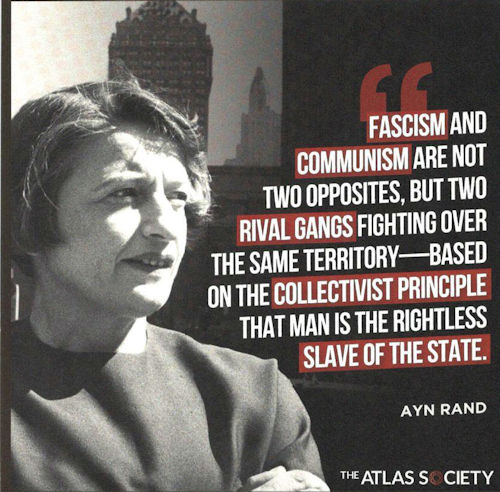
So, along came Ayn Rand. While very spiritual, it was the spirit of an earthly, rational, productive, and happiness-seeking man that she worshiped. She recognized that man lived by his rational faculty, which was his sole source for understanding reality. She reveled in the accomplishments of mind that many people contributed in their professional careers and thought that the system which most enabled these accomplishments was the Capitalist system of free trade in goods, services, and ideas. Religious tribalism or feudalism and socialism, whether of the fascist or communist varieties, squelched the mind and inhibited man's quest to thrive on this earth. She unabashedly identified the source of man's progress in the fruits of individual minds. She endorsed rationality, individuality, ethical egoism, productive achievement, and the quest for personal happiness.

Politically, a highly limited government, such as the framer's of The Constitution attempted to give us, was necessary if man were to be able to exercise his individual right to life, liberty, and the pursuit of happiness. Unfortunately, Americans have always been ambivalent about endorsing rationality, individuality, ethical egoism, productive achievement, and the quest for personal happiness. More than any other country on earth, we tolerated, and sometimes encouraged these human pursuits, but in early times, ancient religious belief interfered and now, more and more, a cheap desire to escape personal responsibility manifests itself in socialist evasions. Along the way, our Constitution has been reinterpreted to turn a requirement that the government behave consistent with the general welfare into an opening to allow almost any government action restricting the rights of the individual if only it was claimed to be in the name of the general welfare. If this had been the intention of the Framers, why would they try so hard to enumerate the few powers that government had? If this broadening of power was not enough, many others, such as a huge broadening of the mandate to regulate interstate trade has been added. It is difficult to make an argument so convoluted and trivial that it is not held that the government has a power to restrict many human activities based upon the commerce clause. As Judge Narragansett says in Galt's Gulch in Atlas Shrugged, an amendment must be added to the Constitution saying that Congress shall make no law abridging trade and depriving the people of their property. Of course now, we must even buttress our right to free speech, which is cruelly abridged by the McCain-Feingold Act, claimed to be an election reform.

Because of American misconceptions of political freedom, we have a society in which the members are pitted against one another on the basis of the industries they work for, the size of the companies they work for, whether they are management or labor, which quintile of income they fall into, whether they own a home or not, whether they have children in the public schools or not, whether they are man or woman, whether they are heterosexual or otherwise, whether they have bought medical insurance or not, whether they are old or young, and based upon their ethnicity. Because government uses its monopoly on the use of force to take up the part of these various groups against the interests of the opposing group, there are constant battles involving those who seek the unearned and those who seek to defend themselves. These are commonly very messy battles, since they have degenerated into very complex mixtures of the legitimate desire to protect oneself and the dastardly desire to take advantage of others. What could be uglier than parents taking advantage of their children by maintaining a Ponzi scheme social security system? What could be more disgusting than one ethnic group claiming special favors from government and discriminating against other ethnic groups. Shouldn't men be judged by their individual character rather than the color of their skin? The politicians and the media by and large encourage this constant factionalization. It gives them more power and brings them more attention and money. The philosophy is clearly to create conflict and to divide and conquer.

If the individual is ever to recover and then to fully realize his right to life, liberty, and the pursuit of happiness, it will be critical that he understand that man can live in harmony with others only by adapting Ayn Rand's philosophy of Objectivism. If the individual is to be respected, it must be understood that he lives by the product of his rational mind. When no man provides for himself by using force to appropriate the means of their living from others who have produced wealth, income, goods, and services by using their minds, then we can earn the shear joy of living as harmoniously as do the great producers of Galt's Gulch in Atlas Shrugged. By giving us such a life-affirming and inspirational view of the possibility of so much joy in living one's own life and sharing it with worthy friends and neighbors, Ayn Rand has given us a book for the ages. Atlas Shrugged should endure as has Homer's Iliad and Odyssey for showing us man as an heroic and joyous being.