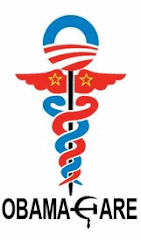
No, I am not going to discuss the federal government subsidy programs of 1804. The number in the title is the number of federal subsidy programs in 2008 according to a recent Cato Institute study by Chris Edwards.
The Catalog of Federal Domestic Assistance, 2,205 pages, lists federal programs for aid, subsidies, grants, loans, insurance, scholarships, and other benefits. The number of such programs by year is reproduced below:
2008 1804
2006 1696 [Edwards, Cato Institute, Tax and Budget Bulletin of 2006]
2005 1645
2000 1425
1995 1390
1990 1176
1985 1013 [Cutbacks by President Ronald Reagan]
1980 1123
1975 1009
1970 1019
The biggest new subsidy program was the $62 billion prescription drug program. Among the other programs are:
Homeland Security Grants $1,040,000,000
Local Firefighter Staffing $180,500,000
Clean Diesel Funding Assistance $156,000,000
Healthy Marriage Promotion $150,000,000
Community Abstinence Education $117,054,000
Education Data Systems Grants $100,000,000
Small Shipyard Grants $98,000,000
Bioenergy Fuels Grants $80,000,000
Specialty Crop Block Grant $49,000,000
Anti-gang State Grants $45,000,000
Laura Bush Librarian Program $26,500,000
Senior Farmers Market Program $22,000,000
As Edwards points out there is more and more funding and, no doubt, interference of the federal government in state and local government affairs revealed in these programs. What on earth is the federal government doing to promote healthy marriages? Frankly, no government has any business messing with marriages. The only proper role of government is to issue domestic partnership contracts as far as I am concerned. Then there is the nonsense and uselessness of the Community Abstinence Education grants! Stay out of our sex lives government! In fact, if government would also stay out of the education business and allow private schooling its proper role, we would have much more rational people and many of their sexual and marriage problems would be ameliorated. Then there are the subsidized fuel programs for clean diesel and for biofuels in this list. The two massively bloated farm bill of 2008 added many subsidies. Examples are apparently the Specialty Crop Block Grants and the Senior Farmers Market Programs above. Why on earth do Senior Farmers need a special market program?
What areas gave rise to the biggest increases in numbers of programs? Here is the list:
Interior, +88
Agriculture, +74
Homeland Security, +64
Transportation, +33
Health & Human Services, +27
Justice, +15
So, not only does Interior hog huge fractions of the land of many states, especially in the west, but it also is especially prolific in producing subsidy programs. I wonder what kind of mischief they are up to, other than refusing to allow anywhere near enough drilling for oil and gas and interfering with attempts to develop coal, tar sands, and oil shale extractions. Both the 2002 and 2008 huge farm bills produced the big increase in the subsidies of the Agriculture Department.
The reasons offered for most of these programs have little to do with their real purpose. The real purpose is always to buy votes in elections. There is little effort ever made to determine the effectiveness of these programs. When a program is shown to be ineffective, it is very rarely ended. Commonly, a completely false assertion is made that they are effective, with the facts being so blatantly ignored that one cannot help but know that the politicians and bureaucrats are lying.
I am still waiting for Congress to end the Ethanol Mandates now that it is well-known scientifically that there is no net energy production from corn-based ethanol and there is no pollution reduction advantage to mixing ethanol in with gasoline. I expect to have to wait a very long time because the program's real reason for existence was always as an excuse to subsidize farming and the ethanol refining companies such as ADM. Meanwhile, the program drives up the cost of corn, corn oil, corn syrup, beef, chicken, and pork directly and because farmland, water, and fertilizer are diverted to corn production, fewer soybean, wheat, and other crops are grown and the farm inputs cost more, which causes their prices to go up due to the ever-present law of supply and demand. This is just an example of the way in which subsidies for one thing drive up costs for many other things in our economy.
If you want to start putting some pressure on the politicians, go to www.usaspending.gov and look up the subsidy programs and who is getting the money and start complaining about it.
Meanwhile, government debt soars and will continue to do so until Americans finally throw the bums out of Washington. Then, the voters must return to the principle that the only non-tyrannical government is that which exists only to protect and defend the sovereign individual right to his own life, his liberty, his property, and his pursuit of happiness. We must insist that politicians are not appointed to choose our values for us and then to force us to live our lives in accordance with the values they have chosen.
Showing posts with label farm bill. Show all posts
Showing posts with label farm bill. Show all posts
25 April 2009


22 May 2008
Democrats: Which Farm Bill Did We Pass?
The House of Representatives, controlled by the Democrats, has just finished over-riding President Bush's veto of the wrongheaded and massive porky farm bill. But, it turns out that the bill sent to the President as the bill voted on by the House, was not the bill voted on by the House. A version of the farm bill not voted on was sent to the President by the Democratic House leadership. Perhaps this is to be fully expected of these foolish politicians, who do not bother to read the bills they vote on. They believe themselves capable of running all aspects of our lives from our health, our use of energy, our use of chemicals, our charities, our education, our hiring and firing, many of our professions and businesses, growing and marketing food, they manage and fund scientific research, and they label us polluters because we breathe out carbon dioxide, but can they do the fundamentals of their own job?
But then the provisions of the farm bill that they will have to go through the motions of passing again will also prove their incompetence. The incompetent Democrats voting to over-ride the President's veto numbered 216 and they were joined by 100 incompetent Republicans. They have plenty of incompetent colleagues in the Senate also. There, the incompetent Senators on their vote before the Presidential veto numbered 85.
There is some good news in this. It will take some time for the House to pass this bill again. This is likely to mean that some other mischief they had planned to do will be pushed off the calender. Too bad that they will find the time to pass a farm bill as bad as that vetoed by the President.
The report on the fiasco by the Washington Times is here.
But then the provisions of the farm bill that they will have to go through the motions of passing again will also prove their incompetence. The incompetent Democrats voting to over-ride the President's veto numbered 216 and they were joined by 100 incompetent Republicans. They have plenty of incompetent colleagues in the Senate also. There, the incompetent Senators on their vote before the Presidential veto numbered 85.
There is some good news in this. It will take some time for the House to pass this bill again. This is likely to mean that some other mischief they had planned to do will be pushed off the calender. Too bad that they will find the time to pass a farm bill as bad as that vetoed by the President.
The report on the fiasco by the Washington Times is here.
05 May 2008
Congress Backpeddling on Ethanol
It seems clear now that both the Democrats and the Republicans in Congress are largely coming to the conclusion that they made a big mistake in backing ethanol mandates, subsidies, and exclusionary tariffs. Some aspects of the magnitude of their mistake have only relatively recently become clear such as the fact that there is probably no net energy achieved with the use of farmed plants to create ethanol, with the possible exception of sugar cane grown in some very favorable areas. Another example of recent knowledge is that ethanol use does not likely reduce net pollution when all factors are accounted for. On the other hand, the idea that one-quarter of all corn could be used to create ethanol and that this would not greatly increase the cost of corn, those end products dependent upon corn such as beef, pork, chicken, corn oil, and corn syrup, and of soybeans and wheat as corn was planted in their stead, was ludicrous. This year, 35% of the corn crop may be going to ethanol production.
President Bush is still saying that the ethanol mandates are not barely responsible for the food cost increases. He is disappointingly slow on coming around on this. It is true that corn and other food prices are going up both because of the reduction of supply due to the ethanol mandates and due to a major increase in world-wide demand for better and more food.
Congress has pleasantly surprised me by starting to change course so soon. House Minority Leader Steny Hoyer, Democrat, is not as nimble-minded as he should be, but he is now advocating that the upcoming farm bill, delayed from last year, should reduce the ethanol subsidy. They would also increase the subsidy for cellulosic ethanol. He has said, "Obviously, sometimes there are unforseen or unintended consequences of actions." Imagine a committed socialist allowing that he is not omnipotent! Even that he may have been wrong-headed!
Republicans in Congress actually want now to remove mandates requiring the blending of ethanol with gasoline. Representative Jeff Flake, Arizona Republican, introduced a bill to end all federal ethanol supports, including the requirement to blend it with gas, the tax credits for ethanol refiners, and the tariffs to prevent the importation of sugar cane produced ethanol, primarily from Brazil. He recognizes that our economy does not need big increases in food prices on top of those for energy, such as oil. Senator Kay Bailey Hutchison, Texas Republican, wants to freeze the ethanol mandate for gasoline at this year's level. On Rush Limmbaugh's program, she noted that cattle and pig producers were being hurt badly. Apparently there are a few of them in Texas! Rick Perry, Texas governor, has asked the EPA to allow Texas to use only half as much ethanol in gasoline blends as is required.
Meanwhile, some farmers are asking Congress to put windfall taxes on oil producing companies, claiming that these companies are responsible for driving up their costs. The National Corn Growers Association made the foolish claim that the use of biofuels with gasoline was saving Americans $69 billion a year. Others such as Hillary Clinton are also demagogically calling for windfall profit taxes on the oil companies.
President Bush is still saying that the ethanol mandates are not barely responsible for the food cost increases. He is disappointingly slow on coming around on this. It is true that corn and other food prices are going up both because of the reduction of supply due to the ethanol mandates and due to a major increase in world-wide demand for better and more food.
Congress has pleasantly surprised me by starting to change course so soon. House Minority Leader Steny Hoyer, Democrat, is not as nimble-minded as he should be, but he is now advocating that the upcoming farm bill, delayed from last year, should reduce the ethanol subsidy. They would also increase the subsidy for cellulosic ethanol. He has said, "Obviously, sometimes there are unforseen or unintended consequences of actions." Imagine a committed socialist allowing that he is not omnipotent! Even that he may have been wrong-headed!
Republicans in Congress actually want now to remove mandates requiring the blending of ethanol with gasoline. Representative Jeff Flake, Arizona Republican, introduced a bill to end all federal ethanol supports, including the requirement to blend it with gas, the tax credits for ethanol refiners, and the tariffs to prevent the importation of sugar cane produced ethanol, primarily from Brazil. He recognizes that our economy does not need big increases in food prices on top of those for energy, such as oil. Senator Kay Bailey Hutchison, Texas Republican, wants to freeze the ethanol mandate for gasoline at this year's level. On Rush Limmbaugh's program, she noted that cattle and pig producers were being hurt badly. Apparently there are a few of them in Texas! Rick Perry, Texas governor, has asked the EPA to allow Texas to use only half as much ethanol in gasoline blends as is required.
Meanwhile, some farmers are asking Congress to put windfall taxes on oil producing companies, claiming that these companies are responsible for driving up their costs. The National Corn Growers Association made the foolish claim that the use of biofuels with gasoline was saving Americans $69 billion a year. Others such as Hillary Clinton are also demagogically calling for windfall profit taxes on the oil companies.
14 April 2008
Tax Monies Making Some Farmers Rich
"Oh, come on Charles, now you are going to claim that the farm subsidy program, which is meant to keep the family farm in existence, is just another government mistake or a fraud! Heck, we sent the Senators and Representatives we want to Congress and they, in their wisdom, believe the farmers need this help. This is fine, because there is something reassuring and comforting in knowing that many Americans families are still able to stay close to the soil."
Two-thirds of American farmers do not receive Federal subsidies. There are no guaranteed prices or protection for the production of cherries, melons, almonds, potatoes, pears, grapes, blueberries, apples, pistachios, lettuce, celery, cabbage, cauliflower, beef, and poultry. Despite this, these foods are farmed profitably and represent two-thirds of the value of the agricultural market. Corn, soybeans, cotton, rice, wheat, milk, sugar, peanuts, tobacco, and cotton are subsidized. The first five, corn through wheat, receive more than 90% of all farm payments. In 2004, government support for farm production provided 18% of all farm income. Did this subsidy money go largely to small family farmers?
NO. In 2003, the top 10% in subsidy payments received were paid 68% of the Federal farm support funds. The top 5% were paid 55%! Riceland Foods of Stuttgart, Arkansas received $68.9 million as the largest single recipient. Producers Rice Mill of the same town received the second largest payment of $51.4 million. In more recent years, the top 10% have edged upward to getting about 72% of the payment amount. Fortune 500 companies on farm welfare include Archer Daniels Midland, International Paper, Westvaco, John Hancock Insurance, Chevron, Electronic Data Systems, and Caterpillar. Multi-multi-millionaires such as Ted Turner, Edgar Bronfman, and David Rockefeller are on the farm dole. Many of the politicians who vote for these farm supports in the Congress are also on the dole, including Representative John Salazar (Colorado Democrat) and Charles Grassley (Iowa Republican). These are certainly not the small family farmers most Americans seem to think are the ones being helped by the farm subsidy programs.
But to look on the bright side, the program does raise the dead! The Senate Finance Committee asked the GAO to perform an audit of the subsidies and they found that from 1999 to 2005, the Agriculture Department sent out payments totaling $1.1 billion to more than 170,000 dead people. 40% of the dead had been dead more than 3 years and 19% had been dead more than 7 years. How happy their relatives must have been to have such consolation from the Dept. of Agriculture! Overall improper payments were found to be over $500 million per year. Democrat Senator Harkin said, "Given the extremely tight budget restraints it is no longer tolerable to permit billions of farm bill payments to go to individuals who in instances don't even farm or are no longer alive." Aren't we all very reassured that he is on the job and watching over our tax money with such enthusiasm and vigor now that the budgets are restrained for the first time? Hmm....you and I have always been aware that our budgets were restrained, how is it that he has just become aware that his budget is restrained?
If we look at average farm household income in 2005, we find it was $79,965 or 26% higher than the average household income of all Americans. This was not a fluke year. In 2006, it was $81,420, or 29% above the national average. Agricultural prices are high and farm property values have risen greatly. Corn prices were up 41% for the 12 months prior to 25 March. Soybeans were up 74% and wheat prices were up 126%. The soybean and wheat prices were up even more than corn prices because subsidies for corn and for ethanol drove farmers to convert some land from growing soybeans and wheat to growing corn. The lessened supply of soybeans and wheat caused their prices to go up. Net farm income grew 48% from 2006 to 2007. In 2002, farm profits were $40.1 billion and in 2007 they were $87.5 billion. Farm land prices have risen 78.5% since 2002.
Between 2003 and 2006, the total of the net farm profits in those four years was $279 billion, which was the highest 4-year total ever. Despite these profits, the Senate Agriculture Committee, under Chairman Tom Harkin, Democrat of Iowa, approved a new farm subsidy program totaling $288 billion over the five-year life of the new farm bill. The Senate version and the House versions had some differences and they have been unable to resolve them, so the government is operating under an extension of the 2002 Farm Bill which was supposed to be revised and reapproved in 2007. A major difference is that the Senate wanted to put an upper limit on how much money could go to an individual and how much could go to a husband and wife, while the House refused to do so.
Aside from being soaked as taxpayers, we are also being soaked as food consumers. Between March of 2007 and March of 2008, the price of a dozen eggs went up 40%, milk went up 26%, and bread has gone up 11%. Beef prices have gone up about 20% since 2006. The sugar protective tariff program guarantees a price of $0.229 per pound for beet sugar and $0.18/pound for cane sugar. The world price is only about $0.10/pound for sugar. The U.S. International Trade Commission found that between 2000 and 2002 the average domestic price of nonfat milk was 23% higher than the world price, cheese was 37% higher, and butter was more than double the world price. Trade policy also increased the price of cotton, beef, peanuts, orange juice, and canned tuna. The mounting concerns about inflation are being fueled largely by energy costs going up and by rising food costs. The government drives up fuel costs by denying drilling for oil in the U.S., by holding the oil shale and tar sand lands in the West, and with its ethanol policy. They drive up food costs with their subsidies, their tariffs on imported foods, and their ethanol mandates.
These higher costs for food and food inputs hurt the restaurant business and it hurts the food industry dependent upon food product exports. This results in less investment in those industries, fewer employees, lower payscales, and hurts our overall export value. Food production is a major American business strength, but with our tariffs and our subsidies, we discourage greater productivity and decrease innovations in these industries. Their contribution to the balance of trade is then reduced. The number of sugar refineries in the last 20 years has dropped from 23 to 8. The confectionary industry, once very big in Chicago, has been bleeding badly. Farm subsidy reform is also required as part of the World Trade Organization talks to reduce tariff barriers to trade. Lacking that, we are reducing the exports of many other industries as well. The World Bank estimates that the removal of world trade barriers to farm products would result in world farm exports becoming 74% higher in 2015 than without this reform. U.S. exports would be up $88 billion, while our imports would rise by $28 billion, giving us a surplus in trade of $60 billion.
For about 100 years the amount of land being farmed has been dropping in the U.S. This has led to the regrowth of huge acreage of forested land. The current drive to use huge amounts of farmland to grow corn for ethanol and the fact that farm crop subsidies encourage land to be used in general for the purpose of receiving as much subsidy money as possible, is likely to cause an increase in the amount of land farmed. This also means that more marginal, less suitable land will be farmed. Plowed land produces more silt in rivers and lakes. The use of more fertilizer and insecticides results in more pollutants in our rivers, lakes, and bays. The EPA says that 72% of our rivers and 56% of our lakes suffer from agriculturally caused pollution. Agricultural water subsidies cost $2 billion per year and encourage the growing of cotton in Arizona, where that water could and should be put to better uses. The sugar supports cause farmers to grow sugar cane in Central Florida, where they have taken large amounts of water from the Everglades. The damage that has done to the Everglades allowed Congress to spend billions more tax dollars to provide a bit of mitigation to the problems caused.
The fact that we do not import more foods from abroad hurts the small farmers in many underdeveloped countries around the world. In many cases, our subsidy-induced overproduction drives world prices for some farm commodities down and makes it difficult for them to compete. It rightfully causes many of them to resent us, despite the fact that most developed countries have higher protective tariff barriers for their agricultural industries than we do. In 2004, the European Union provided 33% of farm income through subsidies, while the U.S. provided 18%. Japan provides 56%, Canada 21%, South Korea 63%, Turkey 27%, Switzerland 68%, and Mexico 17%. The good guys here are Australia at 4% and New Zealand at 3%! In terms of an equivalent tariff, the U.S. support for agriculture is 19.9%, while the European Union provides support at a 46.4% rate and Japan at an 82.0% rate. So, there are worse actors in the world, but we are nonetheless hurting ourselves and many of the poor in less developed areas of the world. This harm is not compensated by our foreign aid programs.
So, why are our elite rulers, our elected politicians who know what is best for us peon citizens, shoving these stupid programs with their baleful consequences down our throats? Apparently because we are either too uninformed to notice the problems or we simply do not have enough incentive to spend our time fighting them. There are special interests out there who have a lot to gain from these foolish programs for farm supports and they do fight hard for them. Hard enough to get the programs passed through Congress and signed by a President over and over since the Great Depression. We taxpayers and food consumers just keep taking it on the jaw and do nothing. We do not protest loudly that this is all clearly unconstitutional. We do not get angry at our tax bill. We do not mind paying much more for food. And we certainly do not care that the U.S. exports less, employs fewer people, and we earn less, all as consequences of these stupid programs.
The U.S. farm support programs fit the pattern of unconstitutional government programs, which clearly hurt the General Welfare and do not lie within the enumerated powers of Congress, and yet they proliferate. They do serve unethical and unprincipled Congressmen and the recipients of the major welfare payments. If the farm support program does not hurt most of us enough to get up off our rear ends and fight for our individual rights, then one would hope that the sum of these many deleterious programs would give us sufficient incentive. This problem is repeated over and over at all levels of government. We must learn to fight it by standing on our principles and never letting up in our fight for the rights of the individual against all such intrusions and all such little enslavements. The sum of the enslavements is no minor thing. The only pragmatic way to fight them is to stand on our principles and demand that our elected officials and all special interests give way to those principles. When government makes it its duty to protect the rights of the individual to life, liberty, and the pursuit of happiness, then it justifies its existence in the only way it can do so. Otherwise, it does evil to most of us and evil to future generations.
Two-thirds of American farmers do not receive Federal subsidies. There are no guaranteed prices or protection for the production of cherries, melons, almonds, potatoes, pears, grapes, blueberries, apples, pistachios, lettuce, celery, cabbage, cauliflower, beef, and poultry. Despite this, these foods are farmed profitably and represent two-thirds of the value of the agricultural market. Corn, soybeans, cotton, rice, wheat, milk, sugar, peanuts, tobacco, and cotton are subsidized. The first five, corn through wheat, receive more than 90% of all farm payments. In 2004, government support for farm production provided 18% of all farm income. Did this subsidy money go largely to small family farmers?
NO. In 2003, the top 10% in subsidy payments received were paid 68% of the Federal farm support funds. The top 5% were paid 55%! Riceland Foods of Stuttgart, Arkansas received $68.9 million as the largest single recipient. Producers Rice Mill of the same town received the second largest payment of $51.4 million. In more recent years, the top 10% have edged upward to getting about 72% of the payment amount. Fortune 500 companies on farm welfare include Archer Daniels Midland, International Paper, Westvaco, John Hancock Insurance, Chevron, Electronic Data Systems, and Caterpillar. Multi-multi-millionaires such as Ted Turner, Edgar Bronfman, and David Rockefeller are on the farm dole. Many of the politicians who vote for these farm supports in the Congress are also on the dole, including Representative John Salazar (Colorado Democrat) and Charles Grassley (Iowa Republican). These are certainly not the small family farmers most Americans seem to think are the ones being helped by the farm subsidy programs.
But to look on the bright side, the program does raise the dead! The Senate Finance Committee asked the GAO to perform an audit of the subsidies and they found that from 1999 to 2005, the Agriculture Department sent out payments totaling $1.1 billion to more than 170,000 dead people. 40% of the dead had been dead more than 3 years and 19% had been dead more than 7 years. How happy their relatives must have been to have such consolation from the Dept. of Agriculture! Overall improper payments were found to be over $500 million per year. Democrat Senator Harkin said, "Given the extremely tight budget restraints it is no longer tolerable to permit billions of farm bill payments to go to individuals who in instances don't even farm or are no longer alive." Aren't we all very reassured that he is on the job and watching over our tax money with such enthusiasm and vigor now that the budgets are restrained for the first time? Hmm....you and I have always been aware that our budgets were restrained, how is it that he has just become aware that his budget is restrained?
If we look at average farm household income in 2005, we find it was $79,965 or 26% higher than the average household income of all Americans. This was not a fluke year. In 2006, it was $81,420, or 29% above the national average. Agricultural prices are high and farm property values have risen greatly. Corn prices were up 41% for the 12 months prior to 25 March. Soybeans were up 74% and wheat prices were up 126%. The soybean and wheat prices were up even more than corn prices because subsidies for corn and for ethanol drove farmers to convert some land from growing soybeans and wheat to growing corn. The lessened supply of soybeans and wheat caused their prices to go up. Net farm income grew 48% from 2006 to 2007. In 2002, farm profits were $40.1 billion and in 2007 they were $87.5 billion. Farm land prices have risen 78.5% since 2002.
Between 2003 and 2006, the total of the net farm profits in those four years was $279 billion, which was the highest 4-year total ever. Despite these profits, the Senate Agriculture Committee, under Chairman Tom Harkin, Democrat of Iowa, approved a new farm subsidy program totaling $288 billion over the five-year life of the new farm bill. The Senate version and the House versions had some differences and they have been unable to resolve them, so the government is operating under an extension of the 2002 Farm Bill which was supposed to be revised and reapproved in 2007. A major difference is that the Senate wanted to put an upper limit on how much money could go to an individual and how much could go to a husband and wife, while the House refused to do so.
Aside from being soaked as taxpayers, we are also being soaked as food consumers. Between March of 2007 and March of 2008, the price of a dozen eggs went up 40%, milk went up 26%, and bread has gone up 11%. Beef prices have gone up about 20% since 2006. The sugar protective tariff program guarantees a price of $0.229 per pound for beet sugar and $0.18/pound for cane sugar. The world price is only about $0.10/pound for sugar. The U.S. International Trade Commission found that between 2000 and 2002 the average domestic price of nonfat milk was 23% higher than the world price, cheese was 37% higher, and butter was more than double the world price. Trade policy also increased the price of cotton, beef, peanuts, orange juice, and canned tuna. The mounting concerns about inflation are being fueled largely by energy costs going up and by rising food costs. The government drives up fuel costs by denying drilling for oil in the U.S., by holding the oil shale and tar sand lands in the West, and with its ethanol policy. They drive up food costs with their subsidies, their tariffs on imported foods, and their ethanol mandates.
These higher costs for food and food inputs hurt the restaurant business and it hurts the food industry dependent upon food product exports. This results in less investment in those industries, fewer employees, lower payscales, and hurts our overall export value. Food production is a major American business strength, but with our tariffs and our subsidies, we discourage greater productivity and decrease innovations in these industries. Their contribution to the balance of trade is then reduced. The number of sugar refineries in the last 20 years has dropped from 23 to 8. The confectionary industry, once very big in Chicago, has been bleeding badly. Farm subsidy reform is also required as part of the World Trade Organization talks to reduce tariff barriers to trade. Lacking that, we are reducing the exports of many other industries as well. The World Bank estimates that the removal of world trade barriers to farm products would result in world farm exports becoming 74% higher in 2015 than without this reform. U.S. exports would be up $88 billion, while our imports would rise by $28 billion, giving us a surplus in trade of $60 billion.
For about 100 years the amount of land being farmed has been dropping in the U.S. This has led to the regrowth of huge acreage of forested land. The current drive to use huge amounts of farmland to grow corn for ethanol and the fact that farm crop subsidies encourage land to be used in general for the purpose of receiving as much subsidy money as possible, is likely to cause an increase in the amount of land farmed. This also means that more marginal, less suitable land will be farmed. Plowed land produces more silt in rivers and lakes. The use of more fertilizer and insecticides results in more pollutants in our rivers, lakes, and bays. The EPA says that 72% of our rivers and 56% of our lakes suffer from agriculturally caused pollution. Agricultural water subsidies cost $2 billion per year and encourage the growing of cotton in Arizona, where that water could and should be put to better uses. The sugar supports cause farmers to grow sugar cane in Central Florida, where they have taken large amounts of water from the Everglades. The damage that has done to the Everglades allowed Congress to spend billions more tax dollars to provide a bit of mitigation to the problems caused.
The fact that we do not import more foods from abroad hurts the small farmers in many underdeveloped countries around the world. In many cases, our subsidy-induced overproduction drives world prices for some farm commodities down and makes it difficult for them to compete. It rightfully causes many of them to resent us, despite the fact that most developed countries have higher protective tariff barriers for their agricultural industries than we do. In 2004, the European Union provided 33% of farm income through subsidies, while the U.S. provided 18%. Japan provides 56%, Canada 21%, South Korea 63%, Turkey 27%, Switzerland 68%, and Mexico 17%. The good guys here are Australia at 4% and New Zealand at 3%! In terms of an equivalent tariff, the U.S. support for agriculture is 19.9%, while the European Union provides support at a 46.4% rate and Japan at an 82.0% rate. So, there are worse actors in the world, but we are nonetheless hurting ourselves and many of the poor in less developed areas of the world. This harm is not compensated by our foreign aid programs.
So, why are our elite rulers, our elected politicians who know what is best for us peon citizens, shoving these stupid programs with their baleful consequences down our throats? Apparently because we are either too uninformed to notice the problems or we simply do not have enough incentive to spend our time fighting them. There are special interests out there who have a lot to gain from these foolish programs for farm supports and they do fight hard for them. Hard enough to get the programs passed through Congress and signed by a President over and over since the Great Depression. We taxpayers and food consumers just keep taking it on the jaw and do nothing. We do not protest loudly that this is all clearly unconstitutional. We do not get angry at our tax bill. We do not mind paying much more for food. And we certainly do not care that the U.S. exports less, employs fewer people, and we earn less, all as consequences of these stupid programs.
The U.S. farm support programs fit the pattern of unconstitutional government programs, which clearly hurt the General Welfare and do not lie within the enumerated powers of Congress, and yet they proliferate. They do serve unethical and unprincipled Congressmen and the recipients of the major welfare payments. If the farm support program does not hurt most of us enough to get up off our rear ends and fight for our individual rights, then one would hope that the sum of these many deleterious programs would give us sufficient incentive. This problem is repeated over and over at all levels of government. We must learn to fight it by standing on our principles and never letting up in our fight for the rights of the individual against all such intrusions and all such little enslavements. The sum of the enslavements is no minor thing. The only pragmatic way to fight them is to stand on our principles and demand that our elected officials and all special interests give way to those principles. When government makes it its duty to protect the rights of the individual to life, liberty, and the pursuit of happiness, then it justifies its existence in the only way it can do so. Otherwise, it does evil to most of us and evil to future generations.
Subscribe to:
Posts (Atom)







 Posts
Posts