Steve Forbes discusses the Federal Reserve action on its latest stress tests of the nation's 18 largest banks in his Fact & Comment in the 6 May issue of Forbes. Of the 18 biggest banks, the Federal Reserve claimed four had serious problems which it said must be cleared up. Ally Financial is the present name for GM's bankrupt and reorganized financial services arm. It is in real trouble. But Steve Forbes claims that JPMorgan Chase, Goldman Sachs, and BB&T were named as having problems purely for small-minded political reasons.
JPMorgan's Jamie Dimon has expressed displeasure with the Obama administration, but it is a well-run company with a good balance sheet. Goldman Sachs was too close to Romney and Lloyd Blankfein also made it clear he is not happy with Obama. So, the Federal Reserve concocted reasons to fault these two institutions.
Most troubling was the claim that the best run major bank in the entire nation had serious problems because it uses its own economic models and judges its own loan portfolio differently than the Federal Reserve wants it to. Independent thinking is discouraged, even when a company's track record justifies it to any rational observer. In fact, if all banks work on one model, the risks of a systemic banking failure go up. This is especially true when the dictated model is designed by bureaucrats for their purposes, not those of the private sector. It is even more true when the appointments to the Federal Reserve are poisoned by Obama appointees.
Steve Forbes notes that the Basel Accords required banks to have heavy reserves for loans to even the best commercial companies, but none for loans to Greece or Iceland or Ireland. Those government accords also enshrined mortgages for special low reserve treatment. Look where these imposed government models led the world financial institutions in 2008 and 2009.
BB&T bank CEO John Allison IV, now retired and heading the Cato Institute, opposed the TARP program and was most forcefully forced to take that money in 2008-2009. His bank was so well run it had no need for the money. The Federal Reserve wanted to hide the worst banks by making sound banks take the money and it was hiding potential losses on its loans by making a forced profit in interest from sound banks that did not want the money in the first place. Allison further earned the enmity of the Federal Reserve and the Obama Regime by writing The Financial Crisis and the Free Market Cure - Why Pure Capitalism is the World Economy's Only Hope, published in 2013 by McGraw Hill.
Government thugs cannot stand the heat of criticism, especially when it is well-stated. In the Obama Chicago style, they strike back brutally with the misuse of government power. You do as they say, or they will breaka you knee caps.
Showing posts with label loans. Show all posts
Showing posts with label loans. Show all posts


05 November 2012
Why Romney is Better for Small Businesses
Businesses that pay taxes at the individual income tax rate employ 54% of American workers. Obama wants to raise the marginal income tax rate of business owners making more than $200,000 a year, while Romney wants to lower this marginal tax rate by 20%. Obama will raise the marginal tax rate in the two highest income tax brackets from 35 to 39.6% and from 33 to 36%. He will add a 0.9% increase in Medicare taxes to people in these brackets and will increase the tax rate on dividends, interest, and capital gains by 3.8% beginning in January. He will reduce their deductions as well, which will make their marginal tax rate a real 44.8%.
As Obama says, these tax rates will not apply to 97% of small business owners, but they will apply to those who hire most of the new employees. In 2008, there were 27.28 million companies and only 18,469 had more than 500 employees. This means that about 27.26 million firms are small businesses or about 99.93% of all businesses are small businesses. 78.26% of all firms had no employees. Those with 4 or fewer employees accounted for 91.6% of all small businesses. The businesses that account for most of the new hiring employ from 20 to 499 employees and these are only about 2.3% of all businesses. Most of the high income business owners Obama wants to tax at 44.8% marginal rates are owners of such businesses. Such high marginal tax rates will serve as a strong disincentive to work so hard to grow a company.
Small businesses are the result of free associations of individuals in the private sector, not the government sector, or the falsely, but optimistically termed public sector. The owner(s) of the small business voluntarily formed the business to supply services or goods to others in voluntary trade. The owner(s) may hire employees, who voluntarily trade their labor for a wage or salary. The only necessary role of government is to prevent others from using force to interfere with these voluntary trades and associations. Small businesses are very much creatures of the private sector.
Large businesses are sometimes in a position to purchase politicians to bend the excessive powers of big government to provide them with special advantages, much as labor unions and trial lawyers do the same. Among the favorite tactic of such nefarious big businesses is the use of excessive regulations to reduce the ability of otherwise lean and determined smaller businesses to compete with them. The big business can readily hire several compliance lawyers and accountants, while hiring one of each is a huge expense for the competing small business. Of course, under Obama, the big business just has legislation passed that directly gives it an advantage, such as a mandate that people must use their product or service. The green energy companies and the Too-Big-To-Fail financial companies are the recipients of such advantages. So are ethanol producers. Almost any advantage an unethical big business gets with its political pull is harmful to most small businesses.
Small business owners tend to be more independent-minded and more individualistic than most people. They are willing to take on a greater amount of self-responsibility and the risks that manifestly come with trying to build a small business. They have to carefully identify their values and control their limited resources with wisdom and understanding. These are not the traits of people who wish to be dependents of government in its Nanny State guise. Small business owners tend to be willing to rise or fall based upon their own productivity.
Broadly speaking, the Democratic Party is more the champion of big government than is the Republican Party. In particular, it tends to be anti-economic rights in its viewpoint. Property rights, the right to earn a living, the right to hire employees exercising freedom of contract, the right to travel, the right to trade goods and services with others under the freedom of contract, and the right to create new ideas, goods, and services are all critical individual rights which small businesses require to flourish. It is the maximization of these freedoms, not special interest favors, that small businesses need most to have the opportunity to succeed.
That the greatest need of small businesses is economic freedom is seen empirically by studies that rank nations and states (here, here, and here) by their economic freedom and examine their economic growth. Generally, a small business does better when its customers are doing better, so targeted favors from government are of little use if your customer and suppliers are not doing equally well. Bigger and growing markets also tend to bring down the costs of its business inputs more as more innovation occurs and businesses can take more advantage of scale or find more niche markets adequate to their growth.
Independent-minded small businessmen should want this open field of a healthy and robust private sector to operate in. They are not equipped to field an army of lobbyists to protect themselves from politician's attempt to extort money from them. They are not able to come up with the campaign donation bribes to pay the game of seeking special interest legislation or regulations. The small business owner has his mind fully occupied by the business needs of his business and does not need a ton of government paperwork to do, hundreds of thousands of pages of government regulations to read and decipher, long discussions with politicians behind closed doors, and weeks of hearings and trials to attend. Neither does he want subsidies, credits, and deductions which are supposed to reward him for obeying the wishes of politicians. He is an independent businessman because he wants to do things his way, not as the manipulated serf of a politician.
Obama has been making the claim that he has lowered taxes for small businesses 18 times. Yes, he has manipulated small businesses with a number of small or short term tax breaks. My own small business has never benefited from any of these tax breaks. In the Obama economy, I have not been able to hire an additional employee, so I have not received the benefit of paying only 90% of the taxes owed on quarterly tax payments, with the rest to be made up at the end of the year. No, I have had no advantage from this also since my company pays payroll taxes every month in full. Small business owners are not allowed to deduct the cost of their health insurance premiums, but for one year (2010) Obama allowed relief from this nasty ill-treatment of business owners. In a couple of years, the amount of equipment one could deduct in the year of purchase was increased, but the usual lower amount is much more than most small businesses can purchase in a year anyway, so only a few small businesses can benefit from this tax break. Start-up costs of up to $10,000 for a new business can now be deducted instead of a paltry $5,000, but that is worth little unless the start-up business makes money quickly. And then it is still worth little.
Obama claims to have increased Small Business Administration loans. They come with incredible paperwork, long wait times, and are for relatively small amounts. It is easier to earn the money and pay for growth from earnings than to try to get money from the SBA. Or, many small businesses used to finance growth by taking money from the refinance of the owner's home, but the policies of big government that led to the sub-prime mortgage bubble have killed that option for capital seed money. Obama and the Democrats were especially prominent in support of the sub-prime loan bubble and its collapse. The SBA programs for which Obama increased funding are directed at sub-prime loans to small businesses. Many of them will fail when they cannot make their loan payments.
Obama's website for Small Business Owners claims that:
The SBA 7(a) Loan Program is ideal for businesses with less established credit histories looking to borrow up to $5,000,000. Great, but what responsible small businessman will borrow anything like $5 million when his business is not well-established enough that he can be sure to pay back so much money? I suppose the answer is a Democrat businessman, especially one who has bundled campaign contribution money for Obama.
The supposition of all of Obama's small business programs is that a small business wants to partner in some way with the government. Well, no, most of us just do not want government to view us as a source of income for wasteful government spending, such as on green energy subsidies. We do not want to pay higher taxes on our marginal income if we manage to generate a profit. We really just want government to stay off our backs and out of our way as we exercise the economic rights which legitimate government is supposed to protect, not violate.
As Obama says, these tax rates will not apply to 97% of small business owners, but they will apply to those who hire most of the new employees. In 2008, there were 27.28 million companies and only 18,469 had more than 500 employees. This means that about 27.26 million firms are small businesses or about 99.93% of all businesses are small businesses. 78.26% of all firms had no employees. Those with 4 or fewer employees accounted for 91.6% of all small businesses. The businesses that account for most of the new hiring employ from 20 to 499 employees and these are only about 2.3% of all businesses. Most of the high income business owners Obama wants to tax at 44.8% marginal rates are owners of such businesses. Such high marginal tax rates will serve as a strong disincentive to work so hard to grow a company.
Small businesses are the result of free associations of individuals in the private sector, not the government sector, or the falsely, but optimistically termed public sector. The owner(s) of the small business voluntarily formed the business to supply services or goods to others in voluntary trade. The owner(s) may hire employees, who voluntarily trade their labor for a wage or salary. The only necessary role of government is to prevent others from using force to interfere with these voluntary trades and associations. Small businesses are very much creatures of the private sector.
Large businesses are sometimes in a position to purchase politicians to bend the excessive powers of big government to provide them with special advantages, much as labor unions and trial lawyers do the same. Among the favorite tactic of such nefarious big businesses is the use of excessive regulations to reduce the ability of otherwise lean and determined smaller businesses to compete with them. The big business can readily hire several compliance lawyers and accountants, while hiring one of each is a huge expense for the competing small business. Of course, under Obama, the big business just has legislation passed that directly gives it an advantage, such as a mandate that people must use their product or service. The green energy companies and the Too-Big-To-Fail financial companies are the recipients of such advantages. So are ethanol producers. Almost any advantage an unethical big business gets with its political pull is harmful to most small businesses.
Small business owners tend to be more independent-minded and more individualistic than most people. They are willing to take on a greater amount of self-responsibility and the risks that manifestly come with trying to build a small business. They have to carefully identify their values and control their limited resources with wisdom and understanding. These are not the traits of people who wish to be dependents of government in its Nanny State guise. Small business owners tend to be willing to rise or fall based upon their own productivity.
Broadly speaking, the Democratic Party is more the champion of big government than is the Republican Party. In particular, it tends to be anti-economic rights in its viewpoint. Property rights, the right to earn a living, the right to hire employees exercising freedom of contract, the right to travel, the right to trade goods and services with others under the freedom of contract, and the right to create new ideas, goods, and services are all critical individual rights which small businesses require to flourish. It is the maximization of these freedoms, not special interest favors, that small businesses need most to have the opportunity to succeed.
That the greatest need of small businesses is economic freedom is seen empirically by studies that rank nations and states (here, here, and here) by their economic freedom and examine their economic growth. Generally, a small business does better when its customers are doing better, so targeted favors from government are of little use if your customer and suppliers are not doing equally well. Bigger and growing markets also tend to bring down the costs of its business inputs more as more innovation occurs and businesses can take more advantage of scale or find more niche markets adequate to their growth.
Independent-minded small businessmen should want this open field of a healthy and robust private sector to operate in. They are not equipped to field an army of lobbyists to protect themselves from politician's attempt to extort money from them. They are not able to come up with the campaign donation bribes to pay the game of seeking special interest legislation or regulations. The small business owner has his mind fully occupied by the business needs of his business and does not need a ton of government paperwork to do, hundreds of thousands of pages of government regulations to read and decipher, long discussions with politicians behind closed doors, and weeks of hearings and trials to attend. Neither does he want subsidies, credits, and deductions which are supposed to reward him for obeying the wishes of politicians. He is an independent businessman because he wants to do things his way, not as the manipulated serf of a politician.
Obama has been making the claim that he has lowered taxes for small businesses 18 times. Yes, he has manipulated small businesses with a number of small or short term tax breaks. My own small business has never benefited from any of these tax breaks. In the Obama economy, I have not been able to hire an additional employee, so I have not received the benefit of paying only 90% of the taxes owed on quarterly tax payments, with the rest to be made up at the end of the year. No, I have had no advantage from this also since my company pays payroll taxes every month in full. Small business owners are not allowed to deduct the cost of their health insurance premiums, but for one year (2010) Obama allowed relief from this nasty ill-treatment of business owners. In a couple of years, the amount of equipment one could deduct in the year of purchase was increased, but the usual lower amount is much more than most small businesses can purchase in a year anyway, so only a few small businesses can benefit from this tax break. Start-up costs of up to $10,000 for a new business can now be deducted instead of a paltry $5,000, but that is worth little unless the start-up business makes money quickly. And then it is still worth little.
Obama claims to have increased Small Business Administration loans. They come with incredible paperwork, long wait times, and are for relatively small amounts. It is easier to earn the money and pay for growth from earnings than to try to get money from the SBA. Or, many small businesses used to finance growth by taking money from the refinance of the owner's home, but the policies of big government that led to the sub-prime mortgage bubble have killed that option for capital seed money. Obama and the Democrats were especially prominent in support of the sub-prime loan bubble and its collapse. The SBA programs for which Obama increased funding are directed at sub-prime loans to small businesses. Many of them will fail when they cannot make their loan payments.
Obama's website for Small Business Owners claims that:
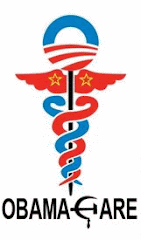
When President Obama took office, American small businesses were struggling under the devastating effects of the recession, runaway health care costs, and a credit freeze created by the Wall Street meltdown.How interesting. Small businesses, especially most of those serving mid- and large-size businesses are still feeling a recession due to the $2 trillion that these companies have been hording rather than using to buy the services of small businesses. Our healthcare costs have only increased due to ObamaCare, or the ObamaUncaringTax according the Supreme Court Chief Justice Roberts. The quote on our healthcare plan for my business went up 20% this year. We had to drop the benefit as many other small and larger companies have also done. Thanks to the Obama FDIC, the Federal Reserve, and the Dodd-Frank so-called financial reform law, it is still very hard for a small business to get a loan. Of course, who wants a loan when the economy is so bad and so variable that one cannot be sure one can make the payments on it?
The SBA 7(a) Loan Program is ideal for businesses with less established credit histories looking to borrow up to $5,000,000. Great, but what responsible small businessman will borrow anything like $5 million when his business is not well-established enough that he can be sure to pay back so much money? I suppose the answer is a Democrat businessman, especially one who has bundled campaign contribution money for Obama.
The supposition of all of Obama's small business programs is that a small business wants to partner in some way with the government. Well, no, most of us just do not want government to view us as a source of income for wasteful government spending, such as on green energy subsidies. We do not want to pay higher taxes on our marginal income if we manage to generate a profit. We really just want government to stay off our backs and out of our way as we exercise the economic rights which legitimate government is supposed to protect, not violate.
06 September 2010
The Soon-to-Burst Education Bubble
In early June, Glenn H. Reynolds, professor of law at the University of Tennessee and the Instapundit, wrote that the education bubble would burst soon. He pointed out that Money magazine reported that "After adjusting for financial aid, the amount that families pay for college has skyrocketed 439 percent since 1982... Normal supply and demand can't begin to explain cost increases of this magnitude."
Reynolds notes that:
Michael Barone has picked up on this Reynolds prediction of the education bubble burst in the Sunday Washington Examiner of 5 September 2010 in an report entitled "Higher education bubble poised to burst." He notes that the National Center for Education Statistics has found that most college graduates are insufficiently proficient in verbal and quantitative literacy. Philip Babcock and Mindy Marks of the University of California found that the average time a college student studies now is 14 hours a week compared to 24 hours in 1961.
Frankly, I do not believe a student belongs in college if they are not studying 36 hours a week. This number of 14 hours of study a week makes it very clear that the average college student has no business being in college, given the expense. A college is a very expensive playground and people 18 through 21 years old have no business spending four years playing. This is childish and irresponsible.
The American Council of Alumni and Trustees (ACTA) surveyed 714 colleges and came to the obvious conclusion that "by and large, higher education has abandoned a coherent content-rich general education curriculum." Jay Leno on his many visits to college campuses has long made that very clear!!! Well, ACTA notes that college students are not taught the basics of literature, history, math, or science. Most colleges do not require economics, American history and government, or a foreign language. You can examine the requirements of these colleges here.
It is being noted that college administrations are hugely bloated, just as governments are. Meanwhile, their endowments have generally taken a beating with the recent collapse of the stock market and other investments. State governments are cutting back on the tax monies passed on to colleges. State-funded colleges have generally had to raise tuition and fee costs. For-profit colleges are beginning to siphon students away with offers of economically valued training. These are signs of the impending collapse.
Barone and Glenn Reynolds agree with me that college is not for many or even most of those going to college. Barone notes that in 1910, about 2% of Americans graduated from college. The number of graduates in 1910 was 39,755, which is fewer than are to be found on many single college campuses today.
He observes that:
Reynolds notes that:
- Just as with the housing bubble, "cheap and readily available credit has let people borrow to finance education."
- The consumer ignorance of students and parents denies how tough it will be to repay the loans. [ I'll attest to this, especially when the same government that makes the loans easy to get causes a massive recession that harms the parent's small business.]
- There is "a belief that, whatever the cost, a college education is a necessary ticket to future prosperity."
- Bubbles burst when ignorance and excessive optimism can no longer sustain them.
- Student loan demand is decreasing and students are more willing already to go to less expensive colleges.
- It may make them more economically productive by providing a skill of economic value in the marketplace.
- It provides a credential employers want for which they will not be accused of discrimination as they would if they required IQ tests and the degree suggests an ability to follow instructions and to show up.
- The degree may assist in forming a social network that may provide jobs and opportunities.
Michael Barone has picked up on this Reynolds prediction of the education bubble burst in the Sunday Washington Examiner of 5 September 2010 in an report entitled "Higher education bubble poised to burst." He notes that the National Center for Education Statistics has found that most college graduates are insufficiently proficient in verbal and quantitative literacy. Philip Babcock and Mindy Marks of the University of California found that the average time a college student studies now is 14 hours a week compared to 24 hours in 1961.
Frankly, I do not believe a student belongs in college if they are not studying 36 hours a week. This number of 14 hours of study a week makes it very clear that the average college student has no business being in college, given the expense. A college is a very expensive playground and people 18 through 21 years old have no business spending four years playing. This is childish and irresponsible.
The American Council of Alumni and Trustees (ACTA) surveyed 714 colleges and came to the obvious conclusion that "by and large, higher education has abandoned a coherent content-rich general education curriculum." Jay Leno on his many visits to college campuses has long made that very clear!!! Well, ACTA notes that college students are not taught the basics of literature, history, math, or science. Most colleges do not require economics, American history and government, or a foreign language. You can examine the requirements of these colleges here.
It is being noted that college administrations are hugely bloated, just as governments are. Meanwhile, their endowments have generally taken a beating with the recent collapse of the stock market and other investments. State governments are cutting back on the tax monies passed on to colleges. State-funded colleges have generally had to raise tuition and fee costs. For-profit colleges are beginning to siphon students away with offers of economically valued training. These are signs of the impending collapse.
Barone and Glenn Reynolds agree with me that college is not for many or even most of those going to college. Barone notes that in 1910, about 2% of Americans graduated from college. The number of graduates in 1910 was 39,755, which is fewer than are to be found on many single college campuses today.
He observes that:
Government's student loan subsidies have enabled institutions to grow faster over the last three decades than the economy on whose productivity they ultimately depend. ... The people running America's colleges and universities have long thought they were exempt from the laws of supply and demand and unaffected by the business cycle. Turns out that's wrong.Of course governments can do wonders to obscure the law of supply and demand, but in the end, even they cannot silence its demands. This seems to be a recurring theme in my own writings on many a subject here. In the aftermath of the college education bubble bursting, one wonders if the remaining colleges might take economics more seriously and actually try to understand how the private sector produces the goods and services which support government and colleges. In the long run, the colleges have done more to harm the business of America than to help it. The colleges will one day find that they were actually poisoning themselves, albeit with a slow poison.
20 May 2010
Mark Mix On the GM Loan Repayment
National Right to Work President Mark Mix has dug up a bit more information on the GM loan repayment I discussed in this previous post and this previous update. The $5.8 billion paid back on 21 April was the balance of a $6.7 billion loan at 7% interest. Obama praised GM for this repayment and its CEO Ed Whitaker touted it in an ad shown extensively on TV. This was in fact repaid with part of $43 billion of taxpayer money it received in 2009. Now, Mark Mix says this repayment was made in good part to secure a new loan for $10 billion at a lower interest rate of only 5%.
The government-chosen management and the UAW sure are demonstrating a knack for getting their hands on our money. I do not remember choosing GM as an investment. Did you?
The government-chosen management and the UAW sure are demonstrating a knack for getting their hands on our money. I do not remember choosing GM as an investment. Did you?
22 March 2009
A Bank Without Bad Loans Criticized
The Boston Business Journal reports that the East Bridgewater Savings Bank has no bad loans. One might think that this is a good thing, especially at this time. A review by the FDIC, however, criticized the East Bridgewater Savings Bank for not making enough loans in its Community Reinvestment Act area. It was urged to replace its careful loan evaluations and to make more and more risky loans. This really does happen!
14 October 2008
Politicians: Greed Caused Financial Crash
Politicians are all clamoring mightily that greed caused the financial crash. They claim this greed was entirely that of Wall Street fat cats with multi-million dollar golden parachutes. They are right that greed had much to do with the crash. They are wrong to locate that greed primarily on financial company executives. The primary source of greed was Washington, state, and local politicians. The greed was primarily for power and secondarily for campaign contribution money and favors to keep them from messing with business. This greed circumvented the usual constraints that financial business executives have to keep them reality-oriented. This political greed forced businesses to take foolish risks to satisfy politicians who claimed they were guilty of racial discrimination if they did not loan enough money to people who did not have enough income to pay back the loans. This was the purpose of the Community Reinvestment Act given primarily to us by the Democrats.
Fanny Mae and Freddy Mac were set up as government-sponsored businesses to encourage risky home mortgage loans to people and package those in the form of securities that financial businesses and retirement funds would buy. The oversight of the Securities and Exchange Commission was minimized by Congress. Low interest rates set by the Federal Reserve further fed the madness. Local and state governments drove up the cost of housing with building restrictions often called growth management. People in managed growth places such as California where homes cost 8 times their average family incomes clamored for subprime mortgages and Congress saw that Fanny Mae and Freddy Mac provided them. Finally, when the financial companies found that they held mortgage loan-based securities with large subprime obligations and no one would pay anything like their purchase price for them at this time, they had to write their value down to almost nothing to be compliant with Congress' Sarbanes-Oxley accounting legislation. This further insured that no one could afford to buy these securities, even though only a fraction of the mortgages they are based on will not be repaid.
Some business executives went more overboard than others, thinking that the government policies would protect them from the consequences. Most of these executives have lost their jobs and most of the value of the company stock that was used to reward them for their work has vanished. But.....as usual, our politicians are unscathed and unrepentant for their dastardly roles. They have been able to use the crisis to grab even more power. The more they clamor, the more responsibility they generally have for the mess our economy has been put in. Look primarily to these polititicians, who are so good at distracting us from the real issues, for those most responsible for this catastrophy. Remember that many of these same rascals are backers of catastrophic global warming theories that will allow the government to take control of our use of energy, as well as our financial industries. Doubt their motives at all times! Throw these rascals out of office. Sweep the House and Senate clean.
Unfortunately, both of the major presidential candidates are busy spouting the nonsense that the crash was caused by the greed of Wall Street and of fat cat executives. They are among those trying to distract us from the real issues of governmental interference in the free market. When the market is free, businessmen act to make sound investments, not unsound investments. The scale of this financial crash is itself a great indicator that it was primarily government policies that fed the problem. This was clearly the case in socialist Europe as well.
We are now unreservedly the Socialist People's Republic of the United States! We must call a spade, a spade. Rational men will soon be retiring to Galt's Gulch as Atlas shrugs everywhere. The next president of the United States will either be a moderate socialist or he will be a very committed and very radical socialist. This socialist president will have a very socialist Congress to work with. The sovereign American individual will find nothing but disrespect and, increasingly, chains.
Alan Reynolds has written an interesting article on the plight of those businessmen who most followed Washington's lead and who most went overboard with risky loans and subprime-mortgage based securities.
Fanny Mae and Freddy Mac were set up as government-sponsored businesses to encourage risky home mortgage loans to people and package those in the form of securities that financial businesses and retirement funds would buy. The oversight of the Securities and Exchange Commission was minimized by Congress. Low interest rates set by the Federal Reserve further fed the madness. Local and state governments drove up the cost of housing with building restrictions often called growth management. People in managed growth places such as California where homes cost 8 times their average family incomes clamored for subprime mortgages and Congress saw that Fanny Mae and Freddy Mac provided them. Finally, when the financial companies found that they held mortgage loan-based securities with large subprime obligations and no one would pay anything like their purchase price for them at this time, they had to write their value down to almost nothing to be compliant with Congress' Sarbanes-Oxley accounting legislation. This further insured that no one could afford to buy these securities, even though only a fraction of the mortgages they are based on will not be repaid.
Some business executives went more overboard than others, thinking that the government policies would protect them from the consequences. Most of these executives have lost their jobs and most of the value of the company stock that was used to reward them for their work has vanished. But.....as usual, our politicians are unscathed and unrepentant for their dastardly roles. They have been able to use the crisis to grab even more power. The more they clamor, the more responsibility they generally have for the mess our economy has been put in. Look primarily to these polititicians, who are so good at distracting us from the real issues, for those most responsible for this catastrophy. Remember that many of these same rascals are backers of catastrophic global warming theories that will allow the government to take control of our use of energy, as well as our financial industries. Doubt their motives at all times! Throw these rascals out of office. Sweep the House and Senate clean.
Unfortunately, both of the major presidential candidates are busy spouting the nonsense that the crash was caused by the greed of Wall Street and of fat cat executives. They are among those trying to distract us from the real issues of governmental interference in the free market. When the market is free, businessmen act to make sound investments, not unsound investments. The scale of this financial crash is itself a great indicator that it was primarily government policies that fed the problem. This was clearly the case in socialist Europe as well.
We are now unreservedly the Socialist People's Republic of the United States! We must call a spade, a spade. Rational men will soon be retiring to Galt's Gulch as Atlas shrugs everywhere. The next president of the United States will either be a moderate socialist or he will be a very committed and very radical socialist. This socialist president will have a very socialist Congress to work with. The sovereign American individual will find nothing but disrespect and, increasingly, chains.
Alan Reynolds has written an interesting article on the plight of those businessmen who most followed Washington's lead and who most went overboard with risky loans and subprime-mortgage based securities.
Subscribe to:
Posts (Atom)






 Posts
Posts