Showing posts with label depression. Show all posts
03 May 2014
The Obama Jobs "Recovery"
Let us update the extent of the Obama jobs "recovery." The most important datum informing us of the health of the economy to provide Americans a means to earn a living is the employment to population ratio. When many people work, the economy is more likely to hum along fine and operate to raise our standard of living. When fewer people work, there are more demands for high government extractions of wealth from the productive private sector, the standard of living stagnates or worse, and the people become more dependent upon the Big Government parasite. So here is the non-seasonally adjusted data on the employment to population percentage according to the Bureau of Labor Statistics:
The fraction of the American non-institutionalized population over 16 which is employed has risen somewhat through April 2014 from a downward drop in the latter half of 2013. However, this all-critical employment to population ratio is still well below the already very low ratio when he first took the oath of office of the presidency in January 2009. More critically for Americans, the usual pattern of a recovery from recession within a couple of years to return to a similar employment to population ratio as that prior to the recession is in no way evident. It is far more accurate to call this employment stagnation in the depths of a never-ending depression than to call this a recovery.
Yet many are shouting harrahs because the so-called unemployment rate dropped in April, even as 800,000 people left the workforce. Many Americans are in the depth of despair at finding a decent job. The reports are that most of the jobs that were created in April were relatively low-paying and unskilled jobs. This is hardly surprising to me given the assertively anti-private sector policies of the Obama Oligarchy Gang of his dictatorial, individual rights trampling, Constitution ignoring, anti-energy, anti-business, micromanaging, lawless, and self-ownership denying regime. In such a chaotic environment, the private sector does not invest in new business ventures and does not hire. Obama's claims that money spent by government, which it removes from the private sector, is an investment has been tested many times throughout history. That experiment always fails to back the statist theory and has failed once again under the Obama Regime.
This remains the never-ending Great Socialist Recession. Although, given its duration and the degree of human misery it has caused, it is becoming more and more nearly correct to upgrade this condition to the Great Socialist Depression of the 21st Century. The low employment, the huge transfer of wealth from the private to the government sector, the lawlessness of the government, and the rate of implementation of new socialist programs is very akin to the Great Depression of the 20th Century. This is what you get when you put government in the hands of the Progressive Elitists. For all their pretense to know better than most Americans how their lives should by micro-managed by this Progressive Elitist clique, they always manage to mess our society up royally.
We Americans do much better when we insist on controlling our own lives and living them in accordance with our self-chosen values. Our standard of living is highly dependent upon our rejection of the Progressive Elitist claim that we did not make that. It is each of us as an individual who must make our own lives and must honor and protect the right of every other individual to do the same. We must fight off the usurpation of power over our lives by a power-lusting Progressive Elitist cabal. That cabal refuses to recognize our highly individualistic natures, rich in complexity and highly differentiated. It refuses to recognize our self-ownership as ObamaCare especially makes clear. It refuses to recognize our ability to use reason to improve our own lives while exercising our individual rights to life, liberty, property, and the pursuit of our own happiness. As the Declaration of Independence asserts the protection of such broad individual rights as the sole legitimate justification for a highly limited government and thereby defines the American Principle, the Progressive Elitist movement is profoundly anti-American.
The fraction of the American non-institutionalized population over 16 which is employed has risen somewhat through April 2014 from a downward drop in the latter half of 2013. However, this all-critical employment to population ratio is still well below the already very low ratio when he first took the oath of office of the presidency in January 2009. More critically for Americans, the usual pattern of a recovery from recession within a couple of years to return to a similar employment to population ratio as that prior to the recession is in no way evident. It is far more accurate to call this employment stagnation in the depths of a never-ending depression than to call this a recovery.
Yet many are shouting harrahs because the so-called unemployment rate dropped in April, even as 800,000 people left the workforce. Many Americans are in the depth of despair at finding a decent job. The reports are that most of the jobs that were created in April were relatively low-paying and unskilled jobs. This is hardly surprising to me given the assertively anti-private sector policies of the Obama Oligarchy Gang of his dictatorial, individual rights trampling, Constitution ignoring, anti-energy, anti-business, micromanaging, lawless, and self-ownership denying regime. In such a chaotic environment, the private sector does not invest in new business ventures and does not hire. Obama's claims that money spent by government, which it removes from the private sector, is an investment has been tested many times throughout history. That experiment always fails to back the statist theory and has failed once again under the Obama Regime.
This remains the never-ending Great Socialist Recession. Although, given its duration and the degree of human misery it has caused, it is becoming more and more nearly correct to upgrade this condition to the Great Socialist Depression of the 21st Century. The low employment, the huge transfer of wealth from the private to the government sector, the lawlessness of the government, and the rate of implementation of new socialist programs is very akin to the Great Depression of the 20th Century. This is what you get when you put government in the hands of the Progressive Elitists. For all their pretense to know better than most Americans how their lives should by micro-managed by this Progressive Elitist clique, they always manage to mess our society up royally.
We Americans do much better when we insist on controlling our own lives and living them in accordance with our self-chosen values. Our standard of living is highly dependent upon our rejection of the Progressive Elitist claim that we did not make that. It is each of us as an individual who must make our own lives and must honor and protect the right of every other individual to do the same. We must fight off the usurpation of power over our lives by a power-lusting Progressive Elitist cabal. That cabal refuses to recognize our highly individualistic natures, rich in complexity and highly differentiated. It refuses to recognize our self-ownership as ObamaCare especially makes clear. It refuses to recognize our ability to use reason to improve our own lives while exercising our individual rights to life, liberty, property, and the pursuit of our own happiness. As the Declaration of Independence asserts the protection of such broad individual rights as the sole legitimate justification for a highly limited government and thereby defines the American Principle, the Progressive Elitist movement is profoundly anti-American.
01 February 2014
Continued References to Economic Recovery Are Weird
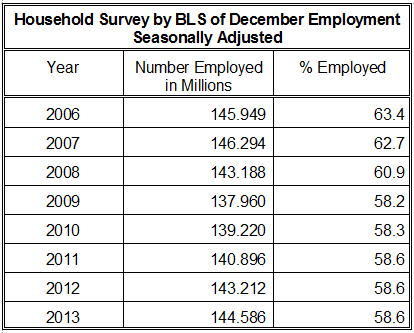
Fewer Americans were employed in December 2013 than were employed in either December 2006 or December 2007. The percentage of non-institutionalized adults employed both in December 2012 and December 2013 was far lower than in December 2006 and December 2007.
Over and over we hear that the economy is recovering, albeit slowly. We have heard this throughout 2012 and 2013. But note that the percentage of working age Americans employed in December 2011, 2012, and 2013 has been stuck at 58.6%. This is 4.8% below the employment percentage of December 2006, which was just before the sudden cost of oil increase in early 2007 and before the subsequent financial crisis in 2008.
This is an incredible degree of employment stagnation. Yes, 58.6% is above the low 58.2% of December 2009, but the 0.4% increase relative to that low point is only a fraction of the total December 2009 loss relative to December 2006 of 0.4% / 5.2% = 0.077. In other words, for all intents and purposes, from 2009 through 2013 the employment situation has been essentially unchanged and awful.
We need to have 11.843 million more jobs to have the same percentage employment we had in December 2006. Because of the big government policies of George W. Bush prior to Obama, that December 2006 employment percentage was already lower than it had been in December 1999. Our jobs stagnation problem actually began at the start of this century.
Apparently a government jobs program, consisting of
But then a program to take people out of the private sector workforce, to transfer money from the private sector to the government sector, and to limit the options of the private sector's entrepreneurs and consumers could have no other outcome. It is not as though this sort of program has not been tried before and been found to fail disastrously. But those who believe in the efficacy of big government will not learn from history.
As a result, we have had at least 5 years of a jobs depression. Given Obama's wrongheadedness and pigheadedness, we are likely to see this continue for at least another 4 years. Four years being 3 more years of Obama and one year for a more rational and less abusive President to return control of the economy to the private sector.
Over and over we hear that the economy is recovering, albeit slowly. We have heard this throughout 2012 and 2013. But note that the percentage of working age Americans employed in December 2011, 2012, and 2013 has been stuck at 58.6%. This is 4.8% below the employment percentage of December 2006, which was just before the sudden cost of oil increase in early 2007 and before the subsequent financial crisis in 2008.
This is an incredible degree of employment stagnation. Yes, 58.6% is above the low 58.2% of December 2009, but the 0.4% increase relative to that low point is only a fraction of the total December 2009 loss relative to December 2006 of 0.4% / 5.2% = 0.077. In other words, for all intents and purposes, from 2009 through 2013 the employment situation has been essentially unchanged and awful.
We need to have 11.843 million more jobs to have the same percentage employment we had in December 2006. Because of the big government policies of George W. Bush prior to Obama, that December 2006 employment percentage was already lower than it had been in December 1999. Our jobs stagnation problem actually began at the start of this century.
Apparently a government jobs program, consisting of
- bailouts,
- stimulus programs,
- Food Stamp increases,
- Social Security Disability increases,
- Extended Unemployment Benefits,
- ObamaCare,
- Dodd-Frank and other financial regulations,
- Tax increases,
- Increased fossil fuel sourced energy costs (recently moderated by shale oil and gas increased production on private lands, while extensive federal land and off-shore oil and gas were denied development), and
- Subsidized so-called green energy,
But then a program to take people out of the private sector workforce, to transfer money from the private sector to the government sector, and to limit the options of the private sector's entrepreneurs and consumers could have no other outcome. It is not as though this sort of program has not been tried before and been found to fail disastrously. But those who believe in the efficacy of big government will not learn from history.
As a result, we have had at least 5 years of a jobs depression. Given Obama's wrongheadedness and pigheadedness, we are likely to see this continue for at least another 4 years. Four years being 3 more years of Obama and one year for a more rational and less abusive President to return control of the economy to the private sector.
17 October 2009
The French, Socialism, and Suicide
In the past, I have written that depression and excessive drunkenness tend to be common in despotic and specifically communist and highly socialist societies. I wrote about the increase in drinking and health problems in socialist Great Britain. There I also referred to the heavy drinking in Russia. I believe heavy drinking, depression, drug use, and suicide tend to increase when people feel little empowered to control their own lives. Since socialism is the shift of self-control to government control, there is likely to be a tendency for depression, drinking, drug use, and suicide to increase as a nation becomes more socialist. This tendency is particularly strong for men, who seem to have a greater need for self-control than do women. This is evidenced in the higher percentage of men who are Republican compared to women in the United States. The social conservatives are more evenly split between men and women, but the fiscal and defense Republicans are more predominantly men.
The French are coddled. They are provided health care, long holidays, protected jobs, free college educations, and welfare galore. There are problems, however:
- There are few permanent jobs for the young, since job-protection rules keep employers from hiring and young people are only brought onto projects as contract workers.
- Permanent workers cannot be let go, so they are often given meaningless work, sometimes in the hopes that they will leave the company.
- Competitive pressures are increasing , due to foreign competition and the privatization of some French government operations.
- Only 32% of French employers have confidence in their workers, while German employers have a 47% confidence level and Americans a 54% confidence level.
Perhaps this kind of society is just too eviscerating for men. Perhaps they need a challenge and they even need the insecurities of life that make the personal achievement of security rewarding and makes life more interesting. Boredom is more depressing than challenge any day.
According to an Editorial in the Economist of 10 - 16 October, the French suicide rate is 14.6 per 100,000 people, with men having a rate of 22.8 vs. a rate of 7.5 for women. Only the suicide rates of Finland and Belgium exceed those of France in Western Europe. In Eastern Europe, the Russians had a suicide rate of 32.2 per 100,000 people in 2005. The suicide rates in Lithuania and Ukraine are also very high. The French suicide rate is twice that of Great Britian and 40% higher than in Germany and the U.S.
This is the direction Obama is taking the United States in. We can anticipate higher rates of depression and more suicides, especially among men. We can also anticipate smaller cars and increased rates of highway deaths and injuries due to his demands for ever lighter cars to meet higher and higher gas mileage requirements. He will also lead us to rationed health care and the added deaths that come with fewer future medical innovations and less aggressive treatments due to health care rationing. We need to keep track of the death toll in each of these categories as we travel the deadly road to ever more intrusive socialism.
27 October 2008
Eviscerating the Private Sector
The private sector is under total attack by government, the mainstream media, and socialists, who are now nearly everywhere in charge of educating our children by virtue of their control of the public schools, of colleges, arts and culture, and increasingly of religion. The attack is unremitting and the inroads toward total control of the economy are terrifyingly extensive. What has happened:
- It has been established in the courts that anything we may wish to sell, whether goods or services, is subject to regulation under the Interstate Commerce clause of the Constitution, despite its purpose being to free trade.
- The financial industry was heavily regulated, but now the winners are chosen by the federal government using bailout money, with those not being chosen being forced to merge by takeover with those who were chosen.
- The disposal of waste products is largely controlled by governments, with many areas having draconian recycling laws which make no economic sense.
- It has long been law that governments can prosecute a company for charging more for its goods and services than other companies do (proves monopoly), or for charging the same (proves collusion), or for charging less (proves cut-throat dumping). Woe be the company that angers government.
- Homes and commercial buildings cannot be built in most areas of the country without currying the favor of local and often state governments. When they are allowed to be built, they must often be built according to archaic, expensive building codes. Architectural designs must often be approved by conventional thinking local agencies. Often homes can only be built on very large lots, which means that it only makes sense to build large, expensive homes on those lots.
- The Clean Air Act gives the Environmental Protection Agency a very freely exercised power over power plants, manufacturing firms, and the user's of many products such as paints, aerosols, insecticides, and plastic foams.
- The Clean Water Act controls the use of water and the emissions or dumping of chemicals which may pollute water sources. It also means that low spots which are only very occasionally wet, cannot be used, since they are declared wetlands.
- Employers are required to hire some people and reject others, sometimes forcing them to adopt racist policies. They are required to serve as unpaid tax collectors and record keepers for governments and their employees. In some cases, they are required to confiscate the pay of their employees.
- People are required to subsidize many businesses through their tax monies. Examples of such businesses are those farmers who grow corn, rice, wheat, soybeans, peanuts, sugar, sugar beets, and many other crops; banks, especially those favored with bailout money; home mortgage holders, especially those in default who will soon be given bailout money; industries protected by tariffs, such as sugar growers, ethanol producers, steelmakers, and many more; power companies using wind-driven electric generators and solar power; companies granted monopolies by government such as cable companies, electric power companies, land-line telephone companies, gas stations on many toll roads, and others; and by companies and individuals given licenses for operation such as cab companies, plumbers, electricians, interior decorators, beauticians, real estate agents, certified public accountants, doctors, psychiatrists, dentists, EPA and FDA and state and local government accredited laboratories; those who purchase energy-efficient cars or who add insulation to their homes; those who send children to college on student loans; those who send children to public education schools; those small businesses who get subsidized loans from the Small Business Administration; those businesses owned by favored minorities and by women; businesses located in depressed zones; and many other activities favored by government.
- Redistribution of income using the progressive income tax, which moves money from those who create wealth and value to those who do not. This is an essential defining characteristic of socialism and has no basis in the American heritage prior to the New Deal in about 1937.
- Rare and unimportant species and the occasional hill or mountain take precedence over human needs for land or resources even in situations where the harm to the living species is unknown or minimal while the harm to humans of inaction is very clear and considerable.
- Businesses are required to keep expensive records of all transactions involving money, despite the fact that their only purpose is to be used as evidence against a firm that it is not paying some tax money some government wishes to take from entities with no voting privileges. The more government can tax business the happier it is, since voters care little and understand little about how these taxes have deleterious impact upon their lives. Businesses are required by Sarbanes-Oxley accounting requirements to use accounting procedures which make little economic sense.
- The declaration that the use of most energy forms produces polluting and climate-changing CO2, so our use of all the major forms of energy will be curtailed. This means much less economic activity since coal, oil, and natural gas use will be greatly reduced, despite the fact that this will do very little to reduce climate change, which is dominated by the forces of nature, not by those of man.
- Much more massive redistribution of income, with non-taxpayers receiving deceptively termed tax rebates from hard-working and creative thinkers who earn higher incomes.
- Slower economic growth caused by reduced use of energy, more expensive energy, less efficient investment of income due to government favored redirections, less total investment since lower income people invest less, an unwillingness to invest in longer term projects because of erratic and arbitrary government interferences such as changes of tax law and emission standards, the holding of investments for excessive periods to avoid paying higher capital gains taxes, shifting investment into government bonds, the increased commitment to expanding operations abroad where corporate taxes are lower, and creative and hardworking people working less.
- A great increase in required service to the government or to those charitable activities it may favor. Women will be required to register for the draft. More schools will require community slavery, err... service, before children are allowed to graduate from high school. College loans will be dependent upon signing up for service with the government, which will put many ignorant and untrained young people into the business of using government power, resources, and our tax money to do all sorts of mischief.
- Heavier dependence upon Social Security for retirement as stocks and securities either continue to shrink in value or grow much more slowly. As the economy grows more slowly, the tax income to support those on Social Security will diminish. Obama would give tax rebates to people who do not pay income tax, claiming that the rebate is really because they pay Social Security taxes. The distinction between income tax and Social Security tax will be completely lost. Since the Social Security money already collected has already been spent largely on non-Social Security programs by the federal government, that distinction was already very weak. In order to continue the Social Security program for Baby Boomers and beyond, the tax burden on the remaining workers will increase until they rebel, assuming that their vote is any longer able to take power away from the governments. Obama may choose to rule as his socialist hero Hugo Chavez does in Venezuela where the voters have little say.
- Freedom of speech will be everywhere as limited as it is now on most college campuses and in most public schools. Important issues will no longer be discussed, because if an issue is important, it has the power to make someone upset and it is not allowable to upset anyone, unless he is intelligent, hardworking, and a creative and rational thinker. The remaining pablum which we will be allowed to talk about will be the subject of radio talk show hosts chosen initially to have equal numbers of conservatives and socialists and very few libertarians under a Fairness Doctrine. After awhile, all libertarians and most conservatives will be banned, since it will be claimed that they are guilty of hate-speech and racism or that they are global-warming deniers.
- Human beings will be discouraged from procreating, since they are considered a threat to the planet and natural ecosystems. They cut down forests, build homes, use resources, and breathe out the greenhouse gas CO2. Humans will be considered inherently evil by most people rather than just the elitist environmental radicals of today and those young people recently rolled out of the propaganda mills called schools. Western Europe and Russia, where new births are far below replacement levels, will set the example in the U.S. where our population is damned for growing.
- Massive depression of the population will set in as they realize that they cannot do anything unless they get the approval of 25 government agencies, all of whom are fighting for power and have different, often contradictory, requirements. Many more people will turn to alcohol and drugs, as they do in Russia, to forget their helplessness and their total insignificance. Some, those who can remember the time, will dream of living a self-directed life.
- The United States of America will be as jaded as France and Germany. People will lose all sense of individuality. They will be defined only by what gender, race, and economic class they fall into. Employers will have the duty to provide jobs and will be thoroughly hated. More and more, government will attempt to chain them to their posts. Slavery will make a historical return with minorities and women as slave masters of so-called white males. Of course, this slavery will be directed through the agency of government, so that it will be easier for people to pretend that it is just required service. The slave masters will be many, rather than a single individual.
21 April 2008
Depression Lunacy
There is a great deal of talk in the media, broadcast and print, that we are heading into a depression, or at least a significant recession. We had a one-month drop in manufacturing followed by a rise the next month and we had a brief leap in unemployment, which has since leveled out. Housing starts are certainly down and energy and food costs are certainly up. Despite all of this, the economy has not been knocked to the ground. It seems determined to chug on. Many companies just announced first quarter earnings which beat expectations. Consequently, stocks went up last week. But, the Gloom and Doomers have great staying power, especially with a Presidential election coming up. So, let's see what economist Alan Reynolds has to say about the state of the economy.
On 11 April, before most companies announced their first quarter earnings, Reynolds had an article appear in the New York Post. He notes that the gloomy economic news is of a credit crisis or a financial crisis. He points out that since WWII, no U.S. financial crisis has become an economic disaster. The S&L crisis of 1986-1995 was the worst financial crisis since WWII, but the economy grew by an average 2.9% a year in that time. There was a recession in that time lasting 8 months and beginning with the invasion of Kuwait by Iraq when oil prices jumped 113%. By then, the S&L problems were healing.
So, what is going on now? The LA Times asked on 20 March if another Great Depression was just over the horizon. On 6 April, the NY Times claimed that the "focal point for the stock market's difficulties" is that "banks have been reluctant to lend money to one another, or to anyone else." Reynolds points out that this is nonsense since the six-month London Interbank Offered Rate (LIBOR) would not have fallen from 5.3% to 2.6% in the last year if this were so. Bank loans to "anyone else" have increased by 8% according to Federal Reserve Board data since last August. As a further anecdotal measure, numerous companies are calling me daily eager to loan my laboratory money to buy equipment!
So, where is the difficulty? Reynolds says, "It is in selling or valuing exotic securities." The IMF, the Washington Post reports, says the crisis will cost nearly $1 trillion. Well, that estimate was for the entire world, not the U.S. This is the accounting loss of 4.1% on all sorts of loans and securities. The IMF estimates losses of $115 billion on mortgages alone. But, these accounting losses are in many cases only temporary. In many cases the future cash flow produced by the mortgages will be much higher than implied by the accounting loss declared. Standard and Poors says these write-down losses may be as much as $285 million. Well, in comparison, the S&L losses were 3% of GDP, which would be $450 billion now! Reynolds notes that many of these potential losses will be to foreign banks now, rather than U.S. banks or S&Ls as they were in the S&L crisis.
The villain socialist Paul Krugman (remember the guy of a few posts ago who did not like BB&T giving money to universities to teach Ayn Rand's philosophy) told Fortune that we should expect $6 or 7 trillion in capital losses in housing. Reynolds notes that the Federal Reserve estimated the value of household real estate was $22.5 trillion in the 4th quarter of 2007. A 30% fall in house prices would generate a $6.8 trillion loss! A 30% decrease in value across the nation is unlikely. Furthermore, Reynolds points out that this household real estate is not just single family homes, but it is actually all commercial, farm, and rental property as well owned by households and nonprofit institutions!
Further, the often quoted S&P Case-Shiller index of house prices only covers single-family homes in 20 metropolitan areas. The extra-expensive LA, San Francisco, and San Diego areas are weighted heavily at more than 25% of the total loss of 10.7% for home values in this index. Data for the whole country show that single-family homes lost 3% in the year ending in January. Between the 4th quarters of 2006 and 2007, home values rose an average of 3.8% in 29 states not appearing in the S&P Case-Shiller index. Two states not included in the S&P index actually did see home values decrease, but it is clear that the home value losses are largely localized to metropolitan areas heavily overweighted in the S&P index.
Others have claimed similarities to the 2000-2002 tech-stock collapse. But, Reynolds notes that in 1999 to 2000, oil prices also nearly tripled and in late 2000, the Fed increased the fed-funds rate to 6.5% with industrial production falling. Then came 9/11. So, there were more shocks to the economy than just the tech-stock collapse.
Actually, the S&L and tech-stock crises were quite mild recessions. They were brought on by worse economic conditions than we have now, so it is insane to be drawing analogies to the Great Depression. It is a common practice for socialists and some contrarians to tend to exaggerate the problems of the U.S. market. The socialists do it to create an excuse to have more government controls put in place and to hit higher income taxpayers with higher taxes. The contrarians often do it because they underestimate the resilience and resourcefulness of American producers and investors. Others do it because a frightened public will pay more money for investment advice. The media does it because frightened people watch and read the news more. As a result, you have to carefully seek out those who know what they are talking about, like Alan Reynolds.
On 11 April, before most companies announced their first quarter earnings, Reynolds had an article appear in the New York Post. He notes that the gloomy economic news is of a credit crisis or a financial crisis. He points out that since WWII, no U.S. financial crisis has become an economic disaster. The S&L crisis of 1986-1995 was the worst financial crisis since WWII, but the economy grew by an average 2.9% a year in that time. There was a recession in that time lasting 8 months and beginning with the invasion of Kuwait by Iraq when oil prices jumped 113%. By then, the S&L problems were healing.
So, what is going on now? The LA Times asked on 20 March if another Great Depression was just over the horizon. On 6 April, the NY Times claimed that the "focal point for the stock market's difficulties" is that "banks have been reluctant to lend money to one another, or to anyone else." Reynolds points out that this is nonsense since the six-month London Interbank Offered Rate (LIBOR) would not have fallen from 5.3% to 2.6% in the last year if this were so. Bank loans to "anyone else" have increased by 8% according to Federal Reserve Board data since last August. As a further anecdotal measure, numerous companies are calling me daily eager to loan my laboratory money to buy equipment!
So, where is the difficulty? Reynolds says, "It is in selling or valuing exotic securities." The IMF, the Washington Post reports, says the crisis will cost nearly $1 trillion. Well, that estimate was for the entire world, not the U.S. This is the accounting loss of 4.1% on all sorts of loans and securities. The IMF estimates losses of $115 billion on mortgages alone. But, these accounting losses are in many cases only temporary. In many cases the future cash flow produced by the mortgages will be much higher than implied by the accounting loss declared. Standard and Poors says these write-down losses may be as much as $285 million. Well, in comparison, the S&L losses were 3% of GDP, which would be $450 billion now! Reynolds notes that many of these potential losses will be to foreign banks now, rather than U.S. banks or S&Ls as they were in the S&L crisis.
The villain socialist Paul Krugman (remember the guy of a few posts ago who did not like BB&T giving money to universities to teach Ayn Rand's philosophy) told Fortune that we should expect $6 or 7 trillion in capital losses in housing. Reynolds notes that the Federal Reserve estimated the value of household real estate was $22.5 trillion in the 4th quarter of 2007. A 30% fall in house prices would generate a $6.8 trillion loss! A 30% decrease in value across the nation is unlikely. Furthermore, Reynolds points out that this household real estate is not just single family homes, but it is actually all commercial, farm, and rental property as well owned by households and nonprofit institutions!
Further, the often quoted S&P Case-Shiller index of house prices only covers single-family homes in 20 metropolitan areas. The extra-expensive LA, San Francisco, and San Diego areas are weighted heavily at more than 25% of the total loss of 10.7% for home values in this index. Data for the whole country show that single-family homes lost 3% in the year ending in January. Between the 4th quarters of 2006 and 2007, home values rose an average of 3.8% in 29 states not appearing in the S&P Case-Shiller index. Two states not included in the S&P index actually did see home values decrease, but it is clear that the home value losses are largely localized to metropolitan areas heavily overweighted in the S&P index.
Others have claimed similarities to the 2000-2002 tech-stock collapse. But, Reynolds notes that in 1999 to 2000, oil prices also nearly tripled and in late 2000, the Fed increased the fed-funds rate to 6.5% with industrial production falling. Then came 9/11. So, there were more shocks to the economy than just the tech-stock collapse.
Actually, the S&L and tech-stock crises were quite mild recessions. They were brought on by worse economic conditions than we have now, so it is insane to be drawing analogies to the Great Depression. It is a common practice for socialists and some contrarians to tend to exaggerate the problems of the U.S. market. The socialists do it to create an excuse to have more government controls put in place and to hit higher income taxpayers with higher taxes. The contrarians often do it because they underestimate the resilience and resourcefulness of American producers and investors. Others do it because a frightened public will pay more money for investment advice. The media does it because frightened people watch and read the news more. As a result, you have to carefully seek out those who know what they are talking about, like Alan Reynolds.
19 April 2008
Liberals Supervising and Directing Markets
Jay Ambrose wrote a fine column published in the Washington Times on 18 April 2008 on a New York Times Week in Review article claiming that liberals need to supervise and direct markets to keep chaos from running amok. They say that the Milton Friedman era has passed. Jay Ambrose points out that "even if we are less burdened and more prosperous than many of our industrial rivals, we are nowhere close to the low-spending, low-tax, government-shriveled, regulation-reduced, libertarian dream embraced by Friedman. In many respects, we have been marching in the opposite direction."
"Right now, says James Gattuso of the Heritage Foundation, 50 federal agencies are enforcing 145,000 pages of regulations at a cost to the economy roughly equal to all the income taxes paid last year, some $1.1 trillion. And contrary to what some might guess, writes this research fellow, regulatory costs have been climbing upward during the George W. Bush presidency -- by about $30 billion since 2001." This $30 billion increase is substantial, though nothing like the rate we would have under a President Obama or Clinton.
Ambrose goes on to discuss how the tale that President Franklin D. Roosevelt saved the country with his New Deal is entirely wrong. He quotes Thomas DiLorenzo's book How Capitalism Saved America as showing that despite FDR's creating many new federal programs and directly employing about 10 million Americans in relief jobs, the economy was as bad in 1938 as in 1933 and only the post-war recovery ended the depression.
A minor slowdown in the present economy should not be sufficient cause for us to abandon the self-correcting wisdom of the Capitalist system which repairs the wounds in the economy much more efficiently and with much less pain than do a gaggle of government bureaucrats. Those in favor of more government control and direction of the economy and of us as individuals are very adept at exaggerating problems to justify more government intervention. The fact that home values are now going up again in many areas of the country and that many companies just reported surprisingly high earnings for this last quarter shows that the harm to the economy of the housing credit and oil cost problems was probably exaggerated, in the best progressive tradition. Our motto should always be: "Trust the free market, stupid."
"Right now, says James Gattuso of the Heritage Foundation, 50 federal agencies are enforcing 145,000 pages of regulations at a cost to the economy roughly equal to all the income taxes paid last year, some $1.1 trillion. And contrary to what some might guess, writes this research fellow, regulatory costs have been climbing upward during the George W. Bush presidency -- by about $30 billion since 2001." This $30 billion increase is substantial, though nothing like the rate we would have under a President Obama or Clinton.
Ambrose goes on to discuss how the tale that President Franklin D. Roosevelt saved the country with his New Deal is entirely wrong. He quotes Thomas DiLorenzo's book How Capitalism Saved America as showing that despite FDR's creating many new federal programs and directly employing about 10 million Americans in relief jobs, the economy was as bad in 1938 as in 1933 and only the post-war recovery ended the depression.
A minor slowdown in the present economy should not be sufficient cause for us to abandon the self-correcting wisdom of the Capitalist system which repairs the wounds in the economy much more efficiently and with much less pain than do a gaggle of government bureaucrats. Those in favor of more government control and direction of the economy and of us as individuals are very adept at exaggerating problems to justify more government intervention. The fact that home values are now going up again in many areas of the country and that many companies just reported surprisingly high earnings for this last quarter shows that the harm to the economy of the housing credit and oil cost problems was probably exaggerated, in the best progressive tradition. Our motto should always be: "Trust the free market, stupid."
Subscribe to:
Posts (Atom)