Among the issues most commonly discussed are individuality, the rights of the individual, the limits of legitimate government, morality, history, economics, government policy, science, business, education, health care, energy, and man-made global warming evaluations. My posts are aimed at intelligent and rational individuals, whose comments are very welcome.

"No matter how vast your knowledge or how modest, it is your own mind that has to acquire it." Ayn Rand

"Observe that the 'haves' are those who have freedom, and that it is freedom that the 'have-nots' have not." Ayn Rand

"The virtue involved in helping those one loves is not 'selflessness' or 'sacrifice', but integrity." Ayn Rand

For "a human being, the question 'to be or not to be,' is the question 'to think or not to think.'" Ayn Rand
Showing posts with label banks. Show all posts

16 November 2016

Krugman and Schramm: The Fool and the Wise Man

Paul Krugman, post-election: "It is true that we've been adding jobs at a pretty good pace and are quite close to full employment."

Prof. Carl J. Schramm, Opinion in 16 Nov 2016 Wall St. Journal:  "Despite the addition of 161,000 jobs in October, the labor-force participation rate fell to its second lowest level in nearly 40 years, according to the St. Louis Federal Reserve.... America needs at least 325,000 new jobs every month to stanch the growing numbers of discouraged workers, according to the Bureau of Labor Statistics."

How low the left sets the bar for employment!  High employment is clearly not one of their premier goals.

Prof. Schramm, of Syracuse University, once headed the Kaufmann Foundation, which promotes American entrepreneurship.  He notes that:

  • Firms less than 5 years old create more than 80% of new jobs.
  • Fewer than 500,000 new businesses were started in 2015, which is a 30% decrease since 2008.
  • Over the last 8 years, the number of new businesses has decreased by more than 1 million.  The missing new businesses mean 7 to 10 million missing jobs, which would have been enough to provide jobs to the millions of discouraged workers.
  • New businesses are more likely to be started when the economy is growing at a 4% rate than when it is growing at a 2% rate.  The faster growth rate gives consumers the confidence to buy the innovative products of start-up companies.
  • Too much attention is given to Silicon Valley whose start-ups are only about 5% of all start-ups and have higher failure rates and create proportionally fewer jobs than the businesses started by franchisees, which are 40% of all new businesses.
  • Dodd-Frank suppressed the financing by local banks of local businesses in their communities, whose business prospects they are best qualified to gauge.
  • Municipal regulations are particularly protective of older businesses and likely to discriminate against new businesses.
Address these problems and he says we can enjoy 4% economic growth.  The first step was to remove the anti-jobs, anti-business party from the presidency.

30 April 2013

Federal Reserve Joins Vendetta Politics of Obama Regime

Steve Forbes discusses the Federal Reserve action on its latest stress tests of the nation's 18 largest banks in his Fact & Comment in the 6 May issue of Forbes.  Of the 18 biggest banks, the Federal Reserve claimed four had serious problems which it said must be cleared up.  Ally Financial is the present name for GM's bankrupt and reorganized financial services arm.  It is in real trouble.  But Steve Forbes claims that JPMorgan Chase, Goldman Sachs, and BB&T were named as having problems purely for small-minded political reasons.

JPMorgan's Jamie Dimon has expressed displeasure with the Obama administration, but it is a well-run company with a good balance sheet.  Goldman Sachs was too close to Romney and Lloyd Blankfein also made it clear he is not happy with Obama.  So, the Federal Reserve concocted reasons to fault these two institutions.

Most troubling was the claim that the best run major bank in the entire nation had serious problems because it uses its own economic models and judges its own loan portfolio differently than the Federal Reserve wants it to.  Independent thinking is discouraged, even when a company's track record justifies it to any rational observer.  In fact, if all banks work on one model, the risks of a systemic banking failure go up.  This is especially true when the dictated model is designed by bureaucrats for their purposes, not those of the private sector.  It is even more true when the appointments to the Federal Reserve are poisoned by Obama appointees.

Steve Forbes notes that the Basel Accords required banks to have heavy reserves for loans to even the best commercial companies, but none for loans to Greece or Iceland or Ireland.  Those government accords also enshrined mortgages for special low reserve treatment.  Look where these imposed government models led the world financial institutions in 2008 and 2009.

BB&T bank CEO John Allison IV, now retired and heading the Cato Institute, opposed the TARP program and was most forcefully forced to take that money in 2008-2009.  His bank was so well run it had no need for the money.  The Federal Reserve wanted to hide the worst banks by making sound banks take the money and it was hiding potential losses on its loans by making a forced profit in interest from sound banks that did not want the money in the first place.  Allison further earned the enmity of the Federal Reserve and the Obama Regime by writing The Financial Crisis and the Free Market Cure - Why Pure Capitalism is the World Economy's Only Hope, published in 2013 by McGraw Hill.

Government thugs cannot stand the heat of criticism, especially when it is well-stated.  In the Obama Chicago style, they strike back brutally with the misuse of government power.  You do as they say, or they will breaka you knee caps.

23 May 2010

How is Obama's European Socialism Plan Working in Europe?

Europe started suffering from the oil price spike in early 2007 before we in the United States of America did.  Europe's energy prices, thanks to their socialist government's policies and taxes, were already much higher than those in the U.S.  In addition, the weight of the public sector on the private sector was even greater, making the private sector much more susceptible to the strain of the oil price spike.  As is very clear now, many of the countries of Europe are burdened with excessive debt.  In fact, Greece and Latvia are considered to be among the 7 governments in the world most likely to go into default.  Almost no one now believes the recent $1 trillion bailout of Greece is going to prevent that nation's default.  The regional government of Sicily in Italy is the 10th most likely governmental default.  Portugal, Spain, Italy, and Ireland are in very serious trouble.  Even Great Britain is said to be dubious.  There is now reason to believe that Germany is also.

As I noted in my last post, of the largest banks in the world to go under in this recession, one was a German bank.  The Sachsen LB bank had to be taken over by the Landesbank Baden-Wuerttenberg  with help from the Saxony government in December of 2007.  It turns out that there is reason to believe that part of the reason the German banks were so willing to help bailout little Greece with only about 2% of the GDP of the EU, was because many German banks are seriously over-extended.  Let us look at a bit of background history on what is going on in Obama's idea of a socialist utopia, socialist Western Europe.

Socialists do not understand economics.  They cannot because economics deals with the very complicated interactions of huge numbers of individuals trading huge numbers of values for other values.  The socialist assumes that all economic activity can be dictated, controlled, regulated, and governed by a central planning authority in government.  A real economy is much too complicated for that, but socialists insist in living in a Platonic dream world of pure economic forms.  In this world, the complex multivariate interactions of a private sector are almost always shoe-horned into some simple-minded governmental industrial and trading policy such as mercantilism.  Usually, the controlling government selects certain industries for their export potential and controls its currency to keep it artificially low in value in comparison with that of other countries in order to help keep its exports low in cost.  The selected industries may also have many effective subsidies as well.  This is what happened to Japan and brought its post-war recovery to an end in the 1980s and has left Japan in the doldrums ever since.  China has shown recent problems with this also.  So too does Germany show similar problems with its mercantilism policy.

Germany has a large export surplus with respect to most of the world and this includes the rest of Europe.  What should happen in such a case is that the German currency should become worth more and go up in value relative to other currencies.  The currency is rather like the stock in a country.  When it proves itself to be productive enough to do well in the export market, its stock should go up.  Imports from other countries then start to look very inexpensive and the country with the export advantage both starts losing that advantage and starts importing more.  This tended not to happen in Germany even before the euro became the common currency of most of the European Union.  The Germans had little choice but to put their money into savings, since it was too expensive to spend it on imports.  The banks in turn had to find ways to invest that money.  The German banks did this by loaning it to their many trading partners who had trade deficits with Germany.  Many of these countries do not offer many good investments, so the German banks have become very good at losing the money that Germans save with them.  The banks are under-capitalized.

Once most of Europe went to sharing a common currency, there was no longer even a possibility that the currency of Germany might go up in value relative to the currency of its net importers in other countries of Europe.  The trade imbalance issues have actually become more acute.  One of the reasons Germany was willing to put so much money into the Greek rescue plan was because French President Sarkozy furiously threatened German Chancellor Merkel with abandoning the common euro currency.  The Greeks also had more leverage in negotiations than one would have expected.  It turns out that a mercantile economy can be very fragile.  How fragile?

The German government has put a ban in place on short selling.  The mandate calls for a short selling ban in particular on 10 large German banks including Deutsche Bank, Commerzbank, and Allianz.  It also banned the purchase of naked credit default swaps of European Union government bonds.  This can be expected to have some negative effects:
  • Large fixed income investors will be less able to adequately hedge their positions or be faced with insufficient market liquidity in the future to exit their positions.  They will be driven to invest in other markets.  The almost immediate stock market drop attests to this.
  • The ban is a signal to the markets and investors that more bad news is coming. Investors are likely to lose even more confidence in European debt markets.  Spain recently had to reduce the amount of national bonds it could sell due to too few takers, so this may already be manifesting itself.
Germany, just as Japan and China have found, is not really in the catbird seat by virtue of having an export surplus.  It is highly dependent upon the health of the many countries which are running a trade deficit with it.  The old saying that one should neither a debtor nor a lender be has some solid truth in it.  One's country's exports and imports should be in balance.  If they are not, then the country to which one is lending should be growing rapidly so that one's investment is good.  On the other hand, if one is a debtor nation, one's economy had also best be growing rapidly.  This is not the case in Western Europe, where most countries have so immersed themselves in socialism that the public sector is seriously weighing down the private sector.

Obama's socialist heaven, Western Europe, is not feeling well at all.  Yet, it and Obama continue to criticize the free market of ideas, goods, and services that at one time characterized the U.S. and enabled it to become the economic superpower of the world.  The U.S. became an empire of wealth, created by free individuals voluntarily trading values with one another as they wished with little governmental interference.  This proven engine for economic growth is not in fashion in socialist Western Europe where unemployment rates of 10 to 20% have long been common, along with slow growth rates.  Nonetheless, it is this model that our lying leader wishes to dictate that we adopt.  This last week, he made major in-roads on this effort with the Dodd Financial Institution Take-Over.  Obama sure knows how to use an "emergency" to take a firm grasp on ever more totalitarian power.

24 January 2010

Edward Hudgins: Paternalists Want Power and Bank on Envy

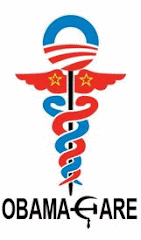
In an article called Banking on Envy, Edward Hudgins, of the Atlas Society, says that the defeat of ObamaCare has caused Obama to invoke envy to attack the banks.  He says envy is the chief weapon, and frequent motivation, of the paternalist.  Obama claimed that the banks were responsible for the current recession and that the government had had to bail them out because the banks had made risky loans in pursuit of profit and bonuses.  He failed to note that the government forced the banks to take the money and they rapidly paid it back with interest.  And, of course, he failed to note that the banks had been pushed hard by the government over a couple of decades to make more and more risky loans to home buyers so that home ownership would increase, especially among the poor and lower middle class.

Hudgins says,
With chutzpah pouring out of his every pore, Obama announced support for restrictions on what he defines as risky bank activities “that are central to the legislation that has passed the House under the leadership of Chairman Barney Frank, and that we’re working to pass in the Senate under the leadership of Chairman Chris Dodd.”  Here he named the two members of Congress who most of all laid the groundwork for the current economic crisis. Both worked for years to force banks to make risky home loans to individuals who couldn’t afford them and both took campaign funds from the government-chartered Fannie Mae, which was making money packaging and marketing those bad loans. They sold the crack, and now they want to be deputized as drug-busting police.
Obama argued that the banks get cheap money from the Federal Reserve and use this "privilege" to trade for profit.  His implication is that profit is evil.  Now it is true that the banks get cheap money and that they try to use it to make a profit, but the government set this system up itself.  Hudgins says that the Obama paternalist's tactics are revealed by his effort to gain more effective control of the already highly regulated banking industry.  He goes on a great rampage next against paternalists and their lust for power.
His proposed restrictions on banks will further constrain capital investment in the American economy and reduce so-called “risky” lending. These constraints will certainly slow economic growth. They will especially make it tough for entrepreneurs to create whole new industries that are by their nature risky ventures, for which they bear the costs of the risk, and by which they hope to make huge, well-deserved profits. But it really isn’t economic growth and prosperity that paternalists seek.

Obama is shameless to suggest that his government, which is overseeing the most irresponsible and wasteful spending spree with taxpayer money in American history, should be imposing discipline on private bank responsibility. But it’s not responsible, efficient, and honest government that paternalists seek.

Paternalists want power. They are obsessed by the need to control every aspect of our lives. That’s why Leftists reacted as they did to the Supreme Court’s ruling—released on the same day as Obama’s anti-bank press conference—that corporations have free speech rights to make their thoughts about candidates known during elections. Obama is vowing to find ways to stamp out these First Amendment freedoms. The freedom of others to criticize is a grave danger to control-freak paternalists.

One of the principal tactics that paternalists use to induce individuals to surrender their freedom is to stoke their envy, resentment, and hate against some scapegoat and to promise that they, the paternalists, are the only ones who can punish the villains. “Look, that one is richer than you! Let’s get ‘em!”

Envy, of course, is an essentially nihilistic sentiment that revels in tearing down. It is a form of social relativism that teaches that one’s worth or status is always in comparison to others. And the easiest way to raise one’s own pseudo-sense of worth and status is to tear down others, to judge one’s self as better off only if others are worse off. Envy is a path to individual and social destruction.
 It is so good to have company that shares my sense of outrage at the elitist paternalists using low envy to satisfy their lust for power while not caring what harm is done to free markets and the rights of the individual.

15 September 2009

Socialist Government Requires Company Bank Account Numbers

Just when businesses are feeling really uncomfortable with the knowledge that the federal government is now controlled by corrupt, anti-business forces and seriously committed socialists, the federal government now forces companies to make on-line payments of payroll taxes. To do that, we have to give the government our company checking account numbers.

Is there a pattern here? The government wants to make everyone's individual tax forms available to numerous federal agencies so they can determine whether to subsidize them for the purchase of health insurance or tax them more heavily as part of their proposed "health insurance reform." This same corrupt, socialist, anti-business government suddenly forces every company to give them their bank account number!

This same government has deficits which our great, great grandchildren will still be paying off. Is anyone getting nervous about this? Will the government simply declare that any company with more than x dollars times the number of employees in the account will have to forfeit the excess to the government?

08 August 2009

Putting the Fox in the Chicken Coop

While the recession was actually initially the result of the sudden rise in oil and gasoline prices in 2007 and started first in many other countries throughout the world, the popular mythology is that it started in the U.S. and was due to sub-prime mortgage loan defaults and errors of our financial institutions. The later did make the recession worse and those failures came home to roost suddenly due to the effects of the initial recession caused by the oil and gasoline price spike. Congress, in its usual tradition, responded by claiming that the fault was that entirely of Wall Street and our banks and called for more regulation of those private institutions.

The Congress that wants to regulate the banks and the financial industry more, itself hugely contributed to the problems we recently experienced with more stringent requirements being added to the Community Reinvestment Act and with their encouragement given to Fanny Mae and Freddy Mac to buy up risky home mortgages so they would pass them on to investors.

I am presently reading Glenn Beck's Common Sense. He reminds us that Congress has a history of managing its own bank. The House of Representatives had a bank of their own. The customers were the Representatives themselves. They bounced 8,331 checks and had to close their bank. It had no penalties for overdrafts, so Congressmen apparently felt little responsibility for not writing checks in excess of their balances. Guess they got used to doing that with the balances of taxpayer money in the U.S. Treasury, which were never large enough to cover their spending habits. They always felt free to overdraw that balance and apparently felt equally free in overdrawing their personal balances.

Of course, no Congressman was ever held accountable for these overdrafts of the House Bank, just as they are never held accountable for overspending tax revenues. But, Congressmen are always ready to have someone else take a fall for them. In the case of the House Bank, they had the House Sergeant-at-Arms sentenced to 24 months in jail. Similarly, instead of taking the blame for their role in encouraging sub-prime and risky home mortgages, they blamed the banks and Wall Street financial institutions. They proposed more regulations to be determined by themselves to correct any such future problems. They also responded to the financial portion of the crisis by taking a financial role in 500 American banks, including most of the largest banks in the country.

Do not let it be said that the House of Representatives is ever slowed down in expanding its powers, at the expense of further violations of our Constitution, by any rational assessment of its own competency. No, these people are absolutely lacking in any power of introspection and self-evaluation. Such people are truly dangerous when vested with immense power.

And now they also want to exercise much more control of our health care and our energy production and use. What do you suppose their competency is in those fields?

In the field of health care, we already know a great deal from the history of Medicare and Medicaid. They have allowed huge cost overruns in both programs and run up huge debts with both. They have responded by decreeing too low doctors fees and hospital charges in some areas, which has led to doctors and hospitals desperately padding their bills and transferring many costs to their private patients. This is a big factor in the high rate of increase in health insurance costs, which Congress now uses to try to justify its taking still more control of the health care industries. The fox is already in the chicken coop here, but he wants to bring in his vixen to help him slaughter the chickens at a faster rate.

In the field of energy production and use, Congress also has a long history. Since Jimmy Carter, there have been massive government programs to develop alternative energy sources. Many years of research and development and pilot programs and what do we have to show for it? Damn little. Only about 2.4% of the electricity generated in the U.S. is from renewable energy sources other than the old standby of hydroelectric power. Much of that is used only because of state and federal mandates and due to subsidies. In other words, it is still not price competitive after all these years. Congress has been effective in preventing any rational plan for the storage of nuclear waste, which has greatly hurt the nuclear power industry.

For transportation purposes, Congress has given us huge subsidy programs for ethanol. Ethanol from corn actually provides no new and no net energy. It is just a conversion program to turn corn food into fuel while using up equal amounts of energy produced by other energy sources. This program is very effective in driving up the cost of food as well. Congress has also been very effective in thwarting all efforts to discover and produce more oil and gas in America and offshore.

Once again, Congress has shown no competence in the field of energy use and production. But, this weasel is in the chicken coop and causing havoc. The weasel now wants to hugely expand its powers with carbon cap and trade taxing and mandating. The weasel is not yet satisfied with his chicken slaughtering capability. No, it wants to bring its bitch or jill into the coop to speed up its rate of kill.

11 April 2009

Reynolds - High Oil Prices Caused Worldwide Recession

Alan Reynolds is one of my most favorite economists. He has written another very good and very important article, It Didn't Start Here, which was published in the New York Post on 9 April 2009.

The recent G-20 meeting in London produced a consensus: The United States started and caused the worldwide recession. The United States should be humbled. Obama agreed. The Finance Minister of Germany, Peer Steinbrueck, said the Anglo-Saxon attitude in America and Great Britain had encouraged risky lending and investment practices due to "an exaggerated fixation on returns."

Reynolds says, "Hey, wait a minute folks, let's look at the data." Examine when industrial production first started declining in some countries. It began to decline in Canada in July 2007, in Italy in August 2007, in France in October 2007, and the Euro area as a whole in November 2007. Japan's production reached a peak in October 2007, though it had a one-month uptick in February 2008. The decline in the U.S. was in February 2008.

In January 2008, the OECD leading indicators were down from a year before by 4.1 points in Ireland, 2.8 points in Japan, 2.6 points in Korea, 2.3 points in Sweden, but only 0.8 points in the U.S. Stock prices are another leading indicator. Stock prices peaked in Japan and in the Euro area four months before they peaked in the U.S. and the U.K. in October 2007!

In the 4th quarter of 2008, real GDP was lower around the world than it had been 1 year before, but it had dropped by much less in the U.S. than almost anywhere else. The list is:

Taiwan, -8.4%
Turkey, -6.2%
Sweden, -4.9%
Japan, -4.3%
Singapore, -4.2%
Denmark, -3.7%
South Korea, -3.4%
Italy, -2.9%
Hong Kong, -2.5%
Great Britain, -2.0%
Germany, -1.7%
Mexico, -1.6%
France, -1.1%
U.S., -0.8%
Canada, -0.7%

So, how did the the failures of U.S. and British banks and financial institutions in September and October of 2008 cause the recession which had started in Japan and in Europe in January 2008?

The housing price boom and the low cost of borrowing in the U.S. and in Britain were problems, but they were also problems in a number of other countries. These problems developed later and many countries which went early into recession, such as Japan, Sweden, and Canada had had no housing booms. Reynolds points out that James Hamilton of the University of California at San Diego showed in 1983 that "all but one of the US recessions since World War Two have been preceded, typically with a lag of around three-fourths of a year, by a dramatic increase in the price of crude petroleum." Reynolds says the years 1946 to 2007 saw 10 dramatic spikes in the price of oil -- each soon followed by a recession. He also notes that in January 2008, he wrote that the US economy was likely to slip into recession due to the high energy costs no matter what the Federal Reserve did with respect to monetary policy.

The logical conclusion from this is that the U.S. was probably doing a whale of a job in diminishing the worldwide recession. Indeed, the dollar value of US imports did not start to fall until August 2008 and our purchases of consumer goods did not fall until September 2008. Strange that so many in the rest of the world are so eager to blame the US for this recession, including the very anti-American Barack Obama! It would be more logical to see the U.S. as the hero in these trying times.

Reynolds points out that Jagadeesh Gokhale, his colleague at the Cato Institute, noted that "the prolonged decline in exurban housing construction that began in early 2006 was a logical response to rising prices of oil and gasoline at that time. So was the equally prolonged decline in sales of gas-guzzling vehicles. And the US/UK financial crises in the fall of 2008 were likewise as much a consequence of recession as the cause: Recessions turn good loans into bad."

So, it would appear that part of the reason that existing home prices were shooting up was because new home building was becoming more expensive and few homes were being built, due to the energy crisis. The energy crisis certainly weakened the U.S. auto industry, which was making all of its profits and most of its income from SUVs, trucks, and large cars. When people were paying more than twice what they had been paying to fill their gas tanks, they became less likely to be able to pay more for home mortgages or to make payments on such new cars as they did buy. The banks came under increased pressure and the many high-risk loans that government had pushed them into became a real liability, albeit one exaggerated by the Sarbanes-Oxley mark-to-market asset evaluation requirement. Another gift from government.

So, what would a rational response be to minimizing such a future spike in energy costs, given that such spikes are the chief cause of recessions? For the U.S., it would be to allow oil and gas drilling in the Eastern Gulf of Mexico, as was approved by George Bush, but then immediately killed by Obama. It would be to open ANWR to drilling. A non-starter with our very foolish Obama. A rational response would be to sell off much of the excessive federal holdings of land in the western US and encourage companies to drill for oil and gas using modern good practices. When OPEC, which did cause the present worldwide recession, spikes prices upward, the US production facilities could run production at full output and hold down the price increases a bit in the U.S. This would help to moderate our future recessions.

What very irrational, shall we say, even insane policy are we following? First, the media and the government are blaming American banks and financial institutions for this recession, while claiming that this means they need to be be managed by our ever-perspicuous government. Second, they are using this to broadly blame Capitalism. Note that OPEC is a cabal of nationalized oil companies, which have nothing to do with Capitalism. Furthermore, Obama and his cut-throat gang are using this crisis as a means to cripple the fossil fuel energy industries in the U.S. One of the reasons the U.S. weathers the oil price spike caused recessions better than many other countries is because we have the world's greatest reserve of coal. We still use it to produce half of our electricity. Without it, we will be even more subject to the whims of OPEC and to the subsequent OPEC-caused recessions.

Do you suppose it is possible that the same impulse that causes Obama to bow to the King of Saudi Arabia, who is an important Islamic leader, is also causing him to make the U.S. itself more subservient to the Islamic Middle East for its energy supplies? Do not argue that Obama is going to replace our fossil fuel use with alternative energy sources. First, if it is done, it will be done by the free market far more than by government or any amount of community organizing and rabble rousing. Second, he is keen on destroying the American fossil fuel industries to the point that he is already doing this with no viable alternative energy replacements in sight. This man is a destroyer, not a creator.

Instead of characterizing this crisis as a financial crisis, let us remember to call it the oil crisis. We must also recognize that while OPEC has been primarily responsible for our post-WWII recessions, we can easily be the cause of future recessions by following policies designed to increase the cost of energy!

06 April 2009

Insane Mark-to-Market Finally Killed

Congress has finally killed the insane mark-to-market assets evaluations which the Democrats imposed through the Sarbanes - Oxley accounting regulation bill in the aftermath of the Enron collapse. This, in so far as a banking and financial crisis befell us, was more the cause of company failures and potential failures than even the inflated home and real-estate values which began the crisis. Yet correcting this very transparent problem, after much time with their fore paws up their Donkey hind quarters, took a backseat to all kinds of posturing and claims that the market was too little regulated. It also took a backseat to executives flying corporate jets and managers being paid bonuses.

The mark-to-market provision, coupled with threatened law suits against accountants who did not rigorously apply it, meant that an asset had to be valued at its very immediate market value. If the asset was illiquid, it was worthless. So, how much is your home worth? You have one day to sell it. How much do you think you can get for it in one day?

Of course this is nonsense. But there is hardly any nonsense too transparent that Congress will not buy into it, if they can put on a grandstand show by going along with the nonsense. That they were certainly able to do following Enron's demise. But, they could have quietly eliminated this part of the deadly nonsense long ago and prevented the current crisis. But, they were asleep at the wheel as usual and well, that fore paw was pleasantly occupied.

The problem of valuing somewhat illiquid assets held by banks and other financial institutions at much lower than rational values is that these institutions can commonly loan out many times as much money as the value of their assets. If the asset is artificially undervalued, then the amount of loans must drop by about 9 times the amount of the undervaluation. It is also ridiculous to tell a bank that an asset is nearly worthless when it is providing a healthy stream of income in the form of mortgage payments or other loan and interest payments. Yet, despite that healthy income, the banks were crimped in how much they could loan by the mark-to-market provision of the absurd Sarbanes-Oxley accounting act.

The end of mark-to-market and a vote in the Senate which will make it unlikely that Congress will pass a carbon cap-and-trade tax-mandate is the reason the stock market went up last week despite the fears of the federal government choosing business managers as they did for GM and as they threaten to do to banks and financial institutions.

09 March 2009

Importing Japan's 1990s Miseries

Those who have not learned from history are doomed to relive the past, especially if they believe in some mythology about the past which imprints all the wrong lessons upon their minds.

One of the great examples of a mythology leading men astray is that of the Great Depression in which the demi-god Franklin D. Roosevelt gave Americans the confidence they lacked to rebuild the economy with his fireside chats and his determined pragmatic experimentation with social welfare programs. In fact, FDR greatly prolonged a recession and turned it into a deep depression and then when the economy began to improve, turned it into a second depression. The back to back depressions became the Great Depression and were not brought to an end until after the war, though wartime activity in some respects made it seem as though the depression ended when war production got well underway. FDR had an uncanny knack for creating maximal investment uncertainty and this kept private investors on the sidelines until after the war. The story is well told in The Forgotten Man: A New History of the Great Depression by Amity Shlaes and in Jim Powell's FDR's Folly: How Roosevelt and His New Deal Prolonged the Great Depression.

There is a more recent case of history from which we could learn. In the entire decade of the 1990s, Japan suffered an economic meltdown due to a boom in stock prices and real estate prices brought on by a flood of easy money supplied by the Japanese government in the 1980s through 1990. Benjamin Powell has written an excellent commentary on this called Avoid Japan's Mistakes in the 8 March 2009 Washington Times. Powell points out that the Nikkei stock market index fell about 70% and real-estate prices fell by 80%. This was a significantly more severe downturn than our present travails are.

Between 1992 and 1995, the Japanese had six stimulus bills providing an average yearly stimulus equal to 3% of the Japanese GDP. In 1998, the Japanese stimulus programs were 8.5% of the GDP. Even this huge stimulus had little effect upon Japan's plight. Our present $787 billion stimulus bill is 6% of the American GDP. By the mid-1990s, Japan had a very low central bank interest rate like ours now. Japan turned to big bank bailouts and to nationalization of the banks in 1998 and 1999, only to make matters still worse. Japan also provided huge sums of government funds for construction projects to no effect.

The real-estate booms in both Japan and the U.S. caused too much money, too many capital goods, and too many people to enter the construction industry. Powell says, "Bank bailouts and fiscal stimulus bills don't work because they strive to maintain the status quo. But the status quo is the problem and exactly what needs to be corrected. ..... "Stimulus" bills that emphasize public works and infrastructure merely prop up the over-expanded construction industries."

Returning to my own viewpoint: This is true, but it is also the case that the financial industry itself was on a bubble and had too many people in it. The masses of people refinancing mortgages and dealing in the financial derivatives markets were excessive and now need to be pared back substantially. The market will take care of this and also of the bankruptcy of General Motors and perhaps Chrysler as well, if only the government will get out of the way. The huge sums of bailout monies are saddling our children and grandchildren with pointless debt. The derivatives financial institutions, many real estate firms, GM, some banks, and some construction companies are way beyond saving. Let them fail and let wiser heads take over their physical assets and hire and manage the people who used to work for these loser companies. There is surely no point in wasting more money on foolish bailout schemes.

Not only is the money being wasted, but the very uncertain and surprising ways in which the government is spending it is causing private investors to take their money out of the market and wait on the sidelines. Every time Obama sneers at the "investor class" he makes them more uneasy and more passive. Obama has frozen the energy of the most dynamic and creative economic forces. The ineffectiveness of the whole effort is causing people who had signed on as part of Obama's economic team to back away from government jobs in the Treasury Department so they will not be stained by association with such a losing effort. The banks and financial institutions who took the Federal money nearly forced upon them, marked themselves as losers. GM and Chrysler also put on targets as losers when they took bailout money. Interestingly, so did the United Auto Workers Union. The image of what they did to the American automotive companies in the competition with the Japanese, Korean, and European auto makers, may be enough to defeat the union card check bill killing secret ballots to decide the issue of union representation.

The concerted efforts of the Obama - Pelosi - Reid Axis Powers to do all of the following in a massive and rapid push designed to cripple the private sector and to build the socialist government-dominated society of their choice:
  • the takeover of medical services with tighter controls and rationing of medical services by means of the newly created computer record system
  • the move to control medical insurance
  • the elimination of a doctor's right to refuse all Medicare funding, thereby making him completely subservient to the government
  • the threat to force increased unionization upon small businesses
  • the creation of massive government debt with crippling future interest payments
  • the coming high inflation
  • the meddling with the management of banking and other financial institutions, including forcing them to continue making risky, yet low interest rate loans
  • the transfer of money from the private sector to the ever-obstructive and meddling government sector
  • the promised higher taxes on investment profits
  • the vendetta against the "investor class"
  • the higher income and Social Security taxes on higher income families
  • the ban against drilling for oil in the Gulf of Mexico and still more restrictions against drilling for oil and gas on the excessively extensive Federal lands
  • the killing of funds to relocate spent nuclear fuel rods to Yucca Mountain thereby killing nuclear power in the near future
  • the promised Federally orchestrated bankruptcy of the coal-fired electric power plants, which produce 50% of all U.S. electricity
  • the punishing taxes or fees to be leveled on the oil and gas industries
  • the restrictions of energy use and the greatly increased costs of energy use to fall on every American
  • the huge stock market losses which will make many Baby Boomers more dependent upon government for retirement and health care
  • the funding of more civil service organizations to remove workers from productive work in the private sector and make them cheap labor for the politicians
  • the flooding of still more money into universities where most professors will use it to advocate more socialism in America and an ever-diminished role for the individual while college education costs continue to skyrocket
  • masses of more government-chosen winners, who will be rewarded at the expense of hardworking and responsible taxpayers
  • increased restrictions on trade with other countries
  • increased submission to the so-called international law of the dictator and socialist government-dominated United Nations
  • increased expenses for business mandated by governments as a way to keep bribes to voters off Federal and state expense accounts
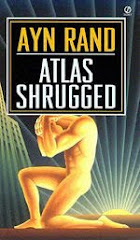
All of which ought to cause a massive and sustained Second Great Depression. The Obama Axis Powers will be happy to use the continuing crisis as a means to push for still more government power as a means to solve the problems they have themselves caused. Of course, they will continue to blame everything on George Bush and perhaps Rush Limbaugh. Meanwhile, bewildered Americans will more and more frequently read Ayn Rand's Atlas Shrugged in order to really understand the root of all the evil which has overtaken them. Will the sign of the dollar and decals asking "Who is John Galt?" become commonplace on Depression era cars?

If you have any hope of thinking for yourself, choosing your own values, and managing your own life in accordance with those values, you are under a massive and brutal attack. It is way past time for every American who has any understanding of his right to life, liberty, property, and the pursuit of happiness to stand sure in his insistence upon preserving this essence of his individual life. Without it, there is no joy in living. We must stand united and individually in rebellion against this statist takeover of our lives.

This is much, much worse than anything King George III ever conceived of. In comparison to Obama, the king was a hero of freedom. Let us hope Americans can recover some measure of the concern they once had for individual freedoms before they lose everything.

03 March 2009

No Banking Crisis Exists

Overall lending at U.S. commercial banks is up 5.7% in January from last year. It is at an all-time high of $9.85 trillion! This is just a bit below the average annualized monthly lending growth increase rate of 7.3% since 1990. This bit of a decrease is mostly due to reduced home mortgage lending, which is hardly a surprise given that people are not refinancing and that more people are out of work.

On the other hand, commercial and industrial loans were up 8.4% in January. Consumer loans were up 10.1%. This is a fairly robust lending market, not the crisis we are being told it is.

There are some financial institutions which have participated heavily in the bond market, hedge funds, and commercial paper markets who are in serious trouble, but the traditional banks generally are not. In fact, 90% of the traditional banks are well-capitalized and in pretty good shape.

We have to ask why the politicians and the media have tried so hard to imply that our banks are about to fail as many did in the Great Depression. One has to wonder if the politicians don't think that manufacturing a Great Depression would be good for them, however bad it might be for the rest of us.