Prof. Walter E. Williams asks in his column entitled Who Benefits from Democratic Control? whether blacks are being well-served by the Democrats who are given more than 90% of their votes in most elections.
He notes that of the 20 major U.S. cities with the highest homicide rates in terns of homicides per 100,000 people, that 19 of the 20 highest murder rate cities are controlled by Democrats, many of them for decades. The only exception of the 20 major cities is Tulsa, Oklahoma where much of my family lives. The worst cities in murder rate are in order: St. Louis, Baltimore (nearby for me), Detroit, New Orleans, Kansas City (a sister lives nearby), Cleveland (my wife's home city), Memphis, and Newark, NJ, Chicago, Cincinnati, Philadelphia, and Washington, DC (nearby for me).
Prof. Williams also notes that many cities are losing their populations. Detroit, St. Louis, Cleveland, and Pittsburgh are among those whose present populations are less than half what they were in 1950. The populations of Washington, DC, Baltimore, Camden, NJ, and many others are much reduced due to safety issues, poor schools, and unpleasant environments.
So Walter E. Williams asks blacks what do they have to lose by trying politicians who are not Democrats.
Showing posts with label Chicago. Show all posts
Showing posts with label Chicago. Show all posts


05 March 2016
Why Some U.S. Companies are Fleeing to Mexico and Trump Cannot Negotiate Us Out of this Mess
In my recent 1 March post Making America Great and Donald Trump, I said
The Wall St. Journal response to that is:
Nabisco is hardly alone in abandoning Chicago or Illinois. In 2015, Illinois bucked the increase in manufacturing jobs in other nearby states by losing 56 jobs a working day. Meanwhile, Michigan gained 74 manufacturing jobs a working day, Ohio gained 58, Indiana gained 20, and Wisconsin gained 18 manufacturing jobs a day. The unfriendly business climate in Illinois has dire consequences.
Both Ford and General Motors are doubling their production in Mexico by 2018. Ford is building two engine and transmission plants in Mexico and will manufacture small cars and hybrids required to meet the federally imposed fuel standard fleet requirements on all Ford vehicles manufactured. These required small cars are money losers, so it is particularly hard to manufacture them in the U.S.
The United Auto Workers Union has won an agreement that will raise the hourly cost of wages and benefits for its members to $60, from the already very high cost of $57/hour cost for Ford and a $55/hour cost for GM. In comparison, foreign-owned automakers in the U.S. have labor costs of about $50/hour.
In addition to lower labor costs, Mexico has free-trade agreements with 45 countries, while the U.S. has free-trade agreements with only 20 countries. Trump clearly wants to reduce our free-trade agreements, hurting the U.S. still further in this competitive advantage. He will drive still more plants to Mexico following his trade-war policies.
The Wall St. Journal says the way to make the U.S. economy great is to
the primary reason the opening of new trade markets around the world has not led to the growth of the American economy is because the American government does not allow American businesses to be competitive. He notes the importance of corporate tax reductions, but only after implying that bad trade negotiations caused job loses in America. The job losses in America are due to excessive taxes, paperwork, and regulations that American businesses are hobbled with, thanks to Washington. Business expenses are very high in America compared to many other countries in the world. To compete, we need to be free to take full advantage of our design and innovation capabilities, while shedding governmental burdens that provide no or insufficient benefits. We should be taking advantage of our abundance of inexpensive and reliable energy, not trying to make it more expensive as Obama has done. We should be taking advantage of our great banking and financial companies, not smothering most of them in disabling requirements under Dodd-Frank so-called reform. We should not be raising the cost of business with governmental dictates of minimum wages, paid leave benefits, the highest corporate and personal taxes in most of the developed nations, ObamaCare, NLRB rulings favoring forced unionization, and EPA regulations based on exaggerated claims of mercury or catastrophic man-made global warming.The lead Opinion article in the 4 March Wall St. Journal was titled Trump on Ford and Nabisco. Trump has been claiming that Mexico hijacked both Ford and Nabisco plants resulting in plant closings in the U.S. Trump says this is why he "Does not mind trade wars."
The Wall St. Journal response to that is:
That's one way of looking at it. Another way is that both companies made rational decisions to move some of their operations to Mexico because the tax and regulatory climate in the U.S. under President Obama has become increasingly hostile to business. Before picking destructive trade fights with the world, maybe the next President could work to make America great for doing business again.Nine production lines at the largest bakery in the world, in Chicago, are to be closed by Nabisco to build a higher technology plant in Salinas, Mexico. Nabisco will save $46 million a year with the new plant. Nabisco gave the labor union at the Chicago plant the opportunity to match that annual savings. The labor union brought in a Bernie Sanders campaign official to help them. Operating a business in Chicago is especially tough. Illinois has unusually high corporate taxes and property taxes, not to mention very high worker's compensation expenses. Underfunded city employee pensions are forcing taxes upward rapidly.
Nabisco is hardly alone in abandoning Chicago or Illinois. In 2015, Illinois bucked the increase in manufacturing jobs in other nearby states by losing 56 jobs a working day. Meanwhile, Michigan gained 74 manufacturing jobs a working day, Ohio gained 58, Indiana gained 20, and Wisconsin gained 18 manufacturing jobs a day. The unfriendly business climate in Illinois has dire consequences.
Both Ford and General Motors are doubling their production in Mexico by 2018. Ford is building two engine and transmission plants in Mexico and will manufacture small cars and hybrids required to meet the federally imposed fuel standard fleet requirements on all Ford vehicles manufactured. These required small cars are money losers, so it is particularly hard to manufacture them in the U.S.
The United Auto Workers Union has won an agreement that will raise the hourly cost of wages and benefits for its members to $60, from the already very high cost of $57/hour cost for Ford and a $55/hour cost for GM. In comparison, foreign-owned automakers in the U.S. have labor costs of about $50/hour.
In addition to lower labor costs, Mexico has free-trade agreements with 45 countries, while the U.S. has free-trade agreements with only 20 countries. Trump clearly wants to reduce our free-trade agreements, hurting the U.S. still further in this competitive advantage. He will drive still more plants to Mexico following his trade-war policies.
The Wall St. Journal says the way to make the U.S. economy great is to
- lower corporate and marginal tax rates
- reform pensions and entitlements
- institute right-to-work laws
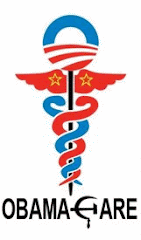
- repeal ObamaCare
12 April 2010
The Public School Scandal
I have stated over and over that our biggest problem in the fight for the equal, sovereign, and unalienable rights of the individual to life, liberty, and the pursuit of happiness in the United States of America is the fact that the education of our young is controlled by government. Government at the local, state, and federal levels always has a conflict of interest in education. American children need an education in which a cornerstone of their knowledge is knowing that legitimate government, as stated in our Declaration of Independence, is that government which governs with the consent of the governed for the purpose of securing their individual rights. They need to understand that the purpose of the Constitution was to insure that the federal government had very limited powers dedicated to the purpose of securing individual rights and nothing more. To understand how important this is, students need a knowledge of the history of great numbers of governments which oppressed the People. They need a realistic knowledge of the Capitalist system with its free markets for goods, services, and ideas and how that system serves every unique individual by allowing them many, many choices and an easy path to forming many voluntary associations with others for specialized purposes of their own. They need to understand that socialism cannot accommodate individual rights, cannot recognize the individuality and uniqueness of each of us, and cannot allow us to develop and express ourselves as the individuals we are. Students need to understand that a Capitalist, free market society offers a richness of life no other system can offer. Yet, all governments inevitably want to grow and want to feel needed in far more ways than the protection of our individual rights. And frankly, many politicians hunger for power and learn how to use special interest groups to help them attain it. Hence, government has a fundamental conflict-of-interest when it is put in charge of running our education system.
Yet, in America, as in most countries, government is in charge of the education of our young. We know that the quality of government-run education in many other fields than history and civics is also very disappointing. The governments that run the welfare system, the DMVs, job licensing, metro transportation systems, regulate health insurance and electricity rates, and much else equally poorly, do not do much better with education. In many cases, they also spend far more money on education than they tell us they spend on it as I reported in this post on Washington, D.C. public schools. According to a study released on 10 March 2010 by Adam Schaeffer with the Cato Institute's Center for Educational Freedom entitled They Spend WHAT? The Real Cost of Public Schools, this problem of under-reporting the real cost of public school educational expenses is very widespread. He examines the reported spending and the real spending per pupil for six metropolitan regions, including the five largest for K-12 public schools. He also compares the cost of the K-12 public schools to an estimate of the cost for private schools in that metropolitan area. The results are very enlightening and offer a sound reason for hope that we can convince the People that government-run education is a very bad deal indeed.
The Cato Institute report compiled public school K-12 costs for the central city school district, for the highest income adjacent school district and for the lowest income adjacent school district. I have complied a table to condense the most important of the results found by Adam Schaeffer in the following table:

The public school districts under-reported the true cost of public education per pupil anywhere from 3% to 151%. Only the low-income North Chicago school district did a faithful job of reporting their real expenditures, though the low-income district in the Phoenix area of Deer Valley at 13% and the low-income district in the Washington, D.C. area of Prince George's County at 17% were much more accurate than most in their reporting. Los Angeles city school district was the worst: they spent more than 2.5 times as much as they claimed to spend per pupil! The other districts spent between 22 and 85% more than they reported spending. It turns out that many voters when told about the difference in real spending from what they thought was being spent per student were very upset. They indicated that they were not willing be taxed so much as they were for the purpose of spending so much.
Equally interesting as the great deception of the People about the amount spent on public education, is the fact that the public education is clearly no bargain compared to private education. The public school districts spent between 21% and 201% more than the local private schools! In 8 out of the 18 public school districts examined, the public schools spent more than 100% more than (twice as much) did the local private schools per pupil. Only the Houston school districts and the low-income school districts of Phoenix, Los Angeles, and Washington, D.C., were less than 50% more expensive than the local private schools and all but one of them was one-third or more higher in costs.
Now, I am pretty sure that these private schools are generally offering as good or better educations than the public schools. I am very sure that if they spent as much as the public schools do per pupil, most private schools would offer a substantially better education. It would seem very clear that the taxpayers in many of these examined school systems could be convinced that a voucher system that allowed them to send their children to a private school instead of the public school money-eater would be preferable both for providing their children a better education and to save the local tax district a huge amount of money, as they shut down more and more of their schools. Indeed, even the taxpayers with no children to educate would clearly be better off.
Some will argue that many of the private schools are associated with religious groups. Indeed, in a country in which the taxpayer has to pay for these very expensive public schools and then has to shell out a substantial amount of money for a private school, there is likely to be another motivation of the effort and commitment, such as a strong belief of some kind. But, if public policy allows a healthy voucher system, the market for private schools will expand greatly. Many secular schools will be established, as will be schools with strong arts programs or strong science programs. The competition to provide good educations at reasonable prices will produce many more good schools that people can afford more readily than the bloated socialist holding cells we call schools today.
So, when the topic of public education comes up in your school district, do not feel bashful about informing your conversant that public schools are ridiculously expensive and provide a poor education compared to what a private school can and will provide. Let's get the People to demand a shift from government-run schools to private schools, where the parents will once again have a say in the education of their children and the taxpayers will have some relief. The public schools are just one more case of the gullible being taken for a ride by government.
Yet, in America, as in most countries, government is in charge of the education of our young. We know that the quality of government-run education in many other fields than history and civics is also very disappointing. The governments that run the welfare system, the DMVs, job licensing, metro transportation systems, regulate health insurance and electricity rates, and much else equally poorly, do not do much better with education. In many cases, they also spend far more money on education than they tell us they spend on it as I reported in this post on Washington, D.C. public schools. According to a study released on 10 March 2010 by Adam Schaeffer with the Cato Institute's Center for Educational Freedom entitled They Spend WHAT? The Real Cost of Public Schools, this problem of under-reporting the real cost of public school educational expenses is very widespread. He examines the reported spending and the real spending per pupil for six metropolitan regions, including the five largest for K-12 public schools. He also compares the cost of the K-12 public schools to an estimate of the cost for private schools in that metropolitan area. The results are very enlightening and offer a sound reason for hope that we can convince the People that government-run education is a very bad deal indeed.
The Cato Institute report compiled public school K-12 costs for the central city school district, for the highest income adjacent school district and for the lowest income adjacent school district. I have complied a table to condense the most important of the results found by Adam Schaeffer in the following table:

The public school districts under-reported the true cost of public education per pupil anywhere from 3% to 151%. Only the low-income North Chicago school district did a faithful job of reporting their real expenditures, though the low-income district in the Phoenix area of Deer Valley at 13% and the low-income district in the Washington, D.C. area of Prince George's County at 17% were much more accurate than most in their reporting. Los Angeles city school district was the worst: they spent more than 2.5 times as much as they claimed to spend per pupil! The other districts spent between 22 and 85% more than they reported spending. It turns out that many voters when told about the difference in real spending from what they thought was being spent per student were very upset. They indicated that they were not willing be taxed so much as they were for the purpose of spending so much.
Equally interesting as the great deception of the People about the amount spent on public education, is the fact that the public education is clearly no bargain compared to private education. The public school districts spent between 21% and 201% more than the local private schools! In 8 out of the 18 public school districts examined, the public schools spent more than 100% more than (twice as much) did the local private schools per pupil. Only the Houston school districts and the low-income school districts of Phoenix, Los Angeles, and Washington, D.C., were less than 50% more expensive than the local private schools and all but one of them was one-third or more higher in costs.
Now, I am pretty sure that these private schools are generally offering as good or better educations than the public schools. I am very sure that if they spent as much as the public schools do per pupil, most private schools would offer a substantially better education. It would seem very clear that the taxpayers in many of these examined school systems could be convinced that a voucher system that allowed them to send their children to a private school instead of the public school money-eater would be preferable both for providing their children a better education and to save the local tax district a huge amount of money, as they shut down more and more of their schools. Indeed, even the taxpayers with no children to educate would clearly be better off.
Some will argue that many of the private schools are associated with religious groups. Indeed, in a country in which the taxpayer has to pay for these very expensive public schools and then has to shell out a substantial amount of money for a private school, there is likely to be another motivation of the effort and commitment, such as a strong belief of some kind. But, if public policy allows a healthy voucher system, the market for private schools will expand greatly. Many secular schools will be established, as will be schools with strong arts programs or strong science programs. The competition to provide good educations at reasonable prices will produce many more good schools that people can afford more readily than the bloated socialist holding cells we call schools today.
So, when the topic of public education comes up in your school district, do not feel bashful about informing your conversant that public schools are ridiculously expensive and provide a poor education compared to what a private school can and will provide. Let's get the People to demand a shift from government-run schools to private schools, where the parents will once again have a say in the education of their children and the taxpayers will have some relief. The public schools are just one more case of the gullible being taken for a ride by government.
24 September 2009
Obama and his ACORN partnership
John Fund made a number of interesting comments in the Wall Street Journal about ACORN and Obama's relationship with it. On the many Sunday news shows he appeared on, only one asked him about his connections with ACORN. Despite the scandals due to the video taping of many workers supporting illegal actions, he said
Obama was recognized as a community organizer expert and became a favored trainer at ACORN's Chicago meetings. In 1995 he served as ACORN's lawyer and worked on a lawsuit to force Illinois to comply with the federal Motor Voter Law. ACORN later used that law's weak voter registration requirements to add huge numbers of fake names to the voter rolls. In 1996, Obama's listing of his supporters in the campaign for the Illinois Senate started with ACORN, though it was not an alphabetical list.
Frankly, it's not something I've followed closely.Fund says that Obama and ACORN go back to 1991, when he took time off from his law career to operate a voter-registration drive for Project Vote, which was an ACORN partner and was later folded into ACORN. Obama's effort added 135,000 registered voters in Chicago and gave an upset victory to Democrat Carol Moseley Braun over the incumbent, Senator Alan Dixon in the 1992 Democrat primary.
Obama was recognized as a community organizer expert and became a favored trainer at ACORN's Chicago meetings. In 1995 he served as ACORN's lawyer and worked on a lawsuit to force Illinois to comply with the federal Motor Voter Law. ACORN later used that law's weak voter registration requirements to add huge numbers of fake names to the voter rolls. In 1996, Obama's listing of his supporters in the campaign for the Illinois Senate started with ACORN, though it was not an alphabetical list.
Subscribe to:
Posts (Atom)






 Posts
Posts