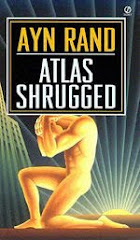
I have loved the book Atlas Shrugged by Ayn Rand since I first read it when I was just turning 18 in April 1965. On 15 April 2011, I saw the movie Atlas Shrugged Part 1 for the first time at an 18-screen theater in Gaithersburg, Maryland in a 9:15 PM showing with a good-sized audience. To my surprise, the audience did not have an age distribution similar to that of people who have read the novel. In fact, the age distribution was quite young. There were almost no children, but almost all of the audience appeared to be in their late teens to early thirties. One Objectivist commentator I read regularly, Robert Tracinski, said that the number of theaters showing Atlas Shrugged grew greatly in the last few weeks because Tea Party enthusiasts requested it. Maybe, but the audience at the showing I went to was much younger on average than the people I see at Tea Party rallies. This young audience seemed to be paying rapt attention to the movie. There were a number of times when many people laughed at the beliefs expressed by the usual Progressive Elitists. Such comments as I heard after the movie seemed to indicate that the audience enjoyed the movie. If this is true in the highly Socialist State of Maryland in the highly Socialist County of Montgomery, this is very significant. We have a very leftist school system here, yet some young people are looking for an alternative view of life to that they have grown up with. It is clear that most of this young audience is unlikely to have read Atlas Shrugged yet. Based on this, I expect a surge in book sales is going to result.
My wife Anna and I enjoyed the movie ourselves. It is an effective telling of the story. The movie makes it clear that man's well-being and human civilization depend upon those who use their independent minds to create ideas, goods, and services that enrich our lives and enhance our security. It also makes it clear that those advancing collectivism are largely using it to gain power and to enrich themselves at the expense of others, while the producers are enriching themselves and others. The movie shows Dagny Taggart, Hank Rearden, and Ellis Wyatt as capable, heroic people worthy of our respect. It also conveys the brotherhood of the producers and their exchange of love and affection for one another.
Given the rushed production of the movie, I thought it was itself an heroic achievement. Professional movie critics seem to be inclined to claim the film has many shortcomings in the filming. I am not a professional movie critic, but just a movie viewer. I did not see those shortcomings in any significant way. I thought there was a great deal of striking and appropriate cinematography in fact. It is not the case that there were no areas of improvement that I could see, however.
There was so much material to cover from the first ten chapters of the book, that I really do think the movie should have been 30 minutes longer so there could have been more character development. I do not believe the character development was so underdone that one could not assess the nature of most of the important characters. I just think that Ayn Rand developed the nature of Dagny and Hank as heroic producers and as people who hungered for the sight of achievement and purpose in others so greatly that this is one of the main rebuttals to the frequent collectivist claim that businessmen care only about themselves. The movie tries to establish this fellowship, but that fellowship is so rich that it would have made a greater movie if the movie had had the time to develop it further. There may have been many financial, time, and distribution reasons why the movie could not be longer, especially given that it was not backed with the promotion power of a major movie production company. This may make my wish for a longer movie no more than that: a wish.
There were a few oddities. It took me a moment to get over the fact that Ellis Wyatt was played by an older man, rather than a younger man than Dagny Taggart. In the novel he is full of youthful enthusiasm and he comes upon the scene of Colorado and quickly changes everything. He actually takes over his father's rundown oil field and finds ways to extract remarkably more oil from them and then discovers new fields. The older actor does work fine in the story and nothing essential was lost. It was just a momentary jolt. In fact the actor playing Ellis Wyatt did a very good job. Anna was very impressed by his performance.
Another casting oddity to my mind was Francisco D'Anconia. Almost every Objectivist woman who has read the novel falls in love with Francisco. I am not convinced that the actor in the movie would have that effect on women, even if he had had adequate screen time. It would be interesting to have the response of women who have seen the movie on this.
I generally liked Taylor Schilling as Dagny. She projects good strength of character, intelligence, and she is a beautiful woman. There were a few times when she probably should have been slightly more assertive or more passionate. There is also a scene in which she is called back to Taggart Transcontinental to deal with an emergency and she seems to move somewhat more slowly than I can imagine Dagny doing. Of course, it is hard to move really fast in very high heeled shoes, so maybe I am being unfair. It just seemed to indicate a bit less passion than I would expect of Dagny. I think Dagny would have taken her high-heeled shoes off and run barefoot or she would have worn shoes she could run in. The bottom line though is this: could I love the woman Dagny in the movie? Not as much as Dagny of the novel, but, yes, I could love her. Her agony upon reaching Ellis Wyatt's oil field, with it ablaze and a sign saying he was giving it back as he found it, brought tears to my eyes. When I read the book the first time, Ayn Rand's development of that event brought tears to my eyes also. The injustice that such suffering should be visited upon Dagny was a part of the reason, but perhaps it was more graphic yet in the movie. As a man and a romantic, it is just revolting to see the effects of such evil upon a great and lovable woman such as Taylor, er.... Dagny.
When the movie noted that a producer had vanished, it put up the name, what industry he was in, and a date of disappearance. In the novel, the first man-of-the-mind disappearance noted is McNamara, who was the Cleveland contractor who finished building the San Sebastian Line to Francisco D'Anconia's copper mine in Mexico in which James Taggart and Orren Boyle had invested. Dagny was counting on him to rebuild the Rio Norte Line to Ellis Wyatt's oilfields in Colorado, where a cluster of productive manufacturing companies had grown. The movie just notes his disappearance after that of several other people and identifies him as a Manufacturing CEO without any connection to the upcoming building of the John Galt Line. Richard Halley, the composer, is the second disappearance in the novel, but he is not mentioned. Only businessmen are mentioned. To be sure, the first disappearance in the movie is of a prominent businessman, the banker Midas Mulligan, which we later learn in the novel was the first such man to disappear.
Another incongruity was the bridge on the Rio Norte Line that Hank Rearden tells Dagny he can affordably replace with one built of Rearden Metal. They walk onto the edge of the bridge which has a structure only suitable to span a narrow gap or if the gap is wider, which must have many supporting legs. You do not see the complete bridge, but the part you see is decrepit. Later, the train making the inaugural run on the John Galt Line, the temporary name for the railroad Dagny has created to rebuild the Rio Norte Line using the controversial Rearden Metal, passes over a magnificent bridge of unusual structure that could not be built of steel. The gap it spans is too wide and too deep for the kind of bridge it was represented as replacing. It is consistent with the challenge the bridge solved in the novel, however. It is also understandable. No bridge available for filming over such a chasm could be in such bad condition as the one shown had been. We have not yet arrived at that level of decay.
These differences from the novel and oddities are nit-picking. I really do not think they significantly detract from the movie or from Ayn Rand's work. But, part of the fun of seeing the movie is in trying to see which things you can identify as different. Why not have the fun of observing them, but then do put them in context. Remember that context is everything, or at least crucially important.
I really do recommend that people with any interest at all in Atlas Shrugged or Ayn Rand's ideas go see the movie. I believe most of you will enjoy it, if you give it a chance as a movie. Remember, no movie can be a substitute for reading the great novel. As most of us know who have loved the novel, it has many, many layers of themes and a very broad, life-living philosophy permeating paragraph after paragraph. The novel is a remarkable work of genius. The movie Atlas Shrugged Part 1 is at least very good and entertaining. With the success of this movie, the producers will make a still better Part II, I expect. I think they will have learned from making Part I and they ought to have more time and resources to make Part II. I also think they will have a bigger audience after DVD sales of Part I and after it reaches TV audiences.
Eventually, at least most people will know the answer to the question, "Who is John Galt?" It amazes me that many educated and professional people do not have a clue. Many more people will also read the novel itself. I am sure of that now. That will be the ultimate measure of the success of the movie in my mind.
Showing posts with label Taylor Schilling. Show all posts
Showing posts with label Taylor Schilling. Show all posts
17 April 2011


Subscribe to:
Posts (Atom)






 Posts
Posts