The No Fly List is an often incompetently compiled list which does not follow the judicial procedures that are a necessary protection of individual rights. It denies individuals the right to travel by air with the false claim that one does not have a right to travel by air. It is claimed that travel is just a privilege which government can revoke at its whim.
This is not true. The right to travel is a very fundamental right. Just as no one has the obligation to provide us with happiness, no one is obliged to enable our travel. But, no one is justified in preventing our traveling with the use of force or the threat of force so long as we do so without hurting anyone else. Before one's right to travel can be abridged, there must be a judicial determination that one has a history of initiating the use of force or that one has plans to do so.
The right to bear arms is an explicitly guaranteed right in our Bill of Rights. The Second Amendment to the Constitution specifically recognizes this right to own arms. Obama's call to prevent the sale of arms and the possession of arms to those on the No Fly List is highly irrational. I am sure it seems to make sense to many Americans, but it does not.
Only those who have established felony histories can be denied their Second Amendment right to bear arms. This means those who are deprived of their gun rights have been first evaluated by our judiciary as a reasonable threat to others should they be allowed to own a gun. But note what Obama is doing to undermine this basic right guaranteed in our Bill of Rights: He is denying this right on the basis of a list made in denial of a travel right without a proper judicial review of those denied this right. In his own terms, he is using the revocation of what he calls a privilege to justify the revocation of an individual right protected in our Bill of Rights. The downgrade of our travel rights is being used as a basis to downgrade a right protected in our Constitution.
Even in the Articles of Confederation, the right to travel from one state to another was recognized. Many court cases decided under the Constitution have also recognized this right to travel. Yet since 9/11, this right has been denied, especially in air travel. Now we see once again how the violation of one right is used to justify the violation of another individual right.
Showing posts with label Bill of Rights. Show all posts
Showing posts with label Bill of Rights. Show all posts
08 December 2015


04 October 2013
A Democrat Wants to Know, Sort Of
A young Democrat of my acquaintance, who was educated as an engineer at Georgia Institute of Technology and has a Wharton School of Business MBA, sent me the following note:
Now despite this thinking, this young man is of considerable importance to me. As a consequence, I have had several discussions with him, though as is usually the case when talking to a Democrat, there has been no change of his opinions despite my sterling reason! There is always the sense that a Democrat simply lives in a different universe and all the laws of physics and economics are different there and they cannot imagine what those laws are on Earth.Again the GOP strikes with the Govt shutdown. It all stinks of politics, and the unfortunately for the GOP, they are not very likeable right now, so the American people don't buy what they are selling. How childish was Cruz the other day?? If every politician threw a tantrum every time they didn't get what they wanted or believed in, where would we as a country be?Simple questions. Why is there no leadership in the GOP? Why is the Tea Party effectively blocking the everything? This GOP is frankly a shitshow (excuse my french), and there is no site in end. It is a shame, I am starting to think that an independent may have just as good a chance as the GOP in the next presidential elections, because almost everyone there is either useless, or has to flip flop numerous times just to get the party nomination (a la Romney - a good candidate). I know how you feel about the Affordable Care Act, but I don't think it is a bad idea to ask people to chip in when it is health related. America needs to go away from the "every man for himself" motto when it comes to basic fundamentals like health. The Affordable Care Act does not make America a socialist country.
Here is my reply:
When government
spends 24 to 25% of the entire GDP and has a couple of hundred thousand
pages of regulations that impose restrictions on the actions of
individuals and many cost and time requirements on individuals in
addition to its actual spending, then passions will run high on
political issues. And contrary to the pretense of those who believe
wholeheartedly in Big Government, government is all about the use of
force. With our democratic pretense, we suppose that 50.1% of the
voters have the right to use that force to make 49.9% do anything they
please. This is not the case. It does make every government act of the
legislature and of the President a matter of politics.
The purpose
of legitimate government is to protect the rights of the individual.
These rights are very broad with respect to freedom of conscience,
freedom of association, and the freedom to take all actions which
support your own life and happiness without the use of force against
others. Those broad freedoms are only partially spelled out as a few
particulars in the Bill of Rights. The 9th Amendment which might
protect the full scope of our individual rights is ignored and this is
not surprising because too few people have thought out the complete
scope of our individual rights.
The Constitution listed the few powers of the government and the list was short. Had the government and many special interests not long fought to ignore the limits of that list, most individual rights would not be violated by the government. In fact, many of the Framers of the Constitution made this very argument against a Bill of Rights, noting that a Bill of Rights would be too narrow a protection and just protect a portion of one's individual rights. They argued that this would be taken as a reason to say the government can do anything to anyone which is not then denied by the Bill of Rights. This is what has happened and then some. Now even rights explicit in the Bill of Rights are violated, such as Freedom of Speech, Freedom of Religion, Freedom to Assemble, Freedom to Petition the Government, and the right to own and bear arms.
The Constitution listed the few powers of the government and the list was short. Had the government and many special interests not long fought to ignore the limits of that list, most individual rights would not be violated by the government. In fact, many of the Framers of the Constitution made this very argument against a Bill of Rights, noting that a Bill of Rights would be too narrow a protection and just protect a portion of one's individual rights. They argued that this would be taken as a reason to say the government can do anything to anyone which is not then denied by the Bill of Rights. This is what has happened and then some. Now even rights explicit in the Bill of Rights are violated, such as Freedom of Speech, Freedom of Religion, Freedom to Assemble, Freedom to Petition the Government, and the right to own and bear arms.
Let us
return to the problems of unfettered democracy with a big government.
This creates a society in which on issue after issue a slim majority (in
the ideal case, in actuality, special interests very often control such
a government and the beliefs of the people be damned) uses force to
impose their will on a minority. The minority is enraged both by having
to do something they think is wrong and by the fact that they are
forced to do it by force-wielding thugs, agents of the government.
There is the wrongness of the thing itself and there is the wrongness of
the force itself.
Even if you are on the majority side in many cases, you will inevitably be on the minority side many times also. This is an awful way to live life. It is very stressful and very confrontational. But, it is the nature of unfettered democracy and is a substantial part of the reason such democracies soon collapse. They destroy the society and replace a natural tendency to cooperate with one another in the private sector with a mob or gang mentality striving to control the use of government force to their advantage. They also make laws to cover many activities they simply do not understand. This really gums up the works by removing the specialists in the private sector from the decision process.
If a minority and a number of special interests combine with a socialist President, they can even impose a monster system such as ObamaCare, despite most of the People opposing it. Most of the things that big government does have some special interest group wanting it and most of the People are actually remarkably uninformed about it. They are also generally victims of that action and do not understand that.
Even if you are on the majority side in many cases, you will inevitably be on the minority side many times also. This is an awful way to live life. It is very stressful and very confrontational. But, it is the nature of unfettered democracy and is a substantial part of the reason such democracies soon collapse. They destroy the society and replace a natural tendency to cooperate with one another in the private sector with a mob or gang mentality striving to control the use of government force to their advantage. They also make laws to cover many activities they simply do not understand. This really gums up the works by removing the specialists in the private sector from the decision process.
If a minority and a number of special interests combine with a socialist President, they can even impose a monster system such as ObamaCare, despite most of the People opposing it. Most of the things that big government does have some special interest group wanting it and most of the People are actually remarkably uninformed about it. They are also generally victims of that action and do not understand that.
Big Government is all about every faction for itself. It is not about the welfare of the People. That is the pretense and it is very clear these days that it is a very hollow pretense. Contrary to your statement, the private sector is not properly characterized as "every man for himself." The private sector is characterized by people cooperating with one another for a multitude of purposes of their own choosing and helping one another to achieve the goals that each has chosen of his own free will. The private sector, unlike the government sector, does not live by the use of force and does not allow some to impose their will on others. It is the government sector that refuses to allow us to work out mutually agreeable contracts and associations with others in many, many ways. The government limits our activities mostly in interactions with others and thereby forces us to go it alone in many cases where we would have sought out a mutually beneficial cooperative enterprise with others.
Such effects are very clear with such laws as the Minimum Wage Law. If I wish to hire an under-educated and inexperienced young person and he wishes to take the job I may be able to give him, we are not allowed to negotiate any wage lower than the minimum wage. I never get to evaluate his work ethic and ability to do productive work and he never gets to prove he can do the job and move on to a higher pay grade. I have to go it without his potentially good production and he gets to turn to a life of crime.
Or take the fact that ObamaCare is forcing employers to stop hiring before they grow to 50 employees and it pushes them to reduce the hours worked in a week to fewer than 30 hours. In effect, ObamaCare is forcing the employer to go it alone. His ability to cooperate with others for their mutual benefit is restricted. Then there are many, many medical providers who are now being laid off because their employers cannot make enough money to survive under ObamaCare. Once again, Big Government is making people go it alone.
You say you do not think it is a bad idea to ask people to chip in to provide health care to others. I do not much care whether you ask them to do so or not. Go ahead and ask all you want, provided you are not being terribly dishonest and are not actually using force to make them contribute their hard-earned income to provide for the health of others. But you are being dishonest here. There is nothing that gives you the right to make others do this. This is nothing but your particular wish. Unfortunately, others wish that everyone had the same income. Others wish that everyone has a nice home. Others want everyone to eat well. There is no end to what people wish with respect to others. Imagine how awful a society would be if everyone got to use force to make everyone else live according to their wishes.
By and large, the Republican Party is for a slightly smaller government than is the Democrat Party. To have a slightly smaller Big Government, such a party will often say no to the Party that is constantly proposing a new government program. Some of the People actually want a substantially smaller government. Many of these people are in the Tea Party movement, which I associate with myself. They generally are Republicans, though not very happy Republicans. Some are in the Libertarian Party. But, naturally they are not going to join the party most enthusiastic about Big Government. So, they have become a fractious element in the Republican Party. They want that party to stand up for something closer to a constitutional government. Naturally, they are opposed to most programs that would make the government still bigger and still more intrusive in our lives.
You bemoan the lack of Republican leaders holding the membership in an iron grip of control. Well, what do you really expect of people who want to manage their own lives and choose their own values. Those who want government to do this for them are naturally inclined to follow leaders. Those who like to think independently and control their own decisions in life do not naturally turn to a leader to tell them what to do. Traditionally, Americans never did, but after 100 years of growing Progressive Elitist effort and influence in the government-run or bribed schools, there are many people now well-conditioned to do as they are told. I am of the old school and never allowed myself to be so conditioned.
The iron grip of control of the Democrat Party line is actually very exposed as it forces them to maintain beliefs obviously contrary to reality. They still maintain that Americans will have better healthcare under ObamaCare at a lower cost and that enough medical care providers will be available. This is clearly not going to be the case. Many employers are dropping health insurance plans, many people will find that their doctor is no longer available, most people will find their costs will go up and that much of the cost provides them with care they do not want. Many young people especially will not be able to get jobs because they would cost the employer more under ObamaCare than they used to. It used to be that if you hired a young person, the average age in your insurance pool dropped so your health insurance cost went down and gave you some incentive to train the young hire. Now you add a young person and his affordable plan cost at 9.5% of his pay is likely to force the company to reduce the coverage offered to its longer time employees to keep the young hire's health insurance below 9.5% or cost you a $3000 penalty tax. Or you do not hire the young person. It is so simple. More and more Americans are realizing how ridiculous the Democrat Party claims are and the lock-step adherence to the party line will be deadly to the Democrats.
Another clear example of the inability of the Democrats to think rationally and independently is the adherence to the claim that man's emissions of CO2 will cause catastrophic global warming. After 17 years of no surface temperature increase and rising CO2 concentrations in the atmosphere, this claim has become entirely laughable. Yet Obama just recently made the claim that 97% of scientists support the catastrophic man-made global warming hypothesis, which is also a very untrue statement. So his EPA is putting out a new regulation to keep anyone from building a coal-fired power plant and he still has not approved the Keystone XL Pipeline using this specious argument as the justification. It is imposing many uneconomic mandates such as for the use of ethanol in gasoline, an increase in vehicle gasoline efficiency, electric vehicle programs, and programs pushing solar and wind energy generation that are very much hurting the economy and helping to raise the unemployment rate. Despite these obvious deleterious effects, few Democrats have departed from the party line.
No X, I prefer to think for myself and be a member of the Republican Party that at least sometimes acts to slow down or stop the growth of society-destroying government. I will remain in the libertarian and the Tea Party wing which is most determined to keep the iron hob-nailed boot of government off of our necks. However many people want to be dependents of the government, I will not be one who wants that. I want to be left alone by gangs of thugs to establish my own cooperative agreements with others to work toward our mutually chosen goals. It really matters to me both that I am able to pursue my goals and that they are able to pursue theirs.
Please give what I am saying some real thought X.
08 July 2013
A Nation of Sovereign Individuals with Unalienable Rights
Obama's 6 July radio address said that on 4 July 1776, a small band of men declared that we Americans were created equal and free to think and worship as we pleased. He said we were now a land of liberty and opportunity.
Obama did not say in what very limited manner we were equal because his agenda requires that to be vague. He did not note that while we are still free to think and worship as we please, we are very often not free to speak and write what we think or to act upon our beliefs, religious or not. He did not note that our liberties are constantly becoming fewer and that he wants them to become fewer. He did not say that he also wants to dictate the nature of our ever more limited opportunities and pick who will be given greater opportunity than others with manipulative government policies. He habitually defends unequal status before government as an honest effort to create equality among the People.
To understand how insulting this man's ideas and policies are to the sovereign rights of the individual, we really need a much better understanding of what our individual rights are than most people have. Indeed, even our founding fathers had an inadequate view of them, though I generally admire them for having understood the problem as well as they did in their time.
The Declaration of Independence, agreed upon on 2 July and published on 4 July 1776, wonderfully stated that "all Men are created equal, that they are endowed by their Creator with certain unalienable Rights, that among these are Life, Liberty, and the Pursuit of Happiness -- That to secure these Rights, Governments are instituted among Men, deriving their just Powers from the Consent of the Governed, that whenever any Form of Government becomes destructive of these Ends, it is the Right of the People to alter or to abolish it, and to institute new Government, laying its Foundation on such Principles, and organizing its Powers in such Form, as to them shall seem most likely to effect their Safety and Happiness."
Yes, I do not agree that our rights come from our "Creator", but they do derive as Ayn Rand observed from our nature. At that time, almost everyone assumed the nature of man had been determined by man's Creator and therefore the rights that derived from man's nature were endowed by man's Creator. This reference to our Creator is a big deal with many who are religious today and because they attribute many of their beliefs to the will of a god they know nothing about, there are unfortunate consequences to this. Despite this error, there are many really great insights in this quoted statement of the Declaration of Independence.
The statement firmly places sovereignty in the hands of the People, not with government. It clearly takes individual rights to be of a very broad nature. Note that it even implies rights beyond those of each individual to life, liberty, and the pursuit of their happiness with the word "among." At the time, most Americans believed in the individual right to life, liberty, and property. The substitution of pursuit of happiness for property was clearly a way of broadening the claim of individual rights. Of course, the pursuit of happiness implied a freedom to acquire and keep property. But, it also would imply such things as a freedom to choose one's own friends and domestic partners, to choose what books one would read, to choose a religion or not to choose one, to enter into trade with others of one's choosing for the purposes of one's choosing, to maintain the privacy one desires, and many more actions leading to any of the many means to and forms of happiness that individuals might choose. This is a clear statement of a very broad concept of individual rights.
These rights are unalienable. The existence of a government does not diminish these rights. These rights are always sovereign in the individual. These rights are not given to the individual by the government. No, the government is only legitimate and able to claim a reason for its very existence to the extent that the government serves faithfully and well to protect these unalienable rights sovereign in the individual. The government is the servant of individual rights and when it fails to protect them as a matter of principle, the sovereign individuals will reform and reorganize government by their right so that it does follow principles to protect their individual sovereign rights.
These are powerful, well-stated principles that are manifestly ignored and/or misunderstood by the Progressive Elitists who dominate most academic viewpoints on the role of government today. This American principle of highly limited government with a legitimacy limited to its protection of individual rights held unalienably by sovereign individuals is unheard in academia, most media, and from most politicians. The People, long educated in government-run and dominated schools, no longer have a clear concept of their sovereignty, of their broad rights, and of their equally unalienable claim to these rights. Individuals are obviously unequal in most respects, but in the context of government, the most essential way in which they are equal is with respect to their equal and sovereign individual rights. To give some people favored status by law is to abrogate this one critical respect in which we are equal before the law. Those who most claim to believe in equality in the present political arena are most likely to destroy the most important sense in which we are equal. For all of his talk promoting equality, the Progressive Elitist today believes in neither equal rights nor even one-man, one-vote.
The sovereignty of the individual is re-affirmed in the Preamble of the Constitution. The statement of the highly limited powers of government issues from the sovereignty of the individuals who constitute that government. The government is formed only to serve their needs by protecting their liberties and their general welfare. This reference to general welfare is now often used in an out-of-context manner to support the welfare state and a massive redistribution of wealth. This could not be further from the intention of the time. No, then the general welfare implied government actions beneficial to everyone, not a bare majority or some special interest as it means today. Securing individual rights would provide peace and tranquility, justice, and the general welfare for everyone. No other government purpose can do this. Other government actions will most likely be unjust to many, require threats of violence upon many, and will harm the interests of many.
The 9th Amendment of the Bill of Rights makes a clear statement that the rights of the individual are broad and are indeed unalienable. They are not to be denied or disparaged by the government. It is no small infraction of the principle of legitimate government that our government has long ignored this amendment and overtly claimed it to be meaningless. Indeed, the Supreme Court has actually claimed that the government is sovereign, which it most manifestly is not. Were this the case, then there would be no means by which a legitimate government could be formed and judged. There would be no possible basis for overthrowing it when it became tyrannical and inimical to the rights of the individual. Such a government would be inconsistent with both the Declaration of Independence and the Constitution. Indeed, a sovereign government, rather than a government serving to protect the rights of sovereign individuals, is inconceivable in a human-centered morality in which individuals think and act as individuals for the purpose of preserving their lives, flourishing in liberty, and pursuing their own happiness.
This enlightenment and early American view of sovereign individual rights and very limited government legitimately protecting individual rights is very much at odds with the loose and hoary notions of government and rights held by Obama, the Progressive Elitists, and other advocates of big government today. They assume that it is the purpose of government to grant individuals such rights as it may choose to give them. They assume that government is supposed to hurt the interests of many for the purpose of helping some who are incompetent in living their lives. They believe it is just and moral to propagate innumerable laws and regulations limiting our individual freedoms, even as each mandate is enforced by the threat of violence should anyone stand upon their individual rights. No peace and tranquility are possible as faction upon faction, special interest upon special interest, and even race upon race, battle for control of the brutal power of government. It is clear that by the criteria of our own Declaration of Independence, our government today is illegitimate.
The rational American does not celebrate the federal government on the 4th of July. He celebrates the American Principle set forth by the Declaration of Independence and implemented in the Constitution by the mandate of American individuals. The American Principle states that the individual is sovereign and each individual has equal and broad rights to life, liberty, and the pursuit of happiness. It states that the only legitimate purpose of government is the protection of the unalienable rights of the individual. Due to this very limited function, government has and can claim but few powers. The sovereign individual retains his sovereignty with respect to the freedom to exercise his rights, while government is entirely his servant devoted to the sole task of protecting the rights of each and every individual American. By adherence to this dedicated purpose, good government harms no one and never initiates the use of force against anyone.
Obama did not say in what very limited manner we were equal because his agenda requires that to be vague. He did not note that while we are still free to think and worship as we please, we are very often not free to speak and write what we think or to act upon our beliefs, religious or not. He did not note that our liberties are constantly becoming fewer and that he wants them to become fewer. He did not say that he also wants to dictate the nature of our ever more limited opportunities and pick who will be given greater opportunity than others with manipulative government policies. He habitually defends unequal status before government as an honest effort to create equality among the People.
To understand how insulting this man's ideas and policies are to the sovereign rights of the individual, we really need a much better understanding of what our individual rights are than most people have. Indeed, even our founding fathers had an inadequate view of them, though I generally admire them for having understood the problem as well as they did in their time.
The Declaration of Independence, agreed upon on 2 July and published on 4 July 1776, wonderfully stated that "all Men are created equal, that they are endowed by their Creator with certain unalienable Rights, that among these are Life, Liberty, and the Pursuit of Happiness -- That to secure these Rights, Governments are instituted among Men, deriving their just Powers from the Consent of the Governed, that whenever any Form of Government becomes destructive of these Ends, it is the Right of the People to alter or to abolish it, and to institute new Government, laying its Foundation on such Principles, and organizing its Powers in such Form, as to them shall seem most likely to effect their Safety and Happiness."
Yes, I do not agree that our rights come from our "Creator", but they do derive as Ayn Rand observed from our nature. At that time, almost everyone assumed the nature of man had been determined by man's Creator and therefore the rights that derived from man's nature were endowed by man's Creator. This reference to our Creator is a big deal with many who are religious today and because they attribute many of their beliefs to the will of a god they know nothing about, there are unfortunate consequences to this. Despite this error, there are many really great insights in this quoted statement of the Declaration of Independence.
The statement firmly places sovereignty in the hands of the People, not with government. It clearly takes individual rights to be of a very broad nature. Note that it even implies rights beyond those of each individual to life, liberty, and the pursuit of their happiness with the word "among." At the time, most Americans believed in the individual right to life, liberty, and property. The substitution of pursuit of happiness for property was clearly a way of broadening the claim of individual rights. Of course, the pursuit of happiness implied a freedom to acquire and keep property. But, it also would imply such things as a freedom to choose one's own friends and domestic partners, to choose what books one would read, to choose a religion or not to choose one, to enter into trade with others of one's choosing for the purposes of one's choosing, to maintain the privacy one desires, and many more actions leading to any of the many means to and forms of happiness that individuals might choose. This is a clear statement of a very broad concept of individual rights.
These rights are unalienable. The existence of a government does not diminish these rights. These rights are always sovereign in the individual. These rights are not given to the individual by the government. No, the government is only legitimate and able to claim a reason for its very existence to the extent that the government serves faithfully and well to protect these unalienable rights sovereign in the individual. The government is the servant of individual rights and when it fails to protect them as a matter of principle, the sovereign individuals will reform and reorganize government by their right so that it does follow principles to protect their individual sovereign rights.
These are powerful, well-stated principles that are manifestly ignored and/or misunderstood by the Progressive Elitists who dominate most academic viewpoints on the role of government today. This American principle of highly limited government with a legitimacy limited to its protection of individual rights held unalienably by sovereign individuals is unheard in academia, most media, and from most politicians. The People, long educated in government-run and dominated schools, no longer have a clear concept of their sovereignty, of their broad rights, and of their equally unalienable claim to these rights. Individuals are obviously unequal in most respects, but in the context of government, the most essential way in which they are equal is with respect to their equal and sovereign individual rights. To give some people favored status by law is to abrogate this one critical respect in which we are equal before the law. Those who most claim to believe in equality in the present political arena are most likely to destroy the most important sense in which we are equal. For all of his talk promoting equality, the Progressive Elitist today believes in neither equal rights nor even one-man, one-vote.
The sovereignty of the individual is re-affirmed in the Preamble of the Constitution. The statement of the highly limited powers of government issues from the sovereignty of the individuals who constitute that government. The government is formed only to serve their needs by protecting their liberties and their general welfare. This reference to general welfare is now often used in an out-of-context manner to support the welfare state and a massive redistribution of wealth. This could not be further from the intention of the time. No, then the general welfare implied government actions beneficial to everyone, not a bare majority or some special interest as it means today. Securing individual rights would provide peace and tranquility, justice, and the general welfare for everyone. No other government purpose can do this. Other government actions will most likely be unjust to many, require threats of violence upon many, and will harm the interests of many.
The 9th Amendment of the Bill of Rights makes a clear statement that the rights of the individual are broad and are indeed unalienable. They are not to be denied or disparaged by the government. It is no small infraction of the principle of legitimate government that our government has long ignored this amendment and overtly claimed it to be meaningless. Indeed, the Supreme Court has actually claimed that the government is sovereign, which it most manifestly is not. Were this the case, then there would be no means by which a legitimate government could be formed and judged. There would be no possible basis for overthrowing it when it became tyrannical and inimical to the rights of the individual. Such a government would be inconsistent with both the Declaration of Independence and the Constitution. Indeed, a sovereign government, rather than a government serving to protect the rights of sovereign individuals, is inconceivable in a human-centered morality in which individuals think and act as individuals for the purpose of preserving their lives, flourishing in liberty, and pursuing their own happiness.
This enlightenment and early American view of sovereign individual rights and very limited government legitimately protecting individual rights is very much at odds with the loose and hoary notions of government and rights held by Obama, the Progressive Elitists, and other advocates of big government today. They assume that it is the purpose of government to grant individuals such rights as it may choose to give them. They assume that government is supposed to hurt the interests of many for the purpose of helping some who are incompetent in living their lives. They believe it is just and moral to propagate innumerable laws and regulations limiting our individual freedoms, even as each mandate is enforced by the threat of violence should anyone stand upon their individual rights. No peace and tranquility are possible as faction upon faction, special interest upon special interest, and even race upon race, battle for control of the brutal power of government. It is clear that by the criteria of our own Declaration of Independence, our government today is illegitimate.
The rational American does not celebrate the federal government on the 4th of July. He celebrates the American Principle set forth by the Declaration of Independence and implemented in the Constitution by the mandate of American individuals. The American Principle states that the individual is sovereign and each individual has equal and broad rights to life, liberty, and the pursuit of happiness. It states that the only legitimate purpose of government is the protection of the unalienable rights of the individual. Due to this very limited function, government has and can claim but few powers. The sovereign individual retains his sovereignty with respect to the freedom to exercise his rights, while government is entirely his servant devoted to the sole task of protecting the rights of each and every individual American. By adherence to this dedicated purpose, good government harms no one and never initiates the use of force against anyone.
07 July 2013
Taking the Fifth is Always Wise Policy, Especially Under Big Government
A law Professor, James Duane of the Regent Law School of Virginia Beach, VA, offers a very interesting and convincing argument for why anyone questioned by the police should always take the 5th. This is a really entertaining and enlightening presentation.
Among other points, he notes that the complexity of the law is itself a reason for not talking to the police or for that matter to IRS agents. The federal government has no idea how many federal criminal laws there are. What is more, one might reveal that one has violated some obscure federal agency regulation or interpretation of a law or that one is even guilty because you have violated a law of another nation to which you have never been. Under big government, no one is innocent.
Also, cooperation with the police will not help you. A police officer cannot testify that you helped them or that what you said exonerated you, since that is taken as mere hearsay and is not permissible evidence. Talking to government agents can only hurt you.
Any mistake or seemingly irrelevant little lie will hurt you. Even the truth stated by an innocent man can hurt him. Then again, the police may mis-remember what you said and that can be used against you. Or a wrong witness contradicting something you said may hurt your chances of avoiding conviction.
This is a seriously important presentation, which also indicates the great wisdom of our Bill of Rights:
http://www.youtube.com/watch?
H/t Alexander Strugatsky.
Among other points, he notes that the complexity of the law is itself a reason for not talking to the police or for that matter to IRS agents. The federal government has no idea how many federal criminal laws there are. What is more, one might reveal that one has violated some obscure federal agency regulation or interpretation of a law or that one is even guilty because you have violated a law of another nation to which you have never been. Under big government, no one is innocent.
Also, cooperation with the police will not help you. A police officer cannot testify that you helped them or that what you said exonerated you, since that is taken as mere hearsay and is not permissible evidence. Talking to government agents can only hurt you.
Any mistake or seemingly irrelevant little lie will hurt you. Even the truth stated by an innocent man can hurt him. Then again, the police may mis-remember what you said and that can be used against you. Or a wrong witness contradicting something you said may hurt your chances of avoiding conviction.
This is a seriously important presentation, which also indicates the great wisdom of our Bill of Rights:
http://www.youtube.com/watch?
H/t Alexander Strugatsky.
27 May 2013
Democrat Senator Durbin Questions Freedom of the Press
On Fox News Sunday, Democrat Senator Dick Durbin of Illinois questioned whether bloggers were protected by the 1st Amendment under freedom of the press. Let us re-read the 1st Amendment of the Constitution and see if his doubts about the rights of bloggers to write as an exercise of their freedom of conscience makes any sense at all.
The breadth of this amendment as a means to allow individuals to use their minds, to produce their own ideas, and to make those ideas known to others is the unifying theme of this amendment. Most people at the time of its adoption believed that this amendment guaranteed a broad freedom of conscience. Certainly Thomas Jefferson and James Madison thought so.
When the amendment was written, the written word could only be distributed to others by using a rather expensive invention, the printing press. But note that the amendment also allowed people to speak freely, to assemble and share ideas, and to complain to or seek reforms by the government. In this context, it is not possible to believe that the 1st Amendment was only intended to allow those who distributed their ideas using a printing press to exercise their freedom of conscience. I do not see the People then as thinking that freedom of the press was something that belonged only to someone who had made an investment in a printing press. The core idea of the 1st Amendment was to allow people to use their minds and to share their ideas with others.
No, it seems very clear that the dissemination of an individual's ideas and thoughts by right was to be broadly protected by this amendment. That being the case, the freedom to write down one's ideas and to disseminate them was to be protected from any abridging acts of Congress. Thus, the right of bloggers to write down their ideas and to make them available to others for reading is clearly protected by the 1st Amendment.
With experienced Senators such as Dick Durbin showing such profound ignorance of the 1st Amendment, it is no wonder our government has become such a constant threat to the rights of the individual to life, liberty, property, the ownership of one's own body, mind, and labor, and to the pursuit of personal happiness.
To be sure, there is considerable evidence that Dick Durbin is less ignorant than a man of evil intent. He, like all socialists, is only too happy to mislead the many who are uninformed about their individual rights. Persons asserting their individual rights are necessarily a major problem for the supporters of Big Government and socialism.
Congress shall make no law respecting an establishment of religion, or prohibiting the free exercise thereof; or abridging the freedom of speech, or of the press, or the right of the people peaceably to assemble, and to petition the Government for a redress of grievances.
The breadth of this amendment as a means to allow individuals to use their minds, to produce their own ideas, and to make those ideas known to others is the unifying theme of this amendment. Most people at the time of its adoption believed that this amendment guaranteed a broad freedom of conscience. Certainly Thomas Jefferson and James Madison thought so.
When the amendment was written, the written word could only be distributed to others by using a rather expensive invention, the printing press. But note that the amendment also allowed people to speak freely, to assemble and share ideas, and to complain to or seek reforms by the government. In this context, it is not possible to believe that the 1st Amendment was only intended to allow those who distributed their ideas using a printing press to exercise their freedom of conscience. I do not see the People then as thinking that freedom of the press was something that belonged only to someone who had made an investment in a printing press. The core idea of the 1st Amendment was to allow people to use their minds and to share their ideas with others.
No, it seems very clear that the dissemination of an individual's ideas and thoughts by right was to be broadly protected by this amendment. That being the case, the freedom to write down one's ideas and to disseminate them was to be protected from any abridging acts of Congress. Thus, the right of bloggers to write down their ideas and to make them available to others for reading is clearly protected by the 1st Amendment.
With experienced Senators such as Dick Durbin showing such profound ignorance of the 1st Amendment, it is no wonder our government has become such a constant threat to the rights of the individual to life, liberty, property, the ownership of one's own body, mind, and labor, and to the pursuit of personal happiness.
To be sure, there is considerable evidence that Dick Durbin is less ignorant than a man of evil intent. He, like all socialists, is only too happy to mislead the many who are uninformed about their individual rights. Persons asserting their individual rights are necessarily a major problem for the supporters of Big Government and socialism.
05 July 2011
American Exceptionalism in the Moral Foundation of the Declaration of Independence
The United States of America is unusual in that it became a nation comparatively recently and its People have maintained a similar philosophy of government, at least implicitly, throughout its lifetime. For decades, however, the Progressive Elitists have been working hard to change that philosophy to one more like that of most nation-states and their societies. What is the keystone of the American philosophy of government and why would Progressive Elitists want to change it?
The Declaration of Independence clearly spelled out the central fact of the exceptional American Principle of Government. Without this great and noble document, our Constitution cannot be viewed in its proper context and becomes a much weakened limit on the scope and powers of government. The United States of America were declared independent of Great Britain on 4 July 1776 with a very exceptional purpose in the annals of nations. Other nations simply had a government controlled by aristocrats, commonly in an alliance with high-level clergy, who were empowered to protect the people and take care of them, at least in theory. Our first founding document, The Declaration of Independence, clearly and emphatically states that a legitimate government is the tool of the People as the holders of sovereign, equal individual rights to protect and defend their rights. This is the first part of the exceptional American Principle of Government.
Let us read this straight from the Declaration of Independence:
The Constitution was ordained and established by the People as our second form of government in 1789 after they had found that the first form of government under the Articles of Confederation was somewhat too weak. The People wanted a federal government more capable of providing defense, without too heavy a dependence upon the states. They found it necessary to prevent the states from violating the property rights of the People and from prohibiting or impeding their trading with one another in commerce. They needed a government more capable of dealing with foreign powers. They needed a government to help them establish courts to handle disputes across state lines, nationwide postal service with post roads, patent laws, provide a common coinage, and common weights and measures so that the People in the various states might have some basic rules and means to develop more commerce with one another.
This was still a government of very limited scope and with a few, carefully enumerated powers. This was not a government that gave the People certain rights. It was the People, with their rights already in hand, who ordained and established the government. That government had such limited powers precisely because the People knew that strong governments with wide-ranging powers become the greatest threat to individual rights. Such governments always seek to expand their powers. The People knew from history that freedom was lost in Greece and in Rome, for instance, to governments which had acquired too much power. They knew of many other abuses of government power from British history. The Americans were fortunate to know these things and fortunate to generally have escaped the indoctrination of government-run schools.
The Constitution has its moral foundation in the Declaration of Independence. The Constitution had to provide for a government with no more than minimal powers and scope or the government operating under it would necessarily become an instrument to violate the rights of the individual to Life, Liberty, and the Pursuit of Happiness. This is the second part of the exceptional American Principle of Government, which was explained in the Declaration of Independence somewhat and enacted in the Constitution. This must happen because the Rule of Law must apply to all, but few laws can be written to accommodate the highly differentiated and complex natures of thinking Men. The Rule of Law requires that every law apply equally to every Man.
There are only a few laws that can comply with this requirement, however. For instance, a law might say that no Man may initiate the use of force against another. Such a law is consistent with the General Welfare since it is necessary for the protection of each and every Man's rights. But once government takes on powers beyond the protection of the rights of every man, then every law becomes one to promote a special interest rather than the General Welfare. For instance, a law of the form: Every Man with an income greater than $250,000 will pay a higher tax rate on his income than any Man with a lower income, is a special interest law, which violates the General Welfare by only addressing the welfare of those making less than $250,000 of income a year. A law that requires a doctor to treat a patient who does not have enough money to pay for his treatment is another such special interest law which does not satisfy the condition that it provide for the General Welfare. The doctor's right to his own Life and how he will spend the hours of it is violated. He is not at Liberty to Pursue his own Happiness under such law. This is a clear violation of the doctor's equal and sovereign individual rights. The requirement by law that one must purchase a health insurance plan approved by government is a clear violation of the right of every Man to own his own life and to manage his own health care needs. Some, for instance, might rationally be wealthy enough to be self-insured. Others might have no need for a low-deductible policy or for mental health care. Some may not need pre-natal care. Individuals have differing needs and their values will differ accordingly. Government laws under progressive governments deny these basic facts of reality.
The Constitution recognizes the importance of the Rule of Law applying equally to everyone many times. It refers to the General Welfare as a requirement that must be provided for whenever any of the limited powers of government are executed. The government is authorized to build military facilities, but it is not authorized to have the Speaker of the House give the construction contract to his son-in-law at three times the lowest responsible bid cost. For him to do so, would be a violation of the General Welfare and of the Rule of Law. The many laws that apply to all Americans except the members of Congress and/or their staff, are another example of special interest law in violation of the General Welfare and the Rule of Law. Similarly, the award of government contracts only to those paying union wages is another obvious violation of the moral rule stated in the Declaration of Independence.
There is a presumption of liberty for the individual in both the Declaration of Independence and the Constitution. The long list of grievances against the interferences of Great Britain make this clear in the Declaration of Independence. The entire effort to limit the powers and scope of government in the Constitution makes this clear in that document. The long list of rights the government acknowledged in the Bill of Rights is another recognition of this fact, especially given the 9th Amendment which says:
The Declaration of Independence is a critically foundational document of the exceptional American Principle of Government. Its moral principles provide the real backbone to the Constitution. If one can eliminate the Declaration of Independence from our understanding of our moral duty as citizens and as a definition of legitimate government, then the Constitution is greatly weakened and becomes more subject to changing interpretations and tortured mutations of constitutional law and precedent.
The central purpose of the Progressive Elitist is to make government much more powerful and to put it to the endless task of providing goodies for an endless list of special interests. That list presently includes government employees, labor unions, big financial and car outfits with special protection by government against their bad business decisions, trial lawyers, government-run school teachers, non-competitive energy providers, ethanol refiners and blenders, farmers with subsidized crops, tariff-protected industries, low income housing users, high income housing owners who want green space, zoning laws, and building codes to keep lower income people away from their neighborhoods, and the unemployed who like sitting at home on unemployment benefits. None of this is consistent with the General Welfare or the Rule of Law. It is just faction against faction to win special interests at the expense of violating the individual rights of others.
Obama very clearly explained that he does not like the Constitution which is a barrier to his central purpose of redistributing the wealth by taking some of the People's time, money, and property and giving it to others of his choosing. Vice President Biden explicitly stated that there are no such things as Natural Rights. Rights are given to People by the government he says. Of course, this means that People do not have unalienable rights. If the Declaration of Independence is wrong about that, then it is also perhaps wrong in claiming that the People have equal rights. It is certainly wrong in the minds of such Progressive Elitists for the Declaration of Independence to define legitimate government as that government that protects the equal rights of the individual to Life, Liberty, and the Pursuit of Happiness. These two men are very aware that the Declaration of Independence and the Constitution form a very strong front against their idea of government. Indeed, Progressive Elitists very often claim the Declaration of Independence has no standing in the law. How odd a claim this is given that it is the moral foundation upon which the Constitution rests. But, as with a fortress, the Constitution is no stronger than its foundation.
The 9th Amendment has been virtually struck from the Constitution by Progressive judges. Even the explicitly enumerated rights of the individual in the Bill of Rights have been split into categories which deserve strong protection and those which are mere after-thoughts. Any right to pursue one's happiness through commerce is now completely subject to the whim of the government. That means that the People have lost all of their economic rights, which most people spend many hours a day pursuing. Clearly, such rights must be denied by a government that presumes to choose the People's values and to micromanage their lives with Central Planners. This is the goal of the Progressive Elitists. Obama is particularly derogatory about people who pursue their happiness in part by making money or creating wealth. This predilection against commerce explains why he has proven so effective in destroying the jobs many Americans once had in the private sector.
Note also that the Declaration of Independence says the People have a moral duty to change the form of their government if it becomes illegitimate by violating their rights. This is a very scary idea for a Progressive Elitist who desperately wants to dictate our values to us and force us to live in accordance with those mandated values. He believes the People are generally unable to wisely choose their values and are not up to managing their own lives well. He lacks the faith of the Declaration of Independence in the People.
It is interesting in this light to note the study by two Harvard University professors, David Yanagizawa-Drott and Andreas Madestam in which they found that
It is a fine thing to remember the great deeds of our veterans on the 4th of July, but let us also remember that we are celebrating the great and critically important ideas of the Declaration of Independence on that wonderful day. They are the moral foundation of our Constitution and they inform of us of when our government is legitimate and when it is our moral duty to reform it. It is clear that our present government is not legitimate and that we must reform it. We must carry this realization with us into the election of 2012 and do our duty as defined by the most exceptional and moral American Principle of Government. It is time to stand for that American Principle of Government as the Winter Soldiers did in our Great American Revolution.
The Declaration of Independence clearly spelled out the central fact of the exceptional American Principle of Government. Without this great and noble document, our Constitution cannot be viewed in its proper context and becomes a much weakened limit on the scope and powers of government. The United States of America were declared independent of Great Britain on 4 July 1776 with a very exceptional purpose in the annals of nations. Other nations simply had a government controlled by aristocrats, commonly in an alliance with high-level clergy, who were empowered to protect the people and take care of them, at least in theory. Our first founding document, The Declaration of Independence, clearly and emphatically states that a legitimate government is the tool of the People as the holders of sovereign, equal individual rights to protect and defend their rights. This is the first part of the exceptional American Principle of Government.
Let us read this straight from the Declaration of Independence:
WE hold these Truths to be self-evident, that all Men are created equal, that they are endowed by their Creator with certain unalienable Rights, that among these are Life, Liberty, and the Pursuit of Happiness -- That to secure these Rights, Governments are instituted among Men, deriving their just Powers from the Consent of the Governed, that whenever any Form of Government becomes destructive of these Ends, it is the Right of the People to alter or to abolish it, and to institute new Government, laying its Foundation on such Principles, and organizing its Powers in such Form, as to them shall seem most likely to effect their Safety and Happiness. Prudence, indeed, will dictate that Governments long established should not be changed for light and transient Causes; and accordingly all Experience hath shewn, that Mankind are more disposed to suffer, while Evils are surfferable, than to right themselves by abolishing the Forms to which they are accustomed. But when a long Train of Abuses and Usurpations, pursuing invariably the same Object, evinces a Design to reduce them under absolute Despotism, it is their Right, it is their Duty, to throw off such Government, and to provide new Guards for their future Security.Legitimate government secures our individual unalienable rights. Government cannot take our rights away from us and it certainly cannot give them to us. Our rights are the result of our nature as thinking individuals who must use our independent minds to survive and to choose the values that we will act to gain or to keep. At that time, it was assumed that the nature of man was given to man by a god, so therefore God was the giver of rights. Prior to the French and Indian War, or the Seven Years War in Europe, Americans had long been neglected by the government of Great Britain. They had developed their own legislatures and had taxed themselves very lightly under local governments of very limited scope for a long time. When Great Britain awoke to the fact that the Colonies had become rather well off and could be taxed to help pay off the huge war debt from the Seven Years War, they levied new taxes and sent of a swarm of new officers to the Colonies to tell Americans what they could and could not do. By the standards of Americans then, the government of Great Britain had become illegitimate because it was violating the individual rights of the People.
The Constitution was ordained and established by the People as our second form of government in 1789 after they had found that the first form of government under the Articles of Confederation was somewhat too weak. The People wanted a federal government more capable of providing defense, without too heavy a dependence upon the states. They found it necessary to prevent the states from violating the property rights of the People and from prohibiting or impeding their trading with one another in commerce. They needed a government more capable of dealing with foreign powers. They needed a government to help them establish courts to handle disputes across state lines, nationwide postal service with post roads, patent laws, provide a common coinage, and common weights and measures so that the People in the various states might have some basic rules and means to develop more commerce with one another.
This was still a government of very limited scope and with a few, carefully enumerated powers. This was not a government that gave the People certain rights. It was the People, with their rights already in hand, who ordained and established the government. That government had such limited powers precisely because the People knew that strong governments with wide-ranging powers become the greatest threat to individual rights. Such governments always seek to expand their powers. The People knew from history that freedom was lost in Greece and in Rome, for instance, to governments which had acquired too much power. They knew of many other abuses of government power from British history. The Americans were fortunate to know these things and fortunate to generally have escaped the indoctrination of government-run schools.
The Constitution has its moral foundation in the Declaration of Independence. The Constitution had to provide for a government with no more than minimal powers and scope or the government operating under it would necessarily become an instrument to violate the rights of the individual to Life, Liberty, and the Pursuit of Happiness. This is the second part of the exceptional American Principle of Government, which was explained in the Declaration of Independence somewhat and enacted in the Constitution. This must happen because the Rule of Law must apply to all, but few laws can be written to accommodate the highly differentiated and complex natures of thinking Men. The Rule of Law requires that every law apply equally to every Man.
There are only a few laws that can comply with this requirement, however. For instance, a law might say that no Man may initiate the use of force against another. Such a law is consistent with the General Welfare since it is necessary for the protection of each and every Man's rights. But once government takes on powers beyond the protection of the rights of every man, then every law becomes one to promote a special interest rather than the General Welfare. For instance, a law of the form: Every Man with an income greater than $250,000 will pay a higher tax rate on his income than any Man with a lower income, is a special interest law, which violates the General Welfare by only addressing the welfare of those making less than $250,000 of income a year. A law that requires a doctor to treat a patient who does not have enough money to pay for his treatment is another such special interest law which does not satisfy the condition that it provide for the General Welfare. The doctor's right to his own Life and how he will spend the hours of it is violated. He is not at Liberty to Pursue his own Happiness under such law. This is a clear violation of the doctor's equal and sovereign individual rights. The requirement by law that one must purchase a health insurance plan approved by government is a clear violation of the right of every Man to own his own life and to manage his own health care needs. Some, for instance, might rationally be wealthy enough to be self-insured. Others might have no need for a low-deductible policy or for mental health care. Some may not need pre-natal care. Individuals have differing needs and their values will differ accordingly. Government laws under progressive governments deny these basic facts of reality.
The Constitution recognizes the importance of the Rule of Law applying equally to everyone many times. It refers to the General Welfare as a requirement that must be provided for whenever any of the limited powers of government are executed. The government is authorized to build military facilities, but it is not authorized to have the Speaker of the House give the construction contract to his son-in-law at three times the lowest responsible bid cost. For him to do so, would be a violation of the General Welfare and of the Rule of Law. The many laws that apply to all Americans except the members of Congress and/or their staff, are another example of special interest law in violation of the General Welfare and the Rule of Law. Similarly, the award of government contracts only to those paying union wages is another obvious violation of the moral rule stated in the Declaration of Independence.
There is a presumption of liberty for the individual in both the Declaration of Independence and the Constitution. The long list of grievances against the interferences of Great Britain make this clear in the Declaration of Independence. The entire effort to limit the powers and scope of government in the Constitution makes this clear in that document. The long list of rights the government acknowledged in the Bill of Rights is another recognition of this fact, especially given the 9th Amendment which says:
The enumeration in the Constitution of certain rights shall not be construed to deny or disparage others retained by the people.This amendment clearly states that the government is not the source of individual rights. The government has the duty to recognize and honor the unalienable rights of the every individual to Life, Liberty, and the Pursuit of Happiness. The Declaration of Independence even implied that there were other rights not covered by that very broad combination of Life, Liberty, and the Pursuit of Happiness when it precedes that list of rights with "among these are." I am not sure what rights are not covered by that list, which does cover many rights not listed in the Bill of Rights, but this is another strong example of the presumption of liberty which legitimate government must not violate.
The Declaration of Independence is a critically foundational document of the exceptional American Principle of Government. Its moral principles provide the real backbone to the Constitution. If one can eliminate the Declaration of Independence from our understanding of our moral duty as citizens and as a definition of legitimate government, then the Constitution is greatly weakened and becomes more subject to changing interpretations and tortured mutations of constitutional law and precedent.
The central purpose of the Progressive Elitist is to make government much more powerful and to put it to the endless task of providing goodies for an endless list of special interests. That list presently includes government employees, labor unions, big financial and car outfits with special protection by government against their bad business decisions, trial lawyers, government-run school teachers, non-competitive energy providers, ethanol refiners and blenders, farmers with subsidized crops, tariff-protected industries, low income housing users, high income housing owners who want green space, zoning laws, and building codes to keep lower income people away from their neighborhoods, and the unemployed who like sitting at home on unemployment benefits. None of this is consistent with the General Welfare or the Rule of Law. It is just faction against faction to win special interests at the expense of violating the individual rights of others.
Obama very clearly explained that he does not like the Constitution which is a barrier to his central purpose of redistributing the wealth by taking some of the People's time, money, and property and giving it to others of his choosing. Vice President Biden explicitly stated that there are no such things as Natural Rights. Rights are given to People by the government he says. Of course, this means that People do not have unalienable rights. If the Declaration of Independence is wrong about that, then it is also perhaps wrong in claiming that the People have equal rights. It is certainly wrong in the minds of such Progressive Elitists for the Declaration of Independence to define legitimate government as that government that protects the equal rights of the individual to Life, Liberty, and the Pursuit of Happiness. These two men are very aware that the Declaration of Independence and the Constitution form a very strong front against their idea of government. Indeed, Progressive Elitists very often claim the Declaration of Independence has no standing in the law. How odd a claim this is given that it is the moral foundation upon which the Constitution rests. But, as with a fortress, the Constitution is no stronger than its foundation.
The 9th Amendment has been virtually struck from the Constitution by Progressive judges. Even the explicitly enumerated rights of the individual in the Bill of Rights have been split into categories which deserve strong protection and those which are mere after-thoughts. Any right to pursue one's happiness through commerce is now completely subject to the whim of the government. That means that the People have lost all of their economic rights, which most people spend many hours a day pursuing. Clearly, such rights must be denied by a government that presumes to choose the People's values and to micromanage their lives with Central Planners. This is the goal of the Progressive Elitists. Obama is particularly derogatory about people who pursue their happiness in part by making money or creating wealth. This predilection against commerce explains why he has proven so effective in destroying the jobs many Americans once had in the private sector.
Note also that the Declaration of Independence says the People have a moral duty to change the form of their government if it becomes illegitimate by violating their rights. This is a very scary idea for a Progressive Elitist who desperately wants to dictate our values to us and force us to live in accordance with those mandated values. He believes the People are generally unable to wisely choose their values and are not up to managing their own lives well. He lacks the faith of the Declaration of Independence in the People.
It is interesting in this light to note the study by two Harvard University professors, David Yanagizawa-Drott and Andreas Madestam in which they found that
The political right has been more successful in appropriating American patriotism and its symbols during the 20th century. Survey evidence also confirms that Republicans consider themselves more patriotic than Democrats. According to this interpretation, there is a political congruence between the patriotism promoted on Fourth of July and the values associated with the Republican party. Fourth of July celebrations in Republican dominated counties may thus be more politically biased events that socialize children into Republicans.There are plenty of Progressive Elitists in the Republican Party, but they tend to be less radical than those in the Democrat Party and fewer in percentage. The impact of 4th of July parades on the People that pushes them toward the Republicans is due to there being less resistance among Republicans to the ideas of our Declaration of Independence. These ideas are still more in sync with those of the Tea Party. It is these ideas that make Americans exceptional. The Democrats have a great deal of difficulty seeing American principles as exceptional because they have dismissed all of our American principles and hold none that are unique to America. Their core values all hinge on an aristocracy of college-indoctrinated elitists running the country by controlling its all-powerful government. This is a variant of the Medieval concept of government that long-preceded the Scottish and French Enlightenment philosophy found in the Declaration of Independence. The peasants in their society are the many who received just enough indoctrination in the government-run schools that they will be docile in obeying the government they are told has only their best interest at heart. Such docile peasants bear no resemblance to the Americans of our founding period.
It is a fine thing to remember the great deeds of our veterans on the 4th of July, but let us also remember that we are celebrating the great and critically important ideas of the Declaration of Independence on that wonderful day. They are the moral foundation of our Constitution and they inform of us of when our government is legitimate and when it is our moral duty to reform it. It is clear that our present government is not legitimate and that we must reform it. We must carry this realization with us into the election of 2012 and do our duty as defined by the most exceptional and moral American Principle of Government. It is time to stand for that American Principle of Government as the Winter Soldiers did in our Great American Revolution.
14 December 2009
The Sovereign Rights of the Individual
The sovereign rights of the individual are well summarized by The Declaration of Independence as the right to life, liberty, and the pursuit of happiness. But what then are these rights? Some of them are given in the original Constitution and some more are given in the Bill of Rights of the Constitution. But, the 9th Amendment of the Bill of Rights implies that there are more rights which are not enumerated. What might some of these additional rights be?
In modern politics, it is common for the socialists to claim that a person has a right to adequate food, clothing, education, housing, and a good job. This is nonsense, since any of these "rights" as they understand them mean that someone else is expected to provide these goods and services to the "right" claimer and that someone else is then enslaved to the right claimer to some degree. No right can entail the enslavement of others or their involuntary labor or the taking of their income or property. When one person claims their rights, those of others must not be thereby diminished.
It has, however, been often noted that the right to free speech means little if you are starving to death or freezing to death on a cold winter's night. Food is a necessity of life, as is adequate clothing. There is no question that education better prepares us for sustaining our lives and may provide us the information and some of the wisdom needed to pursue happiness with a decent chance of success. Although we have no right to be provided with food, clothing, housing, education, and jobs, we very much have the right to pursue the attainment of each of these values. No one has the right to act to prevent us from growing our own food or from trading for food with those who will join us voluntarily in such a trade. No one has the right to prevent us from having a home, provided we provide ourselves with the land on which it sits and build it, or we trade with others voluntarily for the land and the house or the rent of some housing someone else wishes to rent us by mutual agreement. It is in this sense that we each have the right to food, clothing, housing, education, and a job. Others are never obliged to give these things to us, but they are obliged not to use force to keep us from them either through our own work directly or through our trading with others in a mutually voluntary trade.
To be perfectly clear, when we assert our freedom of speech, we do not require others to rent us an auditorium in which we can comfortably address a crowd who are comfortably seated. We do not have the right to force a radio or television station owner to broadcast our speech. But, others cannot shut us up if we speak in our own home or if we carry on a normal conversation while walking along a sidewalk. Others are not obliged to provide us with a bullhorn or even a soap box, nor are they obliged to listen to us. But, they can only stop us from speaking if we are on their property. Generally, we are free to speak our minds wherever we can make an arrangement with the owner of the land or facility where we will speak.
There is no way in which we can be said to meaningfully have the right to life, liberty, and the pursuit of happiness if we have no right to perform productive labor, to think, to trade with others, to acquire property, and to act to secure our good health. These actions are all necessary to us if we really have the right to life, liberty, and the pursuit of happiness. It is these rights and other rights also necessarily subsumed by our right to life, liberty, and the pursuit of happiness which are secured to each of us by the critically important 9th Amendment, which unfortunately is hardly ever enforced.
Why were these critical rights not explicitly mentioned as protected in the Constitution and the Bill of Rights? I am sure it is because they were so well understood to be rights that they had not been seriously challenged in colonial times in America. The quartering of troops in private homes during peacetime had been forced upon the colonists, so the Bill of Rights protected the right not to have to share one's home with troops involuntarily. Implicit in this protection is the broader recognition that a man has a right to his property and he has a right to his home.
None of the enumerated powers of Congress give it any power to infringe upon the individual's right to their property without just compensation. There is no power to prevent anyone from pursuing their chosen line of work. There is no provision allowing the government to interfere with any citizen's education. There is no power that allows Congress to interfere with the trades and arrangements any citizen might make for his health care. None of these rights can be infringed by a Congress exercising its enumerated powers and no more.
Yet all of these fundamental rights are routinely infringed by our unconstrained Congress and our similarly unrestrained state governments. Sadly, many of our most fundamental individual rights are violated daily by the very governments which were instituted by sovereign individuals only for the purpose of securing our inalienable individual rights. These governments are now generally illegitimate, since they are acting contrary to the purpose for which they exist and by which they are to be judged.
Yet all of these fundamental rights are routinely infringed by our unconstrained Congress and our similarly unrestrained state governments. Sadly, many of our most fundamental individual rights are violated daily by the very governments which were instituted by sovereign individuals only for the purpose of securing our inalienable individual rights. These governments are now generally illegitimate, since they are acting contrary to the purpose for which they exist and by which they are to be judged.
20 July 2009
Sotomayer the Unjust, the Oppressor
I have earlier noted that Judge Sonia Sotomayor has severe shortcomings as a federal judge and would be unsuitable as a Justice of the Supreme Court. I discussed her faults with respect to group identity biases and with respect to her lack of respect for private property rights in posts on 27 May and 3 June of 2009. Today I will discuss another huge problem affecting our individual rights.
This problem is revealed by her decision in the case of Maloney v. Cuomo, which considered whether the recent Supreme Court decision that the people of the District of Columbia have a right to own and bear arms applies to citizens who live in states. Remarkably, Judge Sotomayor found that states have the power to deny their citizens the right to own and bear arms even if they are law-abiding citizens. She held that the Second Amendment does not recognize an individual right which no government in the United States of America was empowered to violate.
It is very clear that the Framer's of the Constitution and the Bill of Rights intended to protect just such an individual right from all levels of government with the Second Amendment, just as they were doing the same to protect individual rights to freedom of speech and a free press in the First Amendment. Indeed, it has been well-established law that the protections of the First Amendment do apply to all Americans, just as freedom from illegal search and seizure guaranteed by the Fourth Amendment does. Sonia Sotomayor thinks otherwise with respect to the Second Amendment.
Given this viewpoint that the amendments to the Constitution may or may not, upon her whim, actually serve as protections of the individual and his sovereign rights from the worst predators extant, namely our governments, it is clear that Sotomayor is even more ready than most progressives to eviscerate the Constitution. She is determined that it will not stand in her way when she personally decides that she likes something or she does not. She has already made it clear that it will not stand in her way when it comes to the law being blind with respect to a person's race or ethnic background. She has made it clear that she recognizes little to no personal property rights, if a government body lusts after an individual's property. She has also made it clear that even a right to which an entire original amendment in the Bill of Rights was devoted, earns no respect from her.
We must rationally conclude that not a single right guaranteed to Americans in the Constitution is safe from her predations. She is clearly such a believer in all-powerful governments that no individual right has any real standing with her. If a government wants it, that government gets it. We, as individuals, have no protection from governments based upon our rights, whether to be judged only on the basis of our character, to own property, or to own and bear arms today; but tomorrow we may just as well have no freedom of speech, no freedom to assemble, to freedom to petition government, no freedom of the press or Internet, and no freedom from unreasonable search and seizure. It seems clear that she, as with Joe Biden, believes that individuals only have those "rights" which government chooses to give them. What government gives at one time, it can take away at another and Sotomayor is prepared to help with the taking.
This problem is revealed by her decision in the case of Maloney v. Cuomo, which considered whether the recent Supreme Court decision that the people of the District of Columbia have a right to own and bear arms applies to citizens who live in states. Remarkably, Judge Sotomayor found that states have the power to deny their citizens the right to own and bear arms even if they are law-abiding citizens. She held that the Second Amendment does not recognize an individual right which no government in the United States of America was empowered to violate.
It is very clear that the Framer's of the Constitution and the Bill of Rights intended to protect just such an individual right from all levels of government with the Second Amendment, just as they were doing the same to protect individual rights to freedom of speech and a free press in the First Amendment. Indeed, it has been well-established law that the protections of the First Amendment do apply to all Americans, just as freedom from illegal search and seizure guaranteed by the Fourth Amendment does. Sonia Sotomayor thinks otherwise with respect to the Second Amendment.
Given this viewpoint that the amendments to the Constitution may or may not, upon her whim, actually serve as protections of the individual and his sovereign rights from the worst predators extant, namely our governments, it is clear that Sotomayor is even more ready than most progressives to eviscerate the Constitution. She is determined that it will not stand in her way when she personally decides that she likes something or she does not. She has already made it clear that it will not stand in her way when it comes to the law being blind with respect to a person's race or ethnic background. She has made it clear that she recognizes little to no personal property rights, if a government body lusts after an individual's property. She has also made it clear that even a right to which an entire original amendment in the Bill of Rights was devoted, earns no respect from her.
We must rationally conclude that not a single right guaranteed to Americans in the Constitution is safe from her predations. She is clearly such a believer in all-powerful governments that no individual right has any real standing with her. If a government wants it, that government gets it. We, as individuals, have no protection from governments based upon our rights, whether to be judged only on the basis of our character, to own property, or to own and bear arms today; but tomorrow we may just as well have no freedom of speech, no freedom to assemble, to freedom to petition government, no freedom of the press or Internet, and no freedom from unreasonable search and seizure. It seems clear that she, as with Joe Biden, believes that individuals only have those "rights" which government chooses to give them. What government gives at one time, it can take away at another and Sotomayor is prepared to help with the taking.
05 August 2008
The Penalty for Breaking any Law
What is the penalty for breaking any law, whether the law be a good or a bad law? Some would say that this is complicated, since there are many penalties covering a wide range of monetary fines, terms of imprisonment, confiscations of property, and occasionally death. Of course, at one level this is very true. But, what if someone objects to the law in question or to its application to him? He might seek a government remedy in the courts, but if he is simply sure that the courts are members to the conspiracy against his well-being or against his rights and his privileges and immunities, what if he chooses to stand up to protect those rights, privileges, and immunities? What if he claims they are protected by The Constitution of the United States of America and by the Law of Nature itself? Should he defend his rights, as he sees them, can he not expect that the government with jurisdiction will use whatever force it believes is needed to get him into jail, to take his property, or to accomplish whatever they choose to put down this rebellion? If he is effective in fighting off the agents of the government, will they not respond by killing him? Perhaps they will also kill his family members and destroy his property. Isn't this what happens?
So, at one level the penalty for breaking and defying any law is the same. The penalty is death. Bearing this in mind, don't you suppose that those who favor any new legislation should be very careful in considering whether someone might reasonably consider that law a violation of their individual right to life, liberty, and the pursuit of happiness? When someone makes the decision that they want to transfer more than 50% of the payment someone else received for working an hour to themselves or a third party, shouldn't they be concerned that the person losing half of his hour might consider that the same as being enslaved for half an hour? If you want to enslave someone, shouldn't you expect that the person to be enslaved might rebel? If he does, are you prepared to administer the penalty for rebellion against your redistributive law, which requires his enslavement and that you serve in the demeaning role of slave master? Are you prepared to kill in the name of your supposed effort to do a good deed for someone with less money or for someone with more political influence and clout than the man to be enslaved? Is this the route by which you come to feel moral satisfaction? Is it so important that your will be accomplished through law and the use of government force that you are willing to threaten the use of force like a thief or a slave master and willing to kill should any person rebel?
And why? Are there not plenty of other options for accomplishing whatever you want accomplished than those acting through government? In most cases there are. When there are, that is the route any moral, benevolent man would take. Such a man would not be constantly daring others to defend their individual rights and die as a consequence when the brutal force of government falls upon him and perhaps upon those he loves. Such a man would not hold cheap the manhood of others. The good man would seek out others in voluntary associations to accomplish whatever he thought was good, rather than turning to government. America has always had a rich tradition of many, many charitable organizations, most of which are much more effective than government in doing good deeds in any case. If you want to do a good deed, doesn't it have to be done by moral means? And what is the point of doing it anyway as ineffectively as government does anything but use force?
So why do people turn constantly to government as the means to do what they think, but usually not very hard, effective thinking, will be a good thing for someone or other? Usually because it is the easy, the lazy thing to do. If they were to take the lead in a private organization, they would have to work harder and think more about how to accomplish the desired ends and how to enlist the support of others. The political process is so easy. You listen to some politician declare that there is some problem in need of a solution and if you vote for him, he will take care of the problem. You do not have to have a clear idea of what the problem is or how to solve it. You do not have to write a check and mail it to an organization. All you need to do is go vote for that guy and you feel as though you are a very moral and good person. Such an easy route to virtue!
Then the politician you voted for will have some staff members work with some special interest group to write a huge law, which the politician will vote for without even reading. Then the executive branch will try to figure out what on earth the 1,000 pages of the law mean and will set up an agency to administer the law. Then the courts will try to straighten out all the complex issues which will result in legal challenges. And, should anyone personally reject the law and disobey it, penalties up to and including death will be meted out. And the voter, who has no idea what he has actually done, will be full of noble feelings. And that my friend is all that matters in this system in which no principles limit the scope and domain of government.
The Framers of the Constitution tried very hard to so limit the scope of the federal government that most of them argued that the Bill of Rights was not necessary because the government had not been given any powers which could be used to violate the individual rights to be protected by the Bill of Rights. Indeed, their argument was actually pretty much correct. They argued that if a Bill of Rights were added to the Constitution that there would be a tendency of the government to assume that they could do whatever was not denied by the Bill of Rights. They were right, but if there had not been a Bill of Rights, it is probably also true that the government would have soon changed the interpretation of the Constitution so severely that they could do almost anything they wanted anyway. Indeed, this is exactly what the government has done also! So, the principle implicit in the Constitution, and explicit in the Ninth Amendment of the Bill of Rights, that the purpose of government was to protect the rights of the individual, has been set aside. Now any issue is considered ripe for government law whenever a plurality of voters approves of it, at least as expressed by their vote for a politician.
The plurality of voters is usually a group of people who know little about most of the issues that new laws are written to address. Such a large group of people can be counted on to understand that government should prevent John from holding up Sam on the street and stealing the money from his wallet. But the laws necessary to prevent that from happening were generally put in place a long time ago. On the other hand, when the government was considering whether a large fraction of the corn crop should be turned into a gasoline additive, the public who voted for the politicians in favor of that fraud and boondoggle, knew nothing about the science, the economics, and the special interest groups interested in the subsidies and the federal mandates to do that. Neither does the public know much about running the television and radio broadcasting or cable operations, or about telephone systems, affordable housing, environmental issues, global warming, railroad freight rates, loan interest rates, drug effects, medical care, financial institutions, and many other issues. The lawmakers they choose as their representatives either know little about these issues themselves or they completely subjugate their knowledge to whatever 30 second soundbite they think they can best sell to the public, or at least to the plurality of voters. The politicians are expert at one thing: getting re-elected.
Ignorance is an excuse for lawmaking activities! The more ignorant the public is about something complex, the easier it is for a politician to play upon their fears of what they do not understand. The elected politician is usually qualified for election by virtue of being very cunning and very manipulative. He is a chameleon skilled at appearing to be all things to most large groups of voters, commonly able to tell one group one thing convincingly, while telling another group something else entirely. For instance, he tells American voters that he opposes NAFTA, while quietly telling the Canadian government that he really does not oppose it. No, this is actually unusual because the Canadian government does not vote in an American election. Ah, but in this case the politician is sure he going to become the President of the U.S. and that he wants good relations with the Canadian government then. OK, so a better example is he tells voters that he will provide affordable housing and he tells building contractors and managers that if they donate lots of money to his campaigns for office, he will see that they get contracts to rennovate and manage the affordable housing projects whether they do the job decently or not.
The politician is a demagogue. He tells the public that there is no need to allow oil companies to drill in more areas than they already have leases to drill in, because they should drill there first. The public is not supposed to know enough to ask whether there is oil on those leases, whether the technology to get it both exists and is affordable, and what does the global price of oil need to be several years from now so that the oil company can make the profit it must make to justify developing an oil field at that lease location. Or the demagogue repeats over and over that there are 47 million Americans without health insurance as justification for a new federal program to require everyone to have health insurance. The public is not supposed to know that many of the 47 million are illegal aliens and that very, very many are able to afford health insurance now, but choose not to have it. Many are self-insured millionaires. Many are young people in good health. Many have a rich relative who will provide for them if they need it. The politician, being a full time politician with a large staff knows this, but this is not what he tells the public.
So these are the people we employ to make up a constant stream of new laws to address issues the voters do not understand and which the politicians either do not understand or do not find it convenient to educate the public about the truth. These politicians see this constant stream of laws with nice sounding names as their means to appearing to be doing something about problems they have often manufactured themselves and certainly are not effectively addressing. The public is pleased to see that some moral problem was solved by themselves in an act of selflessness or that they have won some government plum, whatever the actual cost to the rights of many other individuals may have been.
Only a minority of the people are feeling violated because they understand that their right to their life, liberty, and pursuit of happiness has been made victim to demagogical politicians, ruthless special interest groups, and a largely ignorant voting public feeling very moral because they have robbed some to give a gift to others they like or for whom they feel more sorry. Not only this, but some of these people feel helplessly emasculated because they are unable to face the massive forces of government to uphold their own rights. They feel they should, as the Minutemen did, stand with arms in hand and stop the theiving and protect themselves from slavery, but they know this is sure suicide if they do. These people who understand that government is massively trampling upon their rights, their privileges and immunities, are the victims of the system of government we have converted our once proudly limited government into. Government has become the enemy of the individual and all his values in America.
Governments, federal, state, and local, have commonly come to violate their most sacred trust: that they exist to support and secure the rights of the individual. American governments are widely and comprehensively failing the test of good government. They all are massively threatening to kill any American who stands up for his individual right to life, liberty, and the pursuit of his happiness.
The only solution to this greatest problem of our age is to commit ourselves to the principle of highly limited government which our Constitution was originally intended to provide. The only route to moral politics in America today is this principle that the domain of government laws is limited to those enumerated powers given in the Constitution and that government is good and effective only insofar as it protects the rights of each and every individual American citizen and resident. Any law meant to protect John at Sam's expense is clearly outside the role of government, since the rights of both John and Sam are to be equally protected. Both John and Sam are created equal in this sense before the law and both have their inalienable individual right to life, liberty, and the pursuit of happiness. It is not the role of government to pick winners and losers and it is certainly not its role to see that material goods are distributed equally or more equally. Good government stands aside as John and Sam make their own decisions about how they will pursue their happiness. That is one subject on which John and Sam are more knowledgeable than any government or any plurality of voters. Government and mobs of voters have no business meddling in their pursuit of their happiness as long as neither uses force to pursue it or commits a fraudulent act to acquire a material good.
So, at one level the penalty for breaking and defying any law is the same. The penalty is death. Bearing this in mind, don't you suppose that those who favor any new legislation should be very careful in considering whether someone might reasonably consider that law a violation of their individual right to life, liberty, and the pursuit of happiness? When someone makes the decision that they want to transfer more than 50% of the payment someone else received for working an hour to themselves or a third party, shouldn't they be concerned that the person losing half of his hour might consider that the same as being enslaved for half an hour? If you want to enslave someone, shouldn't you expect that the person to be enslaved might rebel? If he does, are you prepared to administer the penalty for rebellion against your redistributive law, which requires his enslavement and that you serve in the demeaning role of slave master? Are you prepared to kill in the name of your supposed effort to do a good deed for someone with less money or for someone with more political influence and clout than the man to be enslaved? Is this the route by which you come to feel moral satisfaction? Is it so important that your will be accomplished through law and the use of government force that you are willing to threaten the use of force like a thief or a slave master and willing to kill should any person rebel?
And why? Are there not plenty of other options for accomplishing whatever you want accomplished than those acting through government? In most cases there are. When there are, that is the route any moral, benevolent man would take. Such a man would not be constantly daring others to defend their individual rights and die as a consequence when the brutal force of government falls upon him and perhaps upon those he loves. Such a man would not hold cheap the manhood of others. The good man would seek out others in voluntary associations to accomplish whatever he thought was good, rather than turning to government. America has always had a rich tradition of many, many charitable organizations, most of which are much more effective than government in doing good deeds in any case. If you want to do a good deed, doesn't it have to be done by moral means? And what is the point of doing it anyway as ineffectively as government does anything but use force?
So why do people turn constantly to government as the means to do what they think, but usually not very hard, effective thinking, will be a good thing for someone or other? Usually because it is the easy, the lazy thing to do. If they were to take the lead in a private organization, they would have to work harder and think more about how to accomplish the desired ends and how to enlist the support of others. The political process is so easy. You listen to some politician declare that there is some problem in need of a solution and if you vote for him, he will take care of the problem. You do not have to have a clear idea of what the problem is or how to solve it. You do not have to write a check and mail it to an organization. All you need to do is go vote for that guy and you feel as though you are a very moral and good person. Such an easy route to virtue!
Then the politician you voted for will have some staff members work with some special interest group to write a huge law, which the politician will vote for without even reading. Then the executive branch will try to figure out what on earth the 1,000 pages of the law mean and will set up an agency to administer the law. Then the courts will try to straighten out all the complex issues which will result in legal challenges. And, should anyone personally reject the law and disobey it, penalties up to and including death will be meted out. And the voter, who has no idea what he has actually done, will be full of noble feelings. And that my friend is all that matters in this system in which no principles limit the scope and domain of government.
The Framers of the Constitution tried very hard to so limit the scope of the federal government that most of them argued that the Bill of Rights was not necessary because the government had not been given any powers which could be used to violate the individual rights to be protected by the Bill of Rights. Indeed, their argument was actually pretty much correct. They argued that if a Bill of Rights were added to the Constitution that there would be a tendency of the government to assume that they could do whatever was not denied by the Bill of Rights. They were right, but if there had not been a Bill of Rights, it is probably also true that the government would have soon changed the interpretation of the Constitution so severely that they could do almost anything they wanted anyway. Indeed, this is exactly what the government has done also! So, the principle implicit in the Constitution, and explicit in the Ninth Amendment of the Bill of Rights, that the purpose of government was to protect the rights of the individual, has been set aside. Now any issue is considered ripe for government law whenever a plurality of voters approves of it, at least as expressed by their vote for a politician.
The plurality of voters is usually a group of people who know little about most of the issues that new laws are written to address. Such a large group of people can be counted on to understand that government should prevent John from holding up Sam on the street and stealing the money from his wallet. But the laws necessary to prevent that from happening were generally put in place a long time ago. On the other hand, when the government was considering whether a large fraction of the corn crop should be turned into a gasoline additive, the public who voted for the politicians in favor of that fraud and boondoggle, knew nothing about the science, the economics, and the special interest groups interested in the subsidies and the federal mandates to do that. Neither does the public know much about running the television and radio broadcasting or cable operations, or about telephone systems, affordable housing, environmental issues, global warming, railroad freight rates, loan interest rates, drug effects, medical care, financial institutions, and many other issues. The lawmakers they choose as their representatives either know little about these issues themselves or they completely subjugate their knowledge to whatever 30 second soundbite they think they can best sell to the public, or at least to the plurality of voters. The politicians are expert at one thing: getting re-elected.
Ignorance is an excuse for lawmaking activities! The more ignorant the public is about something complex, the easier it is for a politician to play upon their fears of what they do not understand. The elected politician is usually qualified for election by virtue of being very cunning and very manipulative. He is a chameleon skilled at appearing to be all things to most large groups of voters, commonly able to tell one group one thing convincingly, while telling another group something else entirely. For instance, he tells American voters that he opposes NAFTA, while quietly telling the Canadian government that he really does not oppose it. No, this is actually unusual because the Canadian government does not vote in an American election. Ah, but in this case the politician is sure he going to become the President of the U.S. and that he wants good relations with the Canadian government then. OK, so a better example is he tells voters that he will provide affordable housing and he tells building contractors and managers that if they donate lots of money to his campaigns for office, he will see that they get contracts to rennovate and manage the affordable housing projects whether they do the job decently or not.
The politician is a demagogue. He tells the public that there is no need to allow oil companies to drill in more areas than they already have leases to drill in, because they should drill there first. The public is not supposed to know enough to ask whether there is oil on those leases, whether the technology to get it both exists and is affordable, and what does the global price of oil need to be several years from now so that the oil company can make the profit it must make to justify developing an oil field at that lease location. Or the demagogue repeats over and over that there are 47 million Americans without health insurance as justification for a new federal program to require everyone to have health insurance. The public is not supposed to know that many of the 47 million are illegal aliens and that very, very many are able to afford health insurance now, but choose not to have it. Many are self-insured millionaires. Many are young people in good health. Many have a rich relative who will provide for them if they need it. The politician, being a full time politician with a large staff knows this, but this is not what he tells the public.
So these are the people we employ to make up a constant stream of new laws to address issues the voters do not understand and which the politicians either do not understand or do not find it convenient to educate the public about the truth. These politicians see this constant stream of laws with nice sounding names as their means to appearing to be doing something about problems they have often manufactured themselves and certainly are not effectively addressing. The public is pleased to see that some moral problem was solved by themselves in an act of selflessness or that they have won some government plum, whatever the actual cost to the rights of many other individuals may have been.
Only a minority of the people are feeling violated because they understand that their right to their life, liberty, and pursuit of happiness has been made victim to demagogical politicians, ruthless special interest groups, and a largely ignorant voting public feeling very moral because they have robbed some to give a gift to others they like or for whom they feel more sorry. Not only this, but some of these people feel helplessly emasculated because they are unable to face the massive forces of government to uphold their own rights. They feel they should, as the Minutemen did, stand with arms in hand and stop the theiving and protect themselves from slavery, but they know this is sure suicide if they do. These people who understand that government is massively trampling upon their rights, their privileges and immunities, are the victims of the system of government we have converted our once proudly limited government into. Government has become the enemy of the individual and all his values in America.
Governments, federal, state, and local, have commonly come to violate their most sacred trust: that they exist to support and secure the rights of the individual. American governments are widely and comprehensively failing the test of good government. They all are massively threatening to kill any American who stands up for his individual right to life, liberty, and the pursuit of his happiness.
The only solution to this greatest problem of our age is to commit ourselves to the principle of highly limited government which our Constitution was originally intended to provide. The only route to moral politics in America today is this principle that the domain of government laws is limited to those enumerated powers given in the Constitution and that government is good and effective only insofar as it protects the rights of each and every individual American citizen and resident. Any law meant to protect John at Sam's expense is clearly outside the role of government, since the rights of both John and Sam are to be equally protected. Both John and Sam are created equal in this sense before the law and both have their inalienable individual right to life, liberty, and the pursuit of happiness. It is not the role of government to pick winners and losers and it is certainly not its role to see that material goods are distributed equally or more equally. Good government stands aside as John and Sam make their own decisions about how they will pursue their happiness. That is one subject on which John and Sam are more knowledgeable than any government or any plurality of voters. Government and mobs of voters have no business meddling in their pursuit of their happiness as long as neither uses force to pursue it or commits a fraudulent act to acquire a material good.
09 March 2008
Politics -- The Big Picture
Basically, politics concerns itself primarily about when to use the government monopoly on the use of force to make people take one action or another or to refrain from taking one action or another. George Washington put the matter clearly: "Government is not reason; it is not eloquent; it is force. Like fire, it is a dangerous servant and a fearful master."
So, why do we even need such a dangerous servant as is government? Our Declaration of Independence says, "We hold these truths to be self-evident, that all Men are created equal, that they are endowed by their Creator with certain unalienable Rights, that among these are Life, Liberty, and the Pursuit of Happiness -- That to secure these Rights, Governments are instituted among Men, deriving their just Powers from the Consent of the Governed, that whenever any Form of Government becomes destructive of these Ends, it is the Right of the People to alter or abolish it, and to institute new Government, laying its Foundation on such Principles, and organizing its Powers in such Form, as to them shall seem most likely to effect their Safety and Happiness." Essentially, the Declaration of Independence says that government deserves only to exist for the purpose of securing (both protecting and fostering) the right of the individual to his life, his liberty, and to pursue what he deems to be those goals which will give him happiness. When government errs from these Principles, it is to be altered or abolished. This is very strong and clear language.
The government designed to accomplish the principle of securing the rights of the individual to life, liberty, and the pursuit of happiness was described in The Constitution of The United States of America. That document describes a government of strictly limited powers so that it could not evolve as most governments do to add more and more powers until it looms threateningly over the interests of the people and fails to protect their lives, their liberty, and their pursuit of happiness. The Framers of the Constitution largely objected to adding a Bill of Rights, because they feared they could not list all of the particular rights of the people and any omission might be viewed as giving the government the power to abridge the right of the people which was omitted. They argued that there was no need to assert that the individual had freedom of speech, because it was clear that the government had not been explicitly given the power to limit the freedom of speech. Therefore, it could not do so. These objectors to a Bill of Rights proved right in this argument, but they also proved wrong in thinking that the people would continue to understand why it was a critically important principle that the government powers be very rigorously held to those explicitly listed in The Constitution. Amendment IX of the Bill of Rights was included for the purpose of upholding the principle that "The enumeration in the Constitution of certain rights shall not be construed to deny or disparage others retained by the people." This is never cited in defense of our liberties, however.
So, we started with a government of strictly limited powers which was formed to secure the life, liberty, and the pursuit of happiness of the individual. This was a government to be confined in its actions and its use of force to this principle. This was a government of strict principle and to be judged, as a man is, on how well it lived up to its principles. All men were to judge it on this basis. All men were empowered to alter it or abolish it if it failed to live up to this principle.
What disaster befell our great experiment in limited government? How did it come to fail to live up to its principle that its sole purpose was to secure the life, liberty, and pursuit of happiness of the individual? Almost immediately, unprincipled men sought to use the government to deliver special favors to them, provided by the government use of force. Pork barrel projects were put before the very first session of Congress and some were approved. Government tried, as government always does, to expand its powers. There was great temptation to ignore The Constitution from the beginning. Indeed, there were soon those who argued that the "Elastic Clause", now about the only aspect of the Constitution taught in our government-run public schools, gave the government the power to do anything that it claimed was in the Public Welfare. If this were the case, the Founders of our country and the Framers of the Constitution argued, then why had they worked so hard to enumerate the powers of the government? Many, many of them denied that the interpretation now given by voracious government was ever intended by the Framers. Indeed, it is transparently clear from the structure and the purpose clearly designed in The Constitution, that there is no such thing as an "Elastic Clause". But, when Congress today justifies any bill they pass, it is almost always said simply that it is deemed to be for the Public Welfare.
The fatal error in the language of The Constitution occurs in Article. 1., Section. 8. "The Congress shall have Power To lay and collect Taxes, Duties, Imposts and Excises, to pay the Debts and provide for the common Defense and general Welfare of the United States; but all Duties, Imposts and Excises shall be uniform throughout the United States;" and the section continues with the enumerated list of powers. Now, if one chooses to take this clause out-of-context, then it is plausible that this is an elastic clause. But an in-context reading causes one to understand that the Framers held that the general Welfare was served and only served by a government of very strictly delimited powers. It was intended that the enumerated powers would be further constrained by a requirement that they be exercised in a manner consistent with the public welfare. This phrase was never intended to open the floodgates and to allow government to do whatever it wished to do. One has no need for a constitution at all, if one once decides to interpret this clause as giving the power to use force against the people with nothing more than the claim that it is for their own good, in the aggregate. It is clear that when only the general Welfare limits the power of government, then it is free to become a fascist government, which governments always claim that they act for the people, even as they ignore the right of any given individual to life, liberty, and the pursuit of happiness.
When government is on longer limited by principles widely held and proclaimed by most every individual, then it is no longer restrained in its use of force. Such government is especially not reason. It is free to be dangerous and it requires a constant watchful vigilance. It grows ever bigger and more intrusive as law after law is proposed by pragmatic men lacking principles. Many of these laws are turned down, but since there are always special interests seeking their special interest, the pressure is always applied for the passage of laws injurious to the life, liberty, and pursuit of happiness of the individuals who cannot afford the time from their lives to be ever vigilant of the serpent now in their workplace, on the roads, in the fields, in their yards and homes, and sometimes in their bedrooms and bathrooms. The more the scale of government grows, the less able the voter is to maintain even a semblance of vigilance. He cannot keep track of the many laws proposed or even those that are approved. In recognition of the hopelessness of his situation, he simply stops caring about politics. It is too demanding and too depressing.
There is more to how this came to be and much of what I am about to describe can be learned in greater detail from Liberal Fascism (Doubleday, 2007) by Jonah Goldberg. Beginning with the French Revolution, much influenced by the socialist and nationalist Rousseau, fascist socialism reared it ugly head in human affairs. That revolution was widely admired even in the United States, though less and less as the horrific bloodlust continued, until even the French turned to Napoleon to save themselves from it. He was not much of a savior as it turned out, but he was to be preferred to Robespierre. Both were examples of the fascist admiration for strong, enlightened leaders who would show the ignorant masses the way by giving voice to the "general will." This admiration for such leaders is actually very widespread through the Progressives (Teddy Roosevelt & Woodrow Wilson), the Liberals (Franklin Delano Roosevelt & Harry Truman), the Communists (Lenin, Stalin, Krushchev, Mao, Pol Pot), and the Fascists (Mussolini, General Franco, Hitler [Nazi really]), socialists all.
Bismarck, of Prussia, was much admired in the latter 1800s in the US. Many young men went to Prussia for a college education and learned of his socialist government and public schools. They returned to the United States and often worked hard to copy his social programs and his public schools. In general, socialists of almost all variations worked hard to force compulsory public schools upon communities and states. They viewed this as the ideal way to mold citizens who would be amenable to socialism and to separate them from their parents who were too conservative for the Progressives. Some people favored public schools as a way to counter the influence of the Catholics and almost everyone thought them a good means to provide Americans with common characteristics. Among those characteristics was a weakening of moral principles and a substitution of pragmatism. William James and John Dewey worked hard for public schools and John Dewey is worshiped in most teacher's education colleges to this day.
William James taught that living in accordance with principles was stultifying. It was proper to be a pragmatist and whatever actually worked was the thing to do. Or, even whatever one believed worked was the thing to do. The will to believe was elevated over reality and pragmatism over principles. Dewey followed in his footsteps and especially pushed this vision forward in public education.
William James wrote the popular essay "The Moral Equivalent of War", which we hear repeated as a socialist phrase all the time, as in the War on Drugs, the War Against Obesity, the War Against Poverty, and the War Against Cancer. James, however, was advocating militarism as a pragmatic expedient to organize societies with a single, desirable purpose. His Will to Believe was meshed with Friedrich Nietzsche's Will to Power by Sorel, who much influenced Mussolini. Sorel transformed socialist revolutionary politics into a religion in which myth was used to capture the emotions of the ignorant masses to get them to join in the socialist revolution. Mussolini, following William James and Sorel, was called the "Prophet of the Pragmatic Era in Politics", the title of a 1926 article in Political Science Quarterly. James was very interested in the development of pragmatic theory in Italy which led to Mussolini's development of fascism. He also taught Herbert Croly at Harvard University, who went on to become the editor of the New Republic, which was to promote and develop the ideas of Teddy Roosevelt when he was the leader of the Progressive Party.
The New Republic was a cornerstone publication of the Progressives and then the Liberals in the United States. Croly was a pragmatist who believed in a socialist aristocracy and national spiritual rebirth, the use of national myths to motivate the people, contempt for parliamentary democracy, hatred of individualism, the need to treat society like an army and to make politics a religion, military expansion, and great revolutionaries. Like Teddy Roosevelt and Woodrow Wilson, he argued that national life should be like a school with severe coercive measures. Like Roosevelt, he welcomed wars, many of them, as a means of progress; meaning an easy way to gain the implementation of socialist programs.
Croly made John Dewey the resident philosopher of the New Republic. Dewey publicized pragmatism and pushed for interventionist wars. Dewey also pushed for kindergartens (note the German for child in kinder) in order to remove children from their parents as early as possible to shape them into compliant social organs, a part of the people without being individuals. Child welfare agencies sprung up to further lessen the influence of parents. Dewey and President Wilson agreed that the purpose of education was to make children as unlike their fathers as possible. Dewey pushed for governmental experimentation on the people, as did Wilson and FDR.
President Wilson was quite the Progressive Leader, a real piece of work. Prussian chancellor Otto von Bismarck was one of Wilson's early heroes. Though he believed that giving blacks the right to vote was a terrible mistake, he also admired Abraham Lincoln because he centralized the government, implemented a draft, suspended habeas corpus, and sort of let loose the radical Republicans after the war. Wilson was fascinated with power, just as modern Liberals are. Power was God's instrument on earth, so it was to be admired. Wilson wrote Congressional Government when a student at the heavily Prussian-influenced Johns Hopkins University. He wanted the US to change to a parliamentary democracy so the legislature would have fewer checks to its power. He changed his mind when he was impressed by Teddy Roosevelt's being able to develop the power of the Presidency with his oratory. He became one of a long line of Progressives/Liberals who firmly believed in the Imperial Presidency. George Washington had to be spining in his grave. Wilson believed that society was one organic whole without room for those who would not behave. The government's purpose was to control your private thoughts, your home, and everything else about the organic whole of society. The Constitution either had to adapt to the organic redeemer state or be cast aside. He demanded that artificial barriers in our antiquated system of checks and balances be dropped and mocked the Founding Fathers. He said that "living political constitutions must be Darwinian in structure and practice. Society is a living organism and must obey the laws of Life .... it must develop." In his essay Leaders of Men, Wilson said the true leader uses the masses like tools, whose passions must govern their actions, not their minds, so he must be a great demagogue. "Men are as clay in the hands of the consummate leader." Only very concrete concepts can impress their dull minds. When President, Wilson, as Roosevelt had before him, greatly expanded the role of government and of the Presidency, far beyond the bounds of the Constitution.
FDR continued this progression, but the later story will be developed later.
By this time in history, America is already well down the road to a "pragmatic" abrogation of the Constitution as the defining document of government and its powers. We no longer had a government of principle and principle was waning everywhere. Shortsighted pragmatism ruled the affairs of Americans in politics and government.
Our politicians sometimes led the ignorant masses to new socialist programs and sometimes they simply took advantage of the propaganda widely taught in the public government schools with their conflict of interest with respect to the expansion of government power. As education became weaker and weaker and individuals of strength became more rare, the masses were more easily duped and controlled by the leaders. Fancy, pleasant sounding names were put on bills passed in the legislature, which only the lobbyists had read and which accomplished nothing like what the name of the bill suggested. The people were so overwhelmed with a mass of bills and new laws that it became hopeless for them to keep up with what was going on. In time, it was also hopeless for the full-time politicians to keep up with what they were passing. The Congress and the President gave up one of the most important tasks they had in checks and balances by refusing to even consider if a bill was Constitutional. They left that task entirely to the Supreme Court. In the early days of the Republic, the usual reason a President vetoed a bill was because he thought it unconstitutional. But how else could he uphold his pledge to "faithfully execute the Office of the President of the United States, and will to the best of my Ability preserve, protect and defend the Constitution of the United States."
When the people had principles from the Constitution to judge whether a proposed law was within the bounds of government power, it was possible to relatively easily glean out those laws that did not match the very limited powers of government. As the general welfare became the only criterion used to determine the range of laws and powers, the socialist concept of the organic whole displaced the interests of the individual. Pragmatism made politics a game that people played for power and privilege. Public schools were designed to promote big government, to dumb down the population, and make its graduates part of the organic whole, while lacking individuality. This is how the people of the United States came to be ignorant, overwhelmed with new and old laws, pandered to by politicians, bilked by special interests, and generally clay in the hands of its pragmatic, unprincipled, demagogic leaders.
There is only one way out: A return to the clear principles of our Constitution which was designed to protect the life, liberty, and pursuit of happiness of the individual by carefully limiting the power of government to a few enumerated powers. Everything else can be managed within the free enterprise, free market system of voluntary action by many, many specialized and individualized Americans. Then we will have to review all of our laws and straighten them out.
So, why do we even need such a dangerous servant as is government? Our Declaration of Independence says, "We hold these truths to be self-evident, that all Men are created equal, that they are endowed by their Creator with certain unalienable Rights, that among these are Life, Liberty, and the Pursuit of Happiness -- That to secure these Rights, Governments are instituted among Men, deriving their just Powers from the Consent of the Governed, that whenever any Form of Government becomes destructive of these Ends, it is the Right of the People to alter or abolish it, and to institute new Government, laying its Foundation on such Principles, and organizing its Powers in such Form, as to them shall seem most likely to effect their Safety and Happiness." Essentially, the Declaration of Independence says that government deserves only to exist for the purpose of securing (both protecting and fostering) the right of the individual to his life, his liberty, and to pursue what he deems to be those goals which will give him happiness. When government errs from these Principles, it is to be altered or abolished. This is very strong and clear language.
The government designed to accomplish the principle of securing the rights of the individual to life, liberty, and the pursuit of happiness was described in The Constitution of The United States of America. That document describes a government of strictly limited powers so that it could not evolve as most governments do to add more and more powers until it looms threateningly over the interests of the people and fails to protect their lives, their liberty, and their pursuit of happiness. The Framers of the Constitution largely objected to adding a Bill of Rights, because they feared they could not list all of the particular rights of the people and any omission might be viewed as giving the government the power to abridge the right of the people which was omitted. They argued that there was no need to assert that the individual had freedom of speech, because it was clear that the government had not been explicitly given the power to limit the freedom of speech. Therefore, it could not do so. These objectors to a Bill of Rights proved right in this argument, but they also proved wrong in thinking that the people would continue to understand why it was a critically important principle that the government powers be very rigorously held to those explicitly listed in The Constitution. Amendment IX of the Bill of Rights was included for the purpose of upholding the principle that "The enumeration in the Constitution of certain rights shall not be construed to deny or disparage others retained by the people." This is never cited in defense of our liberties, however.
So, we started with a government of strictly limited powers which was formed to secure the life, liberty, and the pursuit of happiness of the individual. This was a government to be confined in its actions and its use of force to this principle. This was a government of strict principle and to be judged, as a man is, on how well it lived up to its principles. All men were to judge it on this basis. All men were empowered to alter it or abolish it if it failed to live up to this principle.
What disaster befell our great experiment in limited government? How did it come to fail to live up to its principle that its sole purpose was to secure the life, liberty, and pursuit of happiness of the individual? Almost immediately, unprincipled men sought to use the government to deliver special favors to them, provided by the government use of force. Pork barrel projects were put before the very first session of Congress and some were approved. Government tried, as government always does, to expand its powers. There was great temptation to ignore The Constitution from the beginning. Indeed, there were soon those who argued that the "Elastic Clause", now about the only aspect of the Constitution taught in our government-run public schools, gave the government the power to do anything that it claimed was in the Public Welfare. If this were the case, the Founders of our country and the Framers of the Constitution argued, then why had they worked so hard to enumerate the powers of the government? Many, many of them denied that the interpretation now given by voracious government was ever intended by the Framers. Indeed, it is transparently clear from the structure and the purpose clearly designed in The Constitution, that there is no such thing as an "Elastic Clause". But, when Congress today justifies any bill they pass, it is almost always said simply that it is deemed to be for the Public Welfare.
The fatal error in the language of The Constitution occurs in Article. 1., Section. 8. "The Congress shall have Power To lay and collect Taxes, Duties, Imposts and Excises, to pay the Debts and provide for the common Defense and general Welfare of the United States; but all Duties, Imposts and Excises shall be uniform throughout the United States;" and the section continues with the enumerated list of powers. Now, if one chooses to take this clause out-of-context, then it is plausible that this is an elastic clause. But an in-context reading causes one to understand that the Framers held that the general Welfare was served and only served by a government of very strictly delimited powers. It was intended that the enumerated powers would be further constrained by a requirement that they be exercised in a manner consistent with the public welfare. This phrase was never intended to open the floodgates and to allow government to do whatever it wished to do. One has no need for a constitution at all, if one once decides to interpret this clause as giving the power to use force against the people with nothing more than the claim that it is for their own good, in the aggregate. It is clear that when only the general Welfare limits the power of government, then it is free to become a fascist government, which governments always claim that they act for the people, even as they ignore the right of any given individual to life, liberty, and the pursuit of happiness.
When government is on longer limited by principles widely held and proclaimed by most every individual, then it is no longer restrained in its use of force. Such government is especially not reason. It is free to be dangerous and it requires a constant watchful vigilance. It grows ever bigger and more intrusive as law after law is proposed by pragmatic men lacking principles. Many of these laws are turned down, but since there are always special interests seeking their special interest, the pressure is always applied for the passage of laws injurious to the life, liberty, and pursuit of happiness of the individuals who cannot afford the time from their lives to be ever vigilant of the serpent now in their workplace, on the roads, in the fields, in their yards and homes, and sometimes in their bedrooms and bathrooms. The more the scale of government grows, the less able the voter is to maintain even a semblance of vigilance. He cannot keep track of the many laws proposed or even those that are approved. In recognition of the hopelessness of his situation, he simply stops caring about politics. It is too demanding and too depressing.
There is more to how this came to be and much of what I am about to describe can be learned in greater detail from Liberal Fascism (Doubleday, 2007) by Jonah Goldberg. Beginning with the French Revolution, much influenced by the socialist and nationalist Rousseau, fascist socialism reared it ugly head in human affairs. That revolution was widely admired even in the United States, though less and less as the horrific bloodlust continued, until even the French turned to Napoleon to save themselves from it. He was not much of a savior as it turned out, but he was to be preferred to Robespierre. Both were examples of the fascist admiration for strong, enlightened leaders who would show the ignorant masses the way by giving voice to the "general will." This admiration for such leaders is actually very widespread through the Progressives (Teddy Roosevelt & Woodrow Wilson), the Liberals (Franklin Delano Roosevelt & Harry Truman), the Communists (Lenin, Stalin, Krushchev, Mao, Pol Pot), and the Fascists (Mussolini, General Franco, Hitler [Nazi really]), socialists all.
Bismarck, of Prussia, was much admired in the latter 1800s in the US. Many young men went to Prussia for a college education and learned of his socialist government and public schools. They returned to the United States and often worked hard to copy his social programs and his public schools. In general, socialists of almost all variations worked hard to force compulsory public schools upon communities and states. They viewed this as the ideal way to mold citizens who would be amenable to socialism and to separate them from their parents who were too conservative for the Progressives. Some people favored public schools as a way to counter the influence of the Catholics and almost everyone thought them a good means to provide Americans with common characteristics. Among those characteristics was a weakening of moral principles and a substitution of pragmatism. William James and John Dewey worked hard for public schools and John Dewey is worshiped in most teacher's education colleges to this day.
William James taught that living in accordance with principles was stultifying. It was proper to be a pragmatist and whatever actually worked was the thing to do. Or, even whatever one believed worked was the thing to do. The will to believe was elevated over reality and pragmatism over principles. Dewey followed in his footsteps and especially pushed this vision forward in public education.
William James wrote the popular essay "The Moral Equivalent of War", which we hear repeated as a socialist phrase all the time, as in the War on Drugs, the War Against Obesity, the War Against Poverty, and the War Against Cancer. James, however, was advocating militarism as a pragmatic expedient to organize societies with a single, desirable purpose. His Will to Believe was meshed with Friedrich Nietzsche's Will to Power by Sorel, who much influenced Mussolini. Sorel transformed socialist revolutionary politics into a religion in which myth was used to capture the emotions of the ignorant masses to get them to join in the socialist revolution. Mussolini, following William James and Sorel, was called the "Prophet of the Pragmatic Era in Politics", the title of a 1926 article in Political Science Quarterly. James was very interested in the development of pragmatic theory in Italy which led to Mussolini's development of fascism. He also taught Herbert Croly at Harvard University, who went on to become the editor of the New Republic, which was to promote and develop the ideas of Teddy Roosevelt when he was the leader of the Progressive Party.
The New Republic was a cornerstone publication of the Progressives and then the Liberals in the United States. Croly was a pragmatist who believed in a socialist aristocracy and national spiritual rebirth, the use of national myths to motivate the people, contempt for parliamentary democracy, hatred of individualism, the need to treat society like an army and to make politics a religion, military expansion, and great revolutionaries. Like Teddy Roosevelt and Woodrow Wilson, he argued that national life should be like a school with severe coercive measures. Like Roosevelt, he welcomed wars, many of them, as a means of progress; meaning an easy way to gain the implementation of socialist programs.
Croly made John Dewey the resident philosopher of the New Republic. Dewey publicized pragmatism and pushed for interventionist wars. Dewey also pushed for kindergartens (note the German for child in kinder) in order to remove children from their parents as early as possible to shape them into compliant social organs, a part of the people without being individuals. Child welfare agencies sprung up to further lessen the influence of parents. Dewey and President Wilson agreed that the purpose of education was to make children as unlike their fathers as possible. Dewey pushed for governmental experimentation on the people, as did Wilson and FDR.
President Wilson was quite the Progressive Leader, a real piece of work. Prussian chancellor Otto von Bismarck was one of Wilson's early heroes. Though he believed that giving blacks the right to vote was a terrible mistake, he also admired Abraham Lincoln because he centralized the government, implemented a draft, suspended habeas corpus, and sort of let loose the radical Republicans after the war. Wilson was fascinated with power, just as modern Liberals are. Power was God's instrument on earth, so it was to be admired. Wilson wrote Congressional Government when a student at the heavily Prussian-influenced Johns Hopkins University. He wanted the US to change to a parliamentary democracy so the legislature would have fewer checks to its power. He changed his mind when he was impressed by Teddy Roosevelt's being able to develop the power of the Presidency with his oratory. He became one of a long line of Progressives/Liberals who firmly believed in the Imperial Presidency. George Washington had to be spining in his grave. Wilson believed that society was one organic whole without room for those who would not behave. The government's purpose was to control your private thoughts, your home, and everything else about the organic whole of society. The Constitution either had to adapt to the organic redeemer state or be cast aside. He demanded that artificial barriers in our antiquated system of checks and balances be dropped and mocked the Founding Fathers. He said that "living political constitutions must be Darwinian in structure and practice. Society is a living organism and must obey the laws of Life .... it must develop." In his essay Leaders of Men, Wilson said the true leader uses the masses like tools, whose passions must govern their actions, not their minds, so he must be a great demagogue. "Men are as clay in the hands of the consummate leader." Only very concrete concepts can impress their dull minds. When President, Wilson, as Roosevelt had before him, greatly expanded the role of government and of the Presidency, far beyond the bounds of the Constitution.
FDR continued this progression, but the later story will be developed later.
By this time in history, America is already well down the road to a "pragmatic" abrogation of the Constitution as the defining document of government and its powers. We no longer had a government of principle and principle was waning everywhere. Shortsighted pragmatism ruled the affairs of Americans in politics and government.
Our politicians sometimes led the ignorant masses to new socialist programs and sometimes they simply took advantage of the propaganda widely taught in the public government schools with their conflict of interest with respect to the expansion of government power. As education became weaker and weaker and individuals of strength became more rare, the masses were more easily duped and controlled by the leaders. Fancy, pleasant sounding names were put on bills passed in the legislature, which only the lobbyists had read and which accomplished nothing like what the name of the bill suggested. The people were so overwhelmed with a mass of bills and new laws that it became hopeless for them to keep up with what was going on. In time, it was also hopeless for the full-time politicians to keep up with what they were passing. The Congress and the President gave up one of the most important tasks they had in checks and balances by refusing to even consider if a bill was Constitutional. They left that task entirely to the Supreme Court. In the early days of the Republic, the usual reason a President vetoed a bill was because he thought it unconstitutional. But how else could he uphold his pledge to "faithfully execute the Office of the President of the United States, and will to the best of my Ability preserve, protect and defend the Constitution of the United States."
When the people had principles from the Constitution to judge whether a proposed law was within the bounds of government power, it was possible to relatively easily glean out those laws that did not match the very limited powers of government. As the general welfare became the only criterion used to determine the range of laws and powers, the socialist concept of the organic whole displaced the interests of the individual. Pragmatism made politics a game that people played for power and privilege. Public schools were designed to promote big government, to dumb down the population, and make its graduates part of the organic whole, while lacking individuality. This is how the people of the United States came to be ignorant, overwhelmed with new and old laws, pandered to by politicians, bilked by special interests, and generally clay in the hands of its pragmatic, unprincipled, demagogic leaders.
There is only one way out: A return to the clear principles of our Constitution which was designed to protect the life, liberty, and pursuit of happiness of the individual by carefully limiting the power of government to a few enumerated powers. Everything else can be managed within the free enterprise, free market system of voluntary action by many, many specialized and individualized Americans. Then we will have to review all of our laws and straighten them out.
Subscribe to:
Posts (Atom)

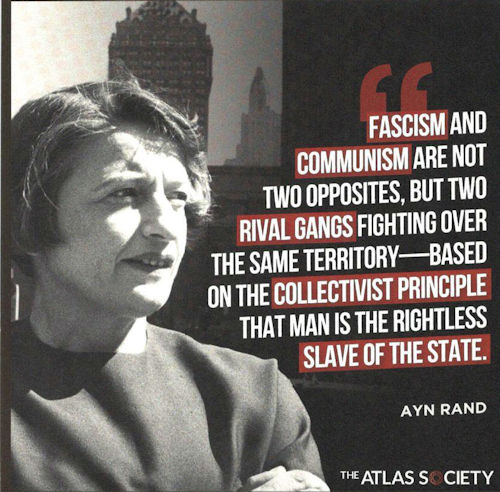



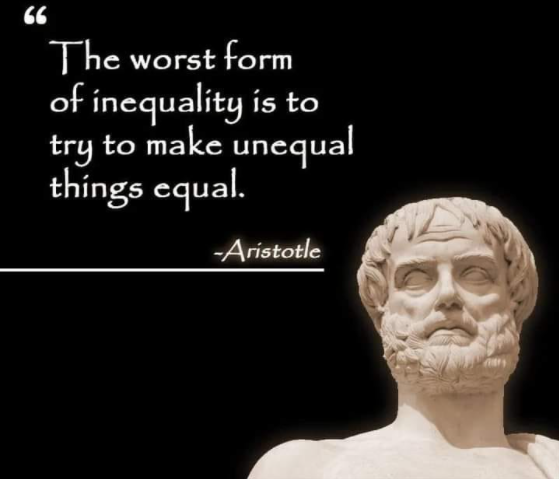


 Posts
Posts