Among the issues most commonly discussed are individuality, the rights of the individual, the limits of legitimate government, morality, history, economics, government policy, science, business, education, health care, energy, and man-made global warming evaluations. My posts are aimed at intelligent and rational individuals, whose comments are very welcome.

"No matter how vast your knowledge or how modest, it is your own mind that has to acquire it." Ayn Rand

"Observe that the 'haves' are those who have freedom, and that it is freedom that the 'have-nots' have not." Ayn Rand

"The virtue involved in helping those one loves is not 'selflessness' or 'sacrifice', but integrity." Ayn Rand

For "a human being, the question 'to be or not to be,' is the question 'to think or not to think.'" Ayn Rand
Showing posts with label CO2. Show all posts

06 July 2023

Independence Day Sullied by a Climate Change Lying Attack Upon Our Independence

The media has been abuzz with claims that this 4th of July was the hottest 4th of July ever.  Given the well-known heat waves of 1936 and 1966, along with memories of many other summers hotter than I have experienced in recent years, I was pretty sure this was one more in a long list of desperate lies to try and keep the myth of catastrophic man-made global warming alive.  It is that myth which the Biden administration, the Democratic Party in general, the United Nations, the World Economic Forum, and many a kleptocracy have been using as a justification for attacking the many and broad rights of the individual to promote a collectivist lowering of the standard of living of all mankind.  Independence Day is anathema to these people, so it must have been very tempting to turn it into an object lesson for catastrophic man-made (man guilty) global warming.

The vigilant CO2 Coalition has looked into the claims that this 4th of July was the hottest 4th of July ever.  Using the data available in the U. S. Historical Climatology Network, NOAA NCEI, for the Lower 48 US states, the maximum average temperature among the weather stations is for the 4th of July:


This chart does not have the 4 July 2023 data point yet, since NOAA apparently has not yet provided such recent data.  Let us suppose that 4 July 2023 actually was the hottest recorded US 4th of July, though I suspect that is not the case.  That would only be significant for the claim of catastrophic man-made global warming if it were part of a 4th of July warming trend.  Now, despite the increasing concentration of CO2 in the atmosphere throughout the period 1890 to 2022, the maximum average temperature on the 4th of July has been nearly constant over the 1895 to 2022 period of time.  The trend line has actually shown a small decrease with time!

The CO2 Coalition has provided us with another way of looking at the temperature record for the 4th of July:


This chart shows the percentage of the weather stations recording temperatures greater than 100F on the 4th of July from 1895 to 2022.  This percentage also has a downward trendline.  

If the temperatures of the U.S. 4th of Julys have a story to tell, it is that the U.S. is slowly cooling.  If CO2 is the thermostat controlling the climate, then the cooling effects of CO2 have become dominant over increased warming effects at the concentrations reached by about 1950.  This would imply that the atmospheric concentration of CO2 for which its warming effect reaches a maximum is about 310 ppm.  Above that concentration, additional atmospheric CO2 causes cooling. Of course, choosing a single day of the year is not the best way to determine whether the U.S. is warming or cooling over more than 12 decades.  But it is a much better indicator than the one single 4th of July of one year that the priests of catastrophic man-made global warming have offered the world as proof of global warming due to man's CO2 emissions.

The catastrophic man-made global warming hypothesis has been proven false many, many times.  It is based on a misunderstanding of thermal radiation, the ignorance of CO2 cooling effects, poor surface temperature records, misguided temperature record manipulations, a wanton neglect of the benefits of atmospheric CO2, an overestimation of the economic harms of warming, and a fervor to reduce mankind's ability to use the resources of the Earth to improve the human standard of living.

Yet Americans continue to leave northern states for the warming climates of southern states.  Apparently, humans prosper in warmth.  Imagine that.

30 September 2022

Washington Post: Climate Change is Fueling Super Hurricanes -- Is it really?

The Washington Post on 30 September 2022, claimed that "climate change is fueling the creation of super hurricanes."  The article says that "as waters warm, 7 super storms have lashed the U.S. since 2017."

The article argues that ocean water is warming, apparently due to global warming, not either warming or cooling climate change.  It argues that hurricanes draw their energy from warm water and therefore become stronger and more frequent.  Yes, hurricanes do draw their energy from warm water, but they also require wind shear to form as hurricanes.  Since global warming does not much affect the temperature of oceans in tropical regions due to the moderating effects of the water cycle, while it does increase temperatures in the mid-latitudes, the wind shear cause of hurricanes is actually reduced.  So what is the historic data on hurricanes?  Let us look at the record for hurricanes that had landfalls on Florida:


Maybe you can see the catastrophic increase if the data is plotted as curves rather than as bars?


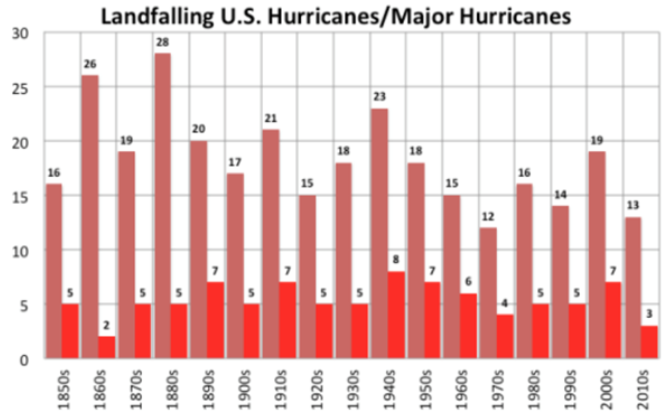
I must confess that the frequency of major landfalling hurricanes does not appear to have increased, unless you only look at the timeline beginning about 1980.  It seems undeniable that the frequency of all hurricanes since the 1870s has decreased.  But, perhaps the focus on Florida is the problem.  Let us look at the data for hurricanes landing anywhere on the U.S.


Do you see a dramatic increase in hurricanes or in major hurricanes in this data?  Once again, it seems clear that the total hurricane frequency is actually decreasing.  The major hurricanes do not seem to be changing much at all.

Almost anyone at all serious about climate issues agrees that a five-year span of time is still just weather, while it takes a minimum of 30 years to be considered climate.  Note that the Washington Post article was claiming that a 5-year span of hurricane history was proof of man-made global warming, which they ridiculously call climate change.  Actually, 30 years is just enough to cover the shortest of the climate cycles, so any real climate argument ought to cover a period of quite a few 30-year cycles.

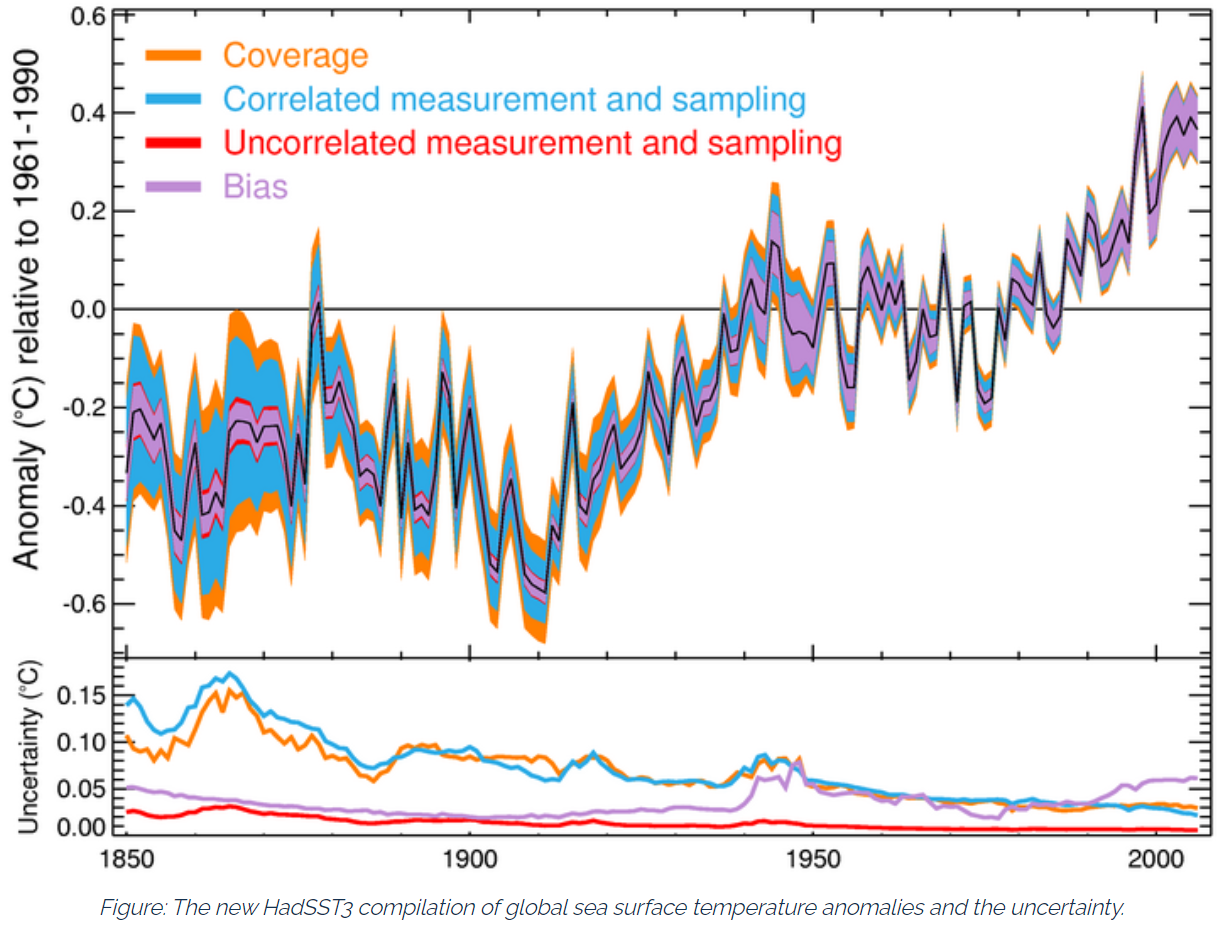
Let us examine the historic data on ocean surface temperatures, since the Washington Post argument says hurricane strength and frequency are just a function of ocean surface temperatures.


According to this data, the ocean temperatures have increased.  They did not change much from 1850 to about 1900.  There was a decrease in temperatures from 1900 to 1910, then an increase in temperature from then until the mid-1940s, then was nearly constant from then until the late 1970s, with another increase from then until about 2010.  Based on the Washington Post's claim that warmer water fuels hurricanes, the increase in water temperature from 1910 to the mid-1940s should have caused a significant increase in hurricanes.  Do you see that in the landfall hurricane charts above?  If the effect is there, it sure is small.  Then again, where is the major increase in landfalling hurricanes from the late 1970s through 2010 compared to earlier periods?

If mankind's use of carbon-based fuels is the cause of warming oceans, what huge increase in fossil fuels caused the warming from 1910 to the mid-1940s?  Europe was not producing very much for several years following WWI and then no one was during the 1930s.  Most of the world's population was not much more industrial than it had been in the 1800s.  So, how did this rapid ocean warming occur during this period?  I cannot see a good argument for it being due to man's use of carbon-based fuels.

Let us look at the concentration of CO2 in the atmosphere since 1958 and see if we can see a correlation between the CO2 concentration and the ocean surface temperatures.


The catastrophic man-made global warming argument is that carbon dioxide is the thermostat for the Earth's temperature, presumably including the 71% of the Earth's surface covered by water.  Any claim that CO2 in the atmosphere causes an increase in the temperature has to acknowledge that the warming effect requires more and more carbon dioxide for a given temperature increase.  The actual increase in CO2 in this record is a bit faster than linear, but it is not exponential or at all close to it.  So, all ocean temperature increases ought to be gradual and constant (or even dropping off) from 1958 to the present.  Yet for much of this time, there was no increase in ocean water temperature.  Then in the late 1970s the temperature takes off a bit in the ocean temperature record, but where was the acceleration in CO2 concentration in the atmosphere?

One can only conclude that there is no scientific evidence that CO2 controls the temperature of the oceans and there is none that warming oceans are enough to cause an increase in the frequency and intensity of hurricanes.  Therefore, there is no reason to claim that man's use of carbon-based fuels is causing an increase in the frequency and intensity of hurricanes.

It is very strange that so many people claim to be scientific experts who yet believe in this nonsense.  It is also very strange that so many people who have no knowledge about such matters are nonetheless strong believers in the adamant claims of those who claim to know the science, without themselves believing they have any need to understand the science themselves.


22 February 2021

The myth (and phony math) of 'green' jobs -- by Duggan Flanakin of CFACT

Governments are killing real jobs and conning us about ‘millions of good green jobs’

 
“Fool me once,” Stephen King wrote, “shame on you. Fool me twice, shame on me. Fool me three times, shame on both of us.” His adage certainly applies to the myth (and fake math) of green jobs.
 
During the 2020 election campaign, Joe Biden asserted that more than 3 million Americans are already “employed in the clean energy economy.” He then boasted that, “if executed strategically, our response to climate change can create more than 10 million well-paying jobs in the United States that will grow a stronger, more inclusive middle class … and not just in cities along the coasts.”
 
That would make Joe twice as boastful as his former boss, who promised the 2009 $787 billion stimulus package would create “over five million” green jobs. Four years later, the Brookings Institution reported that, “of the nearly 2.7 million ‘green jobs’ [the Obama-Biden Administration] identifies, most were bus drivers, sewage workers and other types of work that don’t fit the ‘green jobs of the future’” description.
 
Energy analyst David Blackmon later reported that Obama’s own Department of Labor acknowledged the initial failure to launch. DOL’s September 2011 report, “Recovery Act: Slow pace placing workers into jobs jeopardizes employment goals of the Green Jobs Program,” noted that only a third of the allocated funding had been spent; a fifth of the “degrees” and “certifications” went to people with a single day of training; and half of the “graduates” had five or fewer days of training. Just 2% of program participants held their jobs for at least six months.
 
The Bureau of Labor Statistics counted oil industry lobbyists as holding “green” jobs! The septic tank and portable toilet servicing industry had 33 times more “green” jobs than solar electric utilities. The BLS had to admit in a June 2012 report, “Green Technologies and Practices – August 2011,” that they could identify only 854,700 “green” jobs, including janitors and cleaners.
 
What a sham! Shame on them for trying to con us.
 
David Kreutzer pointed out in a Heritage Foundation report that steel workers had the most “green” industrial jobs. Why? Most U.S. steel is recycled scrap, and some steel gets used in making wind turbines. The next largest groups were bus drivers, waste collectors and used-merchandise store employees – followed finally by engineering and architectural services. The much hated nuclear industry accounted for over 80% of the 44,000 “green” electric utility jobs. There were five times as many “green” jobs in social advocacy (environmentalist group lobbyists) as in renewable electric power.
 
Ah, but that was then – and this is now, you say. Right.  
 
In January, the Associated Press reported on “Biden’s fuzzy math” regarding his claim of creating 1 million new auto industry jobs – even if he actually replaces the 650,000-government vehicle fleet with electric cars and installs 500,000 new EV charging stations – all at taxpayer expense. Theoretically, a huge government buying program will lower EV costs, and the myriad of charging stations will lessen fears of being stuck in a hurricane evacuation in a vehicle you cannot quickly gas up. Theoretically.
 
But hold on! Every electric vehicle job will likely come at the expense of a gasoline-engine vehicle job, and every EV charging station will diminish jobs in pipeline, refining, gasoline retail, gasoline delivery, and other sectors. The AP story adds that industry analysts and the United Auto Workers union agree that EV manufacturing will likely mean fewer automotive jobs. One reason is that EVs have far fewer parts and are simpler to build, thus require fewer workers, and often just need a new $6,000 battery module. Another is that battery manufacturing is easily automated. But that is hardly the whole story.
 
Back in 2019, while losing over a fifth of its U.S. market share of sales over a 3-year period, General Motors admitted it already employed more non-union auto workers in China than union workers in the USA. The harsh reality is that there are 10 times more electric vehicle battery manufacturing facilities in Asia than in all of North America. Maybe Jinping Joe Biden is talking about the number of Chinese “green” jobs. Especially child and near-slave labor in China’s mines and processing plants.
 
Other fact checkers have also found Biden Administration green jobs claims are “mostly false.”
 
Electric vehicles are just part of the Green New Biden Deal. Surrendering our economy to the Paris climate accords and its draconian environmental restraints is another. Abandoning oil, gas and coal – and very likely nuclear energy – and all the jobs those industries create is a third. Mr. Biden is merely following Germany and other European Union countries down the primrose path to economic suicide.
 
According to Deutsche Bank, climate policy regulation of Germany’s automotive sector is triggering “the biggest structural break in the industry in decades.” A bank report explains that strict carbon dioxide limits for new passenger cars in the EU for 2021 and 2030 are forcing manufacturers to prematurely switch to higher cost electric vehicles. The resultant price increases, the bank predicts, will have a very negative effect on future employment in the Germany auto industry.
 
One reason is that the EU’s CO2 limits for passenger cars and subsidies for electric vehicles are “extremely inefficient [expensive] and hardly effective instruments” to achieve emission reduction in the transport sector. While government incentives and mandates may push people toward buying government-favored vehicles, radical climate and energy policies decrease investment in energy-intensive sectors such as metals and chemicals. This will further increase the cost of new German cars.
 
Despite the push for green energy and electric vehicles, the German Trade Union Association reports that the number of “green” jobs in the German renewables sector had fallen from 300,000 in 2011 to just 150,000 in 2018. Many of these lost jobs were due to the collapse of Germany’s solar power industry, as companies were forced out of business by Chinese manufacturers that undercut German prices – and had much easier access to raw materials.
 
The track record for American renewable industry jobs vis-à-vis Chinese competition has mimicked the German experience. A primary reason is China’s near-monopoly on rare-earth metals essential for the Green revolution. Despite these realities, Biden “climate envoy” John Kerry recently said displaced American oil and gas workers can simply and easily go to work making solar panels.
 
Energy economist Tilak Doshi agrees the West’s fascination with renewables-only de-carbonization, and ultimately de-industrialization, is a recipe for economic suicide. He notes that Germany’s “green” world involves behemoth wind turbines with blades made of petroleum-based, fiberglass-reinforced resins; motors built with iron and rare earths extracted, processed and smelted using fossil fuels; concrete that also requires fossil fuels; and factories run on coal and natural gas. Solar panels have the same pedigree.
 
The turbines and panels are installed in forests, grasslands, farmlands and coastal areas, where they destroy scenic vistas and wildlife habitats. Turbine blades kill endangered birds and bats.
 
The result of this save-the-planet zeal? Germany has a burgeoning 17% poverty rate, thanks largely to its shutdown of reliable nuclear and fossil fuel power plants and the resultant skyrocketing electricity prices for homes, factories, businesses and hospitals over the past 15 years.
 
Back in the USA, California operates the world’s fifth largest economy by importing most of its crude oil from overseas (despite massive in-state reserves) and a third of its electricity from other states (also for political expediency). As a result, Californians now pay 60% more than the national average for residential, commercial and industrial electricity, while enduring frequent rolling blackouts due to pricey weather-dependent energy and pathetic forest management. People and industries are fleeing the state.
 
And Team Biden-Harris (Harris-Biden?) wants to turn the rest of the United States into California!
 
Duggan Flanakin is director of policy research at the Committee For A Constructive Tomorrow (www.CFACT.org)
 

14 February 2020

Do Additional Greenhouse Gases Warm or Cool the Earth?


If the Earth’s atmosphere had no infrared-active gases, commonly and confusingly called greenhouse gases, at all, the Earth would be colder on average.  The Earth’s surface would absorb more of the sun’s insolation, since water vapor would not be present to absorb the incoming energy from the sun and there would be no clouds.  Some of the heat absorbed by the surface would still be transferred to the nitrogen, oxygen, and argon molecules or atoms striking the Earth’s surface.  The remaining energy would be radiated from the surface.  Virtually all the energy radiated from the Earth’s surface would travel at the speed of light through the atmosphere into space and be almost instantaneously lost.  The day to night temperature changes would be much more dramatic than they are now.  The greenhouse gases benefit us greatly by moderating the day to night temperature changes.  At sufficiently low concentrations, each infrared gas with a non-overlapping absorption frequency with respect to other infrared-active gases already present, will slow down the rate of cooling at the surface and in the troposphere.  This allows the surface and the troposphere to be warmer than they would be were the infrared-active gas not present.

This is how the idea of a greenhouse effect comes about.  This paper Is not disputing that infrared active gases allow the Earth’s surface to be warmer than it would be if they were not in the atmosphere.  The question being examined is whether the further addition of an infrared-active gas will warm or cool the Earth’s surface and its lower atmosphere, the troposphere, when its atmospheric concentration is increased.

How does a low concentration of an infrared-active gas significantly slow down the cooling rate of the surface and the troposphere?  Suppose this gas molecule absorbs the longwave thermal radiation emitted from the Earth’s surface in the lower troposphere and enters an excited vibrational state.  If that absorbed energy were simply immediately re-emitted and carried off the previously absorbed energy at the speed of light, the absorption event would have no significant effect on the temperature of the surface.  The key fact here is that the excited molecule has billions of collisions per second with the 2500 times as plentiful non-infrared-active molecules of nitrogen and oxygen and atoms of argon.  That absorbed infrared energy is converted into kinetic energy passed to the molecules that collided with the excited molecule long before the lifetime of the excited molecule for re-emission of the absorbed energy by radiation.  What is the overwhelmingly dominant means of energy transport through the troposphere at this point?  It is the convection transport from warmer to cooler portions of the atmosphere, which is generally upward and to the higher latitude regions of the Earth.  The speed of that transport of energy is about 8 orders of magnitude slower than the speed of light.  So that first act of longwave thermal radiation absorption from the Earth’s surface is of immense importance, but after that initial conversion of infrared radiation from the surface into kinetic energy shared by all the molecules (mostly nitrogen and oxygen) and atoms (argon mostly) of our troposphere, the role of any further radiation from infrared-active molecules is a faster means of cooling than is the convection cooling mechanism.

Let us examine why this is true.  If the mean free path for absorption of a given wavelength of the longwave thermal radiation from the surface is short enough that there is an absorption event by an infrared molecule in the lower troposphere, subsequent absorptions of any emitted thermal radiation by molecules at that wavelength at higher altitudes will prevent that radiation from escaping into space.  This does slow down the cooling of the lower atmosphere in this very limited context.  This is what the standard view of greenhouse gases focusses on.  The problem is that the alternative to that infrared-active gas emitting thermal radiation to a higher altitude is its being much, much more slowly transported to higher altitude by convection.  Adding more of that infrared-active gas to the atmosphere results in moving energy upward through the troposphere in steps at the speed of light instead of having more of it moving upward in the slow convection currents.  The implication here is that a very low concentration of an infrared gas in the atmosphere will produce a warmer Earth surface and troposphere, but subsequent additions simply speed up the transport of energy to higher altitudes.  Then the added infrared emitting gas molecules in the upper troposphere and the stratosphere radiate thermal energy at a faster rate directly into space.  For an infrared-active molecule, the initial effect of adding it to the atmosphere is likely to be warming effect, but its warming effect rapidly passes through a maximum and then further additions start bringing down the temperature at the surface and in the troposphere.

Let us pause and get a better understanding of how carbon dioxide absorbs longwave radiation from the surface of the Earth.  An infrared-active molecule has an absorption spectrum over a range of wavelengths with absorption probabilities varying with wavelength over orders of magnitude.  The absorption probability at a wavelength is usually given in terms of an effective cross section, as though the size of the molecule were different for the absorption event at each wavelength.  Here, from a figure in Prof. Howard “Cork” Hayden’s The Energy Advocate, February 2020 (Vol.24, No.7) is the absorption spectrum near the main 15 µm (micrometer) absorption line for CO2:


As Prof. Hayden explains, if the concentration of carbon dioxide in the atmosphere were only 40 ppm by volume (ppmv) or a bit less than one-tenth the present concentration, any radiation at the wavelengths above the red line in the figure at 1 x 10-22 m2 cross-section would be absorbed within a travel distance of 10 meters.  At that same very low concentration of CO2, the absorption distance for radiation in the weaker absorption peaks above the lowest red line is less than 100 meters.  The troposphere in the U.S. Standard Atmosphere is 11,000 meters in altitude.  All parts of the absorption spectrum above the lower red line for as low a concentration of carbon dioxide as 40 ppmv are already absorbed many times traveling through the troposphere from the surface to the upper troposphere.  At 400 ppmv, carbon dioxide will add absorption events for the first time in the lower cross-section parts of the spectrum, but the additional first time absorptions are decreasing rapidly as more CO2 is added to the atmosphere, while the rapid transport effects of carbon dioxide are moving more and more energy to space more quickly than convection would at an increasing rate as CO2 is added.


I am going to develop a simple model for how the infrared-active gases warm the Earth, according to those who believe in catastrophic or even moderate man-made global warming.  This is not a model that I believe is correct.  This is intended as an exercise in determining a very generous upper limit on the size of the greenhouse gas warming claims based on additions of such gases to the atmosphere above those of the present and then showing that those claims are false in the context I have set up above.

I will start with a two layer atmosphere in which radiation from the Earth’s surface, is absorbed entirely in the lower layer L1, which radiates half that energy upward to atmospheric layer L2 where it is absorbed and half back down to the surface where all of it is absorbed.  All of the surface absorbed half from L1 is re-emitted upward and is re-absorbed in L1.  Layer L2 emits half the energy it absorbed from L1 directly to space, where it is permanently lost, and half back to L1 where all of it is absorbed.  Each layer L1 and L2 always emits half of its absorbed radiation energy upward and half downward.  The surface always emits its absorbed energy back to L1, where it is absorbed.  I believe this isotropic emission idea is incorrect, but we are going to do this exercise because it will give us insight and because it is rather a fun task to work out.  Note also that I am entirely ignoring convection as an energy transport mechanism for the sake of this argument.

The results are that space receives a series of emission energy originating with an emission of one unit of energy from the Earth’s surface, Sp, whose sum is


So, all of the unit of energy emitted from the surface is eventually emitted into space.  In fact, the first 5 emissions to space already total 0.7627 of the total energy of 1.  In this crazy model we have assumed all the energy emitted from the surface is absorbed in L1, despite the fact that the atmospheric window actually allows about 70% of all surface radiated longwave energy to pass through the atmosphere unabsorbed and directly into space.  So Sp really equals 0.3 and the first five emissions to space really equal 0.2288.  In this simple model with no thermalization of the absorbing molecule and no significant half-life before it re-emits energy as radiation, sending more than 3/4ths of the surface emitted energy into space takes about the time it would take radiation traveling at the speed of light, 3 x 10⁸ m/s, to travel through the troposphere about 11,000 m high five times.  That time is 3.7 x 10⁻⁵ s.  In comparison, it takes hours for the alternative heat dissipation process of convection currents to raise surface energy to the top of the troposphere where it can be directly emitted to space as radiation.

Of course, the catastrophic man-made global warming argument does not emphasize the speed with which energy is emitted to space by a radiation-centric model.  They emphasize the added time radiation energy spends near the surface because of their isotropic emission model in comparison to the time it would take to go directly from the surface to space if there were no infrared-active molecules.  So what enhancement of radiative energy dwell time are they getting?  With this two atmospheric absorption layer model it would be that the sum of radiation back to the surface from L1, Su, is

This means that the energy dwell time in the lower troposphere has been doubled by this two-layer 100% radiative energy loss model with isotropic emission.  But keeping about 76% of this energy around for about 3.7 x 10⁻⁵ s is not such a big deal.

What if we put three atmospheric absorbing layers into the model?  Then I find that the series of emissions to space from the top layer L3 is

Sp = 1/8 + 1/8 + 7/64 + 3/32 + 41/512 + 35/512 + 239/4096 + 577/16384 + ….

These first eight terms sum to 0.695129, so with eight emissions from L3 to space 69.5% of the unit of energy emitted from the surface has been lost to space.  Consequently, 69.5% of the energy is lost in about 8 (11,000 m) / 3 x 10⁸ m/s or 2.9 x 10⁻⁴ s.

Su = ½ + 3/8 + 5/16 + 17/64 + 29/128 + 99/512 + 169/1024 + 577/4096 + 1731/16384 + …..

The first eight terms of Su sum to 2.01898.  So when Sp is a bit over 2/3 after eight terms and must sum to one, Su is a bit over 2 and seems most likely to sum to about 3.

So, let us make a leap here and assume that with an atmospheric absorption model of n layers with isotropic emission, Su will sum to about n.  [If someone has the time to work this series out to more terms or can find a way to solve it exactly, I would enjoy seeing the result.]

Alright now, let us assume that we have 100 absorption layers in our atmosphere, corresponding to an absorption distance of about 110 m.  Most of the radiation energy emitted from the surface will find its way to space in less time than 100 (11,000) / 3 x 108 = 3.7 x 10⁻³ s.  If you have 10,000 atmospheric absorption layers (an absorption distance of about 1.1 m), the time is then 0.37 s.  But the alternative means of removing that energy to space is convection and that takes hours to do the job.

In fact, radiation between the layers only occurs long after an absorption event during which time many, many collisions with other molecules would occur and the absorbing molecule would give up virtually all the energy it had absorbed from radiation from another layer to the 2500 times as plentiful non-greenhouse gas molecules in the air.  It is a comparatively very long time before the infrared-active molecule emits radiation again.  In the meantime, it is only 1/2500 of the molecules moving energy as part of a convection current.  Yet insofar as these infrared-active molecules do emit radiation, they are acting to speed up the emission of surface energy to space.  They are therefore acting to cool the atmosphere from top to bottom of the troposphere compared to the convection energy transport mechanism.

The lesson here is that the very first absorption event of thermal radiation from the surface in the atmosphere is very important because it puts the transfer of that energy into the hands of a much slower convection cooling process than is that of radiation.  However, whatever further thermal radiation events occur in the atmosphere simply speed up the loss rate of energy to space compared to the rate due to convection.  The addition of further infrared-active gases to the atmosphere causes there to be more absorption layers in the model.  If the atmospheric load of infrared absorption gases was so high that the mean free path length for absorption of their emissions was as short as 1 meter, then the time to dissipate most of the energy to space would still be less than a second, while the time it takes for the alternative energy transport by convection is still hours.

Do additional greenhouse gases warm or cool the Earth?  The addition of a gas in just enough concentration that there is absorption by that gas in the lower troposphere once which would not otherwise have occurred at a given wavelength slows the rate of radiative heat loss and may be regarded as effectively warming the Earth.  It does this by converting the cooling mechanism from rapid radiative cooling to that of slow convection cooling.  However, once that threshold concentration is exceeded for a given wavelength, additions of that gas simply cool the atmosphere more quickly than would the alternative of convection currents.  At such an above threshold concentration, that gas can be regarded as cooling the Earth faster compared to the rate it would cool without its addition.

The lapse rate is the temperature gradient with altitude in the troposphere.  At normal levels of humidity, the adiabatic lapse rate is less than the dry lapse rate is.  This tells us that at normal water vapor concentrations, the water vapor concentration is already high enough to produce a cooling effect on the surface and lower troposphere temperatures.  Water vapor does this with the cooling effect at the surface as liquid water becomes water vapor and then the water vapor rises with convection until it reaches an altitude at which it condenses and releases energy.  At the warm surface it cools with evaporation and at the cooler altitudes it warms by condensing.  The evaporation process increases the water molecule’s kinetic energy, including its vibrational modes, and the molecule carries that energy upward by convection and then releases the kinetic energy of evaporation as it condenses to liquid or solid form.   Each water molecule carries more energy per molecule at a given temperature than can a nitrogen or oxygen molecule.  Thus, as they rise with convection, they are transporting more energy upward per molecule than are the dry air molecules in the same convection current.  In addition, the water molecule is radiating energy to the layer of air above it, which is usually cooler and able to absorb that radiated energy if it also has water vapor molecules in it or sometimes if it has carbon dioxide in it. 

Unlike water vapor molecules, a carbon dioxide molecule carries less energy at a given temperature than do the nitrogen and oxygen molecules with which it shares a convection current.  This means an added CO2 molecule causes a convection current to become a less effective cooling mechanism.  However, it retains the ability to warm the air layer above it throughout the troposphere as it cools its local surroundings by radiation to the layer above it.  In addition, more CO2 in the upper troposphere and in the stratosphere means more molecules radiating energy directly to space.  There is good evidence that the addition of more hot molecules of CO2 in the stratosphere has resulted in a measured  cooling of the stratosphere, as would be expected because these hot molecules are effective radiators.  I believe the concentration of carbon dioxide in the atmosphere is already high enough that additions of CO2 are cooling the troposphere as well or at least counterbalancing the mild warming effect of additional carbon dioxide molecules to a great degree.

Whether I am right or not about this, the claim that a very small warming effect by additional CO2 will be amplified by a greater warming effect by increased water vapor (a positive feedback) is surely false.  The fact that the wet adiabatic lapse rate is less than the dry adiabatic lapse rate makes it clear that the claim of a positive feedback is wrong.  The IPCC and other alarmists depend upon this false claim of a positive feedback by water vapor to make it appear possible that additional carbon dioxide will cause significant harm.  The reality is that additional carbon dioxide has no net significant effect on temperatures at the Earth’s surface or in the lower troposphere.

Meanwhile, additional carbon dioxide in the atmosphere provides plants with the means for easier growth.  With a growing human population, this is very helpful in producing the additional food we need to produce.  This should be a factor in reducing human anxiety for the future.  Of course, I understand that some people just have to have something to worry about.  I suggest you worry, if you must, about another ice age which additional carbon dioxide in our atmosphere cannot prevent.  Or, you might worry about an asteroid  striking the Earth.  But it is even more foolish to worry about problems created by more CO2 in the atmosphere.


28 April 2019

Fake climate science and scientists by Paul Driessen


Alarmists game the system to enrich and empower themselves, and hurt everyone else

The multi-colored placard in front of a $2-million home in North Center Chicago proudly proclaimed, “In this house we believe: No human is illegal” – and “Science is real” (plus a few other liberal mantras).

I knew right away where the owners stood on climate change, and other hot-button political issues. They would likely tolerate no dissension or debate on “settled” climate science or any of the other topics.

But they have it exactly backward on the science issue. Real science is not belief – or consensus, 97% or otherwise. Real science constantly asks questions, expresses skepticism, reexamines hypotheses and evidence. If debate, skepticism and empirical evidence are prohibited – it’s pseudo-science, at best.

Real science – and real scientists – seek to understand natural phenomena and processes. They pose hypotheses that they think best explain what they have witnessed, then test them against actual evidence, observations and experimental data. If the hypotheses (and predictions based on them) are borne out by their subsequent findings, the hypotheses become theories, rules, laws of nature – at least until someone finds new evidence that pokes holes in their assessments, or devises better explanations.

Real science does not involve simply declaring that you “believe” something, It’s not immutable doctrine. It doesn’t claim “science is real” – or demand that a particular scientific explanation be carved in stone. Earth-centric concepts gave way to a sun-centered solar system. Miasma disease beliefs surrendered to the germ theory. The certainty that continents are locked in place was replaced by plate tectonics (and the realization that you can’t stop continental drift, any more than you stop climate change).

Real scientists often employ computers to analyze data more quickly and accurately, depict or model complex natural systems, or forecast future events or conditions. But they test their models against real-world evidence. If the models, observations and predictions don’t match up, real scientists modify or discard the models, and the hypotheses behind them. They engage in robust discussion and debate.

They don’t let models or hypotheses become substitutes for real-world evidence and observations. They don’t alter or “homogenize” raw or historic data to make it look like the models actually work. They don’t hide their data and computer algorithms (AlGoreRythms?), restrict peer review to closed circles of like-minded colleagues who protect one another’s reputations and funding, claim “the debate is over,” or try to silence anyone who dares to ask inconvenient questions or find fault with their claims and models. They don’t concoct hockey stick temperature graphs that can be replicated by plugging in random numbers.

In the realm contemplated by the Chicago yard sign, we ought to be doing all we can to understand Earth’s highly complex, largely chaotic, frequently changing climate system – all we can to figure out how the sun and other powerful forces interact with each other. Only in that way can we accurately predict future climate changes, prepare for them, and not waste money and resources chasing goblins.

But instead, we have people in white lab coats masquerading as real scientists. They’re doing what I just explained true scientists don’t do. They also ignore fluctuations in solar energy output and numerous other powerful, interconnected natural forces that have driven climate change throughout Earth’s history. They look only (or 97% of the time) at carbon dioxide as the principal or sole driving force behind current and future climate changes – and blame every weather event, fire and walrus death on man-made CO2.

Even worse, they let their biases drive their research and use their pseudo-science to justify demands that we eliminate all fossil fuel use, and all carbon dioxide and methane emissions, by little more than a decade from now. Otherwise, they claim, we will bring unprecedented cataclysms to people and planet.

Not surprisingly, their bad behavior is applauded, funded and employed by politicians, environmentalists, journalists, celebrities, corporate executives, billionaires and others who have their own axes to grind, their own egos to inflate – and their intense desire to profit from climate alarmism and pseudo-science.

Worst of all, while they get rich and famous, their immoral actions impoverish billions and kill millions, by depriving them of the affordable, reliable fossil fuel energy that powers modern societies.

And still these slippery characters endlessly repeat the tired trope that they “believe in science” – and anyone who doesn’t agree to “keep fossil fuels in the ground” to stop climate change is a “science denier.”

When these folks and the yard sign crowd brandish the term “science,” political analyst Robert Tracinski suggests, it is primarily to “provide a badge of tribal identity” – while ironically demonstrating that they have no real understanding of or interest in “the guiding principles of actual science.”

Genuine climate scientist (and former chair of the School of Earth and Atmospheric Sciences at the Georgia Institute of Technology) Dr. Judith Curry echoes Tracinski. Politicians like Senator Elizabeth Warren use “science” as a way of “declaring belief in a proposition which is outside their knowledge and which they do not understand…. The purpose of the trope is to bypass any meaningful discussion of these separate questions, rolling them all into one package deal – and one political party ticket,” she explains.

The ultimate purpose of all this, of course, is to silence the dissenting voices of evidence- and reality-based climate science, block creation of a Presidential Committee on Climate Science, and ensure that the only debate is over which actions to take first to end fossil fuel use … and upend modern economies.

The last thing fake/alarmist climate scientists want is a full-throated debate with real climate scientists – a debate that forces them to defend their doomsday assertions, methodologies, data manipulation … and claims that solar and other powerful natural forces are minuscule or irrelevant compared to man-made carbon dioxide that constitutes less that 0.02% of Earth’s atmosphere (natural CO2 adds another 0.02%).

Thankfully, there are many reasons for hope. For recognizing that we do not face a climate crisis, much less threats to our very existence. For realizing there is no need to subject ourselves to punitive carbon taxes or the misery, poverty, deprivation, disease and death that banning fossil fuels would cause.

Between the peak of the great global cooling scare in 1975 until around 1998, atmospheric carbon dioxide levels and temperatures did rise in rough conjunction. But then temperatures mostly flat-lined, while CO2 levels kept climbing. Now actual average global temperatures are already 1 degree F below the Garbage In-Garbage Out computer model predictions. Other alarmist forecasts are also out of touch with reality.

Instead of fearing rising CO2, we should thank it for making crop, forest and grassland plants grow faster and better, benefiting nature and humanity – especially in conjunction with slightly warmer temperatures that extend growing seasons, expand arable land and increase crop production.

The rate of sea level rise has not changed for over a century – and much of what alarmists attribute to climate change and rising seas is actually due to land subsidence and other factors.

Weather is not becoming more extreme. In fact, Harvey was the first Category 3-5 hurricane to make US landfall in a record 12 years – and the number of violent F3 to F5 tornadoes has fallen from an average of 56 per year from 1950 to 1985 to only 34 per year since then.

Human ingenuity and adaptability have enabled humans to survive and thrive in all sorts of climates, even during our far more primitive past. Allowed to use our brains, fossil fuels and technologies, we will deal just fine with whatever climate changes might confront us in the future. (Of course, another nature-driven Pleistocene-style glacier pulling 400 feet of water out of our oceans and crushing Northern Hemisphere forests and cities under mile-high walls of ice truly would be an existential threat to life as we know it.) 

So if NYC Mayor Bill De Blasio and other egotistical grand-standing politicians and fake climate scientists want to ban fossil fuels, glass-and-steel buildings, cows and even hotdogs – in the name of preventing “dangerous man-made climate change” – let them impose their schemes on themselves and their own families. The rest of us are tired of being made guinea pigs in their fake-science experiments.

Paul Driessen is senior policy advisor for the Committee For A Constructive Tomorrow (CFACT) and author of articles and books on energy, environmental and human rights issues.  I have published his article here at his request.


21 January 2019

Climate hysterics skyrocket by Paul Driessen

Increasingly absurd disaster rhetoric is consistently contradicted by climate and weather reality 

Call it climate one-upmanship. It seems everyone has to outdo previous climate chaos rhetoric.

The “climate crisis” is the “existential threat of our time,” Speaker Nancy Pelosi told her House colleagues. We must “end the inaction and denial of science that threaten the planet and the future.”

Former California Governor Jerry Brown solemnly intoned that America has “an enemy, though different, but perhaps very much devastating in a similar way” as the Nazis in World War II.

Not to be outdone, two PhDs writing in Psychology Today declared that “the human race faces extinction” if we don’t stop burning fossil fuels. And yet “even people who experience extreme weather events often still refuse to report the experiences as a manifestation of climate change.” Psychologists, they lament, “have never had to face denial on this scale before.”

Then there’s Oxford University doctoral candidate Samuel Miller-McDonald. He’s convinced the only thing that could save people and planet from cataclysmic climate change is cataclysmic nuclear war that “shuts down the global economy but stops short of human extinction.”

All this headline-grabbing gloom and doom, however, is backed up by little more than computer models, obstinate assertions that the science is settled, and a steady litany of claims that temperatures, tornadoes, hurricanes, droughts et cetera are unprecedented, worse than ever before, and due to fossil fuels.

And on the basis of these hysterics, we are supposed to give up the carbon-based fuels that provide over 80% of US and global energy, gladly reduce our living standards – and put our jobs and economy at the mercy of expensive, unreliable, weather dependent, pseudo-renewable wind, solar and biofuel energy.

As in any civil or criminal trial, the burden of proof is on the accusers and prosecutors who want to sentence fossil fuels to oblivion. They need to provide more than blood-curdling charges, opening statements and summations. They need to provideconvincing real-world evidence to prove their case.

They have refused to do so. They ignore the way rising atmospheric carbon-dioxide is spurring plant growth and greening the planet. They blame every extreme weather event on fossil fuel emissions, but cannot explain the Medieval Warm Period, Little Ice Age or extreme weather events decades or centuries ago – or why we have had fewer extreme weather events in recent decades. They simply resort to trial in media and other forums where they can exclude exculpatory evidence, bar any case for the fossil fuel defense, and prevent any cross-examination of their witnesses, assertions and make-believe evidence.

Climate models are not evidence. At best, they offer scenarios of what might happen if the assumptions on which they are based turn out to be correct. However, the average prediction by 102 models is now a full degree F (0.55 C) above what satellites are actually measuring. Models that cannot be confirmed by actual observations are of little value and certainly should not be a basis for vital energy policy making.

The alarmist mantra seems to be: If models and reality don’t agree, reality must be wrong.
In fact, even as atmospheric carbon dioxide levels climbed to 405 parts per million (0.0405% of Earth’s atmosphere), except for short-term temperature spikes during El Niño ocean warming events, there has been very little planetary warming since 1998; nothing to suggest chaos or runaway temperatures.

Claims that tornadoes have gotten more frequent and intense are obliterated by actual evidence. NOAA records show that from 1954 to 1985 an average of 56 F3 to F5 tornadoes struck the USA each year – but from 1985 to 2017 there were only 34 per year on average. And in 2018, for the first time in modern history, not a single “violent” twister touched down in the United States. 

Harvey was the first major (category 3-5) hurricane to make US landfall in a record twelve years. The previous record was nine years, set in the 1860s. (If rising CO2 levels are to blame for Harvey, Irma and other extreme weather events, shouldn’t they also be credited for this hurricane drought?)

Droughts differ little from historic trends and cycles – and the Dust Bowl, Anasazi and Mayan droughts, and other ancient dry spells were long and destructive. Moreover, modern agricultural and drip irrigation technologies enable farmers to deal with droughts far better than they ever could in the past.

Forest fires are fewer than in the recent past – and largely due to failure to remove hundreds of millions of dead and diseased trees that provide ready tinder for massive conflagrations.

Arctic and Antarctic ice are largely within “normal” or “cyclical” levels for the past several centuries – and snow surface temperatures in the East Antarctic Plateau regularly reach  -90 °C (-130 F) or lower. Average Antarctic temperatures would have to rise some 20-85 degrees F year-round for all its land ice to melt and cause oceans to rise at faster than their current 7-12 inches per century pace.

In fact, the world’s oceans have risen over 400 feet since the last Pleistocene glaciers melted. (That’s how much water those mile-high Ice Age glaciers took out of the oceans!) Sea level rise paused during the Little Ice Age but kicked in again the past century or so. Meanwhile, retreating glaciers reveal long-lost forests, coins, corpses and other artifacts – proving those glaciers have come and gone many times.

Pacific islands will not be covered by rising seas anytime soon, at 7-12 inches per century, and because corals and atolls grow as seas rise. Land subsidence also plays a big role in perceived sea level rise – and US naval bases are safe from sea level rise, though maybe not from local land subsidence.

The Washington Post did report that “the Arctic Ocean is warming up, icebergs are growing scarcer, and in some places the seals are finding the water too hot.” But that was in 1922.
Moreover, explorers wrote about the cyclical absence of Arctic ice long before that. “We were astonished by the total absence of ice in Barrow Strait,” Sir Francis McClintock wrote in 1860. “I was here at this time in [mid] 1854 – still frozen up – and doubts were entertained as to the possibility of escape.”

Coral bleaching? That too has many causes – few having anything to do with manmade global warming – and the reefs generally return quickly to their former glory as corals adopt new zooxanthellae. 

On and on it goes – with more scare stories daily, more attempts to blame humans and fossil fuels for nearly every interesting or as-yet-unexplained natural phenomenon, weather event or climate fluctuation. And yet countering the manmade climate apocalypse narrative is increasingly difficult – in large part because the $2-trillion-per-year climate “science” and “renewable” energy industry works vigorously to suppress such evidence and discussion … and is aided and abetted by its media and political allies.

Thus we have Chuck Todd, who brought an entire panel of alarmist climate “experts” to a recent episode of Meet the Press. He helped them expound ad nauseam on the alleged “existential threat of our time” – but made it clear that he was not going to give even one minute to experts on the other side.

“We’re not going to debate climate change, the existence of it,” Todd proclaimed. “The Earth is getting hotter. And human activity is a major cause, period. We’re not going to give time to climate deniers. The science is settled, even if political opinion is not.” The only thing left to discuss, from their perspective was “solutions” – most of which would hugely benefit them and their cohorts, politically and financially.

Regular folks in developed and developing countries alike see this politicized, money-driven kangaroo court process for what it is. They also know that unproven, exaggerated and fabricated climate scares must be balanced against their having to give up (or never having) reliable, affordable fossil fuel energy. That is why we have “dangerous manmade climate change” denial on this scale.

That is why we must get the facts out by other means. It is why we must confront Congress, media people and the Trump Administration, and demand that they address these realities, hold debates, revisit the CO2 Endangerment Finding – and stop calling for an end to fossil fuels and modern living standards before we actually have an honest, robust assessment of supposedly “settled” climate science.

Paul Driessen is senior policy advisor for the Committee For A Constructive Tomorrow (CFACT) and author of articles and books on energy, environmental and human rights issues.


Charles R. Anderson Comment:
"On and on it goes – with more scare stories daily, more attempts to blame humans and fossil fuels for nearly every interesting or as-yet-unexplained natural phenomenon, weather event or climate fluctuation."
In the pre-science era of mankind's history, every unexplained natural phenomena was attributed to the will of God and man had no need to understand that phenomena because it was sufficient that God understood it.  In the post-science era every unexplained phenomena is attributed to the Climate Change God and no one is supposed to question that god either.

I still aim to actually use science to understand reality, which is why I have written so often about the many huge errors and the inconsistencies in the physics which is claimed to provide the basis for the alarmist catastrophic man-made global warming hypothesis.  Because of these errors, there is no reason to be surprised that the climate models supposedly based on this erroneous science have been making wrong predictions.

However, in the post-science era an hypothesis that makes wrong predictions is held to be unquestionable, when in the science era it would have been obvious that wrong predictions invalidate the hypothesis.  This is the difference between science and theology.