Among the issues most commonly discussed are individuality, the rights of the individual, the limits of legitimate government, morality, history, economics, government policy, science, business, education, health care, energy, and man-made global warming evaluations. My posts are aimed at intelligent and rational individuals, whose comments are very welcome.

"No matter how vast your knowledge or how modest, it is your own mind that has to acquire it." Ayn Rand

"Observe that the 'haves' are those who have freedom, and that it is freedom that the 'have-nots' have not." Ayn Rand

"The virtue involved in helping those one loves is not 'selflessness' or 'sacrifice', but integrity." Ayn Rand

For "a human being, the question 'to be or not to be,' is the question 'to think or not to think.'" Ayn Rand
Showing posts with label heroes. Show all posts

02 September 2016

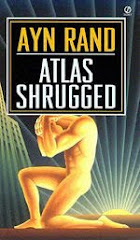
Atlas Shrugged Day!

This is a reprint of a post I wrote on 2 Sep 2010, with some updates on evolved times:

On September 2, 1946, Ayn Rand began writing Atlas Shrugged and she finished her great novel in time for publication in 1957.  Throughout the novel, September 2 is the date of a number of events:
  • In the opening scene of the novel, a bum asking Eddie Willers for a handout, asks "Who is John Galt?"  This and the way it was asked bother Eddie.  As he walks through NYC he is also bothered by the gigantic calendar hanging from a public tower and announcing the date as September 2.    
  • On that date, Hank Rearden and Dagny Taggart decide to take a vacation together.  On that vacation they discover an abandoned motor that should have revolutionized the use of energy in the world.
  • Francisco D'Anconia makes his speech on money on September 2.  He proclaims money to be the tool of free trade and the result of noble effort, not the root of evil.  Those who call money evil choose to replace its use with the force of the gun.
  • D'Anconia Copper is nationalized on 2 September, but the date on the calendar is replaced by "Brother, you asked for it!"
So, on this day of 2 September 2016, let us give thanks to Ayn Rand for her incredibly dedicated effort in writing this path-breaking novel we are finding so important in our lives 59 years after its publication date and 70 years after she started it on 2 September 1946.  This should be a day celebrated much as Thanksgiving Day is celebrated, but without any religious overtones, as a day to respect the creativity and productivity of all the heroic men and women that Ayn Rand's heroic novel commemorates.  At the top of our list of respected heroes and heroines, we should recognize Ayn Rand herself.

02 September 2014

Atlas Shrugged Day Commemorates Human Creativity and Productivity

This is an update of a 2 Sep 2010 post:

On September 2, 1946, Ayn Rand began writing Atlas Shrugged and she finished her great novel in time for publication in 1957.  Throughout the novel, September 2 is the date of a number of events:

  • In the opening scene of the novel, a bum asking Eddie Willers for a handout, asks "Who is John Galt?"  This and the way it was asked bother Eddie.  As he walks through NYC he is also bothered by the gigantic calendar hanging from a public tower and announcing the date as September 2.    
  • On that date, Hank Rearden and Dagny Taggart decide to take a vacation together.  On that vacation they discover an abandoned motor that should have revolutionized the use of energy in the world.
  •  Francisco D'Anconia makes his speech on money on September 2.  He proclaims money to be the tool of free trade and the result of noble effort, not the root of evil.  Those who call money evil choose to replace its use with the force of the gun.
  • D'Anconia Copper is nationalized on 2 September, but the date on the calendar is replaced by "Brother, you asked for it!"
So, on this day of 2 September 2014, let us give thanks to Ayn Rand for her incredibly dedicated effort in writing this path-breaking novel we are finding so important in our lives 57 years after its publication date and 68 years after she started it on 2 September 1946.  This should be a day celebrated much as Thanksgiving Day is celebrated, but without any religious overtones, as a day to respect the creativity and productivity of all the heroic men and women that Ayn Rand's heroic novel commemorates.

At the top of our list of most respected heroes and heroines, we should recognize Ayn Rand herself.  Her great achievement is still a vital inspiration for many an intelligent, hardworking, and creative human being.  Those she has so inspired are among the best among us.


02 September 2012

Celebrate Atlas Shrugged!

Atlas Shrugged continues to be one of the most important books ever written.  It is definitely the most important book I ever read, especially in terms of its effects upon my life.  When I read Atlas Shrugged and The Fountainhead before it, I had the feeling that for once some of the most noble, heroic, and benevolent ideals that I held to be true and central to my character were held by someone else.

I began reading Ayn Rand as a senior in high school, beginning with The Fountainhead and then Atlas Shrugged.  That summer of 1965, while working out of Ardmore, OK and Enid, OK on oil exploration crews, I read all of Ayn Rand's non-fiction books to that time and her newsletter with all the back issues.  I thought this very good preparation for my next adventure as a freshman at Brown University.

I found a philosophy and a worldview which was similar to much of my own, but much more completely developed.  I had always thought man should be moral and heroic.  I had always thought that one should work very diligently to be rational and emotions were properly controlled by and educated by one's rational decisions.  I had understood that very limited government was the only government compatible with reason, the sovereign rights of the individual, and the ability of man to apply his rational faculty to improving life for man on Earth.  I had already understood that big government was essentially a denial of human individuality.

I had long understood that some principles were worth fighting for and, if necessary, dying for.  My father was a naval aviator and was always a heroic presence in my life.  So too were many of our nation's heroes of the French and Indian War, the American Revolution, the War with the Barbary Pirates, the Mexican War, the Civil War, some of the Indian Wars (sometimes the Indians too), WWI, WWII, and the Korean War.  Those principles worth fighting for were worthily found in our Declaration of Independence and our Constitution, which were written by wise and good men.  So too we had many heroes who were inventors and scientists.  I had already understood that the businessman was usually honorably offering goods and services to others in voluntary trade to their mutual benefit.  As such, many businessmen were heroically making human life richer, more secure, and better day after day.  One of the most important things Ayn Rand and I had in common was the fact that we were both human mind and hero worshipers.

Finally, in the summer and fall of 1964, I had realized that many of the teachings of Christianity were simply wrong.  I was not yet at the point of concluding that there was no reason to believe in God, but I was sure that any existent God was better than the Christian God. After reading Rand's non-fiction work, I came to the conclusion that I had no evidence for the existence of any god and that I really had no need for a god.

Basically, when I read Ayn Rand's The Fountainhead and Atlas Shrugged, I had found someone who thought along pathways similar enough to mine that her entire philosophy was useful to me in understanding my world.  She had thought about the issues important to me much longer than I had and she was capable of guiding me to other issues that I needed to think about.

It turns out that 2 September has a special significance for those of us who love Atlas Shrugged.  Let me repeat a post below that I wrote on 2 September 2010, while noting that it is now 66 years since she started writing it and 55 years since its publication:

On September 2, 1946, Ayn Rand began writing Atlas Shrugged and she finished her great novel in time for publication in 1957.  Throughout the novel, September 2 is the date of a number of events:
  • In the opening scene of the novel, a bum asking Eddie Willers for a handout, asks "Who is John Galt?"  This and the way it was asked bother Eddie.  As he walks through NYC, he is also bothered by the gigantic calendar hanging from a public tower and announcing the date as September 2.    
  • On that date, Hank Rearden and Dagny Taggart decide to take a vacation together.  On that vacation they discover an abandoned motor that should have revolutionized the use of energy in the world.
  • Francisco D'Anconia makes his speech on money on September 2.  He proclaims money to be the tool of free trade and the result of noble effort, not the root of evil.  Those who call money evil choose to replace its use with the force of the gun.
  • D'Anconia Copper is nationalized on 2 September, but the date on the calendar is replaced by "Brother, you asked for it!"
So, on this day of 2 September 2010, let us give thanks to Ayn Rand for her incredibly dedicated effort in writing this path-breaking novel we are finding so important in our lives 53 years after its publication date and 64 years after she started it on 2 September 1946.  This should be a day celebrated much as Thanksgiving Day is celebrated, but without any religious overtones, as a day to respect the creativity and productivity of all the heroic men and women that Ayn Rand's heroic novel commemorates.  At the top of our list of respected heroes and heroines, we should recognize Ayn Rand herself.

28 March 2009

A Reader's Comment on Student Gangsters at the Lincoln Memorial

John made the following observation as a comment to another topic as a means of asking me what I thought of it. I like to accommodate my readers reasonable requests, especially because almost all of the comments I get are of a reasonable nature. It is reassuring that the time and effort that I spend writing up my thoughts and observations here provide some value to rational readers as well as to me in clarifying my own thoughts, as a means of standing up for my principles, and as an invitation to challenge to any faulty line of reasoning that I might have exposed here.

John said:

I understand that this comment does not pertain to the Wind Power topic but it is an interesting observation that I want to share and hear your response.

I visited D.C. today after work and decided to walk to the Lincoln Memorial. As I approached the stairs I saw a handful of college students dressed as gangsters and tossing dice as if gambling while another student filmed the event. In witnessing what they were doing I was disgusted by their disrespect. Since I do not believe in pronouncing a moral judgement simply because I feel it, I began to ponder the meaning of my disgust towards them. I asked why does it matter that those individuals were throwing dice on the steps of a monument to Abraham Lincoln. I had to ask what the purpose of a monument is and realized that a monument is a tribute to the greatness of a man and all that he accomplished. A monument is a means for man to celebrate achievement and solidify in such a way that future generations can share in his greatness, not by mooching off of it, but by understanding and recognizing it. A monument of course is not the source of greatness but rather only has value equal to that of which it is representing. If the man is worthless, so to is that which memorializes him. A monument to Hitler would not be worth the materials used to construct it. When a man looks at a monument there are many things for him to admire. He can admire the man immortalized in stone. He can admire the builder who with skill designed and built the magnificent structure. He can admire himself because the reason he admires the monument is because he shares its values.

So by what rational purpose did I pronounce my moral judgement upon those students? Because they failed to recognize the value of that monument and thus what it represented. They fail to see greatness and understand it, and that is the source of my disgust.

I look forward to your additional insight and comments.

I think I would have had to be there and see these students and observe their behavior for a while before I could make an assessment. I can understand your thoughts in the context of what their behavior may have been, but your description of them does not go far enough that I can be sure that their behavior was anything more than light-hearted fun, such as young people often do without any serious desire to cast aspersions upon heroes. Sometimes, the young have not yet acquired the wisdom to value great men and women as they should and they certainly are not encouraged to do so in our anti-hero worshiping public schools and our universities. I do not like this fact, but I am hesitant to condemn the young for it too severely. I was very fortunate in growing up at a time when American heroes were still largely respected. Now, George Washington and Thomas Jefferson are all too often just characterized as dead white men who owned slaves.

Is it possible that they were making a political statement? Suppose since Obama has tried to attach himself to the coattails of President Lincoln, since Obama has risen to power through the corrupt politics of Chicago and Illinois, and since Obama is rolling the dice to turn the American government into a thoroughly socialist government and is thereby completely overthrowing the Constitution, since he is throwing the dice to strip wealthy Americans of their wealth and gambling that they will nonetheless continue to produce, he is throwing the dice to socialize medicine and hoping that somehow medical advances will continue, and since he is throwing the dice generally that some crippled portions of a capitalist system will still support his socialist egalitarian society to provide it with some of the unrecognized trappings of civilized life, that these students were making a protest video for YouTube.

I have a bit of an ambiguous respect for President Lincoln. I do think of him as a relatively remarkable President, but I do not think of him as a remarkably good President. I give him credit for effort, for freeing the slaves, and some credit for holding the union together. At the same time, the South did have long-standing objections to the tariffs that supported young industries in the North, but cost them much higher prices for many of their imported goods. Our government gets its legitimacy from the people, so I do believe that the people of a state have the right to secede, provided they set up a government which is consistent with the rights of every individual to life, liberty, property, and the pursuit of happiness. Clearly, the South was not doing that given the institution of slavery, so armed opposition to secession on that basis would have been justified. But, that was not the basis of Lincoln's use of force to keep the South in the Union. Instead, he simply asserted that no state could secede. Such an assertion is an attempt to nullify the source of the real sovereignty of the individual. In many other matters Lincoln made it all too clear that he was not a strong protector of individual liberties, including his waiting until late in the war before proclaiming the slaves free.

In living our lives, we all have many moments when we are not aware of the many heroes who came before us and developed the ideas that gave us our modern Western civilizations. I expect that many of my readers do think about these men and women often, but all of us are so busy managing our own lives that we frequently go about our affairs without a thought of thanks to Aristotle, Galileo, Sir Francis Bacon, Newton, Faraday, Lavoisier, Pasteur, John Locke, Adam Smith, James J. Hill, Andrew Carnegie, Andrew Mellon, J. P. Morgan, John D. Rockefeller, Albert Einstein, George Washington, Thomas Jefferson, Thomas Paine, Nathaniel Greene, Thomas Edison, Orville and Wilbur Wright, Neils Bohr, Ayn Rand, and many thousands of other great and very useful men and women. In many ways, their great work has enabled our ability to simply concentrate on living our own lives. We all walk among the products of their labors and only occasionally give it thought. But, in many ways, this is what made their work great.

18 May 2008

Thomas Sowell's "Economics Too Complex?" Series

One of the most basic principles of life and also of politics is that wishing something does not make it real. Yes, wishing for something may well serve as an effective means to get us to act to achieve something, but short of the act to achieve it, that value will not materialize in simple response to our wish. Most people come to understand this in their personal life when they have matured past adolescence. Unfortunately, it seems that most people do not understand that the same principle applies to the realities that politics are supposed to deal with!

Many of my recent commentaries have made a point of examining issues as a matter of supply and demand, because in reality, this is how things are priced absent government interference, and ultimately, in various perverted ways even with government interference. If government says that only the graduates of accredited medical schools can perform the duties of doctors and then government acts to limit the number of medical internships which then prevents medical schools from training more doctors, then there will be a shortage of doctors as the population grows and ages. This is what has happened over the last 20 or so years. The shortage of doctors means that doctors can charge more for their services, or if Medicare says they cannot, then they may work fewer hours or retire early. Patients will have less time to discuss their symptoms with the doctor and he will have less time to treat them, to consider interactions between the several drugs a patient might be on, or to review how effective a given treatment was. These issues are not dominated by a desire on the part of doctors to serve patients badly. They were not due to government bureaucrats thinking that it would be good to have a shortage of doctors. There is probably little intentional evil being done here, but there is evil afoot nonetheless. There is the evil of not thinking through important issues in a rational way and then taking foolish actions with the government's monopoly on force while not understanding very understandable issues. It is a shirking of responsibility for thinking, usually in favor of the emotional appeal of nonsense. The real problem here and in a very great many political issues is one of the supply of limited resources and the demand for those limited resources. Unfortunately, politics is usually ruled by politicians pandering to and often encouraging people only to decide issues upon emotional criteria, while ignoring entirely, or at least largely, the basic issues of supply and demand.

Thomas Sowell has just written a series of three commentaries on whether economics is too complex for people to understand or is it that they simply prefer the emotional appeal of thinking only in terms of heroes and villains? In Part 1, he talks about the price of oil to illustrate the preference for false emotional ideas of heroes and villains rather than a critical discussion of supply and demand.

In Part 2, he illustrates this with affordable housing as an issue, though he briefly alludes to restrictions on drilling oil put in place by politicians who are then the loudest in protesting higher prices for oil. He notes: "So long as politicians can get some people's votes by publicly feeling their pain when it comes to housing costs, and other people's votes by restricting the building of housing, they can have a winning coalition at election time, which is their bottom line." Then "So long as voters prefer heroes and villains to supply and demand, this game will continue to be played. It is not because supply and demand is too "complex" to understand, but because it is not emotionally satisfying."

In Part 3, Sowell writes about the tendency of government to object to large businesses selling goods and services for less than smaller local businesses may be able. He talks about San Francisco banning chain stores from some parts of the city. He talks about how the mistaken notion of "a living Constitution" has come to destroy property rights. This results in the economies of scale not being passed along to consumers who can then buy products for less. He mentions the bias against Wal-Mart and the Robinson-Patman Act of 1936, which was known as the anti-Sears, Roebuck law. He mentions the Standard Oil Company and Great Northern Railroad Trust break-ups, despite the fact that they provided ever lower prices. Over and over, Fair Trade laws were used to keep consumers from the enjoyment of lower prices. The reason was that it was more effective politically to indulge people's emotions against so-called villains than it would have been to rationally analyze the costs in terms of supply and demand. Sowell says: "Neither economics nor property rights are too "complex" to understand. But both get in the way of willful people who seek to deny other people the right to make their own decisions." Instead of personally refusing to use a chain store, the villain-destroying person assumes that they have the right to stop others from using their own freedom of choice on whether to shop at the chain store.

Without thinking issues through on the basis of supply and demand, it is very easy to identify the good guys as the villains and the villains as the heroes. A large fraction of the population makes a habit of doing just this.