Among the issues most commonly discussed are individuality, the rights of the individual, the limits of legitimate government, morality, history, economics, government policy, science, business, education, health care, energy, and man-made global warming evaluations. My posts are aimed at intelligent and rational individuals, whose comments are very welcome.

"No matter how vast your knowledge or how modest, it is your own mind that has to acquire it." Ayn Rand

"Observe that the 'haves' are those who have freedom, and that it is freedom that the 'have-nots' have not." Ayn Rand

"The virtue involved in helping those one loves is not 'selflessness' or 'sacrifice', but integrity." Ayn Rand

For "a human being, the question 'to be or not to be,' is the question 'to think or not to think.'" Ayn Rand

23 May 2011

The Right to Work: The Economic Advantage

22 states are Right to Work states in which unions cannot make it a condition of work for a worker to join the labor union or pay some fee assessed by the union based on what it claims is its value to the nonmember worker.  Right to Work states since 1990 have demonstrated much greater economic performance in jobs creation and in the growth of state GDP.  Here are the comparisons between highly unionized and union shop states vs. the least unionized and Right to Work states:

The 22 Right to Work states have produced more new private sector jobs than the more populated 28 states fostering the union shop.  The Right to Work states created new jobs in the critical private sector at a rate 2.3 times that of the Union Shop states.  The least unionized states are increasing their state GDPs at much higher rates than the most unionized states. 

Richard Vedder of Ohio University noted in a Cato Journal publication (Winter 2010) that:
In 1970, 28.5 percent of Americans lived in right-to-work states; by 2008, the proportion had risen to nearly 40 percent (to over 121 million).  The population living in right-to-work states more than doubled, compared with a modest 25.7 percent increase in non right-to-work states. Moreover, only a small proportion (about 15 percent) of the increase in the proportion of Americans in right-to-work states is due to states newly enacting right-to-work laws. Indeed, in the last 20 years, only one state (Oklahoma) has adopted a new right-to-work law. Most of the
population gains arose from greater population increases in right-to-work states.
 Professor Vedder made a mistake in his comment about the affect of Oklahoma becoming a Right to Work state in 2001.  Oklahoma only had a population of 3.687 million in 2009.  Using that figure rather than a slightly lower population in 2008, Oklahoma's conversion only produced about 10% of the increase in the  proportion of the U.S. population in Right to Work states. 


Between 2000 and 2008, 4.7 million Americans moved from Union Shop states to Right to Work states.  Moreover, a larger fraction of the population chooses to work in the Right to Work states than in the Union Shop states.  The only four states with over 70% of the working age population working in 2007 were Right to Work states.  The national average then was 63%.  People in Right to Work states appear to prefer working more than those in Union Shop states.  Greater freedom of association on the job should make work more appealing.  That higher work force participation may also be due to the fact that people in the Right to Work states had a 10% greater growth in personal income between 1993 and 2009.  They also gave rise to the creation of 60% of all new businesses, despite having only about 40% of the population at the end of that time period and less earlier.

Public opinion has swung strongly against the unions being empowered to put workers under pressure to join a union as a condition of employment.  Only 11.9% of the work force is now union and the private sector workforce union rate is only 6.9%.  Legislation to become a Right to Work state is being considered in Wisconsin, Indiana, New Hampshire, and Missouri among other states.  For fear of the union hubbub and a desire to emphasize state debt control, Gov. Mitch Daniels decided that the Right to Work bill that had passed the Indiana state lower legislative branch was not a priority.  So it is on hold.

Missouri which was heavily unionized (25%) in 1978 when it last considered becoming a Right to Work state, was only 11.2% union in 2010.  If you count only those who are actually working, only 9.9% are union members.  In other words, if you are a union member, you are more likely than others to be unemployed.  Missouri is largely surrounded by Right to Work states, such as Iowa, Kansas, Oklahoma, Arkansas, and Tennessee.  Only Illinois and Kentucky of its neighbors are Union Shop states.  The legislature is lining up in favor of becoming a Right to Work state, though the Democrat Governor is expected to veto such a bill.  It is being considered for a statewide referendum to get around that.  Testimony by a company site consultant that 75% of the companies coming to him say they would prefer a site in a Right to Work state and 50% say they will not consider a site in a Union Shop state at all, had a telling effect upon the Republican committee heads.

Unions like to point out that family incomes are higher in Union Shop states, but when union dues are subtracted and the lower cost of living of Right to Work states is taken into account, family income is actually higher in the Right to Work states.  Clearly, the trend is solidly in their direction.  Business growth and jobs creation in the Right to Work states and out-migration from the Union Shop states will continue to put pressure on the Union Shop states to allow more freedom of association in employment.  Of course, many will long continue to be held hostage by unions, but they will pay a huge price.

22 May 2011

Slothful IRS Reduces Consequences of Exceeding Debt Limit

Treasury Secretary Timothy Geithner has told us that the government has a few tricks it can use so that even though the government debt exceeds the debt limit, the government will not have to shut down until early August.  One major reason is not discussed.

The IRS is running late this year on refunding excess taxes paid.  Part of the reason for this is that Congress and Obama did not manage to work out an agreement and sign it into law to prevent a drastic raise in taxes until 17 December of 2010.  In addition to changes that affected future payroll withholdings, some changes required retroactive changes to 2010 tax forms, which delayed the start of filing for many people.  Among these,
  • Taxpayers were allowed to continue choosing to either deduct state income taxes or the state sales tax.  This affected the 50 million filers who itemize deductions.
  • A change was made in who was affected by the Alternative Minimum Tax or AMT, which also affected those who itemize deductions.
  • Teachers who claim the $250 deduction for money spent on classroom supplies which had been scheduled to expire.
  • Qualified college expenses could allow a deduction of up to $4,000 which had been scheduled to expire.
Consequently, the IRS was going to be jammed more than usual due to these late changes.  There is, however, another problem the IRS has on top of this one.

The first Democrat-controlled Congress of four years ago decided that the IRS should provide loans to first-time home buyers at no interest.  A million home buyers took advantage of this program, so that IRS computers are taking in monthly mortgage payments in addition to handling the usual business payroll tax deposits and trying to get the many refunds out to taxpayers.  The IRS is running seriously behind.  This is the normal problem of poor central planning that we have come to understand is central to big government.

But, government has also earned our cynicism.  Could it be that this is also a good excuse for getting refunds, which averaged $2,324 in 2007, back to taxpayers late?  During the period between now and August, the longer it takes for the IRS to refund excess tax payments, the easier it will be to avoid the consequences of having exceeded the debt limit.  The delays on many tax refunds are expected to be 4 months.  Four months from 18 April will be 18 August.  This is very convenient for our overspending government.  Is it possible the IRS and its tax-dodging leader, the Secretary of the Treasury Timothy Geithner, are taking advantage to the fullest of such excuses?  This would help to allow the administration to continue its free-spending ways unabated until August.

18 May 2011

Making ObamaCare a Power-Luster's Dream

As the 137 agencies and panels are set up and start issuing their many rulings on who will receive health care and who will not and at what cost, the total package of power manipulations of our lives by bureaucrats and politicians will become more clear.  But we have already seen states and certain health care operations acquire special treatment for political reasons in the maneuvers to get the votes to pass the unread, unconstitutional legislation in a most unseemly rush to exert the power of the Democrat Socialist Party.

Since that time, we have seen the Obama Department of Health and Human Services grant 1,372 waivers of a provision of ObamaCare.  These waivers are for one year of the medical expense limit requirements, which are higher than those many company or union health plans now offer.  They can be applied for annually through 2014.  These waivers have been granted to hundreds of union locals, despite the unions being the most vociferous of ObamaCare supporters when it was being considered in Congress.  Apparently many union locals changed their minds when they had a chance to actually read it afterward.  Or were the unions assured ahead of time that they would be granted such waivers as they wanted, seeing as how they were such munificent contributors to the election of the Democrat Socialists?  It is hard to know with this most open and transparent group of political operatives who were running the show in the 2010 Congress and the Obama gang.  Oh, did I say open and transparent?  Sorry that must have stuck in my mind from the election campaign that put these Democrat Socialists in control of our government and they thought of our lives.  I meant to say in this closed, deep-caved, murky regime of moles and voles.

These waivers now cover 3.1 million people.  The Daily Caller reports that:

Of the 204 new Obamacare waivers President Barack Obama’s administration approved in April, 38 are for fancy eateries, hip nightclubs and decadent hotels in House Minority Leader Nancy Pelosi’s Northern California district.
That’s in addition to the 27 new waivers for health care or drug companies and the 31 new union waivers Obama’s Department of Health and Human Services approved.
Now there are 435 Congressional districts and each has about the same number of Americans in the district.  If 204 waivers were granted equally among these districts, the distribution should average 0.47 per district.  But, somehow, surely just a statistical anomaly, the district of Nancy Pelosi, the ObamaCare prime mover through the House of Representatives, just happened to get 38 waivers or 81 times her district's equal share of waivers.  God must be loading the dice when he sees that the good people of Pelosi's district are so willing to delegate powers to the federal government that they elected this good, god-favored woman to Congress.  But I, not being much of a god-fearer, must note that this is a severe injustice in a nation of sovereign, equal individuals with full rights to life, liberty, property, the ownership of their minds and bodies, and the pursuit of their personal happiness.  This is the hand of tyranny and it should be no more tolerated than when that hand was the actually lighter hand of King George III.  Under Democrat Socialist rule, there is no such thing as equal individual rights.  No, those are traded for status as either a crony to a powerful politician or the status of the Forgotten Man.  Most of us are forgotten.  I certainly am, unless I am on their enemies list.

One of the remarkable things about the companies getting waivers from Nancy Pelosi's district is that they were expensive, high-end restaurants, hotels, spas, night clubs, and car dealerships.  Apparently many other Congressional districts did not get so many waivers because they just do not have enough wealthy business establishments to compete with Pelosi's San Francisco crony mercantilism companies.  Unless maybe, just maybe, these businesses have special tutoring in how to take advantage of the overly complex and overly belligerent Washington power brokerage system that ordinary Americans will never figure out.  Of course, a call from the office of Nancy Pelosi to HHS head Kathleen Sebelius in her murky subterranean den probably does not hurt either.

17 May 2011

NLRB - From Unconstitutional to Wildly Unconstitutional

The National Labor Relations Board (NLRB) has ordered that people with objections to its actions taken against Boeing be quiet and not voice those objections.  I am today asserting my constitutional right to think, to freedom of conscience, to freedom of speech, and to freedom of the press.  The letter of intimidation came from the General Counsel of the NLRB, Lafe Solomon, who is an Obama appointee.  Obama also stacked the NRLB with Craig Becker, the former associate general counsel for SEIU and the AFL-CIO, with a Congressional recess appointment.  Having delivered little to the unions with legislation in Congress, Obama is trying to deliver the goodies through Executive Branch agencies even if it means the public has to be intimidated out of exercising their right to freedom of speech.

The NLRB has no legitimate power under our Constitution to violate employee-employer contracts and it certainly does not have the right to declare that a company must maintain all of its production activities in one state just because that suits a particular union.  Yet, the NLRB has tried to force Boeing to build a third new production line for the 787 Dreamliner in Washington state, where it built its first production line.  Boeing has nearly finished a second production line in South Carolina and it only needs two production lines.  The International Association of Mechanics (IAM) and the union-owned NLRB are claiming that Boeing built the second production line in the right-to-work state of South Carolina in retaliation against the many strikes they have had in Washington state.  In reality, the second production line is being built at an ex-Vought site bought by Boeing.  The employees at the site were briefly members of the IAM, but decertified it as their representative when they decided that the IAM did not have their best interest at heart.  The IAM and the NLRB are retaliating against that facility in South Carolina as a result.

The NRLB is embarrassed by the weakness of its case.  Whenever the government has reason to be embarrassed and the public has or will likely catch on to that fact, the government either hides the facts and the data from the People or it tells them that they cannot talk about it.  Big government always has many reasons to be embarrassed, so censorship and secrecy have always been a consequence of a big and intrusive government.  After all, no one has ever heard of an effective central planner micromanaging the lives of hundreds of millions of complex and richly differentiated individuals.  It does not happen in the real world.

15 May 2011

Speculators are Good in a Free Market

When I was a sophomore at Brown University in 1966-1967, I sat in on the first semester economics course and then took a test to get credit for the course.  I then took the second semester as a regular course.  The course was taught by a Brown Ph.D. graduate student and in a lecture he made it clear that he did not like speculators and that he did not understand their essential role in a free market economy.  I explained it to him after class, making myself late for my next class.  To this day, few people understand the critical and good role that speculators perform.  They are presently being blamed by Obama, Bill O'Reilly, and many others for the increasing price of gasoline at the pump.

Obama claims that there is plenty of oil available and the price of gasoline should not be so high.  But, he says the mean, cold-hearted, selfish speculators are driving the cost of oil up and therefor the cost of gasoline is going up.  There are indeed times when speculators do drive the cost of oil up.  There are also times when they drive the cost down.  The total longer term average of their effect on the price of oil is probably a downward effect.  Let us consider why this is the case.

If you look at the market for a given product, you see the free market price of that product now fairly readily, if you have a free market.  What is harder to figure out is what the future price of that product will be.  Let us take the case of oil, since that is the present example of most interest.  Let us suppose even that Obama is right that there is enough oil now to meet the present demand for oil in the sense that the supply and the demand do not dictate a price increase.  Is it perhaps the case that speculators are driving the price up?  It may very well be the case.  Yes, even Obama can be partly right every now and then.  Even though he has no understanding of economics and business at all, he is sometimes partly right about something in some moment of time.  What he is most likely wrong about is his assessment that the rising price is entirely caused by speculators and that their contribution is bad.

The speculators are bidding up the price of oil because they think that we will before very long face a situation in which the supply of oil will not be enough to satisfy the future demand for it without the price going up more even than the speculators are bidding it up to now.  The speculator makes money only if he is right in his assessment of the future supply and the future demand.  If he is wrong, he will lose his shirt.

So, speculators have recently bid up the cost of oil by buying it.  Why might they do this?  First, the world economy has been in a severe recession with a slow recovery, so present demand is still suppressed.  Countries such as India, China, and Brazil have had rapidly growing economies in recent times, which may surge ahead as the world gets over the recession.  Many people in under-developed countries have been improving their standard of living and are using more energy.  World trade will grow and the transportation of goods will increase.  Meanwhile, OPEC has been limiting its production of oil.  The national oil companies that control the vast majority of the world's presently developed oil fields are very inefficient oil producers.  Will they be able and inclined to increase production by enough to keep prices near present levels as economies continue to recover from the recession?  There is also a loss of production of oil in Libya and some legitimate concern that the unrest in the Middle East may lead to other disruptions of oil production in other countries. 

Even the rather free market oil companies are not able to increase oil production by much, because many countries are closed off to them and because the U.S. will not allow them to develop new oil fields offshore or on any of the vast federal lands.  Even on private land, they are often prevented from oil field development by lawsuits.  At the moment, there are also some oil refineries being threatened by production problems by the flooding of the Mississippi River.  In addition, speculators are predicting the future value of the dollar.  Will it continue to drop as the Federal Reserve continues to print money?  Perhaps the speculators think oil production will not therefor increase enough as demand increases to keep prices at present levels or at those that speculators are bidding the price up to currently.  Perhaps they are betting -- almost surely correctly -- that the value of the dollar will continue to shrink.

Let us suppose that the speculators are thinking this way and they have bid up the price of oil.  When that future time comes and many people are desperate for oil and its products such as gasoline and plastics, the present production oil of that future time would be bid up to very high prices by consumers.  It is then that the speculators let the oil they have been holding back onto the market.  The supply of oil is then increased and the price is driven down.  The speculator makes a profit if he was right about the future direction and rates of supply and demand changes and the value of the dollar.  If we deny him his profit, he has no reason to take the risk of acting on his judgment to try to smooth out price fluctuations.  The speculator takes advantage of price fluctuations to make a profit.  But, his act to make a profit, provides more supply when supply is low or demand is high, so his action reduces the price fluctuations that would otherwise occur.

In an act of idiocy, Congress made it illegal to speculate on the price of onions.  As a result, the price of onions fluctuates much more than most agricultural products.  Its price fluctuations were used as an illustration of what happens when speculators are removed from a market by a recent John Stossel program on Fox Business News.  He also discussed oil and onion prices in a column.  The horrible onion price fluctuation history goes back to 1958.  Because of the ban on onion speculation, onion prices recently went up by 36%, worse than the price increases on oil.

The present price of oil is not up just due to speculators in any case.  Much of the rise is due to the declining value of the dollar.  Obama and the big spending government thugs want badly to distract us from this effect.  They also want to distract us from the effects that past oil field development restrictions have had on oil prices, because they wish to continue those restrictions.  The loss of a large part of the Libyan oil production also causes world prices on oil to be bid up for its present effect on supply and demand.  Some states, desperate for more tax revenue, have also increased the gasoline tax.  The continued requirements for ethanol in gasoline and the increase of mixes to 15% ethanol causes the price of gasoline to go up as well.  All of these problems are caused by governments and our government wants our attention to be on speculators, not on it.  In similar past times, the government has investigated the role of speculators about 30 times and they never find anything substantial in the investigations.  These hearings are dog and pony show distractions just as Senator Hatch complained this last week.

I made the claim that the average effect of oil speculation is probably one of decreasing the cost.  Why would this be the case?  When the price of oil is low, many oil producers will cut back their higher cost production wells.  For instance, there are oil pumps all over the U.S. that pump oil only a few hours a day or less, as oil slowly seeps into the pump area from porous rock.  Delivering this small quantity of oil to market can be a bit expensive and the maintenance of the pumps which work such a small fraction of the time is high.  They simply get shut down when the price of oil goes way down.  Minimum oil production costs and then refining costs for gasoline will set something of a floor for how low oil and gasoline prices can go.  On the up side, however, there are many critical uses of oil and gasoline that make it possible for the price to go very high when demand becomes very great and the supply becomes too little.  Many a driver will still pay for gasoline to drive to work.  Many an American would pay $8 a gallon if he had to.  Many would pay $10/gallon.  Sudden decreases in supply or of demand could result in huge upward price spikes.

Yes, these price increases will bring on increased production.  For enough money, OPEC will crank up their production somewhat.  Those hour a day pumps will surely be turned back on.  Political pressure on the U.S. government will force it to allow some new oil field development.  While some deep water offshore oil fields will take 10 years of development, there are shallow off-shore and land sources that can be developed much faster.  There are old depleted oil fields in which more expensive oil recovery measures can be justified and more oil can be squeezed from them.  Greater effort can be made in refineries to break down large oil molecules to squeeze out more gasoline.  Things can be done to bring down the high prices, but many of them take time to occur.  Over shorter periods, prices can spike upward badly.  These deleterious effects are mitigated by the much maligned speculators.  Speculators are our friends.  Governments, both the U.S. and the OPEC governments, are our enemy.

Senate Bill to Remove 200 Senate Confirmations Confirms Excessive Size of Government

Senate Bill 679 is a bipartisan effort to reduce the role of the Senate in confirming presidential appointments to Executive branch offices. It is called the Presidential Appointment Efficiency and Streamlining Act of 2011. The Senate has proven unable to keep up with its essential function as a check to the growth of Presidential power and has fallen badly behind on its vetting and confirmation responsibilities. Given the outrageous and cancerous growth of government, this is to be expected.

Under Kennedy the Senate had 286 positions to confirm. At the end of the Clinton presidency, the Senate had 914 positions to confirm.  It now has 1,409 appointments on which to exercise its overview function. It is clear, as S679 maintains, that the Senate cannot do a reasonable job of confirming 1,409 positions. So S679 wants to remove about 200 positions from those needing confirmation.

The Constitution allows the Congress to make a law to vest the appointment of such inferior Officers, as they think proper, in the President alone, .... So the question here is whether the 200 Officers the S679 bill decides to let the President alone vest in office are inferior or not. I expect that most of them are inferior, but not necessarily in the sense of minor Offices.

I expect that Congress has passed laws previously vesting appointments solely with the President, to the courts, and to the Heads of Departments in numerous cases. After all, the Senate is only confirming about 1,409 employee positions in the federal government out of about 2,824,000 civilian positions and out of about 2,445,000 active military positions. [It is interesting that the government tells us how many people were employed in April 2011, but it can only tell us how many government employees there were in 2008 or 2009. Do they have some multiplying swarms of officers let loose upon the land and the People to hide?]

The expansion of government far beyond its constitutional scope and its exercise of powers not given to it by the Constitution is the cause of the Senate's inability to check on the wisdom of the presidential appointments. That growth has made it impossible for the government to rationally manage its operations. The President, the Senate, the House, and the Supreme Court are all overwhelmed with responsibilities that no mortal men can perform reasonably.

We have a massive failure of wisdom, which was wonderfully plentiful among the Framers of our Constitution. Such wisdom is sadly lacking in most of the politicians running our government today. Among the 200 positions S679 would end the Senate confirmation duty for there are surely many that are exercising powers not given them by the Constitution and which are therefore very critical offices very much in need of any checks they might be given. But, the Senate cannot do its job. The Senate should understand that this is a substantial reason why government should not be this huge and act to drastically cut its size. Instead, it wants to cut its responsibilities.

If we assume that all of the $3.4562 trillion spent in 2010 went through the hands of these 1,409 top appointees, they are in control of an average of $2.453 billion of taxpayer money. Maybe some of the 1,409 Senate confirmations influence the spending of much less of this money than the average, but it does seem a bad idea that someone controlling the spending of a substantial part of $1 billion has no vetting from Congress. Worse than the spending is the assumption of unconstitutional powers and the trampling of individual rights which these officers of the federal government are allowed to do, and do with little oversight even.  I seriously doubt that reducing the Senate's overview of 200 of these 1,409 positions will not result in much irrational spending and many additional unconstitutional acts by the Executive branch of the government.  Yet, at present, the Senate cannot focus properly on what may very well be the more important 1,209 positions.

This is an excellent case of the government causing a problem and then acting unwisely to fix the problem it has created.  It has grown too big due to taking on many powers not given to it by the Constitution and therefor powers that were reserved to the People or the States.  Because it has grown excessively and wantonly, it cannot fulfill its responsibility to check Presidential appointments to offices that wield great power, and in many instances, tyrannical power, over the People and the States.  So it responds with S679 to shirk its overview responsibility.  This confirms the generally dim view most Americans have of the Senate.

Government is all about the use of force. Because of this, it attracts people into its principal offices who love wielding force. In other words, it attracts bullies and thugs. Such people never willing give up power because it is the right thing to do. They only understand a superior force, which is still to be found in our ballot boxes, though not for much longer if we do not consistently use that power to force these thugs out of office. Unfortunately, the chief thug has a unbelievably high 42% approval rating. The thugs and con men are not doing too badly politically. 42% of the people conned can be a serious impediment to down-sizing our bubble government. It would be best to down-size it before it bursts, but this is going to be a closely run affair.

The following Senators are co-sponsors of S679:

Sen. Lamar Alexander (R-Tenn.), Sen. Jeff Bingaman (D-N.M.), Sen. Richard Blumenthal (D-Conn.), Sen. Scott Brown (R-Mass.), Sen. Thomas Carper (D-Del.), Sen. Susan Collins (R-Maine), Sen. Richard Durbin (D-Ill.), Sen. Mike Johanns (R-Neb.), Sen. Jon Kyl (R-Ariz.), Sen. Joseph Lieberman (I-Conn.), Sen. Richard Lugar (R-Ind.), Sen. Mitch McConnell (R-Ky.), Sen. John Reed (D-R.I.), Sen. Harry Reid (D-Nev.), and Sen. Sheldon Whitehouse (D-R.I.).

There might be some excuse for any Senators on this list who are serious government down-sizers who wanted to clear their dockets for some serious cutting of spending and the bureaucracy.  Such a Senator might be able to eliminate 200 top positions easily and could then be justified in being in favor of S679.  I see no such Senator on this list, however.

11 May 2011

Sometimes it gets a little crazy in Africa

Zimbabwe issued the highest denomination currency ever and in 2009 it would not buy a bus ticket in its own capital.  These bills are no longer in use as currency in Zimbabwe.  Zimbabwe gave up on adding more zeroes to its currency before 2009 was over, but the bills are now worth something to currency collectors.  The bills are selling on the Internet for more than 15 times what they were worth in circulation.  They are now worth about $5 American as a collector's item.

Since the Democrats will not cut back on their spending and taxation will never provide them as much as they want to spend, I wonder when the American highest denomination bills will hit $100,000, then $1,000,000, then $10,000,000?  Look at the growth of our money supply since 2000 compared to its growth in prior times in the plot below:

The rate of expansion of the M2 money supply from 2000 to 2010 was at a rate of about $380 billion per year.  M2 was very nearly twice as large at the end of 2010 as it was in 2000.  As long as most of M2 is held abroad by people and countries who think the American dollar is reasonably sound, this may be less than totally catastrophic.  But, but, but, if those holding these dollars lose confidence in the dollar and start dumping it in panic, the jig is up.  We may then see that $100,000 bill, with a $1,000,000 bill fast on its heels.

08 May 2011

13.47% Unemployment with Glacially Slow Improvement

The so-called unemployment rate of 8.66%, without seasonal adjustment, or the 9.0% unemployment rate with seasonal adjustment, remains virtually meaningless.  As I do most months, I will calculate the number of missing jobs based on the percentage of Americans who wanted to work when jobs were plentiful and desirable in January 2000.  The result is that the real unemployment rate in April 2011 is 13.47%, which is down from March 2011 when it was 13.86%.  In January 2011, it was still worse at 14.59%.  We are presently missing 21,739,000 jobs.  This is 868,000 more missing jobs than in April of 2010.  Clearly, while the recent real unemployment rate is falling, it is doing so with glacial slowness and our jobs recession is still very much bearing down on us.


The graph of missing jobs going back to November 2009 is updated below:


We made progress to some degree in job creation because the U.S. manufacturing base is doing relatively well compared to the rest of the world.  We are very competitive.  Take a look at this chart from the JPMorgan Global PMI Report of 3 May in which values over 50 represent expansion:

As we see, U.S. manufacturing output dipped lower at the end of 2008 and the start of 2009 than that of China, the U.K., and the Eurozone, though not so deep as Japan.  Since then, U.S. manufacturing output has rebounded strongly, despite the federal government's best efforts to squeeze it dry with excessive regulations and taxes.  We now have the highest corporate taxes in the developed world.  Corporate taxes are particularly onerous as a double tax, since shareholders are taxed again on their dividends and any capital gains and prices of sold goods and services are raised to consumers.  Despite this, American manufacturers are making an heroic effort, which is much under-appreciated.  U.S. manufacturing output fell in April relative to March, but we are still beating the Eurozone, China, and Japan.  This is why manufacturing employment rose by 29,000 in April.  The drop in the manufacturing output in April may have been due to a lack of parts from Japan and sharp increases in many commodity prices in April.  Monetary tightening in China contributed to the downturn there.

The manufacturing employment index from the JPMorgan report is also interesting, with values greater than 50 indicating expansion again:

Manufacturing unemployment took a deeper dip in the U.S. than anywhere in this Great Socialist Recession, but since early 2010, U.S. manufacturers have beaten the Eurozone, China, and Japan in increasing manufacturing employment.  This has been done because U.S. manufacturers have been increasing the productivity per employee and increasing exports.  The manufacturing export index is shown below:


Note that the manufacturing export index for the U.S. did not dip as low as those for China, the Eurozone, and Japan at the worst of the recession and that we now and recently have been beating out the Eurozone by a hair and China and Japan more handily.  Some of this expansion, however, is driven by the lower value of the dollar.  Caterpillar Inc. is selling construction equipment abroad at record rates, especially excavators and underground mining trucks.  Heavy spending on infrastructure in Latin America and Asia is especially a factor in these sales.  About 90% of their large mining trucks are exported.  In the U.S., severe environmental regulations and constant lawsuits are crimping our mining operations despite strong demand for metals and materials.  Since the low point in employment in mining in October 2009, employment has increased by 107,000 jobs in mining.  Crown Equipment Corp. manufactures forklifts and is reporting strong sales abroad as well.

Construction spending is also increasing in the U.S.  It increased by 1.4% in March.  The increase in the private sector was higher at 2.2%.  Construction employment was unchanged in April, however.  It has been very flat since early 2010.  In April, retail trade employment increased by 57,000, professional and business services by 51,000, leisure and hospitality by 46,000, and health care by 37,000 jobs.  The information, financial, and transportation and warehousing industries remained unchanged in employment numbers.  Fortunately, the number employed in state and local governments decreased somewhat.

First quarter 2011 output per hour worked productivity was 1.3% higher than it had been in the first quarter of 2010, but this continued a trend since the first quarter of 2010 of smaller and smaller productivity gains.  Companies are struggling to increase productivity further with the already very lean workforces they have.

06 May 2011

Many of 49% of Americans are Slaves,

while 51% are wastrels responsible for massive government spending they pay no income tax to fund.  Yes, in 2009, the number of Americans not paying income taxes to the federal government became a 51% majority.  For them, it does not matter how wasteful government spending is, because it is not their money.  They can and do ask, "Why should I care what it costs, I do not pay for it."  Obama has succeeded in creating a majority of recipients of his redistributionist theft.  It gets worse, since some of those 49% who pay some income tax, actually do get more in government goodies than the amount they pay in taxes.

For instance, according to the Bureau of Labor Statistics, there were 1,909,000 civilian federal employees in November 2008, excluding the postal employees.  With their generally high salaries and extremely good benefits, they can be said to mostly be receiving more in government payments than they are paying in taxes.  It is interesting to note that the Bureau of Labor Statistics provides data on total employment in April 2011, but only provides the number of federal employees as recently as November 2008.  Do you suppose they do not want the taxpayer to easily find out how bloated the federal bureaucracy truly is?  On top of this, I have seen numbers for January 2009 civilian federal employees without security clearances reported to be 2,748,978.  The CIA, NSA, and other complete federal agencies were left out of that 2.7 million number.  This number may include the postal employees.  Does the federal government have as much trouble keeping track of how many employees it has as it does of how much land, how many buildings, and how much equipment it has?  I would not be surprised.

Then there are also those many businessmen so cozy with the government who are collecting subsidies and who benefit from mandates, such as those to use ethanol, wind energy, solar energy, and partially electric cars.  There are also crony mercantilists benefiting from many regulations designed to bury their competition, especially that of small businesses, under a mountain of government requirements and paperwork.  These people are often called crony capitalists, but that is a contradiction of terms.  Crony mercantilists have been around as long as there have been governed nation-states, which long predates the day of the capitalists with their philosophy of open markets and freedom of choice.  Capitalism is the manifestation of the equal, sovereign individual right to associate with whom one wants for the purposes of one's choosing.

Just recently, every business in America doing any business with FDA-regulated companies or with FAA and DOD regulated aerospace companies has been hit with a blizzard of quality assurance paperwork and the pressure is mounting for every company to become International Standards Organization (ISO) certified at huge expense both initially and in an on-going way.  This is expensive for large companies and will be the death of many a small company.  The small company that always had to try harder to provide good service or quality products will now be killed in many cases in the name of increased quality.  Ha.  We will see what the monopoly of the few companies that can bear the expense of this extra-governmental regulation required by government agencies will provide in future quality!  Every lab will have calibrated equipment, but will pay no attention to correctly interpreting the data provide to obtain the real properties of the materials investigated.  There will be no quality in the end product analytical report, but every laboratory will be a quality lab because ISO says they are.  As Ayn Rand noted long ago, regulation by government sets up lowest common denominator requirements and no company thereafter has as much pressure as before to exceed those low requirements.  But, many a tired, old, and large company is very happy with such regulations, whether set by the government or by a one-world organization such as ISO.  ISO also serves the function of providing import protection to Europe primarily, but secondarily to the U.S., Canada, and Japan.

If you wonder why it is so hard to reduce the size of government or to reduce its out-of-control spending, this is why.  There are too few people paying taxes and many too many people getting payments, subsidies, and protection from effort.  The many have truly enslaved the productive and wealth-creating few.  But it is these few who create the jobs.  As our society has become most determined to enslave and whip these few, they have responded by laying off many of the employees they can no longer support and by refusing to hire more new employees even as they struggle to increase productivity while robbed of the capital with which to do it.

27 April 2011

AIG Bets on Shortened Life Spans

AIG was rescued by the federal government and the Federal Reserve Bank in the bailout binge early in the Great Socialist Recession with $182.5 billion of taxpayer money.  It faces a very uncertain time in its very broad insurance business due to many factors.  Among these are:
  • It is still struggling to pay the government back.
  • The never-ending recession is still reducing its income.
  • Insured property values are depressed and no one knows when they might improve.
  • ObamaCare may or may not remain as written.
  • Many of the most important provisions of ObamaCare are regulations and rules to be written by about 140 agencies and panels.
  • Will the fewer and larger health insurance companies that will likely result with ObamaCare have as much need for re-insurance from AIG as the smaller, more balkanized insurance companies of today do?
  • The present administration is solidly anti-business and constantly advocating increased business taxes and regulations.
  • If ObamaCare becomes fully activated, how fast will medical care become degraded and how much will the lives of the primary insurance holders be shortened?
There does appear to be one business on which AIG will likely be able to make a profit.  It has a growing business in buying older people's life insurance policies.  The business is called life settlements.  If an older person wants the value of his paid-in life insurance, he can sell it to AIG and AIG will continue to make his insurance payments with AIG as the new beneficiary.  If the older person dies while the life insurance policy is in effect, AIG gets a big payout.  AIG wins on this if it can discount the paid-in amount in buying the insurance contract or figure out who is likely to die earlier than the insurance company that initially sold them the policy thought they were going to die.  This means they can look at whether someone has come to suffer a disease that is likely to shorten their lives.

The life settlement business becomes easier if ObamaCare is put into effect.  If ObamaCare works as advertised, some poor people would receive better medical care, while most middle class and wealthier people will find doctor's and hospitals with aging equipment, reduced innovations, less time for them, and a near-slave mentality brought on by being increasingly underpaid and increasing bossed around by thuggish government bureaucrats.  The middle class and the wealthier hold most life insurance policy value and their lives are clearly going to be shortened relative to the reasonable expectation when they bought their life insurance policies.  Worsening medical care under ObamaCare will help AIG to make a profit on its developing life settlement business.  Ironically, this will help AIG pay back the taxpayers who rescued it.

In 2006, the future death benefits of its life settlements business were $3.7 billion with 1,799 contracts.  In 2010, this business had grown to $17.7 billion in future death benefits and 5,673 contracts.  Just as AIG has bundled mortgages to make mortgage bonds, AIG would like to do the same with these life settlement contracts.  Unfortunately, in March, Standard & Poor's refused to put a risk evaluation on such bonds, stating the difficulty of estimating the life expectancies of insured individuals.  Wow!  Life insurance companies have been doing this quite well for decades, but now we suddenly find that this can no longer be done?  What is up?  The answer is that the uncertainty is caused by ObamaCare.  Most of the people want it changed so some changes may be made, it has been ruled both unconstitutional and constitutional, the changes of the health care system are radical, most medical experts understand that it will reduce the quality of medical care with rationing and underpayments of doctors and hospitals, the bureaucracy rules are not written yet, the state programs are not set up, and the rate of life expectancy deterioration is not yet known.

But, despite all this uncertainty, AIG can safely buy up insurance policies issued before ObamaCare was passed against the will of the people and make a profit on those policies.  They are only betting that those people will not live as long as was expected before ObamaCare came along to shorten our lives.  Any half rational adult should be able to see that.  Meanwhile, pity the life insurance companies will have to pay out benefits due to deaths that will occur earlier than expected due to ObamaCare.  This will surely reduce their profits and cause many such life insurance companies to go belly-up.  That in turn will leave many life insurance holders with insurance policies unable to pay out their death benefits.  ObamaCare and so many other Obama policies are proving to be most disruptive by virtue of creating debilitating business uncertainties.

24 April 2011

The Union that did not Represent its Members

Unions that do not represent the interests of their members are common.  This is fundamentally why union membership in the private sector has fallen to only 6.9% in 2010 according to the Bureau of Labor Statistics.  The many grossly underfunded union pension funds are another clear proof that the unions pay little attention to the best interests of their members.  The International Association of Machinists (IAM) is involved with the recent Boeing altercation in which they and the National Labor Relations Board (NLRB) claim Boeing built a production line in the Right to Work state of South Carolina in retaliation for a strike in Washington state by the IAM.  It used to represent the employees at the facility in South Carolina, as well as those in Washington.  It is interesting to see why the South Carolina machinists decertified the IAM.

In 2007, when Vought Aircraft Industries, Inc. owned the facility in North Charleston, South Carolina, the IAM narrowly won an election to represent 200 employees there.  Vought was a Boeing parts supplier and the IAM strike against Boeing forced Vought to close the South Carolina plant temporarily.  The new IAM members were laid off.  Meanwhile, the IAM and Vought spent a year discussing the new labor contract.  The employees were grumbling and there was indication that a decertification attempt was underway.  The IAM quickly put an offer of Vought to a vote, though this surprised Vought which was working up better offers.  Apparently, the IAM wanted some contract to lock in the new members in South Carolina no matter what.  Some employees were unaware of the emergency vote on 7 November 2008 set up by the IAM just as Vought was.  The IAM announced that an overwhelming 92% of membership had approved the new contract.  After some investigation, it was found that of the 200 affected employees, only 13 had voted.  Twelve members out of 200 had committed everyone to a new labor contract.  Many of the relatively new labor union members complained that the 1.5% wage increases would not cover the increased union dues and inflation.

In July 2009, Boeing announced it was buying the South Carolina facility from Vought and completed the purchase that month.  The employees filed to decertify the IAM that month also.  The IAM was thrown out because the workers had concluded that it was not interested in their best interest.  Subsequently, the IAM is furious that Boeing is building a second 787 Dreamliner production line in this South Carolina facility using the now 1000 employees there who are no longer union members.  The Obama-packed NLRB is backing the union vendetta both against Boeing and these dissatisfied former union members.

23 April 2011

The Purpose of the National Labor Relations Board is to Deny Cooperation

As I just wrote in my last post, the benefits of society reside in our freedom of association with others of our choosing for purposes of our choosing.  This fundamental right allows us to cooperate with others in exchanges of mutual benefit so that we might all prosper and live more secure and richer lives.  In this process, we are constantly exchanging values, which we must evaluate and rank using our minds.  We succeed in these exchanges best when we think rationally.  Government properly imposes limits on private action to keep individuals from using force to affect these exchanges so that they are voluntary and people are free to only make exchanges they see as beneficial to them.  Unfortunately, governments also commonly use force to force individuals to make exchanges of values they would not make voluntarily.

The National Labor Relations Board (NLRB) is an especially egregious actor in forcing involuntary associations and involuntary exchanges of values.  Long-established laws have given this board the power to force individuals and associations of individuals owning companies to enter into labor exchanges with labor unions rather than individual employees whenever a majority of the employees vote to join a union.  In many cases, states force those who do not want to be union members to pay union dues nonetheless.  The states that do not force individuals to join the union when the union wins an election, are called Right to Work states.  The Right to Work states preserve a larger measure of the individual employee's right to associate than do the forced union states.  Some argue that the Right to Work laws interfere with a company's right to force its employees to be union members!  That argument is an example of how crazy things get once one allows the use of force to deprive individuals of their rights.  The NLRB has long been charged with depriving companies and individuals of the right to hire union workers or not and to force them to rehire union workers after strikes.  The NLRB also runs the elections in which the employees of a company vote to join or reject a union or accept a bargaining contract.  It places severe restrictions on the freedom of speech of companies during union elections as well.

The NLRB has been stacked by Obama to make it even more biased towards labor unions.  The NLRB's acting general counsel earlier this year threatened to sue South Carolina, Utah, Arizona, and South Dakota because the people of those states amended their constitutions to give their citizens the right to a secret ballot in unionization elections.  It is amazingly presumptuous that a minor federal agency can sue a state because its citizens have decided to protect their rights in their own state constitution.  The people acted because the Obama administration and unions backed a new law that would allow unionization elections to be performed without secret ballots, using what is called card checks.  This would have allowed union bosses to strong-arm employees one by one into signing up for the union without benefit of a secret ballot.  It would be as if Obama had complete lists of everyone who voted for him or against him and could thereafter award all government contracts only to those who voted for him and give entitlement benefits only to those who voted for him.  In addition, he could use the New Black Panther Party people he has refused to prosecute for polling place intimidation to make people vote for him in the first place.  One of the main reasons the labor unions supported Obama so strongly in his election was because they wanted card check and he had agreed to give it to them.  They were gambling heavily on this to turn around their loss of union membership in the private sector, where most employees have caught on to the fact that unions are very good at killing the companies for which the employees work.

Representative Jeff Duncan of South Carolina has introduced legislation to keep the NLRB from pursuing the threatened lawsuit.  He has 30 co-sponsors of the bill.  The NLRB's purpose is so wrongheaded that 176 members of the House of Representatives voted for an amendment by Tom Price of Georgia to completely defund the NLRB.  The freedom of association will always be impaired by this agency.

The most recent new threat to our freedom to cooperate by the NLRB is its claim that Boeing violated federal labor law by not building a production line for its 787 Dreamliner aircraft in Washington state.  The International Association of Machinists and the NLRB claim that Boeing's decision to build the production line in the Right to Work state of South Carolina was retaliation against the union because of its history of strikes that cost the company many billions of dollars.  The union and Obama's NLRB claim this is an infringement of the worker's right to strike.  That right to strike exists, but so does the right of the company not to hire the striking workers back.  Present law does not let the companies fire the strikers, which infringes the rights of the company owners.  Despite the many absurdities of the present law, the Supreme Court has ruled many times that companies can consider the negative effects of strikes when making their business decisions.  What is more, Boeing's present collective bargaining agreement with the IAM allows Boeing to build new plants outside of Washington without union approval.  This is apparently unusual for such union agreements, which only shows how unions have generally been able to impose themselves into company management.

The corrective action the NLRB is asking for is that Boeing be forced to build a 787 Dreamliner production facility in Washington state at great expense.  Boeing was considering building the facility in Washington, but they wanted a no-strike clause in their labor agreement with the union so they would have production stability in their on-going competition with EADS (Airbus) in Europe, which the union would not give them on any affordable terms.  The request for a ruling against Boeing comes when Boeing has nearly completed a new facility for the 787 in North Charleston, where jobs are much needed.  Boeing has already hired 1,000 workers there.  The announcement of their plan to build this plant was made 17 months ago.  Meanwhile, Boeing has hired 2,000 more workers in Washington state, so the union was not retaliated against in terms of a reduction of employees in Washington.  But the union bosses certainly are disappointed that they cannot collect union dues from the new South Carolina employees, since they voted not to join the union.  The first production of airliners in South Carolina is scheduled for July 2011.

The Obama crew, contrary to some reports, is not calling for the direct shutdown of the new largely built facility in South Carolina.  They are just imposing equal large costs to put a facility into Washington state with an equal number of employees, who will be union members.  They no doubt plan to use this fact to claim they are not killing the jobs in South Carolina or stopping the company from continuing its hiring there.  Despite not calling for the shutdown of the South Carolina facility, Boeing, Gov. Nikki Haley, Sen. Lindsay Graham, and Sen. Jim Demint are all protesting the interference of the NLRB.  But, the state of Washington is a better bet to give electoral votes to Obama than is the state of South Carolina in his re-election attempt, so Obama does not care.

Whenever government interferes with the individual right of association or the freedom to cooperate, it causes harm to our society.  This is a real social injustice done to many individuals.  The present action of Obama's NLRB is to try to intimidate companies against building new facilities where a union they have an agreement with does not want them to.  It is also an attempt to keep unionized businesses specifically from building new plants and facilities in Right to Work states.  These restrictions only serve to reduce the value a company can offer its customers in exchanges.  This will reduce the growth of the company and may cause it to fail, ending such union jobs as it presently supplies.

In any case, companies come and go and large companies are replaced by more nimble smaller companies all the time.  If the NLRB is allowed to keep unionized companies from expanding in Right to Work states, new companies will find even stronger incentives to plant themselves in Right to Work states and avoid union interference with their plant and facility siting decisions.  Unionized companies will have no choice but to put their new plants overseas, rather than in the United States.  Overseas companies will have reduced reason to establish new facilities in the U.S. and will stay out.  U.S. unemployment will be higher as a result.  Americans will find themselves with a lowered standard of living.

Of course the Obama Democrats have been talking about placing new taxes on companies who expand aboard instead of at home.  The strongest growth in the American economy now is precisely in companies with operations abroad or with high exports, such as many manufacturers.  The Obama taxes will be targeted at those companies and reduce their growth still more than our highest in the world corporate taxes and most onerous regulations have already done.  These wrongheaded Democrat Socialists are just one economic disaster after another.

20 April 2011

Capitalism: Freedom to Compete or Freedom to Cooperate?

The enemies of Capitalism and free markets like to describe them as being characterized by dog-eat-dog competition and the survival of the fittest.  Ayn Rand's philosophy of Objectivism provides moral support for Capitalism and hence is subjected to the same criticism.  Before examining the derogatory portions of those claims, let us ask if the free market should be viewed as that part of society in which man has the freedom to cooperate or to associate with others.

Of course, all real freedoms adhere to individuals and each and every individual has the same sovereign rights.  If I have the freedom to cooperate or associate with another person, then I have the right to use my mind to evaluate whether I will enter into a particular cooperation or association with another person and  he has the corresponding right.  If we arrive at a mutual agreement to cooperate or associate, we do so.  If we cannot do so, we go our separate ways and perhaps seek out others with whom we can reach a mutual agreement.  In practice, this means that we seek people out who we can trade values with such that each party believes they are better off because of the trade.  There are innumerable such trades being made in a society and it is perfectly rational for the parties to make such trades in many cases.  The value of living in a society is found in the wealth of such advantageous exchanges.

Such free market trading requires that men be free to use their minds to choose their own values and then to manage their own lives in accordance with their values.  Much of the prejudice against free markets is based on the opinion of elitists that others are not capable of choosing their own values and of managing their own lives.  But let us be frank that if men are not allowed the freedom to choose their own values and manage their own lives, then they are fundamentally enslaved.  There will then be no free market or a very restricted domain will be all that is allowed to the free market.

If there is no free market, what have we lost?  We have lost the ability to manage our own lives according to our own values.  We have also lost the ability to cooperate freely with others in our society or even between societies to trade values for mutual benefit.  We lose the freedom of association which is a freedom to choose with whom we will cooperate or associate and for what reason we will do so.  We lose the freedom to exchange money, goods, services, ideas, friendship, and love.  Of course a restricted society which has begun the process of eliminating the freedom of association tends to do so in the realm of money, goods, and services exchanges if freedom of speech was once well-established.  In many societies freedom of speech has never been well-established and in those societies the exchange of ideas may be among the first exchanges lost.

When it is well-established that the government has control of those exchanges, it can further expand its controls to ideas, friendships, and even love.  In America today, we have some cases in which government already controls ideas.  This is common in government-run schools and colleges, as well as in the workplace.  We have restrictions on friendships in the form of outlawed sexual exchanges, especially if friendship is mixed with the exchange of money.  We have restrictions on love in the form of Don't Ask, Don't Tell and the Defense of Marriage Act.  It is perfectly appropriate to view these restrictions as restrictions on the free market, which is a concept really much broader than the strictly economic concept usually given to it.  The reason is that all of our human relationships are based on an exchange of values and these values need not be economic values.  The values may be friendship, love, and ideas.  In this realm of the free market, it is not competition, as people usually think of it, that most characterizes it.  It is cooperation and willing association.

Returning to the economic marketplace, where goods, services, and ideas are exchanged, the more fundamental action an individual makes a choice about is also one of with whom and for what reason will he cooperate and associate.  His primary motive is not to bury some opponent.  It is to find a way to exchange values with others in such a way that each is made happier by the result.  Of course, he may only be thinking of his own happiness, but then so are those with whom he is trying to arrange the trade.  So, the result is that everyone, to the extent they are rationally using their minds, is better off.

Of course, some people may wish to make trades that others will not choose to make with them and they may be disappointed.  This cannot be helped because everyone has an equal, sovereign right to cooperate or associate with others.  Force cannot then be used to make others enter into exchanges to which they have not agreed.  Those who do not like Capitalism or the free market then proclaim that the disappointed person or persons have been "eaten."  This is a clear exaggeration.  The proposed solution to this disappointment is to have the government use force to make people, who calculated that the disappointed person's proposed trade was bad for them, enter into the exchange nonetheless.  A better alternative to using force would be for the disappointed competitor to establish more reasonable evaluations of his proposed trades with others.  If he is simply not good at arranging certain types of exchanges on a voluntary basis, then he needs to find other types of exchanges which he is better at arranging.  A wealthy free market society is rich in possibilities for many other alternative exchanges.

Government restrictions on free markets take the form of mandates disallowing cooperation between people or forcing unwanted exchanges of values.  Either way, the government is destroying the freedom of association, or we might say the freedom to cooperate, that every sovereign individual has.  I just learned about an example of just such a nefarious government interference upon one of my nieces today.  She is a very good soccer player and a deep-thinking strategist of the game.  She teaches soccer to children in classes operated by a sports store.  The other soccer coaches are paid.  She cannot be paid because of the Child Labor Laws.  She teaches soccer because she loves the game and she likes teaching children.  But, there is clearly no justice in the perhaps well-intentioned law, that keeps her from being paid.  Her freedom to associate with children who want to learn to play soccer well because she might both love teaching it and be remunerated is interfered with by government.  She teaches anyway, but her freedom to choose payment and maximize the values gained is lost.  Of course, she is a child, though a very intelligent and hard-working child.  We have governments which are only too happy to restrict the freedom of adults in very many exchanges as well.  Why not, since our governments think adults are no more able to choose their own values and manage their own lives than they think children can.

Government interferences with the free market always take the form of restrictions on the freedom of association.  It is voluntary cooperation that the government limits to prevent competition or to achieve other goals contrary to the choices made by individuals in the free marketplace.  The reason is that the economic marketplace exists so that people can form partnerships and companies together voluntarily, hire voluntary labor, use capital from voluntary investors, buy equipment, facilities, and supply goods from voluntary venders, acquire knowledge and ideas from cooperating consultants and inventors, buy a technical library, and provide goods, services, and ideas to voluntary clients.  Each of these relationships is characterized by a voluntary exchange of goods, services, or ideas.  Each is an example of the freedom of association.  Each is an example of cooperation.

Of course competition usually occurs in the process.  But, competition in the sense that people usually think of it is not as fundamental as the freedom to cooperate is.  While some people have a surfeit of competitive juices, many are simply seeking out one value after another and care only about the value they gain in any given transaction.  They hope to string together many successful transactions and do very well for themselves.  In many cases, they have no idea with whom or what they are in competition.  For instance, when I quote a material analysis job for a possible client, am I in competition with another materials analysis laboratory, or am I in competition with other alternative uses of the company money?  The company could buy a piece of equipment, pay off a loan costing them interest, or send an employee off for training.  My experience is that most often my real competition is not another materials analysis laboratory.  It is a host of other alternative uses that my possible client has for his money.

It is very hard to conjure up visions of dog-eat-dog competition in this context!  What does become clear in this context is that competition is fundamental to an economic exchange only in the broader context that everyone rationally is placing a value on his values that can be realized in a trade.  It is very hard to see this as evil.  Indeed, this is exactly what the moral man does and it is why he develops a moral code.  He needs a moral code to place relative values on the many possible values he might pursue and might gain in exchanges with others.  Of course the exchanges in question are all exchanges of values, of which economic exchanges are a subset.

Competition exists in the free market because people act to realize value gains in their exchanges with others.  But, the exchange itself is an act of cooperation or association.  There is no way to interfere with the natural competition without losing acts of cooperation and denying the freedom of association.  The act of competition is the act of the evaluation of values.  It is not stabbing someone in the chest.  It is not throwing them in a dungeon and starving them.  These are the things governments do when they interfere with our voluntary exchanges of values whether in the economic free market or in the broader free market.

You may say I am extreme in this assessment, but no, I am seeing the complete context very well.  If a government interferes with my sovereign right to associate with others, it may place a less severe penalty on me for trying to go ahead with a denied exchange.  If I then assert my sovereign right and refuse to take or accept the penalty, the government will ratchet up the use of force on its part and may well have a SWAT team shoot me or imprison me for life.  The real penalty for asserting my sovereign right may well be death or permanent enslavement.  This is clearly evil.

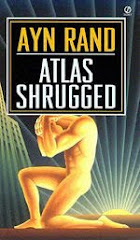
Rational men do not want their societies to go into these sorts of death spirals.  They understand the need to keep their society as free as possible from the use of force, including government-wielded force.  Capitalism is the form society takes when men are free to associate with one another.  Mixed economies deny the freedom to cooperate with others and trample the right of association.  These principles are readily illustrated in Ayn Rand's ingenious novel Atlas Shrugged and in the excellent movie Atlas Shrugged Part I.

19 April 2011

Obama Usurps Congress' Appropriations Power

Obama, already the worst president in my lifetime, has refused to abide by the constitutional appropriations power of Congress.  The bill that passed Congress last week, which Obama has signed into law, reduced the funding to pay the salaries of four of Obama's Czars, the healthcare, climate change, auto and manufacturing, and the urban affairs czars.  Hilariously, Obama claims that the cuts are a violation of his executive power, the exercise of which apparently allows a President to spend any amount of money he wishes to claim is needed for advice at the White House.  He claims that the separation of powers are violated.  This makes sense for an entitlement President.  After all, he is entitled to anything he claims he needs and it is the taxpayers responsibility to feed him according to his needs.

It would clearly be too much to demand that he pick up the phone and get advice from the executive branch Health and Human Services Department on healthcare, the otherworldly combination of the EPA, NASA, and NOAA on climate change, the Commerce Department on autos and manufacturing, or the Housing and Urban Development Department on urban affairs.  Each of these massive bureaucracies can give him advice almost as bad as that which he gets from his czars!

Of course, he could go instead to the CATO Institute, the Competitive Enterprise Institute, Professor Walter E. Williams, Dr. Thomas Sowell, Glenn Reynolds, or me for better advice at a much lower cost.  But Obama is too wrongheaded and too much a spendthrift to do anything so sane.

The Constitution, as a carefully considered part of its separation of powers, gave the appropriations power solely to Congress!  The President can veto an appropriations bill, but he cannot on his own choose to spend money not appropriated by Congress.  If he is allowed to do that, then the Presidency can readily become a Dictatorship.  That is the ideal power every Socialist leader wants.  The fact that no President has the power of appropriations is another reason why Obama does not like our Constitution.

A Congressman just claimed once again in the last few days that Obama is a constitutional scholar.  This ridiculous claim keeps reappearing.  What hogwash!  This violation of his presidential power should be contested before the Supreme Court before the balance of power is still further skewed in favor of the Executive Branch.

17 April 2011

The Movie Atlas Shrugged Part 1

I have loved the book Atlas Shrugged by Ayn Rand since I first read it when I was just turning 18 in April 1965.  On 15 April 2011, I saw the movie Atlas Shrugged Part 1 for the first time at an 18-screen theater in Gaithersburg, Maryland in a 9:15 PM showing with a good-sized audience.  To my surprise, the audience did not have an age distribution similar to that of people who have read the novel.  In fact, the age distribution was quite young.  There were almost no children, but almost all of the audience appeared to be in their late teens to early thirties.  One Objectivist commentator I read regularly, Robert Tracinski, said that the number of theaters showing Atlas Shrugged grew greatly in the last few weeks because Tea Party enthusiasts requested it.  Maybe, but the audience at the showing I went to was much younger on average than the people I see at Tea Party rallies.  This young audience seemed to be paying rapt attention to the movie.  There were a number of times when many people laughed at the beliefs expressed by the usual Progressive Elitists.  Such comments as I heard after the movie seemed to indicate that the audience enjoyed the movie.  If this is true in the highly Socialist State of Maryland in the highly Socialist County of Montgomery, this is very significant.  We have a very leftist school system here, yet some young people are looking for an alternative view of life to that they have grown up with.  It is clear that most of this young audience is unlikely to have read Atlas Shrugged yet.  Based on this, I expect a surge in book sales is going to result.

My wife Anna and I enjoyed the movie ourselves.  It is an effective telling of the story.  The movie makes it clear that man's well-being and human civilization depend upon those who use their independent minds to create ideas, goods, and services that enrich our lives and enhance our security.  It also makes it clear that those advancing collectivism are largely using it to gain power and to enrich themselves at the expense of others, while the producers are enriching themselves and others.  The movie shows Dagny Taggart, Hank Rearden, and Ellis Wyatt as capable, heroic people worthy of our respect.  It also conveys the brotherhood of the producers and their exchange of love and affection for one another.

Given the rushed production of the movie, I thought it was itself an heroic achievement.  Professional movie critics seem to be inclined to claim the film has many shortcomings in the filming.  I am not a professional movie critic, but just a movie viewer.  I did not see those shortcomings in any significant way.  I thought there was a great deal of striking and appropriate cinematography in fact.  It is not the case that there were no areas of improvement that I could see, however.

There was so much material to cover from the first ten chapters of the book, that I really do think the movie should have been 30 minutes longer so there could have been more character development.  I do not believe the character development was so underdone that one could not assess the nature of most of the important characters.  I just think that Ayn Rand developed the nature of Dagny and Hank as heroic producers and as people who hungered for the sight of achievement and purpose in others so greatly that this is one of the main rebuttals to the frequent collectivist claim that businessmen care only about themselves.  The movie tries to establish this fellowship, but that fellowship is so rich that it would have made a greater movie if the movie had had the time to develop it further.  There may have been many financial, time, and distribution reasons why the movie could not be longer, especially given that it was not backed with the promotion power of a major movie production company.  This may make my wish for a longer movie no more than that: a wish.

There were a few oddities.  It took me a moment to get over the fact that Ellis Wyatt was played by an older man, rather than a younger man than Dagny Taggart.  In the novel he is full of youthful enthusiasm and he comes upon the scene of Colorado and quickly changes everything.  He actually takes over his father's rundown oil field and finds ways to extract remarkably more oil from them and then discovers new fields.  The older actor does work fine in the story and nothing essential was lost.  It was just a momentary jolt.  In fact the actor playing Ellis Wyatt did a very good job.  Anna was very impressed by his performance.

Another casting oddity to my mind was Francisco D'Anconia.  Almost every Objectivist woman who has read the novel falls in love with Francisco.  I am not convinced that the actor in the movie would have that effect on women, even if he had had adequate screen time.  It would be interesting to have the response of women who have seen the movie on this.

I generally liked Taylor Schilling as Dagny.  She projects good strength of character, intelligence, and she is a beautiful woman.  There were a few times when she probably should have been slightly more assertive or more passionate.  There is also a scene in which she is called back to Taggart Transcontinental to deal with an emergency and she seems to move somewhat more slowly than I can imagine Dagny doing.  Of course, it is hard to move really fast in very high heeled shoes, so maybe I am being unfair.  It just seemed to indicate a bit less passion than I would expect of Dagny.  I think Dagny would have taken her high-heeled shoes off and run barefoot or she would have worn shoes she could run in.  The bottom line though is this: could I love the woman Dagny in the movie?  Not as much as Dagny of the novel, but, yes, I could love her.  Her agony upon reaching Ellis Wyatt's oil field, with it ablaze and a sign saying he was giving it back as he found it, brought tears to my eyes.  When I read the book the first time, Ayn Rand's development of that event brought tears to my eyes also.  The injustice that such suffering should be visited upon Dagny was a part of the reason, but perhaps it was more graphic yet in the movie.  As a man and a romantic, it is just revolting to see the effects of such evil upon a great and lovable woman such as Taylor, er.... Dagny.

When the movie noted that a producer had vanished, it put up the name, what industry he was in, and a date of disappearance.  In the novel, the first man-of-the-mind disappearance noted is McNamara, who was the Cleveland contractor who finished building the San Sebastian Line to Francisco D'Anconia's copper mine in Mexico in which James Taggart and Orren Boyle had invested.  Dagny was counting on him to rebuild the Rio Norte Line to Ellis Wyatt's oilfields in Colorado, where a cluster of productive manufacturing companies had grown.  The movie just notes his disappearance after that of several other people and identifies him as a Manufacturing CEO without any connection to the upcoming building of the John Galt Line.  Richard Halley, the composer, is the second disappearance in the novel, but he is not mentioned.  Only businessmen are mentioned.  To be sure, the first disappearance in the movie is of a prominent businessman, the banker Midas Mulligan, which we later learn in the novel was the first such man to disappear.

Another incongruity was the bridge on the Rio Norte Line that Hank Rearden tells Dagny he can affordably replace with one built of Rearden Metal.  They walk onto the edge of the bridge which has a structure only suitable to span a narrow gap or if the gap is wider, which must have many supporting legs.  You do not see the complete bridge, but the part you see is decrepit.  Later, the train making the inaugural run on the John Galt Line, the temporary name for the railroad Dagny has created to rebuild the Rio Norte Line using the controversial Rearden Metal, passes over a magnificent bridge of unusual structure that could not be built of steel.  The gap it spans is too wide and too deep for the kind of bridge it was represented as replacing.  It is consistent with the challenge the bridge solved in the novel, however.  It is also understandable.  No bridge available for filming over such a chasm could be in such bad condition as the one shown had been.  We have not yet arrived at that level of decay.

These differences from the novel and oddities are nit-picking.  I really do not think they significantly detract from the movie or from Ayn Rand's work.  But, part of the fun of seeing the movie is in trying to see which things you can identify as different.  Why not have the fun of observing them, but then do put them in context.  Remember that context is everything, or at least crucially important.

I really do recommend that people with any interest at all in Atlas Shrugged or Ayn Rand's ideas go see the movie.  I believe most of you will enjoy it, if you give it a chance as a movie.  Remember, no movie can be a substitute for reading the great novel.  As most of us know who have loved the novel, it has many, many layers of themes and a very broad, life-living philosophy permeating paragraph after paragraph.  The novel is a remarkable work of genius.  The movie Atlas Shrugged Part 1 is at least very good and entertaining.  With the success of this movie, the producers will make a still better Part II, I expect.  I think they will have learned from making Part I and they ought to have more time and resources to make Part II.  I also think they will have a bigger audience after DVD sales of Part I and after it reaches TV audiences.

Eventually, at least most people will know the answer to the question, "Who is John Galt?"  It amazes me that many educated and professional people do not have a clue.  Many more people will also read the novel itself.  I am sure of that now.  That will be the ultimate measure of the success of the movie in my mind.

01 April 2011

More Missing Jobs in March 2011 than in March 2010

While there are 869,000 more people employed in March 2011 than in February 2011, there are 263,000 more missing jobs in March 2011 than in March 2010!  Job creation by the private sector in March 2011 was fantastic, but so many jobs were killed by the idiocracy [consistent wrongheadedness while determinedly ignoring reality] of the Obama Central Planners in 2009 and 2010, that we have a very long way to go to recover from this Great Socialist Recession.  In January 2011 the American economy was missing 23,502,000 jobs and in March that number was down to "only" 22,339,000 missing jobs.  The real unemployment rate has fallen from 14.59% in January to 13.85% in March.

This is progress, but it may be very fragile progress, given that the prices of oil and gasoline are now so high.  Food prices have also risen substantially.  The Republican House of Representatives has as yet been unable to significantly cut government spending and seems even to lack the will to do so.  Since we have already had a double-dip recession, we may be in for a triple-dip recession.  The Democrat Socialist Party is trying very hard to make that happen with its anti-energy policies of treating CO2 emissions as though they are pollutants and denying nearly every attempt to explore, develop, and produce oil, gas, and coal resources in America.  They have reduced the job-killing consequences of ObamaCare by giving out huge numbers of exemptions to mitigate the future harm of that system to jobs and to dampen the criticism of that liberty-trampling fascist program.

The employment figures and the missing jobs calculation are given in the Table below.  The number of jobs is the actual number of working people, not seasonally adjusted jobs.  The number of missing jobs is based on the number of jobs plus jobs sought in January 2000, when jobs were plentiful and enticing.  67.49% of the total non-institutional civilian working age population wanted those good jobs.  If similarly good jobs were available now, I believe 67.49% of the civilian working age population would be working or looking for work now also.


The number of missing jobs since November 2009 is plotted below:  In December 2010, we actually had very slightly fewer missing jobs than in December 2010.  Unfortunately, the number of missing jobs shot upward in January, so that January, February, and March of this year each had more missing jobs than the corresponding month of 2010.  We have a very long ways to go yet in creating jobs.