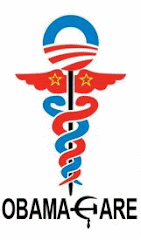
The pattern continues: Obama was ignorant of the NSA surveillance of telecommunications of the leaders of many nations, including our allies, until recently. See the 28 October 2013 issue of the Wall Street Journal. According to Kathleen Sebelius, he also did not know about the massive problems in the roll-out of ObamaCare until those problems were public knowledge.
So, he was ignorant of the management of his signature achievement. He was ignorant of a keystone of his actual constitutional job to act as Commander-in-Chief to secure our national defense and security. He is completely detached from any effort to control federal spending and the national debt. He has no knowledge of what happened in Benghazi and no knowledge of his Justice Department sending thousands of weapons into Mexico. He believes a trimmed budget means he should increase government spending in such a manner as to cause as many people pain as possible by erecting barriers around open-air public facilities.
Meanwhile, the NSA reports it has so many surveillance programs that it could not brief Obama on them all. That may be so. It should not be so. What is more, that does not mean that the NSA should be hiding a program to spy on Angela Merkel and other leaders from Obama. But then again, it is likely that Obama told them to keep him ignorant so he would have plausible deniability!
What we have is a con man pretending to be President who does not meet the constitutional requirement to be President, does not like the Constitution he is sworn to protect, chooses to be ignorant about key national defense and security issues, and nationalizes huge segments of the private sector and is disconnected from the management thereafter of all the resulting impacts upon our lives, including factors essential to our literal life and death.
To realize that some people actually believe Obama cares about people is to wonder about their sanity. There never was a President who took on so many responsibilities and then so greatly and consistently neglected them. It takes too much effort to really care. It is more fun to be a con man.
Showing posts with label nationalized. Show all posts
Showing posts with label nationalized. Show all posts
28 October 2013


21 October 2012
Appendicitis in Nova Scotia and Single-Payer Medicine
A materials physicist friend of mine told me how his socialist sister lost her desire for a single-payer nationalized medical system. She was on temporary business assignment in Nova Scotia, Canada and a neighbor began having severe pains. She took her neighbor to the hospital and they entered the emergency room, where concern was expressed that her pain was caused by appendicitis. The woman was screaming with pain. She was told to wait for Triage and after a long wait, the examiner declared that yes, the pain was due to appendicitis. My friend's sister assumed they would rush her to surgery. But no, the doctor announced that she was not yet close enough to death to warrant surgery.
For 36 hours the woman screamed and writhed in pain. My friend's sister stayed with her and helplessly listened to her screams for 36 hours. Finally, the doctors decided she was close enough to death that they were willing to operate on her, and presumably to shove aside the many patients who had been waiting months for operations. She did survive the operation, but my friend's sister's desire for a nationalized single-payer medical system did not. She is now a furious opponent of single-payer nationalized health care systems.
Obama and many of his friends who want ObamaCare, really ObamaUncaringTax, to fail so it can be replaced with a fully nationalized single-payer system should have been with her. Yes, I do understand that some of his friends are so callous that such an event would not have changed their minds, but no one can listen to a woman scream for 36 hours without at least being miserable. At least, I cannot imagine that they would not be miserable. But, that may be a failure of imagination on my part, because after all, they are Obama's friends.
The story above is anecdotal and scary. Studies of larger populations are certainly useful in testing whether such stories are consistent with the Big Picture. So, here is a Daily Mail report on the National Health Service in Great Britain:
For 36 hours the woman screamed and writhed in pain. My friend's sister stayed with her and helplessly listened to her screams for 36 hours. Finally, the doctors decided she was close enough to death that they were willing to operate on her, and presumably to shove aside the many patients who had been waiting months for operations. She did survive the operation, but my friend's sister's desire for a nationalized single-payer medical system did not. She is now a furious opponent of single-payer nationalized health care systems.
Obama and many of his friends who want ObamaCare, really ObamaUncaringTax, to fail so it can be replaced with a fully nationalized single-payer system should have been with her. Yes, I do understand that some of his friends are so callous that such an event would not have changed their minds, but no one can listen to a woman scream for 36 hours without at least being miserable. At least, I cannot imagine that they would not be miserable. But, that may be a failure of imagination on my part, because after all, they are Obama's friends.
The story above is anecdotal and scary. Studies of larger populations are certainly useful in testing whether such stories are consistent with the Big Picture. So, here is a Daily Mail report on the National Health Service in Great Britain:
Patients having major surgery in NHS hospitals face a much higher risk of dying than those in America, research has revealed.
Doctors found that people who have treatment here are four times more likely to die than US citizens undergoing similar operations.
The most seriously ill NHS patients were seven times more likely to die than their American counterparts.
Experts blame the British fatality figures on a shortage of specialists and lack of intensive care beds for post-operative recovery.
They also suggest that long waiting lists mean diseases are more advanced before they are treated.
Researchers from University College London and Columbia University, in New York, studied 1,000 surgery patients at the Mount Sinai Hospital, Manhattan, and compared them to nearly 1,100 people who had similar operations at the Queen Alexandra Hospital, in Portsmouth.
The results showed that just under ten per cent of British patients died in hospital afterwards compared to 2.5 per cent in America. Among the most seriously ill cases there was a seven-fold difference in the death rates.
The New York patients had paid for treatment through private medical insurance and were therefore likely to be "wealthier and healthier", whereas the NHS patients were from all social classes.
However, the study aimed to "iron out" these differences by rating each patient on their clinical status.We Americans really must get rid of ObamaCare before it collapses and we get the almost inevitable rush by the Democrats to replace it with a fully nationalized single-payer system similar to that of Great Britain or Canada.
21 June 2010
Chavez's Socialist Venezuela Sees Food Rot in Government Warehouses
Food prices have risen by 41% in Venezuela during the last 12 months, despite the recession. Venezuela imports about 70% of its food. The socialist government of Hugo Chavez has taken over between 20 and 30% of the distribution of staple foods. Chavez is now threatening to take over Polar, the nation's largest private food processor, brewer, and miller. Government supermarkets offer discounts of up to 40%, but still the rise in food prices has generally continued. Chavez blames this on the black market and now has army soldiers raiding private groceries and confiscating food. This was brought on by the revelation that 80,000 tons of food, including meat and powdered milk, have rotted in government warehouses. Chavez is embarrassed, so he is making a show of blaming private sector businessmen for the food shortages and replacing the rotted food with stolen food.
Despite a huge oil income, socialist Venezuela is following the long string of socialist countries which cannot feed its people. The equality promised the poor will result in the mass starvation of the poor, and perhaps some of the wealthy also. There are widespread problems in most of Latin America, but socialism is not the path to their correction. One would think that lesson would have been learned by now. Ignorance and foolishness reign in socialist Venezuela.
Despite a huge oil income, socialist Venezuela is following the long string of socialist countries which cannot feed its people. The equality promised the poor will result in the mass starvation of the poor, and perhaps some of the wealthy also. There are widespread problems in most of Latin America, but socialism is not the path to their correction. One would think that lesson would have been learned by now. Ignorance and foolishness reign in socialist Venezuela.
16 May 2010
Deciding Who Lives and Who Dies
Thomas Sowell has just written a column called A 'Duty to Die.' As is always the case, he makes a good point, in this case about nationalized medical systems. His main point is that when he grew up in poverty in the Southeast, his family took in an old aunt and cared for her for a while. The old aunt moved from family to family so no one family was too much burdened, but they all willingly took their turns. Now, he points out that we live in a culture in which very many of the best educated have learned that the old simply have a duty to die so they will not be a burden on the rest of us. He points out that this harkens back to primitive societies so strained in resources and so marginal in their survival, that the old had to wander off into the wilderness alone to die.
This issue has long been bothering me. Those who claim that they are so concerned about their fellow man and his welfare that they believe it is right to use government force to manage scarce medical services resources to provide for the poor or for those who simply do not choose to buy their own health insurance, have taken it upon themselves to make the decisions of who will live and who will die. In the not too distant past, this decision in the United States was made by a combination of the following filters:
In a nationalized health care system, all those who either love the patient or who are voluntarily disposed to help the patient are removed from the decision-making process. A "scientific" decision of how to spend the limited funds of the government medical program takes the place of all these people who may actually know the patient or who may evaluate the patient as an individual to determine if he or she is worthy of their voluntary help. The government must make some kind of pretense of providing medical aid equally, so it must do so with no regard to individual character. One of the easiest ways to do this is with the now inevitable rule of the form: You are older than 70 years old and you have cancer which is expensive to treat, so you will not be treated. Is this a more moral system for determining who gets medical treatment and who does not? To me, it is clear that this system is designed in Hell. The people who choose this system have no heart and are disloyal to every person of good character that they know. They are betrayers of those they claim to love. They are supporters of government-run death panels.
This issue has long been bothering me. Those who claim that they are so concerned about their fellow man and his welfare that they believe it is right to use government force to manage scarce medical services resources to provide for the poor or for those who simply do not choose to buy their own health insurance, have taken it upon themselves to make the decisions of who will live and who will die. In the not too distant past, this decision in the United States was made by a combination of the following filters:
- A lifetime of hard work and savings by an individual provided sufficient money or a substantial part of the money needed for either adequate health insurance or savings for medical care.
- Family members volunteered to help financially or with direct care services.
- Friends did the same.
- Many physicians volunteered their services to those in medical need who could not afford to pay, as my own grandfather did for thousands of patients, especially during the Great Roosevelt Depression.
- Charities provided financial aid and medical services.
In a nationalized health care system, all those who either love the patient or who are voluntarily disposed to help the patient are removed from the decision-making process. A "scientific" decision of how to spend the limited funds of the government medical program takes the place of all these people who may actually know the patient or who may evaluate the patient as an individual to determine if he or she is worthy of their voluntary help. The government must make some kind of pretense of providing medical aid equally, so it must do so with no regard to individual character. One of the easiest ways to do this is with the now inevitable rule of the form: You are older than 70 years old and you have cancer which is expensive to treat, so you will not be treated. Is this a more moral system for determining who gets medical treatment and who does not? To me, it is clear that this system is designed in Hell. The people who choose this system have no heart and are disloyal to every person of good character that they know. They are betrayers of those they claim to love. They are supporters of government-run death panels.
08 April 2008
Inefficient Nationalized Oil Companies
This last week Congress once again called the big American oil companies before committee to ask them why they were making profits when Americans were paying so much at the gas pump for gasoline. The oil companies ran weak ads on TV defending themselves and blaming the cost of oil on OPEC, high demand in developing countries, and the political uncertainties in many oil-producing nations. They did not complain about the government adding to the cost of oil with ethanol mandates and high gasoline taxes. They also did not point out that Congress will not allow them to drill for oil in much of the United States and its territorial waters. They did not point out that oil production is falling in some countries due to the inefficient operation of their nationalized oil companies.
Of the top ten companies in the world in terms of petroleum reserves in 2006, nine are state-owned national oil companies. The largest by far is Saudi Aramco and the 2nd, 3rd, and 4th largest are NIOC (Iran), INOC (Iraq), and KPC (Kuwait). These all have reserves of over 100,000 million barrels of oil. Fifth place is PDV (Venezuela), 6th is Adnoc (United Arab Emirates), 7th is Libya NOC, 8th is NNPC (Nigeria), 9th is Lukoil, and tenth is Qatar Petroleum. Of these, only Lukoil is private and it is controlled by ex-KGB thugs. Exxon-Mobil, the largest US oil company in terms of reserves, is number 14! BP is 17, Chevron is 19, ConocoPhillips is 23, and Shell is 25 in 2006. Because the international oil companies have so few reserves, they have a greatly diminished ability to determine the cost of oil and that ability is diminishing with time.
It is true that the international oil companies carry their weight better when it comes to the actual production of oil. Three of them are actually in the top ten in that respect. In 6th place is BP, in 7th is Exxon-Mobil, and in 9th is Shell. Production is dominated by Saudi Aramco, followed by NIOC (Iran), Pemex (Mexico), PDV (Venezuela), and Kuwait Petroleum Company. PetroChina is 8th and Sonotrach (Algeria) is 10th. Exxon-Mobil and BP each produce about 23% as much oil as Saudi Aramco does. NOIC (Iran) produces about 37% as much and Pemex (Mexico) produces 34% as much. PDV (Venezuela) produces 24% as much as Saudi Arabia. Iran and Venezuela are self-declared enemies of the United States and Saudi Arabia heads the OPEC cartel and Kuwait in position 5 is active in OPEC. Of the top 5 producing oil companies, only Mexico's Pemex is not in OPEC and is not in a country participating in terrorist activities, outside of some bloody drug traffic anyway.
These statistics are known to our grandstanding Congress. They were taken from a report prepared by the Congressional Research Service for Congress. The report is called The Role of National Oil Companies in the International Oil Market. It was written by Robert Pirog and dated 21 August 2007.
Many of these national oil companies are inefficient producers of oil. This goes with having government monopolies in general and the oil business is no exception. Articles appeared in the Economist about the increasing inefficiency of the once relatively efficient PDV, the number 4 producer, under Hugo Chavez in the last couple of years. Pemex, the number 3 producer, is similarly plagued with inefficiencies. NIOC (Iran), ONGC (India), Rosneft (Russia, 75.16%), and PetroChina are very inefficient oil producers. This inefficiency raises the cost of oil.
On Friday, 7 April, the Washington Times had an article on the problems with Pemex. Production at the Cantarell oil field, Mexico's largest, fell 18% last year. Overall, Pemex's production has fallen in 2005, 2006, and again in 2007. Since the price of oil went up 57% last year, company revenues are not decreasing despite the reduced production.
Pemex has virtually no control over the 110,000 union workers among its employees. A fertilizer plant closed in 2002 is still manned with union workers who cannot be fired or transferred. They show up each day and clean the plant a bit and then sit. Meanwhile, despite estimates that there are 30 billion barrels of oil and gas in the deep water areas of Mexican territory in the Gulf of Mexico, Pemex is doing nothing to expand its oil reserves. They do not have the money, the knowledge, and the technology to do so. They suffer also from high taxes, corruption, deteriorating equipment, lack of investment, and lack of competition. Pemex exported 1.67 million barrels of oil last year, but without new oil fields, exports are expected to fall to 290,000 barrels in 2016.
Pemex paid the government $62.5 billion in taxes last year. This is 60% of Pemex revenues! Pemex provided the Mexican government with 40% of federal spending. With continuing production decreases, it is unlikely that Pemex will be able to support so much of the weight of the government. Mexican legislators are themselves becoming a bit worried and have allowed Pemex to retain $18 billion for exploration this year. But, Pemex is limited in its ability to pursue market approaches to solving its problems since the Mexican constitution gives the state the exclusive right to process and distribute oil and natural gas. It appears unlikely that Pemex production will soon stop decreasing.
In general, the national oil companies have little incentive to expand production and they have even less to operate efficiently. They are commonly operated to employ as many people as possible and keep them beholdened to the governments. This is clearly the case in Iran, Venezuela, and Mexico. Taken together these 3 nationalized oil companies produce 94% as much oil as Saudi Arabia does. The other nationalized oil companies are not very efficient either.
There is little we can do about this as Americans, except to open new oil fields of our own in the Gulf, off the Pacific and Atlantic coasts, and in Alaska. We can also open the huge tracts of land in the west languishing in the hands of the Federal government for the development of oil sands and oil shales for oil production. We should build new clean and safe nuclear power plants and use our very plentiful coal for power stations with improved scrubbers to remove pollutants. We will still use foreign oil suppliers, but it is foolish not to increase our options and suppliers, so long as we rely on our most effective weapon, the free market. Unfortunately, our Congress will not allow the free market to do its wonders.
Of the top ten companies in the world in terms of petroleum reserves in 2006, nine are state-owned national oil companies. The largest by far is Saudi Aramco and the 2nd, 3rd, and 4th largest are NIOC (Iran), INOC (Iraq), and KPC (Kuwait). These all have reserves of over 100,000 million barrels of oil. Fifth place is PDV (Venezuela), 6th is Adnoc (United Arab Emirates), 7th is Libya NOC, 8th is NNPC (Nigeria), 9th is Lukoil, and tenth is Qatar Petroleum. Of these, only Lukoil is private and it is controlled by ex-KGB thugs. Exxon-Mobil, the largest US oil company in terms of reserves, is number 14! BP is 17, Chevron is 19, ConocoPhillips is 23, and Shell is 25 in 2006. Because the international oil companies have so few reserves, they have a greatly diminished ability to determine the cost of oil and that ability is diminishing with time.
It is true that the international oil companies carry their weight better when it comes to the actual production of oil. Three of them are actually in the top ten in that respect. In 6th place is BP, in 7th is Exxon-Mobil, and in 9th is Shell. Production is dominated by Saudi Aramco, followed by NIOC (Iran), Pemex (Mexico), PDV (Venezuela), and Kuwait Petroleum Company. PetroChina is 8th and Sonotrach (Algeria) is 10th. Exxon-Mobil and BP each produce about 23% as much oil as Saudi Aramco does. NOIC (Iran) produces about 37% as much and Pemex (Mexico) produces 34% as much. PDV (Venezuela) produces 24% as much as Saudi Arabia. Iran and Venezuela are self-declared enemies of the United States and Saudi Arabia heads the OPEC cartel and Kuwait in position 5 is active in OPEC. Of the top 5 producing oil companies, only Mexico's Pemex is not in OPEC and is not in a country participating in terrorist activities, outside of some bloody drug traffic anyway.
These statistics are known to our grandstanding Congress. They were taken from a report prepared by the Congressional Research Service for Congress. The report is called The Role of National Oil Companies in the International Oil Market. It was written by Robert Pirog and dated 21 August 2007.
Many of these national oil companies are inefficient producers of oil. This goes with having government monopolies in general and the oil business is no exception. Articles appeared in the Economist about the increasing inefficiency of the once relatively efficient PDV, the number 4 producer, under Hugo Chavez in the last couple of years. Pemex, the number 3 producer, is similarly plagued with inefficiencies. NIOC (Iran), ONGC (India), Rosneft (Russia, 75.16%), and PetroChina are very inefficient oil producers. This inefficiency raises the cost of oil.
On Friday, 7 April, the Washington Times had an article on the problems with Pemex. Production at the Cantarell oil field, Mexico's largest, fell 18% last year. Overall, Pemex's production has fallen in 2005, 2006, and again in 2007. Since the price of oil went up 57% last year, company revenues are not decreasing despite the reduced production.
Pemex has virtually no control over the 110,000 union workers among its employees. A fertilizer plant closed in 2002 is still manned with union workers who cannot be fired or transferred. They show up each day and clean the plant a bit and then sit. Meanwhile, despite estimates that there are 30 billion barrels of oil and gas in the deep water areas of Mexican territory in the Gulf of Mexico, Pemex is doing nothing to expand its oil reserves. They do not have the money, the knowledge, and the technology to do so. They suffer also from high taxes, corruption, deteriorating equipment, lack of investment, and lack of competition. Pemex exported 1.67 million barrels of oil last year, but without new oil fields, exports are expected to fall to 290,000 barrels in 2016.
Pemex paid the government $62.5 billion in taxes last year. This is 60% of Pemex revenues! Pemex provided the Mexican government with 40% of federal spending. With continuing production decreases, it is unlikely that Pemex will be able to support so much of the weight of the government. Mexican legislators are themselves becoming a bit worried and have allowed Pemex to retain $18 billion for exploration this year. But, Pemex is limited in its ability to pursue market approaches to solving its problems since the Mexican constitution gives the state the exclusive right to process and distribute oil and natural gas. It appears unlikely that Pemex production will soon stop decreasing.
In general, the national oil companies have little incentive to expand production and they have even less to operate efficiently. They are commonly operated to employ as many people as possible and keep them beholdened to the governments. This is clearly the case in Iran, Venezuela, and Mexico. Taken together these 3 nationalized oil companies produce 94% as much oil as Saudi Arabia does. The other nationalized oil companies are not very efficient either.
There is little we can do about this as Americans, except to open new oil fields of our own in the Gulf, off the Pacific and Atlantic coasts, and in Alaska. We can also open the huge tracts of land in the west languishing in the hands of the Federal government for the development of oil sands and oil shales for oil production. We should build new clean and safe nuclear power plants and use our very plentiful coal for power stations with improved scrubbers to remove pollutants. We will still use foreign oil suppliers, but it is foolish not to increase our options and suppliers, so long as we rely on our most effective weapon, the free market. Unfortunately, our Congress will not allow the free market to do its wonders.
Subscribe to:
Posts (Atom)






 Posts
Posts