Among the issues most commonly discussed are individuality, the rights of the individual, the limits of legitimate government, morality, history, economics, government policy, science, business, education, health care, energy, and man-made global warming evaluations. My posts are aimed at intelligent and rational individuals, whose comments are very welcome.

"No matter how vast your knowledge or how modest, it is your own mind that has to acquire it." Ayn Rand

"Observe that the 'haves' are those who have freedom, and that it is freedom that the 'have-nots' have not." Ayn Rand

"The virtue involved in helping those one loves is not 'selflessness' or 'sacrifice', but integrity." Ayn Rand

For "a human being, the question 'to be or not to be,' is the question 'to think or not to think.'" Ayn Rand
Showing posts with label Institute for Justice. Show all posts

20 February 2019

The Institute for Justice Wins an Important Case Against Excessive Fines at the Supreme Court

As a supporter and contributor to the Institute for Justice, I received the e-mail I am copying below today.  This is another of many good reasons to support the Institute for Justice, which also acts to protect us from improper eminent domain seizures, some ridiculous water protection EPA regulatory activities, licensing requirements that are really intended to favor those who already have licenses to practice their profession, and very importantly to allow us more school choice.

In a unanimous 9–0 decision released this morning, the U.S. Supreme Court sided with IJ and Tyson Timbs and ruled that the Eighth Amendment’s protection against excessive fines applies to every level of government. Writing for the majority, Justice Ginsburg states that “[p]rotection against excessive fines has been a constant shield throughout Anglo-American history for good reason: Such fines undermine other liberties. … They can also be employed, not in service of penal purposes, but as a source of revenue.”
IJ brought this vital constitutional question before the Court last November in the context of civil forfeiture, which perfectly illustrates the majority opinion’s point. In allowing state and local governments to seize and keep cash, cars, homes, and other property—often without ever convicting owners of any wrongdoing—forfeiture laws give law enforcement a powerful incentive to police for profit.
This decision will provide every single American, including those who fall victim to forfeiture abuse, with robust constitutional protection against excessive fines imposed by state and local governments. Moreover, today’s opinion gives IJ ammunition to take on other abusive fines and fees schemes throughout the nation. We also plan on making Timbs the first in a series of cases the Court takes on to fundamentally reassess the constitutionality of civil forfeiture laws.
Thank you for making these historic accomplishments for liberty possible.
Scott
Scott G. Bullock
President and General Counsel
Institute for Justice

19 March 2011

Third-World Property Rights in California

California is well-known for its high taxes, high deficits, never-ending regulations, its coddled government employees, its poor schools despite spending twice the national average per student, its building restrictions and high property costs, its high level of domestic out-migration to other states, and its third-world property rights.  California is one of the states that still allows governments to seize private property for private use virtually without restriction.  National outrage following the Supreme Court decision to allow New London, Connecticut to seize the Kelo home and neighborhood for proposed private use brought reforms in many states and local governments to reign in such abuse of property rights recognized in our Constitution.  The land seized from its rightful owners in the Kelo case is now a vacant wasteland.  Similar vacant wastelands have resulted in troubled California owing to similar eminent domain abuse of private property for private, connected company gain.

Third-world property rights are one of the worst impediments to economic growth and the standard of living in third-world countries.  California, with all its woes, has opted for property rights uncertainty to replicate those destructive effects upon ownership and investment right here in our most populated state.  Tim Cavanaugh gave some examples at reason.com:
But the acres of south Los Angeles wasteland generated by the Community Redevelopment Agency of Los Angeles (CRA/LA), the state’s largest and wealthiest RDA, are a grim testament to failure. The agency’s Normandie 5 Redevelopment Project has generated zero development. Its 107-acre Watts Project area, which has been in effect since 1968, boasts nothing but a Food 4 Less that hardly required government help to come into being. The massive $163 million Marlton Square project has stagnated, unbuilt, for nearly 20 years as a shady developer with friends in City Hall looted taxpayer funds. The two-block project area at the corner of Vermont and Manchester Avenues is a vacant lot. So is the long-fallow Central/Slauson project, where the CRA used eminent domain to shut down a metal works that was the only functioning business in the area.
 He also notes that the people attracted to such government property seizure schemes are not the best people:
Maybe the most important factor is the tendency of public-private partnerships to attract the worst elements of society: union goons, neighborhood activists, reverends, public-trough developers, political appointees, city planners, and so on. The Marlton Square project came close to breaking ground in 1999 under the legendary Lakers point guard and successful developer Magic Johnson—until itinerant local politician Mark Ridley-Thomas forced Magic out and turned the project over to a developer with a history of bouncing checks and cheating on his taxes, who went on to make millions of city dollars vanish before going bankrupt.
One of the more notable characteristics of these ignoble schemes is that they usually victimize the poor or the lower middle class for the comfort and profit of unscrupulous well-off people with good connections to government.  Fortunately, these would-be victims have a resolute champion in the Institute for Justice, which is making a point of becoming a nemesis for such low-life dispossession in the rascal-ridden state of California.  An example of the work the Institute for Justice does is its defense of a community youth athletic center against the out-of-control use of eminent domain by National City near San Diego.  A cavalier declaration of blight has been issued to 700 properties so that the city can exercise eminent domain over any of the properties over the next ten-year period.  The property owners must successfully fight off the blight rulings within a limited time to save their property from some potential exercise of the eminent domain claim in later years.  This means considerable expense and effort to prevent the loss of their property which may or may not happen.  This arrangement is a most cunning way to cause many property owners to fail to get the blight ruling overturned, especially when they are people of limited financial resources.  This is a plague upon the unwealthy for the future benefit of unscrupulous wealthy developers.

The Institute for Justice and some brave would-be victims have something to say about that however:


You can read more about this worthy case here.  Please consider becoming a supporter of the Institute for Justice while you are there.

20 November 2010

Arizona Encourages Government-Dependent Politicians

29 November Update:  The Supreme Court has agreed to hear the free speech case argued by the Institute for Justice discussed in this earlier post.  Congratulations to the Institute for Justice in its efforts to protect our individual rights!

Arizona has an interesting way of promoting the political career of government-dependent politicians.  Arizona law puts politicians on the dole even before they are elected.  Now, I ask you, how can We the People expect politicians on the dole to government to look out for our interests in keeping the power-lusting governments off our backs?  The answer, of course, is that such politicians are guaranteed to be bought and paid for big government supporters.  The Arizona "Clean Elections" Act is the mechanism for buying big government politicians and putting them in office.  The bias in favor of government doing what it most wants to do, which is to gain more and more control of the People's lives, is huge.

The Institute for Justice has challenged this Arizona interference in elections on the basis of its interference with our freedom of speech in a case called Arizona Free Enterprise Club's Freedom Club PAC v. Bennett.  The U.S. Supreme Court is expected to decide whether to hear the Institute for Justice's challenge of this law on Tuesday, 23 November.  The Institute for Justice is also representing the Arizona Taxpayers Action Committee, Arizona State Treasurer Dean Martin, and State Representative Rick Murphy.

The Arizona government subsidizes those candidates for office who elect to take a subsidy.  For every dollar an independent candidate brings in, the subsidized candidate is given an equal amount of money.  The candidate on the dole does not have to do any work to acquire donations from those who believe so strongly in his principles that they will donate their own money to the candidate.  The candidate on the dole is then free to be a perfect demagogue and has no need to be persuasive enough to get people who will carefully consider his viewpoints before giving him campaign donations to actually do so.  Those who part with their money often think about why they are doing so before acting.  Those same Arizonans who favor an independent candidate are then forced to subsidize the candidate whose views they may abhor.  This is not just an abridgment of the freedom of speech, but it is an inversion of speech.  If you believe one thing, you are actually forced to say you believe the opposite!

Fortunately, in January 2010, a federal district court ruling struck down the matching funds in elections as a violation of freedom of speech.  But, the 9th U.S. Circuit Court of Appeals stayed the order of the initial federal district court ruling.  In June, the U.S. Supreme Court took the unusual action of reinstating the initial court ruling which had prevented Arizona from matching funds.  As a result, the 2010 elections in Arizona were not sullied by this big government attempt to bias the selection of politicians in its favor by effectively limiting the freedom of speech of the People of Arizona.

Bill Mauer, an Institute for Justice attorney, said
Matching funds violate the First Amendment rights of candidates, citizens and independent groups.  The government may not give an electoral advantage to one candidate by ‘leveling’ the speech of his opponents.  The system is set up to punish those the government believes are speaking too much, while subsidizing those it believes are speaking too little.  In a free society, the government has no business micromanaging how citizens debate, of all things, who should run the government.
Having been so serious for so long, you deserve a break.  The Institute for Justice has a fun cartoon video summarizing their viewpoint on the effects of the Arizona "Clean Elections" Act.


The Institute for Justice has been very effective in protecting our freedom of speech in other cases involving election laws in a number of states.  Most recently, the 10th U.S. Circuit Court of Appeals ruled on a Colorado law that forced six neighbors opposing a ballot issue to register with the state government and comply with very complex campaign election finance laws.  In this case, Sampson v. Buescher, Judge Harris Hartz wrote for the unanimous court that the campaign finance disclosure requirements were too complex for most citizens and simply prevented them from speaking out on political issues.

The U.S. Court of Appeals for the District of Columbia ruled that the federal government could not restrict how much individuals gave to SpeechNow.org or other similar groups in another Institute for Justice case.  That victory was marred by the ruling that the group did have to abide by the difficult rules of operating a political committee, despite the Supreme Court having ruled in Citizens United that corporations did not have to do so.  Go figure.  The Institute for Justice has also won victories in Florida where its very broad "electioneering communications" law was ruled unconstitutional and in Washington where the state tried to regulate talk radio commentary on a ballot issue.

Not only is the Institute for Justice very effective in winning vital cases to protect our freedoms, but it does it very cost efficiently.  It has won the highest 4-star rating from Charity Navigator for the 9th year in a row.  Please consider fighting for your freedoms by making a donation to the Institute for Justice.

11 November 2010

The Right to Association with Others - The Right to Work and Hire

The equal, sovereign rights of individuals to life, liberty, property, the ownership of their own minds and bodies, and to pursue their own happiness are very broad.  Limitations put upon individuals by legitimate governments are few and strictly limited to the prevention of violence and fraud.  Among the most basic of an individual's rights are the right to work for a living.  Another is the right to associate with others for voluntary purposes, which includes such rights as the right to trade goods and services, the right to hire employees, the right to be an employee of another, the right to be a service provider, the right to be a customer, the right to use property to provide goods and services, the right to practice a profession or trade, the right to enter into a business partnership, the right to enter into a domestic partnership, the right to exchange ideas, and the right to enjoy friendships and romantic and/or sexual relationships.  The freedom to work and the freedom to associate voluntarily with others are very broad freedoms, which legitimate governments seek to protect.  On the other hand, illegitimate governments, which are much more common, seek to interfere with these basic freedoms.

Illegitimate government was defined in our Declaration of Independence.  Government which is destructive to the unalienable rights of the individual to, among other rights, the right to Life, Liberty, and the Pursuit of Happiness is declared illegitimate and tyrannical.  The United States of America today is full of such illegitimate and tyrannical governments.  These governments feel especially free to interfere with our voluntary associations in trade, work, and cooperation in the following ways
  • controls and regulations on the production of goods,
  • mandates and limits on the employer - employee relationships, 
  • the licensing of professionals and tradesmen, 
  • the imposition of slavery upon employers to keep financial records and to keep tax records and file tax forms, 
  • limitations on the exchange of services, 
  • the dictation of who can be hired and who cannot be hired, 
  • the unequal treatment of various domestic partnership combinations, 
  • the denial of access to the market of very large companies, 
  • the excessive burdening of small companies with laws, mandates, regulations, and paperwork,
  • micromanaging safety issues not understood by governments in complex workplaces,
  • micromanaging performance standards not understood by governments in complex professions,
  • exaggerating safety issues to gain control and to reward special interests,
  • exaggerating issues of potential fraud in the interest of control and to award special interests,
  • discriminating against many professions with property taxes on their tools and equipment, which does not hurt government pets such as lawyers and accountants and actually increases their business,
  • discriminating against many professions because some people believe they are immoral, such as prostitution or marijuana suppliers,
  • discrimination against some people in education and the exchange of ideas,
  • preventing those with little wealth or income from entering many professions or trades,
  • using minimum wage laws to discriminate against the undereducated and the disabled,
  • using minimum wage laws to discriminate against young people lacking previous job experience or those living in low-cost-of-living areas (popular with unions),
  • limiting the number of companies providing services to bolster the income of those previously in business,
  • as a change-up, forcing companies and associations to grant special privileges to unions, people of favored races, people with handicaps, and to governments,
  • requiring people to purchase goods and services, such as the services of accountants and lawyers by businesses, health insurance under ObamaCare, seatbelts in cars, child safety seats, high mileage vehicle mandates, unnecessary radiation inspection services for fully contained radiation sources, 
  • the regulation and taxation of fossil fuels due to unproven and scientifically wrong fantasies of man-made global warming disasters,
  • subsidies for favored people, companies, institutions, and industries, such as the cake-taking ethanol, wind generation, and solar power industries,
  • manipulations of the value of the dollar to favor financial institutions or exporters or importers,
  • restrictions on foreign competition such as the Jones Act provisos against foreign-owned shipping,
  • interference with railroad and trucking rate structures,
  • bailing out companies with strong union ties, such as GM and Chrysler, at the expense of other companies and taxpaying consumers,
  • the massive transfer of wealth from the private sector to governments,
  • requiring the payment of labor union labor rates on government projects or by government contractors,
  • crippling American businesses with much higher taxes and regulatory burdens than foreign competitors have,
  • and interfering with or failing to ease restrictions on foreign trade, since every individual has the right to trade with others, even when they are in foreign nations.
Of course, many of these restrictions on the freedom of association and work are justified with claims that public safety or the prevention of fraud make them necessary.  These claims are commonly exaggerated in the interest of some special interest, often that of the politician to award his friends and contributors being the foremost special interest.  Fraud should be combated with vigorous legal action against actual instances of fraud, not by overly active imaginations conjuring up ways in which someone in a profession might defraud a customer.  These anti-fraud prevention schemes will always cause more trouble than they address.  They gain traction, however, because many Progressive elitists believe the People are too stupid to choose their own associations well.  The People are imagined to be defenseless against fraud.  Somehow, the government will anticipate every possible fraud and prevent it.  Or so it wants us to believe.  In fact, it is mostly just successful in keeping entrepreneurs from competing for the business of a nation of sovereign individuals.

One of the best organizations in fighting such abuses of governmental power is the Merry Band of Freedom Litigators at the Institute for Justice. They have a long and successful track record of attacking irrational licensing laws and other approaches to preventing people from working and earning a living.  Here is a recent example of their work:
As demonstrated by a series of eight new reports issued in October 2010 by the Virginia-based Institute for Justice, one of the principal obstacles to creating new jobs and entrepreneurial activity in cities across the country is the complex maze of regulations cities and states impose on small businesses.  IJ’s “city study” reports are filled with real-world examples of specific restrictions that often make it impossible for entrepreneurs to create jobs for themselves, let alone for others.
The Institute for Justice has documented how police in Pine Hills, near Orlando, used barber licensing laws there, to fine barbers hundreds of dollars who had years of experience as barbers, but no license.  These raids on unlicensed barbers were used as a cover to search for drugs without a search warrant, showing how a disregard for some individual rights commonly leads to a disregard for other rights.  They also found that in eight major metropolitan areas, nearly one in three professions requires a license.  In the 1950s only about one in twenty professions needed a license.  One of the best ways to reduce unemployment is simply to let people work.  No subsidies are needed, no tax breaks are needed, and no government-sponsored training need be provided.  The governments simply need to get out of the damn way and allow people to work!

My bullet list above provides reason after reason for why Americans are unable to find jobs or to create their own jobs now.

17 September 2010

Washington D.C. Licenses Tour Guides

Washington D.C. requires tour guides to pass a test and get a license.  Can you imagine why?  It cannot be because if an ill-informed tour guide were to say that the top of the Indian on top of the Capitol is 302 feet above the ground that this would cause great harm to the tourist.  It the tourist goes back to Indiana and tells his neighbor this incorrect fact, his neighbor will tell him, no, from the east side, at the bottom of the steps, to the top of the Indian is 288 feet.  The misinformed tourist would then have no choice but to commit suicide out of embarrassment, right?  Fortunately, in my hypothetical example, the tourist can simply point out that the Capitol was not built on level ground and there probably is a point on the ground above which the Indian does rise to a height of 302 feet.

But what really has me wondering is that there is a tour of sites haunted with ghosts.  Does the D.C. tour guide test check for guide knowledge of the ghosts of D.C.?
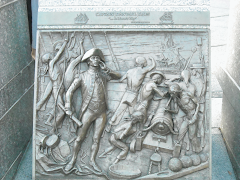
There must be tour guides who specialize in the Capitol, the White House, and the three main presidential memorials.  Then there must be some who specialize in the museums.  Do they all take the same tour guide test?

It turns out that the Institute for Justice has just taken the case of the tour company called Segs in the City to protect them from this licensing requirement.  I suppose the Segway tour guides will have to prove they can drive a bus and talk at the same time.  There are also walking tours.  I wonder if the walking guides also have to show they can drive a bus?

It is getting to be the case in many cities that if you want to earn a living doing anything, you must get a license. When the cities finally get all jobs covered, I expect they will begin issuing licenses for the right to breathe out CO2.  You will have to prove that you are worth the pollution you breathe out due to your social value.  If you cannot, then the politicians will be addressing the over-population problem, right?

22 January 2010

Supreme Court Defends Free Speech

The Bipartisan Campaign Reform Act (BCRA) of 2002, often called the McCain-Feingold Act, placed severe limits on the free speech of corporations and labor unions for 60 days prior to a general election for ads mentioning the name of candidates for federal office.  It also restricted free speech for 30 days before a caucus or a primary election.  President George W. Bush signed the legislation into law, despite having reservations about the free speech restrictions.  He apparently thought the Supreme Court would strike many of its provisions down, so he abrogated his responsibility to veto the bill.  The Supreme Court, in McConnell vs. FEC, upheld most of the provisions of the BCRA of 2002, though it was also clearly its duty to find the restrictions on freedom of speech unconstitutional.

Finally, yesterday, the Supreme Court, in a 5-4 decision, considering Citizens United vs. Federal Election Commission, ruled that the BCRA of 2002 could not restrict the free speech of persons acting through either corporations or labor unions or other groups.  Quoting from a press release from Chip Mellor of the Institute for Justice, which helped defend free speech in this case:
Justice Kennedy, writing for the Court, emphasized that the government’s ban on corporate speech was censorship, pure and simple:  “When Government seeks to use its full power, including the criminal law, to command where a person may get his or her information or what distrusted source he or she may not hear, it uses censorship to control thought.  This is unlawful.”  He added, “The First Amendment confirms the freedom to think for ourselves.”
The Court overturned Austin vs. Michigan Chamber of Commerce and parts of McConnell vs. FEC in the process.  Chip Mellor says:
In today’s opinion, the Court ruled that everyone, including corporations, has the right to speak out about issues and candidates.  The government may not restrict the marketplace of ideas:  “The civic discourse belongs to the people, and the Government may not prescribe the means used to conduct it.”  In other words, the First Amendment rejects government paternalism, instead “entrusting the people to judge what is true and what is false.”
 The Institute for Justice also won a case in Arizona on 20 January on free speech and election issues when, according to the Institute for Justice website:

a federal district court judge declared unconstitutional the challenged “Matching Funds” provision of Arizona’s so-called “Clean Elections Act,” striking a blow for the rights of individuals and groups to speak freely during political campaigns.  The Institute for Justice is challenging Arizona’s scheme of publicly financing elections, which drowns out the voices of individuals and groups who wish to support privately financed candidates who run against taxpayer-funded candidates in a misguided effort to “level the playing filed.” If a group makes an independent expenditure in favor a privately funded candidate, the unelected bureaucrats at the Clean Elections Commission dole out dollar-for-dollar “matching funds” to the publicly funded candidate. That means that for every dollar an individual or group spends to support the candidate of their choice, over the publicly funded candidate’s initial government subsidy, the government pays an equal amount of money to the political competition. IJ also seeks to preserve the right of individuals to run for public office without having to accept taxpayer funds. Arizona’s public financing scheme punishes candidates who reject the political welfare of public funding by burying them in red tape and giving extra money to their publicly funded opponents. The case is being appealed to the Ninth Circuit, where IJ will again demonstrate that "clean Elections" doesn't level the playing field, it levels the players on the field.
A couple of other important freedom of speech court cases are being supported by The Institute for Justice.  SpeechNow.org vs. FEC will be argued before the D.C. Circuit Court of  Appeals on 27 January challenging a federal law that forces people to give up the right to associate in order to use the right to free speech!  Both rights are clearly stated in the First Amendment, so where were the minds of Congress when they passed this law!  The law limits each person joining together to advertise their beliefs to $5000 in contributions to the cause, but acting individually, they would have no such limit.  The Institute for Justice (IJ) is joining the Center for Competitive Politics to represent SpeechNow.org.

In Colorado, a group of neighbors joined together to oppose the annexation of their neighborhood by a nearby town and were sued under a Colorado law which forces any group spending as little as $200 to address a ballot issue to register with the state and disclose all donors making contributions of $20 or more.  IJ is representing these neighbors in the 10th Circuit Court of Appeals.

I have long been impressed by the work of the Institute of Justice and have been a contributor for many years.  I urge others to carefully consider supporting their critical work.  They played a big role in eminent domain reform and the Kelo case a few years ago.  They attack onerous professional licensing laws and many other petty attacks upon our freedoms.  They seem to be a very cost-effective organization as well.

29 October 2009

Institute for Justice to Fight for Bone Marrow Donor Compensation

The 1984 National Organ Transplant Act makes it illegal to compensate people for donating their bone marrow.  Donating bone marrow is nothing like donating a kidney, part of a liver, or a lung.  It no longer even involves the insertion of a long needle into the pelvic bone.  Nowadays, a donor is given a drug to stimulate blood stem cell production and the cells are collected from the blood using the same equipment used to collect blood plasma, for which donors can be paid.

Because marrow cells produce white blood cells and these cells attack foreign tissues and cells, it is particularly important to get a very close match between bone marrow donors and recipients.  For white people awaiting bone morrow, there is a 75% likelihood for finding a match.  However, for minority members, the probability of finding a match falls to 25%!  Apparently, the restriction on bone marrow donation compensation, which would help address the problem of such limited matches, was added to the National Organ Transplant Act at the last moment and no one really considered what they were doing.  How typical for Congress.  Apparently they rushed proposed legislation to a vote in 1984, perhaps without reading it, much as they do now without understanding its consequences!

The Institute for Justice is now working on a legal case to make it possible to pay bone marrow donors so that the chances of finding bone marrow matches will increase.  This could save the lives of thousands of cancer patients.  The Institute for Justice has done great work already in protecting individuals and small businesses from eminent domain abuse and ridiculous business licensing and regulations.  It is a non-profit organization well worth supporting.