Among the issues most commonly discussed are individuality, the rights of the individual, the limits of legitimate government, morality, history, economics, government policy, science, business, education, health care, energy, and man-made global warming evaluations. My posts are aimed at intelligent and rational individuals, whose comments are very welcome.

"No matter how vast your knowledge or how modest, it is your own mind that has to acquire it." Ayn Rand

"Observe that the 'haves' are those who have freedom, and that it is freedom that the 'have-nots' have not." Ayn Rand

"The virtue involved in helping those one loves is not 'selflessness' or 'sacrifice', but integrity." Ayn Rand

For "a human being, the question 'to be or not to be,' is the question 'to think or not to think.'" Ayn Rand
Showing posts with label Objectivist. Show all posts

15 June 2009

A Response to an "Obligated to Give Back" Commenter

Back in my post of 28 March 2009, I wrote about how hard my daughter Katie had worked as a biotechnology major in the Honors Program at Rochester Institute of Technology. Today I received a comment which I posted. If I only did that, few will see my response, so I am going to give it here. The comment was this:
Obviously Katie has done alright by herself...but what has she done for those less fortunate.
Does she tutor, mentor act as a big sister?
As a father you measure your daughter by what she has accomplished...why not add a little of "what she has given back."
Quite possible, she has learned with "me" behavior from her objectivist father.
If you ask these questions from the viewpoint that Katie or I or anyone is obliged to do things for the "less fortunate" then I completely deny your premise. Katie might not do so as completely, but she fully understands that her success has been the result of some very dedicated work on her part. Nobody gave her the knowledge she has acquired. She made a huge effort, which she might have chosen not to make, just as most people do choose not to make it.

However, Katie happens to like helping other people. She has tutored, been a notetaker for classes, collected money and gave time to a number of charities, and she worked very hard as President of the Habitat Club at RIT to build homes for people. I certainly have no problem with this as long as Katie has chosen to do these things because she enjoys doing them, rather than because she feels obliged or forced to do them while feeling little but pain. No one is obliged to feel pain for the sake of others, though they may choose to take it on for a friend or someone of great value to them.

It is a sad mistake that many people believe that the choice one faces in life is either one of only I matter or one of I am but dirt and only others matter. Only the person who knows he is very worthy of life is able to respect and care for others. We cannot help but assess others from the viewpoint of our own introspection. We are only really familiar with our own mind. If your mind is not respected and valued enough by you, you will not be able to perceive anything in others which is worthy of respect and to be valued. I believe that, like me, Katie really is able to see value in others because she sees value in herself.

You and many others make the false assumption that Objectivists cannot care much about others. This is not true about me and it was not true about Ayn Rand. She was personally a very charitable woman. I know the roommate of a man, to whom she was not related, whose B.S. degree in engineering she paid for just because he otherwise was not going to be able to go to college and she wanted him to. She was in many other ways a very caring and generous person, unlike such pretenders as Obama, Biden, and Gore who claim that their lives are dedicated to the good of others. These pretenders instead simply use force to make others give to the less fortunate through governments as the enforcer and conduit. These governments, in turn, provide the Obamas, Bidens, and Gores with power, the lust for which existed among the worst men long before money was invented.

Let me point out one more thing about Katie. Katie is extremely dedicated to doing medical research. She is at this time particularly interested in the study of immunology. She finds the field fascinating and she is looking forward to solving some very real problems so that many will live healthier and richer lives. The altruist who has not done alright by himself and chooses to tackle less arduous studies and to work at a minimally demanding job, is probably going to be objectively of less value to other human beings than Katie is likely to be. If you care so much about others, then you should have no objection to Katie's becoming a great medical researcher, even if she were never to give to charities or to never "give back" in any other way.

There is a terrible sense of the thug in this demand that others serve him or that others should be bowed down before an obligation to serve others. We should resist this by all means at our disposal. There is nothing wrong with exercising the choice to perform an act of charity for someone you care about or even for those who have met misfortune through no or little fault of their own, provided it is your free choice. But, do not attempt to force me to give up my values and adopt your values. Do not attempt to force me to live my life in accordance with your values. I am proud to manage my own life in accordance with the values I choose.

What we are obligated to give back to others is agreement to the principle that our relationships are voluntary and none of us, not even a majority, are to initiate the use of force to make others do our will. I am not to force you to live for me and you are not to force me to live for you. This principle then allows us a wide range of mutually beneficial interactions and trades of values, while yet respecting each other's life and the values we have each chosen as goals in our living.

16 October 2007

50th Anniversary of the Publication of Atlas Shrugged

In October of 1957, Ayn Rand's great novel Atlas Shrugged was published. I was not aware of it, being 10 years old. Much of the rest of the world was not aware of it for some time either, much to Rand's disappointment. Not even the truly creative builders of the world, for whom she fought so hard to bring admiration, seemed to take notice of the valiant and revolutionary defense of reason, egoism, happiness, production, and of Capitalism and free trade which she had provided in the 14 years she had labored since the publication of The Fountainhead in 1943. At the recent Atlas Society celebration of Atlas Shrugged in Washington, DC (yes, the heart of the brutal anti-individualist beast itself) on the 6th of October, Barbara Branden made very heartfelt comments on how America's businessmen had failed Ayn Rand and a rational Capitalist society when they failed to rally to the defense of Atlas Shrugged, as most of academia and the media attacked it or ignored it. Fortunately, many admirers of her work came eventually to discover Atlas Shrugged, making it the book most cited after the Bible as the work which has most influenced people's lives in America. It continues to this day to be a best-seller year after year, selling 140,000 copies a year.

While large numbers of people who have read Atlas Shrugged love it, very many of them do not make that love known to many of their acquaintances and family. Her novel clearly rejected socialism in all of its variants and it was clearly not consistent with religious conservativism either. Consequently, both the left and the right rejected it, usually with considerable hatred. Another good fraction in the middle of the political spectrum ignored it because many of them are apathetic about philosophy, history, and politics.

The socialists hate individualism, since no collective, communitarian scheme can accommodate the complex individuality of man. When the individualist claims that the right to his life implies that he has the right to his own body, he must exercise personal responsibility in his own health and its care. This means that he has the right to provide himself with the best medical care he chooses and to either have or not to have medical insurance. Individualists who choose not to use their money for medical insurance, but can certainly afford it, number about 18 million of those 47 million who are said to live in the United States without medical insurance. The socialists want their audience to assume the 47 million to be poor Americans in need of governmentally assured medical insurance. Other individualists want better medical care than the government will provide and they want it when they want it, not 6 months or a year later as is common in the socialized medicine nations. Still others want to smoke or drink without having to pay punitive taxes to a Nanny state. Then we individualists think we know better how to spend our hard-earned income than a democratic mob listening to demagogues lusting for power. We view the use of our earnings as an essential manifestation of our liberty and our pursuit of happiness, as did the Framers of The Constitution. If our earnings and our property are not truly ours to dispose of, then we are not free to manage our own lives. We think the socialist is utterly presumptuous in believing he can manage our lives better than we ourselves can. But, the socialist is a brute who not only thinks he knows what our values should be better than we ourselves do, but that he has the right to hire government thugs to beat us brutally until we give into his vision of what each and every individual life should be. The socialist wants to design a cookie-cutter life for each of us and does his best to use the public schools as his propaganda tool to this end. Commonly, she or he feels very maternal or paternal in helping the great unwashed masses to make the right decisions. This view holds that most people are incapable of managing their own lives and requires that every adult be continuously treated like a child, with no prospect of ever growing up.

The religious conservative is often thought to be essentially the opposing force in our society. However, the religious conservative often shares a substantial part of the vision of the socialist. He holds that every man is a sinner and that every man needs God to help him manage his life. Man is the equivalent of a sheep, a very dumb animal, which requires the constant supervision of the shepherd. Of course, the priesthood is happy to provide the earthly portion of this shepherd function and it is their route to power and paternal presumptions. Again, the ordinary man is a child at best. Now, the government is to enforce seemly behavior according to the Bible, or the Koran, or Jewish or Hindu teachings. So, here again the individual who does not accept the authority of the Bible, the Koran or the dominant religious teachings of his region, is allowed little opportunity to manage his own life. He is thwarted in many ways from exercising his sovereign right to life, liberty, and the pursuit of happiness. The religions almost always frown upon earthly pleasures to a substantial degree. Commonly, they hold prejudices against wealth and property, many aspects of free trade, many of the many joys of sex, and any vision of man as heroic. Commonly, one's sovereignty of body is crimped sexually and a woman's right to make decisions about that part of her body which is a fetus is denied. Commonly, freedom of conscience is limited when such freedom is not consistent with the regional religious teachings. So much for the right to life which must start with the right to manage one's own body and mind. Should one be homosexual, then the freedom to enjoy an equivalent partnering contract to that offered man and wife is denied. Forget about being bisexual, a bigamist, or polyamorous if one expects equal treatment before the law. Such expressions of individuality are denied by old books. No, wait, being a bigamist or more, is actually endorsed by many of the same old books invoked to deny other freedoms, but still the modern religion holds this evil. Go figure.

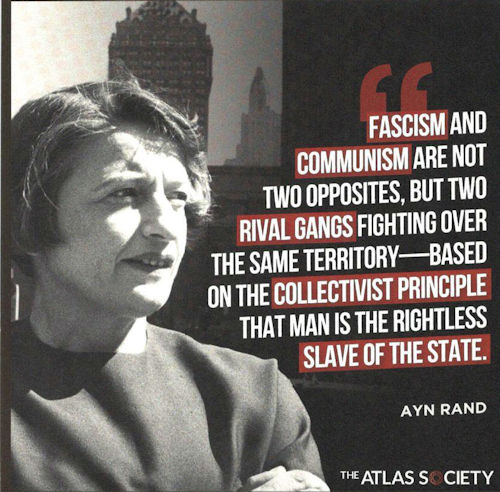
So, along came Ayn Rand. While very spiritual, it was the spirit of an earthly, rational, productive, and happiness-seeking man that she worshiped. She recognized that man lived by his rational faculty, which was his sole source for understanding reality. She reveled in the accomplishments of mind that many people contributed in their professional careers and thought that the system which most enabled these accomplishments was the Capitalist system of free trade in goods, services, and ideas. Religious tribalism or feudalism and socialism, whether of the fascist or communist varieties, squelched the mind and inhibited man's quest to thrive on this earth. She unabashedly identified the source of man's progress in the fruits of individual minds. She endorsed rationality, individuality, ethical egoism, productive achievement, and the quest for personal happiness.

Politically, a highly limited government, such as the framer's of The Constitution attempted to give us, was necessary if man were to be able to exercise his individual right to life, liberty, and the pursuit of happiness. Unfortunately, Americans have always been ambivalent about endorsing rationality, individuality, ethical egoism, productive achievement, and the quest for personal happiness. More than any other country on earth, we tolerated, and sometimes encouraged these human pursuits, but in early times, ancient religious belief interfered and now, more and more, a cheap desire to escape personal responsibility manifests itself in socialist evasions. Along the way, our Constitution has been reinterpreted to turn a requirement that the government behave consistent with the general welfare into an opening to allow almost any government action restricting the rights of the individual if only it was claimed to be in the name of the general welfare. If this had been the intention of the Framers, why would they try so hard to enumerate the few powers that government had? If this broadening of power was not enough, many others, such as a huge broadening of the mandate to regulate interstate trade has been added. It is difficult to make an argument so convoluted and trivial that it is not held that the government has a power to restrict many human activities based upon the commerce clause. As Judge Narragansett says in Galt's Gulch in Atlas Shrugged, an amendment must be added to the Constitution saying that Congress shall make no law abridging trade and depriving the people of their property. Of course now, we must even buttress our right to free speech, which is cruelly abridged by the McCain-Feingold Act, claimed to be an election reform.

Because of American misconceptions of political freedom, we have a society in which the members are pitted against one another on the basis of the industries they work for, the size of the companies they work for, whether they are management or labor, which quintile of income they fall into, whether they own a home or not, whether they have children in the public schools or not, whether they are man or woman, whether they are heterosexual or otherwise, whether they have bought medical insurance or not, whether they are old or young, and based upon their ethnicity. Because government uses its monopoly on the use of force to take up the part of these various groups against the interests of the opposing group, there are constant battles involving those who seek the unearned and those who seek to defend themselves. These are commonly very messy battles, since they have degenerated into very complex mixtures of the legitimate desire to protect oneself and the dastardly desire to take advantage of others. What could be uglier than parents taking advantage of their children by maintaining a Ponzi scheme social security system? What could be more disgusting than one ethnic group claiming special favors from government and discriminating against other ethnic groups. Shouldn't men be judged by their individual character rather than the color of their skin? The politicians and the media by and large encourage this constant factionalization. It gives them more power and brings them more attention and money. The philosophy is clearly to create conflict and to divide and conquer.

If the individual is ever to recover and then to fully realize his right to life, liberty, and the pursuit of happiness, it will be critical that he understand that man can live in harmony with others only by adapting Ayn Rand's philosophy of Objectivism. If the individual is to be respected, it must be understood that he lives by the product of his rational mind. When no man provides for himself by using force to appropriate the means of their living from others who have produced wealth, income, goods, and services by using their minds, then we can earn the shear joy of living as harmoniously as do the great producers of Galt's Gulch in Atlas Shrugged. By giving us such a life-affirming and inspirational view of the possibility of so much joy in living one's own life and sharing it with worthy friends and neighbors, Ayn Rand has given us a book for the ages. Atlas Shrugged should endure as has Homer's Iliad and Odyssey for showing us man as an heroic and joyous being.


08 April 2007

Individuality and Loneliness

There is a constant tension between asserting one's individuality and feeling welcome within a group. In fact, we are all very complex and differentiated individuals and we are also mostly social animals. Many of the most difficult choices we make in life are the result of a tug of war between our desire to be ourselves and our desire to be well-regarded and welcomed by others. In a rational world full of benevolent and tolerant people, the tension in this rope would be reduced, but it would always still be significant with most of the people who may hold the other end of the rope. Of course, they will be different in their capabilities, interests, and values in most cases from ourselves. This is simply a consequence of the complexity and the many differences that exist among people.

To start life, we are different in many ways at birth. We are so complicated at the level of initial biochemistry, that many differences exist between us already. Then, we start experiencing the world and interacting with other people and we each have a unique experience with unique exposures to stimuli from reality. Then, we each make a constant stream of choices in our thoughts and in our actions which have consequences unique to our own life. In the end, there can be no question but that each of us is a highly complex and differentiated individual. This in turn means that if you put any two people on the opposite ends of the rope, there will be tension in that rope. Two sisters at opposite ends of the rope will find times when the tension is great, as will two lovers, two scientists, two farmers, two historians, two philosophers, two friends, two bloggers, two unionists, and two businessmen. The tension is always present at some level.

If we consider even just fairly common traits, we do not find it easy to match two people up on any fairly substantial, yet quite finite set of traits. People have a tendency to be distributed across wide ranges, often along a bell-shaped curve, for given traits. Of course, many people may be close to the maximum of the curve for a given trait, but any two people who are close for that trait may be far apart on the distribution curve for another significant trait. For instance, suppose you are trying to match two people for intelligence, talkativeness, energy level, political beliefs, religious beliefs, and sexual preferences. As we know, it is difficult even with such a limited set of traits to find someone who matches any given individual. In real life, especially if one is looking for a marriageable mate, the number of traits that may be of importance is much greater. We would have to add such items as desire for children, manner of handling money and finances, preferences in homes, driving technique, sharing versus specialization in chores, how to entertain friends, how to interact with each other's family, and how to respond to each other's career needs. Bringing any two lives together is a very challenging task. This is true in many realms beyond that of two marriage partners.

The rope is always under tension. Yet, we are social animals. We want to receive and give affection, we want to exchange ideas, goods, and services, and we want to enjoy and appreciate others who are goal-directed living beings faced with many of the same challenges in life that face us. So, we want to find those to hold the other end of the rope who will not yank us off our feet and will allow us to be the individuals we are. At least, this is what we do if we are rational, because we realize that it is important to also be the individual we are. Less rational people will often try to diminish their individuality to belong comfortably within a large group of people, so they can have any number of people from that group at the other end of the rope without being yanked off their feet. In the Northeastern US and California, many people looking for some large group to belong to will decide to share in the socialist and Europeanized vision of government and society. In the heartland, many people will seek this common ground in a Christian community. In India, they seek it most commonly in Hinduism and the caste system. In Northern Africa and parts of southern Asia, they find it in Islam. Of course, this and other aspects of the common culture in these areas are only a part, though a substantial part, of an effort to reduce the tension in the rope. Most of these efforts involve a considerable sacrifice of individuality and with that a pain of its own.

How much pain there was and how much people had a need to express their individuality has been made very clear by the advent of the Internet and the now widespread communication channels opened between countless individuals seeking to find those who lie on the bell-shaped curve for a given interest or trait near them. For instance, maybe as many as 0.01% of Americans consider themselves to be Objectivists. Despite this small number, there are at least a dozen forums for Objectivists to discuss ideas, each with its own unique flavor. Or, consider the general distain for explicit sex and its public discussion. Yet, the internet is heavily trafficked with hordes of people trying to express their individuality in sexuality which they would never express within their local community. The Internet has become a tool also for finding that mate who might best be a match for marriage. It provides a means to filter through far larger numbers of people than one could ever meet in one's local community or travel to see and it allows people to assert their individuality without as great a risk that it will be discovered at their church, their workplace, or by their political henchmen. So, the Internet has done wonders to redress the constraints put on a person's individuality by the desire to fit in with some group of people without totally suppressing their individuality.

But, there is still that tension of having one realm in which one can be an individual and another in which it is hard to assert that individuality. Yet, oddly, very many of those who try hard to conform in their local community are the individualists of the Internet. Many of them have now been exposed to a higher level of personal expression and therefore freedom on the Internet. As they turn back into their communities, the benefits and the knowledge that have come about other people and their yearnings are bound to have a big impact on the level of benevolence toward individuals and tolerance toward the idea of individuality. This effect will be greater on younger people who came of age on the Internet. Community conformity will be almost certain to diminish over the next couple of decades as a result.

Among many other things, this opens the door for a philosophy for living which stresses individuality. It is also a very strongly positive development because it allows those few people who are willing and able to sustain their end of the rope, when it is under the greater tension characteristic of a little-shared philosophy of life, to meet one another. We Objectivists can at least be a part of a society through the Internet. This Internet society will grow if we practice our rational philosophy rationally. As it does, more and more people who can sustain rope tensions in their local communities of smaller magnitudes will be enticed to become Objectivists. The cost of membership will have to be brought down before a substantial fraction of even the American population will be willing to become Objectivists. If we want Objectivism to become a powerful force in our local world, we must practice both Internet and local community benevolence and toleration. The activation energy for becoming an Objectivist must be decreased, or there will only be a very few Objectivists and too many of them will simply be masochists and contrarians, who will be poor representatives.

Even with the Internet, being an individualist and an Objectivist is a lonely experience. You really must be a strong and resilient person. You must have the strength to bear some rather serious loneliness. Some of that loneliness is the result of already generally being a particularly intelligent person with a strong commitment to understanding reality. That already places you far out on some bell-shaped curves. Then on top of that you reject all the popular philosophies and causes of our time. You reject religion, socialism, environmental animism, tribalism, racism, and simple-minded, relativistic diversity/multiculturalism. You stand out like a sore thumb. You seek company on the Internet then where you can search the entire world and still you find only a small number of individuals you can really admire and whose friendship can be treasured. The cost of loving reality is only exceeded by the cost of acquiring a club to join by denying reality. It remains a fairly lonely business to be an individualist and even more so to be an individualist Objectivist.

Of course, the only real Objectivist is the individualist who expresses his individuality, thinks for himself, lives a productive and creative life, and seeks his own happiness. The orthodox, the cultist, the contrarian, and the masochist do not live the philosophy of Objectivism. They are pretenders or in some cases those who would be carnivores. Life is short and there is much to do. This imposes an economy that dictates against wasting one's time in endless debates with those who will not be convinced by rational argument. One must identify those who treat reality with total respect and ignore those who have other primary allegiances. There are some who distort the findings of science, pick them selectively and in as out-of-context a manner as do the environmental animists while claiming to respect science. This is actually a very fundamental attack on science, one which will totally discredit it, if allowed to go unchallenged.

This attack on science is being carried out very broadly by those environmentalists who falsely claim that there is a scientific consensus that the recent global warming is caused primarily by man rather than by a natural increase in radiation from the sun. But, in some Objectivist forums, there are other attacks upon science. Some are attacks upon quantum theory, which while not yet a completed program, is nonetheless not at fault for the reasons often claimed. Another is an attempt to claim that science has proven that all operations of the mind are now understood in terms of classical physics, classical thermodynamics even! This argument is viewed as a keystone argument that man lacks volition and the mind is really just a very complex program that makes choices. How these choices differ from simple conditional branching in a computer program has not been explained, but these claims have met with widespread acceptance on one major Objectivist forum.

The battle to be true to reality is a never-ending battle and I wonder if I will ever find a reasonable and sustaining number of friends to join me in these battles. If I should not carry the day, at least I will never be defeated! I will be true to my own individual nature and to my primary respect for reality whether I fight alone or with a few magnificent friends. Those who fight under the banner of individuality and reality beside me, I will love.


20 March 2005

Rational Men Must be Tolerant of Others

There are at least three major reasons why a rational man must practice tolerance with other human beings. These are:

  • Tolerance makes it possible to learn from the efforts of other people. Without tolerance, others are not encouraged to put as much effort into thinking, since the fruit of their labor is too often viewed as evil. It becomes less risky not to think about anything prohibited and if they have thought about it, they had best not share the thought. Without tolerance one lives in the Dark Ages in Europe or the Middle East of the present. Tolerance is essential if we do not all wish to enter the world and spend our lives reinventing the wheel. Tolerance is also the great tool that makes it possible for us to challenge our own ideas with those of others. This makes it easier for us to identify our own errors of thought and correct them. Tolerance makes it possible for a group of thinkers to tackle a tough problem and take advantage of each person's different experience, interests, and thinking abilities to understand the whole of it, when each individual could only contribute a part of that understanding. I will call this epistemological tolerance.

  • Individuals are very complex and highly differentiated. We are different biochemically and structurally. We have different experiences. We think in different ways and have a history of myriad unique choices behind us. We have different values. These differences add immensely to the richness of our experience with other people. Similarly, they make each of us a unique experience to others. Some of the value represented by each individual is precisely found in the uniqueness of each of us. As gold is more valuable than iron because it is more rare, each individual has more value because each is unique. But, of course, not all of our differences from one another are valued by others. Some of those differences may be viewed with mistrust, some with disdain, and some with repulsion. When a rational man practices tolerance with respect to the properties and values of others, he does not sign on to vouch for the value of each property or the morality of all of their choices. This form of tolerance recognizes the fact of reality that people are individuals. It recognizes that there is commonly much that is sufficiently good in the differences we find in others that we will generally profit in our interactions with them. I will call this the tolerance of individuality.

  • Throughout the history of man, the political entities that have controlled men around the world have established various balancings of dogma versus individual initiatives in thought. They have also frequently sought to direct what values a man may seek and achieve. They have often favored men of one race, ethnic group, religion, cast, tribe, clan, or profession over others. In Europe, the Hundred Year's War, largely between Catholics and Protestants, caused untold misery until finally Europe realized a more live and let live philosophy held benefits for civilization. In a capitalist republic, the government does not favor one person over another for these reasons. In fact, a capitalist republic finds value in the differences among its people, since the many differences in interests and abilities allow the society the advantages of many specializations and open the door to a wealth of trading among its citizens. It is also recognized that when one group suppresses another group or any individual, the fighting and the discord are distractions at best and very often fatal to the continuance of either the government or the entire society. This form of tolerance is political tolerance.

Each of these forms of tolerance are related to one another. They are each important to us as thinking individuals. Since Objectivists are thinking individuals, they should be foremost among those proclaiming toleration as a great benefit to each of us and to the societies in which we live. Objectivists are also a minority, who are not infrequently viewed as heretics. They are dependent upon others exercising the virtue of tolerance toward them. Taken together, the forms of tolerance allow us to develop and function fully as individuals. They allow us to trade ideas and values that raise the level of our civilization to much greater heights than is possible for a society or group of intolerant individuals.

Dogma and rigid social custom are the enemies of tolerance. Rational thought directed at understanding reality and the celebration of the productive individual are the product of toleration. Toleration allows us to experiment with ideas and test them out. It offers us a rich complexity of theories and choices, while aiding us in our efforts to evaluate those theories and choices. It allows each man to draw on the individual insights of others. It is a major virtue whenever two or more individuals live and work together.

There are dogmatic Objectivists (a contradiction in terms actually) who need very badly to understand these aspects of reality. Because reason is the individual's means of surviving and promoting his life, that which promotes reason is virtuous. Rationality is the most fundamental virtue. Tolerance is a major virtue because it recognizes that every other individual has the right of their own attempt to use reason, just as I have that right. Tolerance recognizes that it is the individual mind that must of its own volition choose to focus upon the creation of concepts and the use of principles to understand reality in all of its complexity. It is to be expected that individuals, even when highly committed to rational thought, will independently arrive at somewhat differing understandings of our complex existence. Tolerance recognizes individuality and allows us to take advantage of it to gain much greater insight of reality by evaluating the ideas generated by other creative and rational minds. What we gain in value makes us much more productive and much less primitive. We gain the advantage of living in a great civilization, provided we can also provide our society with a healthy respect for the rights of the individual. The concept of these rights and their exercise again requires us individually to be committed to tolerance.

Among Objectivists, David Kelley has been the most effective spokesman for the importance of toleration. He has been especially concerned with toleration as a means to increase our knowledge. He has also recognized the virtue of independence in each individual. I highly recommend his book The Contested Legacy of Ayn Rand: Truth and Toleration in Objectivism to anyone interested in how people can work together to greatly improve their understanding of any subject they may have a common interest in. While he especially addresses issues of Objectivism, there is a great deal to think about and use from this book even for a small group of collaborators in a laboratory or in a factory. It is really about being more productive in thought and action than it is possible for a single individual to be acting alone. As I read this book, I kept thinking that it was a marvelously organized and thought out explanation of many principles that I had found essential to the maximization of productive output in the many groups of scientific and engineering collaborators that I had had through the years.

In those groups, I had long worked hard to set such an atmosphere of tolerance in place. As this atmosphere grew, each such group became more productive. I tried to cultivate an atmosphere in which we maintained high standards for our output, but recognized that errors would be made as we sought solutions to the technical problems on which we worked, especially when we tried our hardest to be creative. Working together, we could makes leaps forward by taking advantage of our differing talents and help to correct each other's errors in a constructive way. In fact, we often learned from our errors. When we became comfortable that making an error was not likely to be viewed as evil or a sign of incompetence, ideas poured forth and our rate of solving difficult technical problems increased. It is surprising how often an idea with an error either contains a partial advance or somehow suggests the correct answer. Sometimes the wrong idea led to a test or experiment which proved it a dead end. Yet, that test provided us a clue to the right path to the answer to our problem. The idea that an error is evil is very wrongheaded. In fact, in certain contexts, making an error may actually be considered good. One does not make errors when not thinking. An error is made when one is thinking. Provided that one goes on to thoroughly evaluate the idea and test its validity rationally, the error is not evil and it may be the spur to the final correct identification of reality. In that context, it may be argued that the error served a good function. In that context, we can and should be less afraid of errors. They beat the alternative of stultification hands down.