Among the issues most commonly discussed are individuality, the rights of the individual, the limits of legitimate government, morality, history, economics, government policy, science, business, education, health care, energy, and man-made global warming evaluations. My posts are aimed at intelligent and rational individuals, whose comments are very welcome.

"No matter how vast your knowledge or how modest, it is your own mind that has to acquire it." Ayn Rand

"Observe that the 'haves' are those who have freedom, and that it is freedom that the 'have-nots' have not." Ayn Rand

"The virtue involved in helping those one loves is not 'selflessness' or 'sacrifice', but integrity." Ayn Rand

For "a human being, the question 'to be or not to be,' is the question 'to think or not to think.'" Ayn Rand
Showing posts with label Atlas Shrugged. Show all posts

02 September 2016

Atlas Shrugged Day!

This is a reprint of a post I wrote on 2 Sep 2010, with some updates on evolved times:

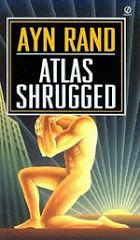
On September 2, 1946, Ayn Rand began writing Atlas Shrugged and she finished her great novel in time for publication in 1957.  Throughout the novel, September 2 is the date of a number of events:
  • In the opening scene of the novel, a bum asking Eddie Willers for a handout, asks "Who is John Galt?"  This and the way it was asked bother Eddie.  As he walks through NYC he is also bothered by the gigantic calendar hanging from a public tower and announcing the date as September 2.    
  • On that date, Hank Rearden and Dagny Taggart decide to take a vacation together.  On that vacation they discover an abandoned motor that should have revolutionized the use of energy in the world.
  • Francisco D'Anconia makes his speech on money on September 2.  He proclaims money to be the tool of free trade and the result of noble effort, not the root of evil.  Those who call money evil choose to replace its use with the force of the gun.
  • D'Anconia Copper is nationalized on 2 September, but the date on the calendar is replaced by "Brother, you asked for it!"
So, on this day of 2 September 2016, let us give thanks to Ayn Rand for her incredibly dedicated effort in writing this path-breaking novel we are finding so important in our lives 59 years after its publication date and 70 years after she started it on 2 September 1946.  This should be a day celebrated much as Thanksgiving Day is celebrated, but without any religious overtones, as a day to respect the creativity and productivity of all the heroic men and women that Ayn Rand's heroic novel commemorates.  At the top of our list of respected heroes and heroines, we should recognize Ayn Rand herself.

30 March 2016

Krugman Demonstrates Lack of Focus Once Again

Paul Krugman has once again demonstrated his lack of focus and poor reasoning skills.  His column criticizes Ayn Rand, Paul Ryan, and Ted Cruz.

He claims that Ted Cruz's tax reform plan will increase taxes on the poor and he references this analysis by the Tax Policy Center of the Urban Institute and Brookings Institute, for a very socialist viewpoint on Cruz's tax plan.  So what does that report say:
In 2017, the proposal would cut taxes at every income level, but high-income taxpayers would receive the biggest cuts, both in dollar terms and as a percentage of income.
This is not a tax increase for the poor as Krugman claims.  Of course the poorest, who pay virtually no taxes now, will not get as big a tax reduction as will high-income taxpayers.  The report does go on to make a prediction based upon a leftist view of the economy that by 2025, the lowest income quintile will be paying $116 more a year in taxes than they would under the present income tax scheme.  Of course, they also assume that Cruz will not succeed in reducing the size of the government relative to the size of the economy and who knows what other assumptions based on a dismal growth of businesses and a failure to count the value of welfare payments to the poorest quintile.  This economic model is likely no more sound than are the computer models that supposedly buttress the catastrophic man-made global warming hypothesis.

Krugman also seeks to discredit Paul Ryan by claiming that Ryan has said he returns over and over to read Francisco D'Anconia's Money Speech from Atlas Shrugged.  According to Krugman the Money Speech is:
one of the interminable monologs in Rand's "Atlas Shrugged"
A monolog less than four and a half pages long is too much for Paul Krugman's ability to focus and think.  He, though supposedly an economist, has little interest in the morality of Capitalism and needs escapist novels to pander to his inability to focus and reason.

02 September 2014

Atlas Shrugged Day Commemorates Human Creativity and Productivity

This is an update of a 2 Sep 2010 post:

On September 2, 1946, Ayn Rand began writing Atlas Shrugged and she finished her great novel in time for publication in 1957.  Throughout the novel, September 2 is the date of a number of events:

  • In the opening scene of the novel, a bum asking Eddie Willers for a handout, asks "Who is John Galt?"  This and the way it was asked bother Eddie.  As he walks through NYC he is also bothered by the gigantic calendar hanging from a public tower and announcing the date as September 2.    
  • On that date, Hank Rearden and Dagny Taggart decide to take a vacation together.  On that vacation they discover an abandoned motor that should have revolutionized the use of energy in the world.
  •  Francisco D'Anconia makes his speech on money on September 2.  He proclaims money to be the tool of free trade and the result of noble effort, not the root of evil.  Those who call money evil choose to replace its use with the force of the gun.
  • D'Anconia Copper is nationalized on 2 September, but the date on the calendar is replaced by "Brother, you asked for it!"
So, on this day of 2 September 2014, let us give thanks to Ayn Rand for her incredibly dedicated effort in writing this path-breaking novel we are finding so important in our lives 57 years after its publication date and 68 years after she started it on 2 September 1946.  This should be a day celebrated much as Thanksgiving Day is celebrated, but without any religious overtones, as a day to respect the creativity and productivity of all the heroic men and women that Ayn Rand's heroic novel commemorates.

At the top of our list of most respected heroes and heroines, we should recognize Ayn Rand herself.  Her great achievement is still a vital inspiration for many an intelligent, hardworking, and creative human being.  Those she has so inspired are among the best among us.


22 October 2012

Article on Ayn Rand in the Economist

The Economist of 20 - 26 October 2012 has an article called Ayn Rand: Who's shrugging now? Sub-headed: The individualist philosopher has fans in some unlikely countries

The article reports that the movie Atlas Shrugged Part I cost $8 million and earned less than $5 million.  Atlas Shrugged Part II was funded with $20 million and it is hoped it will earn $10 million.

Ed Hudgins of the Atlas Society says they have 11,000 non-American monthly visits to the Atlas Society website now, which is up from 7,000 two years ago.  Yaron Brook of the Ayn Rand Institute says their website's visitors are mostly from Britain, Canada, India, and Scandinavia.

Excluding English speakers, Swedes are the leading "Ayn Rand" searchers on Google.  A free-market think-tank in Stockholm named Timbro has sold 30,000 copies of Ayn Rand's books since 2005, which compares very well to sales of 90,000 copies in Britain with six times the population.  Despite this, when Annie Loof, the enterprise minister called Rand "one of the greatest thinkers of the 20th century", she was given a very hard time about it.

After the U.S. and Canada, India leads the world in English-language searches on topics relating to Ayn Rand.  There is a massive market in pirated copies of her books in India, according to Barun Mitra of the Liberty Institute, an Indian think-tank.

The article closes by noting that Ayn Rand's books outsell those of Karl Marx by a factor of 16.

12 October 2012

The Movie Atlas Shrugged, Part II, Either-Or

The movie Atlas Shrugged, Part II on the second of three sections of the great novel by Ayn Rand is opening in theaters today.  The second section of the novel, Either-Or, is full of action and crises brought on by big government and the irrational and immoral ideas that support it.  It also features important developments in the lives of many of the principle characters who have long been taken advantage of and for granted.  The task of a movie to develop the ideas, the evolutions of character and understanding, and the mystery plot is beyond the reasonably possible in a movie format.  But, a movie should be able to achieve an interesting and enjoyable experience in its own terms.  I am expecting that from this movie, especially since my friends David Kelley and Laurie Rice of the Atlas Society helped to advise the producers, writers, director, and actors in this production.


Anna and I will be going to see it this weekend.  It would have been nice to have gone out to see it tonight, but I am incredibly busy in my laboratory and have worked stretches of 29 and 19 continuous hours straight this week as a result.  Postings due to the critical need to thwart the re-election of the damaging socialist Obama and a remodeling of our laboratory website have been poured on top of a surge in laboratory projects.  Tonight, I had a visitor who was interested in filming an advertisement for a university pushing its program in forensic sciences.  He concluded that the Anderson Materials Evaluation laboratory would be a perfect location for this project, which may be scheduled for next week.  Movie cameras and actors may be invading my lab next week!

Anna also falls short on sleep during the week, so Friday night is her catch-up night.  Tomorrow we will see Atlas Shrugged, Part II in a refreshed mode.  I will comment on it here afterwards.

02 September 2012

Celebrate Atlas Shrugged!

Atlas Shrugged continues to be one of the most important books ever written.  It is definitely the most important book I ever read, especially in terms of its effects upon my life.  When I read Atlas Shrugged and The Fountainhead before it, I had the feeling that for once some of the most noble, heroic, and benevolent ideals that I held to be true and central to my character were held by someone else.

I began reading Ayn Rand as a senior in high school, beginning with The Fountainhead and then Atlas Shrugged.  That summer of 1965, while working out of Ardmore, OK and Enid, OK on oil exploration crews, I read all of Ayn Rand's non-fiction books to that time and her newsletter with all the back issues.  I thought this very good preparation for my next adventure as a freshman at Brown University.

I found a philosophy and a worldview which was similar to much of my own, but much more completely developed.  I had always thought man should be moral and heroic.  I had always thought that one should work very diligently to be rational and emotions were properly controlled by and educated by one's rational decisions.  I had understood that very limited government was the only government compatible with reason, the sovereign rights of the individual, and the ability of man to apply his rational faculty to improving life for man on Earth.  I had already understood that big government was essentially a denial of human individuality.

I had long understood that some principles were worth fighting for and, if necessary, dying for.  My father was a naval aviator and was always a heroic presence in my life.  So too were many of our nation's heroes of the French and Indian War, the American Revolution, the War with the Barbary Pirates, the Mexican War, the Civil War, some of the Indian Wars (sometimes the Indians too), WWI, WWII, and the Korean War.  Those principles worth fighting for were worthily found in our Declaration of Independence and our Constitution, which were written by wise and good men.  So too we had many heroes who were inventors and scientists.  I had already understood that the businessman was usually honorably offering goods and services to others in voluntary trade to their mutual benefit.  As such, many businessmen were heroically making human life richer, more secure, and better day after day.  One of the most important things Ayn Rand and I had in common was the fact that we were both human mind and hero worshipers.

Finally, in the summer and fall of 1964, I had realized that many of the teachings of Christianity were simply wrong.  I was not yet at the point of concluding that there was no reason to believe in God, but I was sure that any existent God was better than the Christian God. After reading Rand's non-fiction work, I came to the conclusion that I had no evidence for the existence of any god and that I really had no need for a god.

Basically, when I read Ayn Rand's The Fountainhead and Atlas Shrugged, I had found someone who thought along pathways similar enough to mine that her entire philosophy was useful to me in understanding my world.  She had thought about the issues important to me much longer than I had and she was capable of guiding me to other issues that I needed to think about.

It turns out that 2 September has a special significance for those of us who love Atlas Shrugged.  Let me repeat a post below that I wrote on 2 September 2010, while noting that it is now 66 years since she started writing it and 55 years since its publication:

On September 2, 1946, Ayn Rand began writing Atlas Shrugged and she finished her great novel in time for publication in 1957.  Throughout the novel, September 2 is the date of a number of events:
  • In the opening scene of the novel, a bum asking Eddie Willers for a handout, asks "Who is John Galt?"  This and the way it was asked bother Eddie.  As he walks through NYC, he is also bothered by the gigantic calendar hanging from a public tower and announcing the date as September 2.    
  • On that date, Hank Rearden and Dagny Taggart decide to take a vacation together.  On that vacation they discover an abandoned motor that should have revolutionized the use of energy in the world.
  • Francisco D'Anconia makes his speech on money on September 2.  He proclaims money to be the tool of free trade and the result of noble effort, not the root of evil.  Those who call money evil choose to replace its use with the force of the gun.
  • D'Anconia Copper is nationalized on 2 September, but the date on the calendar is replaced by "Brother, you asked for it!"
So, on this day of 2 September 2010, let us give thanks to Ayn Rand for her incredibly dedicated effort in writing this path-breaking novel we are finding so important in our lives 53 years after its publication date and 64 years after she started it on 2 September 1946.  This should be a day celebrated much as Thanksgiving Day is celebrated, but without any religious overtones, as a day to respect the creativity and productivity of all the heroic men and women that Ayn Rand's heroic novel commemorates.  At the top of our list of respected heroes and heroines, we should recognize Ayn Rand herself.

20 April 2011

Capitalism: Freedom to Compete or Freedom to Cooperate?

The enemies of Capitalism and free markets like to describe them as being characterized by dog-eat-dog competition and the survival of the fittest.  Ayn Rand's philosophy of Objectivism provides moral support for Capitalism and hence is subjected to the same criticism.  Before examining the derogatory portions of those claims, let us ask if the free market should be viewed as that part of society in which man has the freedom to cooperate or to associate with others.

Of course, all real freedoms adhere to individuals and each and every individual has the same sovereign rights.  If I have the freedom to cooperate or associate with another person, then I have the right to use my mind to evaluate whether I will enter into a particular cooperation or association with another person and  he has the corresponding right.  If we arrive at a mutual agreement to cooperate or associate, we do so.  If we cannot do so, we go our separate ways and perhaps seek out others with whom we can reach a mutual agreement.  In practice, this means that we seek people out who we can trade values with such that each party believes they are better off because of the trade.  There are innumerable such trades being made in a society and it is perfectly rational for the parties to make such trades in many cases.  The value of living in a society is found in the wealth of such advantageous exchanges.

Such free market trading requires that men be free to use their minds to choose their own values and then to manage their own lives in accordance with their values.  Much of the prejudice against free markets is based on the opinion of elitists that others are not capable of choosing their own values and of managing their own lives.  But let us be frank that if men are not allowed the freedom to choose their own values and manage their own lives, then they are fundamentally enslaved.  There will then be no free market or a very restricted domain will be all that is allowed to the free market.

If there is no free market, what have we lost?  We have lost the ability to manage our own lives according to our own values.  We have also lost the ability to cooperate freely with others in our society or even between societies to trade values for mutual benefit.  We lose the freedom of association which is a freedom to choose with whom we will cooperate or associate and for what reason we will do so.  We lose the freedom to exchange money, goods, services, ideas, friendship, and love.  Of course a restricted society which has begun the process of eliminating the freedom of association tends to do so in the realm of money, goods, and services exchanges if freedom of speech was once well-established.  In many societies freedom of speech has never been well-established and in those societies the exchange of ideas may be among the first exchanges lost.

When it is well-established that the government has control of those exchanges, it can further expand its controls to ideas, friendships, and even love.  In America today, we have some cases in which government already controls ideas.  This is common in government-run schools and colleges, as well as in the workplace.  We have restrictions on friendships in the form of outlawed sexual exchanges, especially if friendship is mixed with the exchange of money.  We have restrictions on love in the form of Don't Ask, Don't Tell and the Defense of Marriage Act.  It is perfectly appropriate to view these restrictions as restrictions on the free market, which is a concept really much broader than the strictly economic concept usually given to it.  The reason is that all of our human relationships are based on an exchange of values and these values need not be economic values.  The values may be friendship, love, and ideas.  In this realm of the free market, it is not competition, as people usually think of it, that most characterizes it.  It is cooperation and willing association.

Returning to the economic marketplace, where goods, services, and ideas are exchanged, the more fundamental action an individual makes a choice about is also one of with whom and for what reason will he cooperate and associate.  His primary motive is not to bury some opponent.  It is to find a way to exchange values with others in such a way that each is made happier by the result.  Of course, he may only be thinking of his own happiness, but then so are those with whom he is trying to arrange the trade.  So, the result is that everyone, to the extent they are rationally using their minds, is better off.

Of course, some people may wish to make trades that others will not choose to make with them and they may be disappointed.  This cannot be helped because everyone has an equal, sovereign right to cooperate or associate with others.  Force cannot then be used to make others enter into exchanges to which they have not agreed.  Those who do not like Capitalism or the free market then proclaim that the disappointed person or persons have been "eaten."  This is a clear exaggeration.  The proposed solution to this disappointment is to have the government use force to make people, who calculated that the disappointed person's proposed trade was bad for them, enter into the exchange nonetheless.  A better alternative to using force would be for the disappointed competitor to establish more reasonable evaluations of his proposed trades with others.  If he is simply not good at arranging certain types of exchanges on a voluntary basis, then he needs to find other types of exchanges which he is better at arranging.  A wealthy free market society is rich in possibilities for many other alternative exchanges.

Government restrictions on free markets take the form of mandates disallowing cooperation between people or forcing unwanted exchanges of values.  Either way, the government is destroying the freedom of association, or we might say the freedom to cooperate, that every sovereign individual has.  I just learned about an example of just such a nefarious government interference upon one of my nieces today.  She is a very good soccer player and a deep-thinking strategist of the game.  She teaches soccer to children in classes operated by a sports store.  The other soccer coaches are paid.  She cannot be paid because of the Child Labor Laws.  She teaches soccer because she loves the game and she likes teaching children.  But, there is clearly no justice in the perhaps well-intentioned law, that keeps her from being paid.  Her freedom to associate with children who want to learn to play soccer well because she might both love teaching it and be remunerated is interfered with by government.  She teaches anyway, but her freedom to choose payment and maximize the values gained is lost.  Of course, she is a child, though a very intelligent and hard-working child.  We have governments which are only too happy to restrict the freedom of adults in very many exchanges as well.  Why not, since our governments think adults are no more able to choose their own values and manage their own lives than they think children can.

Government interferences with the free market always take the form of restrictions on the freedom of association.  It is voluntary cooperation that the government limits to prevent competition or to achieve other goals contrary to the choices made by individuals in the free marketplace.  The reason is that the economic marketplace exists so that people can form partnerships and companies together voluntarily, hire voluntary labor, use capital from voluntary investors, buy equipment, facilities, and supply goods from voluntary venders, acquire knowledge and ideas from cooperating consultants and inventors, buy a technical library, and provide goods, services, and ideas to voluntary clients.  Each of these relationships is characterized by a voluntary exchange of goods, services, or ideas.  Each is an example of the freedom of association.  Each is an example of cooperation.

Of course competition usually occurs in the process.  But, competition in the sense that people usually think of it is not as fundamental as the freedom to cooperate is.  While some people have a surfeit of competitive juices, many are simply seeking out one value after another and care only about the value they gain in any given transaction.  They hope to string together many successful transactions and do very well for themselves.  In many cases, they have no idea with whom or what they are in competition.  For instance, when I quote a material analysis job for a possible client, am I in competition with another materials analysis laboratory, or am I in competition with other alternative uses of the company money?  The company could buy a piece of equipment, pay off a loan costing them interest, or send an employee off for training.  My experience is that most often my real competition is not another materials analysis laboratory.  It is a host of other alternative uses that my possible client has for his money.

It is very hard to conjure up visions of dog-eat-dog competition in this context!  What does become clear in this context is that competition is fundamental to an economic exchange only in the broader context that everyone rationally is placing a value on his values that can be realized in a trade.  It is very hard to see this as evil.  Indeed, this is exactly what the moral man does and it is why he develops a moral code.  He needs a moral code to place relative values on the many possible values he might pursue and might gain in exchanges with others.  Of course the exchanges in question are all exchanges of values, of which economic exchanges are a subset.

Competition exists in the free market because people act to realize value gains in their exchanges with others.  But, the exchange itself is an act of cooperation or association.  There is no way to interfere with the natural competition without losing acts of cooperation and denying the freedom of association.  The act of competition is the act of the evaluation of values.  It is not stabbing someone in the chest.  It is not throwing them in a dungeon and starving them.  These are the things governments do when they interfere with our voluntary exchanges of values whether in the economic free market or in the broader free market.

You may say I am extreme in this assessment, but no, I am seeing the complete context very well.  If a government interferes with my sovereign right to associate with others, it may place a less severe penalty on me for trying to go ahead with a denied exchange.  If I then assert my sovereign right and refuse to take or accept the penalty, the government will ratchet up the use of force on its part and may well have a SWAT team shoot me or imprison me for life.  The real penalty for asserting my sovereign right may well be death or permanent enslavement.  This is clearly evil.

Rational men do not want their societies to go into these sorts of death spirals.  They understand the need to keep their society as free as possible from the use of force, including government-wielded force.  Capitalism is the form society takes when men are free to associate with one another.  Mixed economies deny the freedom to cooperate with others and trample the right of association.  These principles are readily illustrated in Ayn Rand's ingenious novel Atlas Shrugged and in the excellent movie Atlas Shrugged Part I.

17 April 2011

The Movie Atlas Shrugged Part 1

I have loved the book Atlas Shrugged by Ayn Rand since I first read it when I was just turning 18 in April 1965.  On 15 April 2011, I saw the movie Atlas Shrugged Part 1 for the first time at an 18-screen theater in Gaithersburg, Maryland in a 9:15 PM showing with a good-sized audience.  To my surprise, the audience did not have an age distribution similar to that of people who have read the novel.  In fact, the age distribution was quite young.  There were almost no children, but almost all of the audience appeared to be in their late teens to early thirties.  One Objectivist commentator I read regularly, Robert Tracinski, said that the number of theaters showing Atlas Shrugged grew greatly in the last few weeks because Tea Party enthusiasts requested it.  Maybe, but the audience at the showing I went to was much younger on average than the people I see at Tea Party rallies.  This young audience seemed to be paying rapt attention to the movie.  There were a number of times when many people laughed at the beliefs expressed by the usual Progressive Elitists.  Such comments as I heard after the movie seemed to indicate that the audience enjoyed the movie.  If this is true in the highly Socialist State of Maryland in the highly Socialist County of Montgomery, this is very significant.  We have a very leftist school system here, yet some young people are looking for an alternative view of life to that they have grown up with.  It is clear that most of this young audience is unlikely to have read Atlas Shrugged yet.  Based on this, I expect a surge in book sales is going to result.

My wife Anna and I enjoyed the movie ourselves.  It is an effective telling of the story.  The movie makes it clear that man's well-being and human civilization depend upon those who use their independent minds to create ideas, goods, and services that enrich our lives and enhance our security.  It also makes it clear that those advancing collectivism are largely using it to gain power and to enrich themselves at the expense of others, while the producers are enriching themselves and others.  The movie shows Dagny Taggart, Hank Rearden, and Ellis Wyatt as capable, heroic people worthy of our respect.  It also conveys the brotherhood of the producers and their exchange of love and affection for one another.

Given the rushed production of the movie, I thought it was itself an heroic achievement.  Professional movie critics seem to be inclined to claim the film has many shortcomings in the filming.  I am not a professional movie critic, but just a movie viewer.  I did not see those shortcomings in any significant way.  I thought there was a great deal of striking and appropriate cinematography in fact.  It is not the case that there were no areas of improvement that I could see, however.

There was so much material to cover from the first ten chapters of the book, that I really do think the movie should have been 30 minutes longer so there could have been more character development.  I do not believe the character development was so underdone that one could not assess the nature of most of the important characters.  I just think that Ayn Rand developed the nature of Dagny and Hank as heroic producers and as people who hungered for the sight of achievement and purpose in others so greatly that this is one of the main rebuttals to the frequent collectivist claim that businessmen care only about themselves.  The movie tries to establish this fellowship, but that fellowship is so rich that it would have made a greater movie if the movie had had the time to develop it further.  There may have been many financial, time, and distribution reasons why the movie could not be longer, especially given that it was not backed with the promotion power of a major movie production company.  This may make my wish for a longer movie no more than that: a wish.

There were a few oddities.  It took me a moment to get over the fact that Ellis Wyatt was played by an older man, rather than a younger man than Dagny Taggart.  In the novel he is full of youthful enthusiasm and he comes upon the scene of Colorado and quickly changes everything.  He actually takes over his father's rundown oil field and finds ways to extract remarkably more oil from them and then discovers new fields.  The older actor does work fine in the story and nothing essential was lost.  It was just a momentary jolt.  In fact the actor playing Ellis Wyatt did a very good job.  Anna was very impressed by his performance.

Another casting oddity to my mind was Francisco D'Anconia.  Almost every Objectivist woman who has read the novel falls in love with Francisco.  I am not convinced that the actor in the movie would have that effect on women, even if he had had adequate screen time.  It would be interesting to have the response of women who have seen the movie on this.

I generally liked Taylor Schilling as Dagny.  She projects good strength of character, intelligence, and she is a beautiful woman.  There were a few times when she probably should have been slightly more assertive or more passionate.  There is also a scene in which she is called back to Taggart Transcontinental to deal with an emergency and she seems to move somewhat more slowly than I can imagine Dagny doing.  Of course, it is hard to move really fast in very high heeled shoes, so maybe I am being unfair.  It just seemed to indicate a bit less passion than I would expect of Dagny.  I think Dagny would have taken her high-heeled shoes off and run barefoot or she would have worn shoes she could run in.  The bottom line though is this: could I love the woman Dagny in the movie?  Not as much as Dagny of the novel, but, yes, I could love her.  Her agony upon reaching Ellis Wyatt's oil field, with it ablaze and a sign saying he was giving it back as he found it, brought tears to my eyes.  When I read the book the first time, Ayn Rand's development of that event brought tears to my eyes also.  The injustice that such suffering should be visited upon Dagny was a part of the reason, but perhaps it was more graphic yet in the movie.  As a man and a romantic, it is just revolting to see the effects of such evil upon a great and lovable woman such as Taylor, er.... Dagny.

When the movie noted that a producer had vanished, it put up the name, what industry he was in, and a date of disappearance.  In the novel, the first man-of-the-mind disappearance noted is McNamara, who was the Cleveland contractor who finished building the San Sebastian Line to Francisco D'Anconia's copper mine in Mexico in which James Taggart and Orren Boyle had invested.  Dagny was counting on him to rebuild the Rio Norte Line to Ellis Wyatt's oilfields in Colorado, where a cluster of productive manufacturing companies had grown.  The movie just notes his disappearance after that of several other people and identifies him as a Manufacturing CEO without any connection to the upcoming building of the John Galt Line.  Richard Halley, the composer, is the second disappearance in the novel, but he is not mentioned.  Only businessmen are mentioned.  To be sure, the first disappearance in the movie is of a prominent businessman, the banker Midas Mulligan, which we later learn in the novel was the first such man to disappear.

Another incongruity was the bridge on the Rio Norte Line that Hank Rearden tells Dagny he can affordably replace with one built of Rearden Metal.  They walk onto the edge of the bridge which has a structure only suitable to span a narrow gap or if the gap is wider, which must have many supporting legs.  You do not see the complete bridge, but the part you see is decrepit.  Later, the train making the inaugural run on the John Galt Line, the temporary name for the railroad Dagny has created to rebuild the Rio Norte Line using the controversial Rearden Metal, passes over a magnificent bridge of unusual structure that could not be built of steel.  The gap it spans is too wide and too deep for the kind of bridge it was represented as replacing.  It is consistent with the challenge the bridge solved in the novel, however.  It is also understandable.  No bridge available for filming over such a chasm could be in such bad condition as the one shown had been.  We have not yet arrived at that level of decay.

These differences from the novel and oddities are nit-picking.  I really do not think they significantly detract from the movie or from Ayn Rand's work.  But, part of the fun of seeing the movie is in trying to see which things you can identify as different.  Why not have the fun of observing them, but then do put them in context.  Remember that context is everything, or at least crucially important.

I really do recommend that people with any interest at all in Atlas Shrugged or Ayn Rand's ideas go see the movie.  I believe most of you will enjoy it, if you give it a chance as a movie.  Remember, no movie can be a substitute for reading the great novel.  As most of us know who have loved the novel, it has many, many layers of themes and a very broad, life-living philosophy permeating paragraph after paragraph.  The novel is a remarkable work of genius.  The movie Atlas Shrugged Part 1 is at least very good and entertaining.  With the success of this movie, the producers will make a still better Part II, I expect.  I think they will have learned from making Part I and they ought to have more time and resources to make Part II.  I also think they will have a bigger audience after DVD sales of Part I and after it reaches TV audiences.

Eventually, at least most people will know the answer to the question, "Who is John Galt?"  It amazes me that many educated and professional people do not have a clue.  Many more people will also read the novel itself.  I am sure of that now.  That will be the ultimate measure of the success of the movie in my mind.

02 September 2010

September 2 is Atlas Shrugged Day!

On September 2, 1946, Ayn Rand began writing Atlas Shrugged and she finished her great novel in time for publication in 1957.  Throughout the novel, September 2 is the date of a number of events:
  • In the opening scene of the novel, a bum asking Eddie Willers for a handout, asks "Who is John Galt?"  This and the way it was asked bother Eddie.  As he walks through NYC he is also bothered by the gigantic calendar hanging from a public tower and announcing the date as September 2.    
  • On that date, Hank Rearden and Dagny Taggart decide to take a vacation together.  On that vacation they discover an abandoned motor that should have revolutionized the use of energy in the world.
  • Francisco D'Anconia makes his speech on money on September 2.  He proclaims money to be the tool of free trade and the result of noble effort, not the root of evil.  Those who call money evil choose to replace its use with the force of the gun.
  • D'Anconia Copper is nationalized on 2 September, but the date on the calendar is replaced by "Brother, you asked for it!"
So, on this day of 2 September 2010, let us give thanks to Ayn Rand for her incredibly dedicated effort in writing this path-breaking novel we are finding so important in our lives 53 years after its publication date and 64 years after she started it on 2 September 1946.  This should be a day celebrated much as Thanksgiving Day is celebrated, but without any religious overtones, as a day to respect the creativity and productivity of all the heroic men and women that Ayn Rand's heroic novel commemorates.  At the top of our list of respected heroes and heroines, we should recognize Ayn Rand herself.

16 August 2010

Democrat Unemployment Policy Rewards Immoral Mooching

The Emergency Unemployment Compensation program of 2008 was initially funded by the Supplemental Appropriations Act of 2008.  Since then, it has been extended or expanded 7 times.  The most recent extension was on 22 July 2010.  It now consists of:
  • Tier 1:  Up to 20 weeks of benefits in every state.
  • Tier 2:  Up to 14 additional weeks of benefits in every state.
  • Tier 3:  Up 13 additional weeks of benefits in states with a:
    • 13-week insured unemployment rate of at least 4.0%; or
    • 3-month seasonally adjusted total unemployment rate of at least 6.0%
  • Tier 4:  Up to 6 additional weeks of benefits in states with a:
    • 13-week insured unemployment rate of at least 6.0%; or 
    • 3-month seasonally adjusted total unemployment rate of at least 8.5%.
Since all but 4 of the states in June 2010 had unemployment rates of 6.0% or higher, all but the states of North and South Dakota, Nebraska, and New Hampshire may qualify for Tier 3 unemployment benefits.  Qualification for Tier 4 benefits is harder to get the data on, but it appears that slightly more than half the states presently qualify for Tier 4 benefits.  Thus, half the states are subsidizing the other half, as some unemployed people pick up unemployment benefits for as long as 53 weeks.  Curiously enough, people may qualify from as early as May 2006, or well before the recession, until as late as 30 November 2010, or conveniently after the upcoming elections.

What are some of the effects of such long-term unemployment benefits?  Here are a few: 
  • The unemployed
    • wait longer to look seriously for a new job.
    • refuse to take lower paying jobs.
    • continue to look for a job much like their old job.
    • do not start their own business in order to create their own new job.
    • do not move to states where jobs are more plentiful in general or for their job specialty.
  • Employers
    • cannot find as many qualified applicants as they would like for lower pay jobs.
    • find their qualified applicants will not move to the job.
    • cannot find people for training positions, even if post-training pay will be comparable to the unemployed person's previous employment pay.
    • sell fewer goods and services because people will not buy due to the uncertainty created by high unemployment.
    • have to pay higher unemployment taxes to the states due to the high unemployment, making it more expensive to hire anyone.
    • generally are hit with more taxes by local, state, and federal government because their expenses are up and the tax base is depressed.
    • watch the Federal Reserve print money, which will not circulate, but lurks about to create future investment hazards due to inflation.
    • watch anti-business tirades, legislation, and regulations as desperate and befuddled government tries to find someone else to blame for its mistakes.
    • cannot get business loans because financial companies are afraid of the unknown and there is much unknown.
  • Employed taxpayers
    • generally are hit with more taxes by local, state, and federal government because government expenses are up and the tax base is depressed.
    • are more likely to become unemployed as higher taxes drive more businesses out of business.
    • are more likely to become unemployed as desperate government scares, more heavily regulates, and burdens businesses with more paperwork, such as 1099s galore.
    • are more likely to become unemployed as the recession drags on since the unemployed are not working productively and are dragging the economy down.
    • suffer stagnant salaries and wages as recovery is delayed.
    • watch the investments made for their retirement dwindle
    • worry about the debt piled upon their children and grandchildren.
    • worry about the many lost freedoms as governments meddle with and take over the private sector to give the appearance of having new ideas and responding to needs.
I am sure that I could go on and on with direful consequences of the unemployment benefit extensions, but we are all surely tired of bullets by now.  How many reasons does it take to establish that something is a bad policy after all?

It is sad to see many people, who were once productive workers, now out of work.  Very many of them lost their previous jobs through no fault of their own in this government-induced and prolonged recession.  But, there comes a time, rather quickly, when someone unemployed either finds new employment or they create their own job by starting their own business, unless they are immoral.  There are unemployment programs based upon unemployment taxes.  I do not think government has the right to impose such taxes, but they do and those taxes will support a rather brief unemployment period as the unemployed transition to new jobs.  But, presently, there is little such transitioning going on.  This is due to wrongheaded government meddling in the private sector and these extensions of unemployment benefits are one of many boneheaded actions by the government to prolong this recession.  In very many ways, the Obama administration is mimicking the Roosevelt administration in the folly, erratic, and threatening nature of its economic policies.

The Tier 3 and Tier 4 unemployment benefits are analogous to the Thompson administration in Atlas Shrugged deciding to drain the wealth of burgeoning Colorado to keep going a bit longer in what is clearly a death spiral.  Mooch off  Ellis Wyatt with his new oil fields, Nielson Motors, and Hammond Cars so the unproductive can go on a few more days even at the expense of destroying the last healthy part of the country.  This is a great way to prolong a recession which should be over by now.  This unemployment compensation makes the states with fewer anti-business policies bear the costs of supporting the larger numbers of unemployed generally found in the states with poor business policies.  It takes those companies and industries which are stronger throughout the country and makes them weaker to support those who will not take the personal responsibility of moving to where the jobs are, of taking a lower paying job, of learning a new profession, or creating their own job.  It is often said that Obama is the second coming of Carter, but he is more like the transformation of Thompson from fiction to life.
09 June 2010

Glenn Beck and Atlas Shrugged and The Road to Serfdom

I saw the 8 June 2010 Glenn Beck show in its rerun slot from 2 to 3 AM this morning.  He was primarily talking about F. A. Hayek's The Road to Serfdom, but he held up Ayn Rand's Atlas Shrugged on at least three occasions during the show and said he was going to talk more next week about Ayn Rand, George Orwell, and F. A. Hayek and their important roles in the support of Capitalism at the expense of socialism.

The program talked with an economist, Yuri Maltsev, Prof. of Economics, Carthage College, who left the Soviet Union, who had read The Road to Serfdom there in a locked room and upon swearing that he would tell no one he had read it and that he would not talk about it.  The intention was that if a few economists read the book, they might find a way to improve the floundering Soviet economy by stealing a secret or two from a great proponent of Capitalism! 

Thomas E. Woods, Jr. of the Ludwig von Mises Institute was also a guest on the show and summarized what he thought were the main points of The Road to Serfdom.  To summarize what Woods said were Hayek's main three points:

  • The worst people rise to the top planning and leadership positions, because all they promise is a lie.
  • They are unable to deliver basic goods and services, not even toilet paper, toothpaste, or condoms.
  • Everyone must abide by the central planner's priorities, so no one is allowed to live their own life.

16 May 2010

Ragnar, Sink that Relief Ship Going to Greece!

With our national debt of nearly $13 trillion, huge shortfalls looming for Medicare, Medicaid, and Social Security, certain losses on GM, Chrysler, and many lending institutions, further losses for Ginny Mae and Freddy Mac, large losses for AMTRAK and the Postal Service, bailouts for many underfunded union retirement funds, and looming bailouts for U.S. states such as California, New York, and Rhode Island, the U.S. has recently guaranteed $56 billion of loans to Socialist Greece through our involvement with the IMF.

The loan guarantees to Greece are expected to be insufficient to save the Greek government from insolvency.  The Greek economy is only about 2% of the GDP of the European Union, but its insolvency has been a major threat to the weak economies throughout the EU.  About one-third of all workers in Greece work for the government.  They have retirement for hazardous occupations at age 58 and for women at age 50.  The hazardous occupations include musicians, news announcers, and hairdressers.  Greece worked its way into this insolvency by flouting the EU's rules on deficit spending and misrepresenting their indebtedness.  This was long recognized, but the EU did not enforce its rules, which have been widely violated in other nations in the EU also.  Portugal appears also to be on the verge of collapse.  Spain, with its wildly profligate spending on alternative energy, among many other popular socialist programs, is not far behind.  Italy and Ireland are also in sad shape and even the United Kingdom is in worse shape than the U.S.  We are likely to be expected to bailout all these countries whose socialist policies have brought them to the brink of failure through our contributions to the IMF.

The U.S. itself is near the brink of failure, if not quite as close as Greece, Portugal, Spain, Italy, Ireland, and the United Kingdom.  This is because the Progressives have so long worked so hard and so successfully to transform the U.S. into their European ideal of a socialist state.  We are now driving ourselves even faster into irrecoverable insolvency by sending relief ship after relief ship to Europe.  Where are you Ragnar?  You are needed.

Real life is working very hard at replicating Ayn Rand's great novel Atlas Shrugged.

16 April 2010

On Atlas Shrugged by Ayn Rand

In October of 1957, Ayn Rand's great novel Atlas Shrugged was published. I was not aware of it, being 10 years old. Much of the rest of the world was not aware of it for some time either, much to Rand's disappointment. Not even the truly creative builders of the world, for whom she fought so hard to bring admiration, seemed to take notice of the valiant and revolutionary defense of reason, egoism, happiness, production, and of Capitalism and free trade which she had provided in the 14 years she had labored since the publication of The Fountainhead in 1943. At the recent Atlas Society celebration of Atlas Shrugged in Washington, DC (yes, the heart of the brutal anti-individualist beast itself) on the 6th of October, Barbara Branden made very heartfelt comments on how America's businessmen had failed Ayn Rand and a rational Capitalist society when they failed to rally to the defense of Atlas Shrugged, as most of academia and the media attacked it or ignored it. Fortunately, many admirers of her work came eventually to discover Atlas Shrugged, making it the book most cited after the Bible as the work which has most influenced people's lives in America. It continues to this day to be a best-seller year after year, selling 140,000 copies a year.

While large numbers of people who have read Atlas Shrugged love it, very many of them do not make that love known to many of their acquaintances and family. Her novel clearly rejected socialism in all of its variants and it was clearly not consistent with religious conservativism either. Consequently, both the left and the right rejected it, usually with considerable hatred. Another good fraction in the middle of the political spectrum ignored it because many of them are apathetic about philosophy, history, and politics.

The socialists hate individualism, since no collective, communitarian scheme can accommodate the complex individuality of man. When the individualist claims that the right to his life implies that he has the right to his own body, he must exercise personal responsibility in his own health and its care. This means that he has the right to provide himself with the best medical care he chooses and to either have or not to have medical insurance. Individualists who choose not to use their money for medical insurance, but can certainly afford it, number about 18 million of those 47 million who are said to live in the United States without medical insurance. The socialists want their audience to assume the 47 million to be poor Americans in need of governmentally assured medical insurance. Other individualists want better medical care than the government will provide and they want it when they want it, not 6 months or a year later as is common in the socialized medicine nations. Still others want to smoke or drink without having to pay punitive taxes to a Nanny state. Then we individualists think we know better how to spend our hard-earned income than a democratic mob listening to demagogues lusting for power. We view the use of our earnings as an essential manifestation of our liberty and our pursuit of happiness, as did the Framers of The Constitution. If our earnings and our property are not truly ours to dispose of, then we are not free to manage our own lives. We think the socialist is utterly presumptuous in believing he can manage our lives better than we ourselves can. But, the socialist is a brute who not only thinks he knows what our values should be better than we ourselves do, but that he has the right to hire government thugs to beat us brutally until we give into his vision of what each and every individual life should be. The socialist wants to design a cookie-cutter life for each of us and does his best to use the public schools as his propaganda tool to this end. Commonly, she or he feels very maternal or paternal in helping the great unwashed masses to make the right decisions. This view holds that most people are incapable of managing their own lives and requires that every adult be continuously treated like a child, with no prospect of ever growing up.

The religious conservative is often thought to be essentially the opposing force in our society. However, the religious conservative often shares a substantial part of the vision of the socialist. He holds that every man is a sinner and that every man needs God to help him manage his life. Man is the equivalent of a sheep, a very dumb animal, which requires the constant supervision of the shepherd. Of course, the priesthood is happy to provide the earthly portion of this shepherd function and it is their route to power and paternal presumptions. Again, the ordinary man is a child at best. Now, the government is to enforce seemly behavior according to the Bible, or the Koran, or Jewish or Hindu teachings. So, here again the individual who does not accept the authority of the Bible, the Koran or the dominant religious teachings of his region, is allowed little opportunity to manage his own life. He is thwarted in many ways from exercising his sovereign right to life, liberty, and the pursuit of happiness. The religions almost always frown upon earthly pleasures to a substantial degree. Commonly, they hold prejudices against wealth and property, many aspects of free trade, many of the many joys of sex, and any vision of man as heroic. Commonly, one's sovereignty of body is crimped sexually and a woman's right to make decisions about that part of her body which is a fetus is denied. Commonly, freedom of conscience is limited when such freedom is not consistent with the regional religious teachings. So much for the right to life which must start with the right to manage one's own body and mind. Should one be homosexual, then the freedom to enjoy an equivalent partnering contract to that offered man and wife is denied. Forget about being bisexual, a bigamist, or polyamorous if one expects equal treatment before the law. Such expressions of individuality are denied by old books. No, wait, being a bigamist or more, is actually endorsed by many of the same old books invoked to deny other freedoms, but still the modern religion holds this evil. Go figure.

So, along came Ayn Rand. While very spiritual, it was the spirit of an earthly, rational, productive, and happiness-seeking man that she worshiped. She recognized that man lived by his rational faculty, which was his sole source for understanding reality. She reveled in the accomplishments of mind that many people contributed in their professional careers and thought that the system which most enabled these accomplishments was the Capitalist system of free trade in goods, services, and ideas. Religious tribalism or feudalism and socialism, whether of the fascist or communist varieties, squelched the mind and inhibited man's quest to thrive on this earth. She unabashedly identified the source of man's progress in the fruits of individual minds. She endorsed rationality, individuality, ethical egoism, productive achievement, and the quest for personal happiness.

Politically, a highly limited government, such as the framer's of The Constitution attempted to give us, was necessary if man were to be able to exercise his individual right to life, liberty, and the pursuit of happiness. Unfortunately, Americans have always been ambivalent about endorsing rationality, individuality, ethical egoism, productive achievement, and the quest for personal happiness. More than any other country on earth, we tolerated, and sometimes encouraged these human pursuits, but in early times, ancient religious belief interfered and now, more and more, a cheap desire to escape personal responsibility manifests itself in socialist evasions. Along the way, our Constitution has been reinterpreted to turn a requirement that the government behave consistent with the general welfare into an opening to allow almost any government action restricting the rights of the individual if only it was claimed to be in the name of the general welfare. If this had been the intention of the Framers, why would they try so hard to enumerate the few powers that government had? If this broadening of power was not enough, many others, such as a huge broadening of the mandate to regulate interstate trade has been added. It is difficult to make an argument so convoluted and trivial that it is not held that the government has a power to restrict many human activities based upon the commerce clause. As Judge Narragansett says in Galt's Gulch in Atlas Shrugged, an amendment must be added to the Constitution saying that Congress shall make no law abridging trade and depriving the people of their property. Of course now, we must even buttress our right to free speech, which is cruelly abridged by the McCain-Feingold Act, claimed to be an election reform.

Because of American misconceptions of political freedom, we have a society in which the members are pitted against one another on the basis of the industries they work for, the size of the companies they work for, whether they are management or labor, which quintile of income they fall into, whether they own a home or not, whether they have children in the public schools or not, whether they are man or woman, whether they are heterosexual or otherwise, whether they have bought medical insurance or not, whether they are old or young, and based upon their ethnicity. Because government uses its monopoly on the use of force to take up the part of these various groups against the interests of the opposing group, there are constant battles involving those who seek the unearned and those who seek to defend themselves. These are commonly very messy battles, since they have degenerated into very complex mixtures of the legitimate desire to protect oneself and the dastardly desire to take advantage of others. What could be uglier than parents taking advantage of their children by maintaining a Ponzi scheme social security system? What could be more disgusting than one ethnic group claiming special favors from government and discriminating against other ethnic groups. Shouldn't men be judged by their individual character rather than the color of their skin? The politicians and the media by and large encourage this constant factionalization. It gives them more power and brings them more attention and money. The philosophy is clearly to create conflict and to divide and conquer.

If the individual is ever to recover and then to fully realize his right to life, liberty, and the pursuit of happiness, it will be critical that he understand that man can live in harmony with others only by adapting Ayn Rand's philosophy of Objectivism. If the individual is to be respected, it must be understood that he lives by the product of his rational mind. When no man provides for himself by using force to appropriate the means of their living from others who have produced wealth, income, goods, and services by using their minds, then we can earn the shear joy of living as harmoniously as do the great producers of Galt's Gulch in Atlas Shrugged. By giving us such a life-affirming and inspirational view of the possibility of so much joy in living one's own life and sharing it with worthy friends and neighbors, Ayn Rand has given us a book for the ages. Atlas Shrugged should endure as has Homer's Iliad and Odyssey for showing us man as an heroic and joyous being.


This is a repeat of a post of 16 October 2007 of a post called 50th Anniversary of the Publication of Atlas Shrugged.

03 April 2010

Jim Powell -- Rose Wilder Lane, Isabel Paterson, and Ayn Rand: Three Women Who Inspired the Modern Libertarian Movement

I recently read an excellent and remarkably inexpensive book about the Great Depression called FDR's Folly by Jim Powell.  This book is well-organized and really focuses on the essentials of how FDR deepened and lengthened the Great Depression.  There are other books on the Great Depression, but none of those I have read manage to give the scope of the problems as concisely and clearly as this book does.  I intend to obtain more of his books and read them.  Jim Powell is a Senior Fellow at the CATO Institute, whose website just directed me to this interesting article by Jim Powell on the critical roles of three women in greatly slowing the American slide into the morass of socialism.  The article was published by The Freeman and called Rose Wilder Lane, Isabel Paterson, and Ayn Rand: Three Women Who Inspired the Modern Libertarian Movement and was written in 1996.  He starts out:
Liberty was in full retreat in the early 1940s. Tyrants oppressed or threatened people on every continent. Western intellectuals whitewashed mass murderers like Joseph Stalin, and Western governments expanded their power with Soviet-style central planning. Fifty million people were killed in the war that raged in Europe, Africa, and Asia. The United States, seemingly the last hope for liberty, was drawn into it.
Established American authors who defended liberty were a dying breed. H.L. Mencken had turned away from bitter politics to write his memoirs, while others like Albert Jay Nock and Garet Garrett were mired in pessimism.
Amidst the worst of times, three bold women banished fear. They dared to declare that collectivism was evil. They stood up for natural rights, the only philosophy which provided a moral basis for opposing tyranny everywhere. They celebrated old-fashioned rugged individualism. They envisioned a future when people could again be free. They expressed a buoyant optimism which was to inspire millions.
All were outsiders who transcended difficult beginnings. Two were immigrants. One was born in frontier territory not yet part of the United States. They struggled to earn money as writers in commercial markets dominated by ideological adversaries. All were broke at one time or another. They endured heartaches with men—one stayed in a marriage which became sterile, and two became divorced and never remarried.
These women who had such humble beginnings—Rose Wilder Lane, Isabel Paterson, and Ayn Rand—published major books during the same year, 1943: The Discovery of Freedom, The God of the Machine, and The Fountainhead, respectively. The women, recalled journalist John Chamberlain, “with scornful side glances at the male business community, had decided to rekindle a faith in an older American philosophy. There wasn’t an economist among them. And none of them was a Ph.D.” Albert Jay Nock declared that, “They make all of us male writers look like Confederate money. They don’t fumble and fiddle around—every shot goes straight to the centre.”
If you have read this introduction, I am sure you are now hooked.  Read the rest of  Rose Wilder Lane, Isabel Paterson, and Ayn Rand: Three Women Who Inspired the Modern Libertarian Movement and enjoy yourself.

I am less a fan of Lane's The Discovery of Freedom, Man's Struggle Against Authority (13 customer reviews on Amazon), than I am of Isabel Paterson's God of the Machine (6 customer reviews on Amazon) and, of course, Ayn Rand's The Fountainhead (with 1,012 reader reviews on Amazon) and Atlas Shrugged (2,028 reviews on Amazon!).  The latter three books are great reads and fascinating books.  I find Lane's The Discovery of Freedom interesting for its historical role, useful for some information on a period of time in Europe and the U.S., but strained in the recurring analogy of freedom with energy.  The analogy is useful and true, but its overuse throughout the book bore a weight on me that was just a bit too much about half way through the book.  She is also less clear-minded about many issues than Paterson or Rand and she is too religious in her thinking to be as satisfying.

10 January 2010

A Real Cuffy Meigs or a Real Imitation?

Real life is imitating Ayn Rand's great novel Atlas Shrugged in many ways.  More and more people have observed this and the sales of her novel have shot up tremendously in the last year or more.  But did you know that among the imitations of real life is a character using the name Cuffy Meigs on a blog named Perfunction?  He has a special flare for misspellings and calling the People teabaggers.

In Atlas Shrugged, Cuffy Meigs is a particularly crude and nasty guy, who dresses in a military uniform and carries a pistol.  He is a bully who is made Director of Unification for the Railroads, so that unhealthy railroads can suck the life's blood out of the last of the healthier railroads.  He eventually seizes the weapon of Project X while it is in trial and incompetently manages to destroy a large area of the United States, including the last railroad bridge over the Mississippi River.  He kills himself, his men, and Dr. Stadler in the process.

I have no idea whether the Cuffy Meigs of Perfunction is using his real name or whether he aspires to be like the Cuffy Meigs of Atlas Shrugged.

Postscript:  See the comment of Cuffy Meigs below.  It turns out he is actually rather a libertarian/conservative commentator with an inclination toward sarcasm, irony, and the occasionally slightly twisted way of expressing himself.  He sure managed to mislead me in the posting I had initially read.  Beware that since I am not given to sarcasm and irony, it can take me awhile to understand that that is what is going on in some cases.  Perhaps here I was especially set up by the use of an awful name like Cuffy Meigs to hide one's identity behind.  It may be irony, but it is an irony I cannot conceive of using myself.

09 March 2009

Importing Japan's 1990s Miseries

Those who have not learned from history are doomed to relive the past, especially if they believe in some mythology about the past which imprints all the wrong lessons upon their minds.

One of the great examples of a mythology leading men astray is that of the Great Depression in which the demi-god Franklin D. Roosevelt gave Americans the confidence they lacked to rebuild the economy with his fireside chats and his determined pragmatic experimentation with social welfare programs. In fact, FDR greatly prolonged a recession and turned it into a deep depression and then when the economy began to improve, turned it into a second depression. The back to back depressions became the Great Depression and were not brought to an end until after the war, though wartime activity in some respects made it seem as though the depression ended when war production got well underway. FDR had an uncanny knack for creating maximal investment uncertainty and this kept private investors on the sidelines until after the war. The story is well told in The Forgotten Man: A New History of the Great Depression by Amity Shlaes and in Jim Powell's FDR's Folly: How Roosevelt and His New Deal Prolonged the Great Depression.

There is a more recent case of history from which we could learn. In the entire decade of the 1990s, Japan suffered an economic meltdown due to a boom in stock prices and real estate prices brought on by a flood of easy money supplied by the Japanese government in the 1980s through 1990. Benjamin Powell has written an excellent commentary on this called Avoid Japan's Mistakes in the 8 March 2009 Washington Times. Powell points out that the Nikkei stock market index fell about 70% and real-estate prices fell by 80%. This was a significantly more severe downturn than our present travails are.

Between 1992 and 1995, the Japanese had six stimulus bills providing an average yearly stimulus equal to 3% of the Japanese GDP. In 1998, the Japanese stimulus programs were 8.5% of the GDP. Even this huge stimulus had little effect upon Japan's plight. Our present $787 billion stimulus bill is 6% of the American GDP. By the mid-1990s, Japan had a very low central bank interest rate like ours now. Japan turned to big bank bailouts and to nationalization of the banks in 1998 and 1999, only to make matters still worse. Japan also provided huge sums of government funds for construction projects to no effect.

The real-estate booms in both Japan and the U.S. caused too much money, too many capital goods, and too many people to enter the construction industry. Powell says, "Bank bailouts and fiscal stimulus bills don't work because they strive to maintain the status quo. But the status quo is the problem and exactly what needs to be corrected. ..... "Stimulus" bills that emphasize public works and infrastructure merely prop up the over-expanded construction industries."

Returning to my own viewpoint: This is true, but it is also the case that the financial industry itself was on a bubble and had too many people in it. The masses of people refinancing mortgages and dealing in the financial derivatives markets were excessive and now need to be pared back substantially. The market will take care of this and also of the bankruptcy of General Motors and perhaps Chrysler as well, if only the government will get out of the way. The huge sums of bailout monies are saddling our children and grandchildren with pointless debt. The derivatives financial institutions, many real estate firms, GM, some banks, and some construction companies are way beyond saving. Let them fail and let wiser heads take over their physical assets and hire and manage the people who used to work for these loser companies. There is surely no point in wasting more money on foolish bailout schemes.

Not only is the money being wasted, but the very uncertain and surprising ways in which the government is spending it is causing private investors to take their money out of the market and wait on the sidelines. Every time Obama sneers at the "investor class" he makes them more uneasy and more passive. Obama has frozen the energy of the most dynamic and creative economic forces. The ineffectiveness of the whole effort is causing people who had signed on as part of Obama's economic team to back away from government jobs in the Treasury Department so they will not be stained by association with such a losing effort. The banks and financial institutions who took the Federal money nearly forced upon them, marked themselves as losers. GM and Chrysler also put on targets as losers when they took bailout money. Interestingly, so did the United Auto Workers Union. The image of what they did to the American automotive companies in the competition with the Japanese, Korean, and European auto makers, may be enough to defeat the union card check bill killing secret ballots to decide the issue of union representation.

The concerted efforts of the Obama - Pelosi - Reid Axis Powers to do all of the following in a massive and rapid push designed to cripple the private sector and to build the socialist government-dominated society of their choice:
  • the takeover of medical services with tighter controls and rationing of medical services by means of the newly created computer record system
  • the move to control medical insurance
  • the elimination of a doctor's right to refuse all Medicare funding, thereby making him completely subservient to the government
  • the threat to force increased unionization upon small businesses
  • the creation of massive government debt with crippling future interest payments
  • the coming high inflation
  • the meddling with the management of banking and other financial institutions, including forcing them to continue making risky, yet low interest rate loans
  • the transfer of money from the private sector to the ever-obstructive and meddling government sector
  • the promised higher taxes on investment profits
  • the vendetta against the "investor class"
  • the higher income and Social Security taxes on higher income families
  • the ban against drilling for oil in the Gulf of Mexico and still more restrictions against drilling for oil and gas on the excessively extensive Federal lands
  • the killing of funds to relocate spent nuclear fuel rods to Yucca Mountain thereby killing nuclear power in the near future
  • the promised Federally orchestrated bankruptcy of the coal-fired electric power plants, which produce 50% of all U.S. electricity
  • the punishing taxes or fees to be leveled on the oil and gas industries
  • the restrictions of energy use and the greatly increased costs of energy use to fall on every American
  • the huge stock market losses which will make many Baby Boomers more dependent upon government for retirement and health care
  • the funding of more civil service organizations to remove workers from productive work in the private sector and make them cheap labor for the politicians
  • the flooding of still more money into universities where most professors will use it to advocate more socialism in America and an ever-diminished role for the individual while college education costs continue to skyrocket
  • masses of more government-chosen winners, who will be rewarded at the expense of hardworking and responsible taxpayers
  • increased restrictions on trade with other countries
  • increased submission to the so-called international law of the dictator and socialist government-dominated United Nations
  • increased expenses for business mandated by governments as a way to keep bribes to voters off Federal and state expense accounts
All of which ought to cause a massive and sustained Second Great Depression. The Obama Axis Powers will be happy to use the continuing crisis as a means to push for still more government power as a means to solve the problems they have themselves caused. Of course, they will continue to blame everything on George Bush and perhaps Rush Limbaugh. Meanwhile, bewildered Americans will more and more frequently read Ayn Rand's Atlas Shrugged in order to really understand the root of all the evil which has overtaken them. Will the sign of the dollar and decals asking "Who is John Galt?" become commonplace on Depression era cars?

If you have any hope of thinking for yourself, choosing your own values, and managing your own life in accordance with those values, you are under a massive and brutal attack. It is way past time for every American who has any understanding of his right to life, liberty, property, and the pursuit of happiness to stand sure in his insistence upon preserving this essence of his individual life. Without it, there is no joy in living. We must stand united and individually in rebellion against this statist takeover of our lives.

This is much, much worse than anything King George III ever conceived of. In comparison to Obama, the king was a hero of freedom. Let us hope Americans can recover some measure of the concern they once had for individual freedoms before they lose everything.

09 January 2009

Stephen Moore on Atlas Shrugged

Stephen Moore, who is senior economics writer for The Wall Street Journal, wrote an opinion piece in the 9 January 2009 issue of The Wall Street Journal entitled 'Atlas Shrugged': From Fiction to Fact in 52 Years. He points out how closely there are parallels to the fictional decay of the American economy, with panicked Washington politicians and many incompetent businessmen, and the present atmosphere of economic bailouts. The present bailouts also reward the more incompetent businessmen at the expense of the more competent. The politician's names for rescue and stabilization programs sound remarkably similar to those of Ayn Rand's masterpiece, though Rand's names are slightly more pithy. Finally, the sense of utter panic in Washington is well portrayed in Atlas Shrugged.

Moore notes, "Ultimately, 'Atlas Shrugged' is a celebration of the entrepreneur, the risk taker and the cultivator of wealth through human intellect." "When profits and wealth and creativity are denigrated in society, they start to disappear -- leaving everyone the poorer."

He also quotes the panicked Mr. Thompson, the American leader in the novel, begging John Galt to become his Economic Dictator, which is apparently the contemporary role which has been held by Treasury Secretary Hank Paulson. Galt, knowing this is nonsense, says that the income tax should be abolished. Mr. Thompson, of course, will not go along with that even though he has just told Galt that he can do anything to save the economy. Moore comments that abolishing the income tax really would be an economic stimulus. He is right about that.

But better yet, we should abolish all corporate and investment taxes, if we give a fig about growing the economy and wish to have everyone possible employed. The latter goal would be greatly helped by eliminating the foolish minimum wage laws. Then we should institute a flat-rate income tax without exemptions and tax breaks at a low rate such as 15%. If our bloated government should then need to be pared down, fine. More likely than not, so much more revenue will soon pour into the government that tax revenues will still allow government to grow, most unfortunately.

David Kelley, founder of the Atlas Society, is also quoted as saying that we are now living Atlas Shrugged.

16 April 2008

Krugman Criticizes Teaching of Ayn Rand

Paul Krugman referred to an article about BB&T Bank giving grants to colleges if they would offer the study of Ayn Rand's novel Atlas Shrugged in college classes in his New York Times column Conscience of a Liberal. I made this comment:

Ayn Rand's work and Atlas Shrugged in particular offer students a very different approach to thinking about ethical and political ideas from those they are otherwise exposed to in most universities. I have found the usual collection of favored ethical and political ideas at universities to be simple-minded, weak-kneed, uninspiring, shackling group-think, and laden with childish envy of those who have more material goods. Ayn Rand offers a viewpoint that recognizes the complexity and uniqueness of the individual, enables the individual to claim the right to live his life and pursue his happiness, allows him the self-worth that in turn allows one to perceive and value the worth of others, and encourages everyone to make the most of their rational faculty to pursue productive and creative work and thought. This is a very good philosophy for living life.

The negative comments above have frequently indicated a clear misconception of her ideas, where enough information was given to make such a judgment. Read her works and think hard about what she has to say and some will be able to understand her philosophy. It tends to appeal much more to reality-oriented people than to academics whose theories are so readily disassociated from the real world. This is why it is more popular with businessmen and engineers as a group than with the academics. They cannot afford the luxury of ignoring reality. Ask yourself if the Marxism and socialism generally so popular among academics has proven successful in the real world. Ask yourselves if self-loathing, racial group-think, the rejection of almost all ethical values, class warfare, and the denigration of the values expressed in the Declaration of Independence and in the Constitution are representative of a healthy world view. When Capitalism and limited government are rejected, what are they replaced with? They are replaced with government wielded force. Individuality is given little accommodation and our individual goals and values are given up to the lowest common denominator goals and values of the democratic majority, so long as that will last.

Materials physicist and small business owner,

Charles R. Anderson, Ph.D.

16 October 2007

50th Anniversary of the Publication of Atlas Shrugged

In October of 1957, Ayn Rand's great novel Atlas Shrugged was published. I was not aware of it, being 10 years old. Much of the rest of the world was not aware of it for some time either, much to Rand's disappointment. Not even the truly creative builders of the world, for whom she fought so hard to bring admiration, seemed to take notice of the valiant and revolutionary defense of reason, egoism, happiness, production, and of Capitalism and free trade which she had provided in the 14 years she had labored since the publication of The Fountainhead in 1943. At the recent Atlas Society celebration of Atlas Shrugged in Washington, DC (yes, the heart of the brutal anti-individualist beast itself) on the 6th of October, Barbara Branden made very heartfelt comments on how America's businessmen had failed Ayn Rand and a rational Capitalist society when they failed to rally to the defense of Atlas Shrugged, as most of academia and the media attacked it or ignored it. Fortunately, many admirers of her work came eventually to discover Atlas Shrugged, making it the book most cited after the Bible as the work which has most influenced people's lives in America. It continues to this day to be a best-seller year after year, selling 140,000 copies a year.

While large numbers of people who have read Atlas Shrugged love it, very many of them do not make that love known to many of their acquaintances and family. Her novel clearly rejected socialism in all of its variants and it was clearly not consistent with religious conservativism either. Consequently, both the left and the right rejected it, usually with considerable hatred. Another good fraction in the middle of the political spectrum ignored it because many of them are apathetic about philosophy, history, and politics.

The socialists hate individualism, since no collective, communitarian scheme can accommodate the complex individuality of man. When the individualist claims that the right to his life implies that he has the right to his own body, he must exercise personal responsibility in his own health and its care. This means that he has the right to provide himself with the best medical care he chooses and to either have or not to have medical insurance. Individualists who choose not to use their money for medical insurance, but can certainly afford it, number about 18 million of those 47 million who are said to live in the United States without medical insurance. The socialists want their audience to assume the 47 million to be poor Americans in need of governmentally assured medical insurance. Other individualists want better medical care than the government will provide and they want it when they want it, not 6 months or a year later as is common in the socialized medicine nations. Still others want to smoke or drink without having to pay punitive taxes to a Nanny state. Then we individualists think we know better how to spend our hard-earned income than a democratic mob listening to demagogues lusting for power. We view the use of our earnings as an essential manifestation of our liberty and our pursuit of happiness, as did the Framers of The Constitution. If our earnings and our property are not truly ours to dispose of, then we are not free to manage our own lives. We think the socialist is utterly presumptuous in believing he can manage our lives better than we ourselves can. But, the socialist is a brute who not only thinks he knows what our values should be better than we ourselves do, but that he has the right to hire government thugs to beat us brutally until we give into his vision of what each and every individual life should be. The socialist wants to design a cookie-cutter life for each of us and does his best to use the public schools as his propaganda tool to this end. Commonly, she or he feels very maternal or paternal in helping the great unwashed masses to make the right decisions. This view holds that most people are incapable of managing their own lives and requires that every adult be continuously treated like a child, with no prospect of ever growing up.

The religious conservative is often thought to be essentially the opposing force in our society. However, the religious conservative often shares a substantial part of the vision of the socialist. He holds that every man is a sinner and that every man needs God to help him manage his life. Man is the equivalent of a sheep, a very dumb animal, which requires the constant supervision of the shepherd. Of course, the priesthood is happy to provide the earthly portion of this shepherd function and it is their route to power and paternal presumptions. Again, the ordinary man is a child at best. Now, the government is to enforce seemly behavior according to the Bible, or the Koran, or Jewish or Hindu teachings. So, here again the individual who does not accept the authority of the Bible, the Koran or the dominant religious teachings of his region, is allowed little opportunity to manage his own life. He is thwarted in many ways from exercising his sovereign right to life, liberty, and the pursuit of happiness. The religions almost always frown upon earthly pleasures to a substantial degree. Commonly, they hold prejudices against wealth and property, many aspects of free trade, many of the many joys of sex, and any vision of man as heroic. Commonly, one's sovereignty of body is crimped sexually and a woman's right to make decisions about that part of her body which is a fetus is denied. Commonly, freedom of conscience is limited when such freedom is not consistent with the regional religious teachings. So much for the right to life which must start with the right to manage one's own body and mind. Should one be homosexual, then the freedom to enjoy an equivalent partnering contract to that offered man and wife is denied. Forget about being bisexual, a bigamist, or polyamorous if one expects equal treatment before the law. Such expressions of individuality are denied by old books. No, wait, being a bigamist or more, is actually endorsed by many of the same old books invoked to deny other freedoms, but still the modern religion holds this evil. Go figure.

So, along came Ayn Rand. While very spiritual, it was the spirit of an earthly, rational, productive, and happiness-seeking man that she worshiped. She recognized that man lived by his rational faculty, which was his sole source for understanding reality. She reveled in the accomplishments of mind that many people contributed in their professional careers and thought that the system which most enabled these accomplishments was the Capitalist system of free trade in goods, services, and ideas. Religious tribalism or feudalism and socialism, whether of the fascist or communist varieties, squelched the mind and inhibited man's quest to thrive on this earth. She unabashedly identified the source of man's progress in the fruits of individual minds. She endorsed rationality, individuality, ethical egoism, productive achievement, and the quest for personal happiness.

Politically, a highly limited government, such as the framer's of The Constitution attempted to give us, was necessary if man were to be able to exercise his individual right to life, liberty, and the pursuit of happiness. Unfortunately, Americans have always been ambivalent about endorsing rationality, individuality, ethical egoism, productive achievement, and the quest for personal happiness. More than any other country on earth, we tolerated, and sometimes encouraged these human pursuits, but in early times, ancient religious belief interfered and now, more and more, a cheap desire to escape personal responsibility manifests itself in socialist evasions. Along the way, our Constitution has been reinterpreted to turn a requirement that the government behave consistent with the general welfare into an opening to allow almost any government action restricting the rights of the individual if only it was claimed to be in the name of the general welfare. If this had been the intention of the Framers, why would they try so hard to enumerate the few powers that government had? If this broadening of power was not enough, many others, such as a huge broadening of the mandate to regulate interstate trade has been added. It is difficult to make an argument so convoluted and trivial that it is not held that the government has a power to restrict many human activities based upon the commerce clause. As Judge Narragansett says in Galt's Gulch in Atlas Shrugged, an amendment must be added to the Constitution saying that Congress shall make no law abridging trade and depriving the people of their property. Of course now, we must even buttress our right to free speech, which is cruelly abridged by the McCain-Feingold Act, claimed to be an election reform.

Because of American misconceptions of political freedom, we have a society in which the members are pitted against one another on the basis of the industries they work for, the size of the companies they work for, whether they are management or labor, which quintile of income they fall into, whether they own a home or not, whether they have children in the public schools or not, whether they are man or woman, whether they are heterosexual or otherwise, whether they have bought medical insurance or not, whether they are old or young, and based upon their ethnicity. Because government uses its monopoly on the use of force to take up the part of these various groups against the interests of the opposing group, there are constant battles involving those who seek the unearned and those who seek to defend themselves. These are commonly very messy battles, since they have degenerated into very complex mixtures of the legitimate desire to protect oneself and the dastardly desire to take advantage of others. What could be uglier than parents taking advantage of their children by maintaining a Ponzi scheme social security system? What could be more disgusting than one ethnic group claiming special favors from government and discriminating against other ethnic groups. Shouldn't men be judged by their individual character rather than the color of their skin? The politicians and the media by and large encourage this constant factionalization. It gives them more power and brings them more attention and money. The philosophy is clearly to create conflict and to divide and conquer.

If the individual is ever to recover and then to fully realize his right to life, liberty, and the pursuit of happiness, it will be critical that he understand that man can live in harmony with others only by adapting Ayn Rand's philosophy of Objectivism. If the individual is to be respected, it must be understood that he lives by the product of his rational mind. When no man provides for himself by using force to appropriate the means of their living from others who have produced wealth, income, goods, and services by using their minds, then we can earn the shear joy of living as harmoniously as do the great producers of Galt's Gulch in Atlas Shrugged. By giving us such a life-affirming and inspirational view of the possibility of so much joy in living one's own life and sharing it with worthy friends and neighbors, Ayn Rand has given us a book for the ages. Atlas Shrugged should endure as has Homer's Iliad and Odyssey for showing us man as an heroic and joyous being.