The sexuality of a thinking person is as complexly individual as any aspect of our character. Its basis in our individual biochemistry, nervous system, knowledge, emotional experience, imagination, courage of expression, and history of choices allows the development of a bewildering complexity. The resulting richness of our sexuality contributes greatly to highly differentiating us as individuals, which means it is a key component of our individuality. As such, the individual nature of our sexuality frequently is subject to attack by those who despise expressions of individuality. That which is individual is likely to be unique and valued by its living, individual possessor. This is a barrier to those who want to submerge our individuality in equality or to those who wish to diminish the value of life in favor of a vague afterlife. Our individual sexuality is assaulted by both the liberals and the conservatives in America today.
If one really wants to come to grips with the individuality of people, one must understand our sexuality. Unfortunately, it is widely thought to be impolite and unsafe to honestly discuss our sexuality. In so far as it is discussed, few people will venture to explain to others what they best know about sexuality: what they know about themselves by virtue of introspection. It is not helpful that we cannot quote the introspective evaluations of others either, since these are rarely shared with us and are probably often untruthful given the pressure to conform sexually. Consequently, discussions are generally carried out only in terms of what is known from scientific studies. Usually, such studies are likely only to reveal the more common traits in people's sexuality. The more subtle variations are hard or impossible to detect as statistically significant. The result is that much of the individuality of those studied is unobserved.
Thus, a comparison of heterosexual males and homosexual males may reveal biochemical differences evidenced by genetic trends, actual chemical differences in hormones, different reactions to chemicals such as pheromones, and differences in the structure and functionality of neural systems and brains. In general, there may be correlations of such property differences when comparing heterosexuals to homosexuals. Indeed, there seems to be substantial recent progress in medical studies examining the biochemical differences which correlate well with sexual expressions as heterosexual or homosexual. However, these correlations may neither be necessary nor sufficient. This is harder to demonstrate. In addition, any choices made by the exercise of free will will be harder to detect scientifically than will be chemical differences. Any role that choice and imagination may play will tend to be overlooked. This does not mean that such factors are not significant. Indeed, they are probably responsible for much of the individuality of our sexuality.
An interesting suggestion that knowledge, experience, and imagination can play an important role in human sexuality may lie in the apparent fact that some people are bisexual. Of course, there are many heterosexuals and homosexuals who maintain that there is no such thing as a bisexual. I suspect that they can at best say that they themselves are not bisexual and it is not clear that many would do that honestly. I do not think it is wise to call everyone who claims to be bisexual a liar. If heterosexuals and homosexuals tend to respond as they do to others on the basis of different levels of various hormones and different responses to pheromones, for instance, then how can it be assumed that people do not differ in these chemical levels and responses to such a degree that there is a wide continuum of chemically-directed responses to others with respect to sexual interest and attraction? On the face of it, it would seem more probable than not that there are people who are chemically influenced to be strongly heterosexual, slightly heterosexual, thoroughly bisexual, slightly homosexual, and completely homosexual. This is what we should be prepared to expect unless we see strong evidence develop to the contrary. It is not as though people are always under 5 feet tall or over 6 feet tall! Our heights are distributed over a range and it is likely that our sexual response mechanisms are also.
Why is it that homosexuality truly frightens many people? If one were a member of a small tribe surrounded by powerful, war-like enemies, as the Israelites were 3,000 years ago, suppressing homosexuality may have seemed to make sense. Afterall, every new birth in the tribe meant the possibility of having another warrior to stand up against the tribe's fearsome foes. Hence a taboo against spilling seed upon the ground may have appeared useful to everyone's survival. This may be the reason for the Bible and those who are still unable to understand the world in terms of science having a bias against homosexuals and bisexuals. But in the face of what is known scientifically today and the weakening of belief in and the applicability of the Bible, how is the continuing strong bias to be understood? Why the fear? I suspect it rises from the introspective knowledge that many people have that they themselves are not 100% solid heterosexuals and they are afraid that they cannot hide that fact unless they very strongly maintain the taboo against homosexuality. In fact, the feelings against homosexuality have long been clearly those associated with unreasoning taboos.
Now, interestingly, homosexuality is not as fearsome as bisexuality. First, homosexuality is such a strong attraction to one's own sex that it is probably mostly determined by the biochemistry of the individual. Since only a small fraction of the population is homosexual, most individuals easily know that they are not homosexual and hence they have little to fear from it. What many more people are afraid of is an attraction to someone of their own sex even though they are attracted to members of the opposite sex. This will only apply to that part of the population with a biochemistry which is not very strongly oriented toward the opposite sex. One of the most interesting aspects of the lives of such people would be the fact that they are much more in control of their choices sexually. They can conform to a sexual mode which is wholly heterosexual, without giving up sex in its entirety. They may not be as happy as they might be due to abstaining from sex with a desired member of their own sex, but they may be happier than someone abstaining from all sex. This makes it reasonably practical to conform to society's accepted mores.
However, it also leaves them in a state of anywhere from frequent to rare temptation. They know that they have to maintain a tight mental control over their desires. They fear that intimacy with someone of their own sex might become too great for them to control their urges. They establish friendships with those of their own sex in which these friends are incapable of talking about sex, except as a joke. Indeed, one of the better ways to see how widespread bisexual feelings are, is to understand the frustration that drives much of sexual banter. It is also revealing that even good friends can rarely speak frankly to one another about their sexual identity. Of course, this greatly limits the depth of friendship. Another consequence is that people design games with quite rigid rules that they all agree to play in the workplace, at a neighborhood party, in their churches, or at a bar. Each place has its own rigid set of rules for behavior and if one lives within those rules, one's dangerous individuality, especially one's terrifying sexuality, cannot express itself as an indiscretion. These games can have very complex rules and the more complex they are, the more they distract individuals from fully realizing how they constrain their individuality. They keep people so occupied that they are less aware of the frustrations of not identifying themselves as individuals and of not exploring and developing their individuality, including, of course, their sexuality.
Even while science is more and more revealing the biochemistry behind homosexuality and heterosexuality, many people cling adamantly to the notion that people choose to be either homosexual or heterosexual. While those who are homosexual may make no such choice, those who are bisexual may often choose to be heterosexual or occasionally homosexual in practice. This pervading sense of choice would then be understandable. This sense that they have a choice then makes people fear those who have sex with other members of their own sex because it seems to be an exercise of the choice the bisexual has. It seems clear to them that some people are choosing not to conform. This also makes the possibility that they may fall prey to temptation all the greater, especially since they can clearly identify someone of their own sex among homosexuals who might not be repulsed by the idea of having sex with them.
This is a lot of discourse on bisexuality and homosexuality. The issue of homosexuality and its morality has been under much discussion among Objectivists lately. Many of them seem to have handled the issue of homosexuality rationally upon identifying the fact that homosexuals generally have an attraction to members of their own sex which science has revealed to be at least largely biochemical in nature. If it is their nature to be homosexual and given that sex is clearly essential to the happiness of man, then it is clear that there is no immorality in a homosexual person having sex with a member of their own sex. This is great as far as it goes, but it fails to deal with a larger ground on which biochemistry may play a role of varying degree. As that role varies from individual to individual, is it not likely that some individuals are in a position to exercise choices to a much greater degree than others? What then is the morality of their choice to identify, develop, and express their sexuality as a unique individual who may choose to have sex with the opposite sex only, their own sex only, or with both sexes?
If a philosophy based on the value of each individual and with the aim that each individual is right to seek their own happiness cannot discuss this important issue of individuality, then it is not being true to itself. Our philosophy also holds free will to be important as a manifestation of our choice to focus our rational faculty or not. I will state unequivocally that the rational life should be such that bisexuals can express themselves as bisexuals. Nothing else would be rational, since those who are bisexual by nature should seek their happiness and those who are not bisexual are not threatened by force in any way so long as bisexuals seek only consenting adults as sexual partners. While bisexuals may choose to behave as though they are heterosexuals in order to conform to old prejudices, this choice will leave them feeling unfulfilled and cowardly. On the other hand, a bisexual individual may choose to exercise his or her greater freedom of choice in developing their sexuality by applying their rational faculties and their imaginations to the development of a rich and varied sexual life. They might learn much from their enlarged range for experiment with sex. They might enjoy a greater likelihood of finding a rational and good sexual partner, at least in a more rational society than ours, given a reduction in the need to find a rational and good partner only of the opposite sex.
Objectivists, champions of the freedom of choice and the exercise of free will, should rejoice in the choice of bisexuals to assert their nature and seek their complete happiness. Objectivists should be happy to see that some people have the greater freedom to seek out partners based on their moral and intellectual character, without the limitation that they must only be of the opposite sex. Nothing else would be worthy of the life-affirming individualistic philosophy of Objectivism. Bisexuals have the right to happiness, even if it might seem politically inconvenient to both conservatives and socialist egalitarians.
Another reason I have spent so much effort in discussing this issue is because I supported President George Bush in the last election. I think he was a much better choice than his chief opponent, John Kerry. However, President Bush is and was seriously wrong about banning the marriage of homosexuals. While I would argue that governments should be only empowered to issue civil union contracts to any combination of people desiring to live together and share their assets and that government-issued legal contracts should not be called marriage contracts, at least governments should not discriminate against homosexuals. It is wrong. They deserve the same contract as two people of opposite sexes. Marriage is a state of shared values which goes way beyond the realm of government contracts. This essay is a fulfillment of my pledge to stand against President Bush on those issues on which he was wrong, especially those on which he is morally wrong.
Of course, whether one is heterosexual, bisexual, or homosexual, there are many more ways in which each person has distinct sexual characteristics and expressions. Some few people make a strong effort to identify their sexuality through a significant process of exploration and development. Some are inclined to greatly enjoy sex, some are greatly repressed, and some are largely asexual. Some have nervous systems that are very responsive to stimulation either here or there or almost everywhere. Some respond particularly strongly to breasts, some to asses, some to faces, some to legs, some to big hands, some to big penises, some to many combinations of the above. Some fall in love with another's mind as much or more than their body. Some like an evening of preparation such as a nice dinner out with wine, some like spontaneity, some like a mixture of each. Some like kissing lips, breasts, nipples, eye lids, necks, ears, hands, belly buttons, thighs, pussies, penises, asses, and behind the knees. Some like to nibble. Some to scratch lightly, some to caress with the touch of a feather. Some like to spank or to pinch. Some like a blindfold, some to be tied down. Some like costumes. Some like rituals. Some love to share imagined scenes or make up stories. Some feel like worshippers. Some like vaginal sex, some anal, some cunnilingus, some like to be watched, some like to watch, some like threesomes, and some foursomes. Some can love only one person in any given period of their life, while some can love two or more. What could possibly be more an expression of our own individual soul and body than our sexuality?
If we are individualists, then we must stand up for the value of living our lives in a rational manner consistent with our own individual sexuality. We must be free to identify it, develop and refine it, and be able at least to talk about it with our friends. We should also value the great wealth of complexity of sexuality in other individuals and allow them the same sexual freedoms we ourselves require in the quest for our happiness.
24 May 2005


20 March 2005
Rational Men Must be Tolerant of Others
There are at least three major reasons why a rational man must practice tolerance with other human beings. These are:
- Tolerance makes it possible to learn from the efforts of other people. Without tolerance, others are not encouraged to put as much effort into thinking, since the fruit of their labor is too often viewed as evil. It becomes less risky not to think about anything prohibited and if they have thought about it, they had best not share the thought. Without tolerance one lives in the Dark Ages in Europe or the Middle East of the present. Tolerance is essential if we do not all wish to enter the world and spend our lives reinventing the wheel. Tolerance is also the great tool that makes it possible for us to challenge our own ideas with those of others. This makes it easier for us to identify our own errors of thought and correct them. Tolerance makes it possible for a group of thinkers to tackle a tough problem and take advantage of each person's different experience, interests, and thinking abilities to understand the whole of it, when each individual could only contribute a part of that understanding. I will call this epistemological tolerance.
- Individuals are very complex and highly differentiated. We are different biochemically and structurally. We have different experiences. We think in different ways and have a history of myriad unique choices behind us. We have different values. These differences add immensely to the richness of our experience with other people. Similarly, they make each of us a unique experience to others. Some of the value represented by each individual is precisely found in the uniqueness of each of us. As gold is more valuable than iron because it is more rare, each individual has more value because each is unique. But, of course, not all of our differences from one another are valued by others. Some of those differences may be viewed with mistrust, some with disdain, and some with repulsion. When a rational man practices tolerance with respect to the properties and values of others, he does not sign on to vouch for the value of each property or the morality of all of their choices. This form of tolerance recognizes the fact of reality that people are individuals. It recognizes that there is commonly much that is sufficiently good in the differences we find in others that we will generally profit in our interactions with them. I will call this the tolerance of individuality.
- Throughout the history of man, the political entities that have controlled men around the world have established various balancings of dogma versus individual initiatives in thought. They have also frequently sought to direct what values a man may seek and achieve. They have often favored men of one race, ethnic group, religion, cast, tribe, clan, or profession over others. In Europe, the Hundred Year's War, largely between Catholics and Protestants, caused untold misery until finally Europe realized a more live and let live philosophy held benefits for civilization. In a capitalist republic, the government does not favor one person over another for these reasons. In fact, a capitalist republic finds value in the differences among its people, since the many differences in interests and abilities allow the society the advantages of many specializations and open the door to a wealth of trading among its citizens. It is also recognized that when one group suppresses another group or any individual, the fighting and the discord are distractions at best and very often fatal to the continuance of either the government or the entire society. This form of tolerance is political tolerance.
Each of these forms of tolerance are related to one another. They are each important to us as thinking individuals. Since Objectivists are thinking individuals, they should be foremost among those proclaiming toleration as a great benefit to each of us and to the societies in which we live. Objectivists are also a minority, who are not infrequently viewed as heretics. They are dependent upon others exercising the virtue of tolerance toward them. Taken together, the forms of tolerance allow us to develop and function fully as individuals. They allow us to trade ideas and values that raise the level of our civilization to much greater heights than is possible for a society or group of intolerant individuals.
Dogma and rigid social custom are the enemies of tolerance. Rational thought directed at understanding reality and the celebration of the productive individual are the product of toleration. Toleration allows us to experiment with ideas and test them out. It offers us a rich complexity of theories and choices, while aiding us in our efforts to evaluate those theories and choices. It allows each man to draw on the individual insights of others. It is a major virtue whenever two or more individuals live and work together.
There are dogmatic Objectivists (a contradiction in terms actually) who need very badly to understand these aspects of reality. Because reason is the individual's means of surviving and promoting his life, that which promotes reason is virtuous. Rationality is the most fundamental virtue. Tolerance is a major virtue because it recognizes that every other individual has the right of their own attempt to use reason, just as I have that right. Tolerance recognizes that it is the individual mind that must of its own volition choose to focus upon the creation of concepts and the use of principles to understand reality in all of its complexity. It is to be expected that individuals, even when highly committed to rational thought, will independently arrive at somewhat differing understandings of our complex existence. Tolerance recognizes individuality and allows us to take advantage of it to gain much greater insight of reality by evaluating the ideas generated by other creative and rational minds. What we gain in value makes us much more productive and much less primitive. We gain the advantage of living in a great civilization, provided we can also provide our society with a healthy respect for the rights of the individual. The concept of these rights and their exercise again requires us individually to be committed to tolerance.
Among Objectivists, David Kelley has been the most effective spokesman for the importance of toleration. He has been especially concerned with toleration as a means to increase our knowledge. He has also recognized the virtue of independence in each individual. I highly recommend his book The Contested Legacy of Ayn Rand: Truth and Toleration in Objectivism to anyone interested in how people can work together to greatly improve their understanding of any subject they may have a common interest in. While he especially addresses issues of Objectivism, there is a great deal to think about and use from this book even for a small group of collaborators in a laboratory or in a factory. It is really about being more productive in thought and action than it is possible for a single individual to be acting alone. As I read this book, I kept thinking that it was a marvelously organized and thought out explanation of many principles that I had found essential to the maximization of productive output in the many groups of scientific and engineering collaborators that I had had through the years.
In those groups, I had long worked hard to set such an atmosphere of tolerance in place. As this atmosphere grew, each such group became more productive. I tried to cultivate an atmosphere in which we maintained high standards for our output, but recognized that errors would be made as we sought solutions to the technical problems on which we worked, especially when we tried our hardest to be creative. Working together, we could makes leaps forward by taking advantage of our differing talents and help to correct each other's errors in a constructive way. In fact, we often learned from our errors. When we became comfortable that making an error was not likely to be viewed as evil or a sign of incompetence, ideas poured forth and our rate of solving difficult technical problems increased. It is surprising how often an idea with an error either contains a partial advance or somehow suggests the correct answer. Sometimes the wrong idea led to a test or experiment which proved it a dead end. Yet, that test provided us a clue to the right path to the answer to our problem. The idea that an error is evil is very wrongheaded. In fact, in certain contexts, making an error may actually be considered good. One does not make errors when not thinking. An error is made when one is thinking. Provided that one goes on to thoroughly evaluate the idea and test its validity rationally, the error is not evil and it may be the spur to the final correct identification of reality. In that context, it may be argued that the error served a good function. In that context, we can and should be less afraid of errors. They beat the alternative of stultification hands down.
19 March 2005
The Individuality of a Thinking Human Being
Of course, every human being is very distinguishable from anyone else. But those who think deeply and over sustained periods of time, both understand many more things and make many more judgments and choices. This increases their complexity immensely over that which they would have simply as the product of genetic code or as a result of the interaction of their genetic code with their environment to produce a biochemical system of great complexity. Even this baseline biochemical complexity is huge compared to that of engineering materials whose complexity I discussed in a previous essay. The body itself is a composite material, not with 2 or 6 chemicals in the mix as in an engineering material, but with tens of thousands of chemicals in the mix. In itself, this is nothing to make light of. Nonetheless, it is the operation of our mind that raises the level of complexity and of individuality of each thinking person to mind-boggling heights. Those of us who think are convolutions of convolutions of ideas and emotions in which the complexity grows exponentially. The more you think, the larger the time constant.
Before thinking more about the effects of thinking upon one's richness of properties, I do not want to make light of the differences that exist in our complex biochemistries. We come into the world with many differences. We generally look different. Babies immediately have different temperaments from one another. My first daughter was impatient and demanding from at least her 2nd day of life, while my second daughter was laid back and quiet from her 2nd day of life. Those character differences have not changed over the course of about 20 years. We know that some babies develop allergies to certain foods, while others do not. Some people may die from eating nuts or fish, while most of us are fine. Some people are cured by a medicine, while someone else is killed by it. Some people survive yellow fever, while others do not. Some people have the cycle cell anemia adaptation to malaria, while most do not. Some people have a great sense of smell, while others do not. Some people feel tickled easily, some do not. Some people learn best visually, some learn best aurally. Some people can cut through the complexity of much detail and see what is essential to solve a very complex problem. Others are faster than they are at solving relatively simple and well-formed problems, but they cannot solve the creative problems that require them to isolate the essentials from a complex situation. Of course, some people can leap 38 inches off the ground, while others cannot. Some are quick sprinters, some are better in marathons. Some people are incredibly flexible, while others are stiff. Some have great rhythm and others are beat-impaired. Some enjoy the complexity of a great symphony, while others enjoy a screamer with a strong beat in the foreground. Some are more the slave of pheromones than are others. There are those only attracted to the opposite sex, those attracted only to members of the same sex, and some who are attracted to members of both sexes. Some are pessimists and some are optimists.
Much of this differentiation is likely to be due to the wide ranging biochemical structures of each individual's body. While the music we like is also a function of our conscious choices, it may well be partially a function of our biochemistries as well.
These biochemical differences are themselves important. By taking advantage of them, we can assemble teams of incredible athletes for football or swimming. We can figure that no matter how bad the epidemic, some part of the population will survive. Our differences may make one person better suited to be a soldier than another, one a better scientist, another a better farmer, another a better actor, et cetera. Of course, one may be better at any of these jobs with thought, but some require different temperaments than others, some quick thinking, and some deeper thinking with plenty of time. Some jobs are inherently aural, some inherently visual. Some suit a quiet person, some require someone very outgoing.
Our differences rooted in our distinct biochemistries better enable us to specialize. This is somewhat analogous to building a technological society upon specialized engineering materials. You cannot build cities simply upon a single low-carbon alloy steel. It takes many specialized alloys, as well as many glasses, ceramics, semiconductors, inorganic compounds, and polymers. Similarly, we can take tremendous advantage of our biochemical differences to increase the likelihood that we can find the right person for the sales job, the bank manager job, the ladies hairdresser, the pharmacist, the teacher, the street paver, and the telephone lineman. We should not forget that many of these differences may actually have been selected by the evolutionary process because it was useful to man that there be a great range of natural abilities, temperaments, outlooks, and sexualities.
As important as our biochemical differences may be, we add to these the tremendous differences in how we utilize such capability as each of our mind's holds. As we focus our attention upon identifying the nature of reality and from that investigation select our values, we more and more develop an individual nature. Some of this individuality comes from what aspects of reality we focus our effort upon. Some comes from how rigorously we critically evaluate what we think is true. The degree to which we can think independently is a key factor. Another is how well do we learn from what others have already learned. Everyone of us could spend his lifetime simply trying to reinvent the wheel or learning how to make flint weapons, if we did not learn from others. We also benefit from recognizing the advantages of trade for acquiring goods and services from those best able to provide them.
We have to learn how to trade with others for their ideas, services, and goods, as well. This includes such complex issues as granting them the necessary freedom of conscience to develop their ideas and choose their values, so that we will have these available to us at a later time as potential trade items.
To make this possible, we need to extend the same sense of tolerance to them that we will need them to extend to us. We live in a complex world which we will inevitably make mistakes in trying to understand. So will our fellow man. If we are too eager to evaluate these errors as evil, then we will act to stamp out the development of new ideas, which often must pick a path through errors to final enlightenment. Since the world is complex, the first person to understand something may have a hard time convincing everyone else that he does understand it. They may well react with intolerance for the heresy of the new idea, as they did when the idea that the earth was the center of the universe was challenged. They did this when bacteria were understood to cause many of the deaths previously attributed to the wise hand of God.
We also benefit in our own rich mental complexity when we are cognizant that the very individuality of man causes others to sometimes irritate us, but also makes their mental efforts complementary to ours and improves the chances that they may have some ideas we may never have. Tolerance recognizes individuality. Intolerance defies that fact of reality. Tolerance aids the interactive process of learning with and from others, while intolerance is the path to dogma and ignorance.
To the extent that a man wants to maximize the richness of his mind through understanding as much as possible about our complex reality and the complexity of others and their interactions, he will value the trade of ideas with others. To the extent that he recognizes the futility of having to figure out everything without help, he will value the individuality of others. He will grant them the freedom of conscience to make their own choices and to evaluate ideas in their way, because he knows he will benefit from at least some of the ideas of others to the extent of many lifetimes of learning on his own.
Objectivists are likely to recognize this intellectual advantage given them by Ayn Rand, but they too often do not recognize that we have the advantage of many other life-enhancing ideas from many other people as well. They fail to note that if Americans did not have a very substantial commitment to tolerance, Ayn Rand's ideas would have been stamped out. She and all of her followers would have been hunted down and killed.
Yet, how commonly they call Objectivism a closed philosophical system, which accommodates only those who are virtual clones of Ayn Rand and cannot make manifest their own individuality. The individualist thinker is not tolerated by them, though Objectivism supposedly values the individual life as the source of all value and the individual as the holder of all value. Well, the individual is the source of all reasoning! The individual is also the source of all error, but retains the ability to correct each error and to proceed to a pretty accurate perception of reality. Just as Ayn Rand made great advances over the philosophy of Aristotle, someday, one hopes that someone else will greatly advance Ayn Rand's understanding of philosophy. We should be tolerant enough that such an advance is allowed to happen and that we can recognize it when it has happened.
17 March 2005
The Complexity of Reality
The complexity of reality seems a strangely abstract subject for an essay. Why is that of interest to an Objectivist or indeed to anyone? Well, because reality consists of particular existents, or to be less formal, of particular things. Among these things are us and we are extraordinarily particular, or as we say of people, we are very distinguishable as individuals. Now, if we are in the habit of underestimating the complexity of materials, tables, and cows, are we not much more likely to underestimate the complexity of people and their interactions? It is common for people to do just this and Objectivists are sometimes among the most shameless in oversimplifying everything in our quest for tight, simple, logical arguments.
There is a real place for simplification, but we need to retain consciousness of how and why we have performed it in our thinking. As Ayn Rand astutely noted, concept formation depends upon a kind of simplification. It requires that we delete certain measurements of the attributes of things. A table is a table whether it has four legs or three. It may be 4 feet high or it may be 3 feet high. It may be 6 feet long or 12 feet long. Having the concept of a table is valuable to us. It allows us to say, "We need a table for our dining room." Having noted that, we can next consider the particular characteristics that this table should have. We want it to be high enough that we can sit comfortably in chairs around it and yet do not have to reach too high to gain access to our plates. The height of the table can be so chosen. We need to consider how many people should be able to eat at the table at one time. We need to be sure it will fit in the dining room. We had best think about whether it will fit through the doors, so we can put it there. So, as useful as the general concept of table is, we must in many cases put the dimensions of a particular table back into our thinking as we make use of the general concept of a table. As we do that and consider the materials from which it should be made and how they should be processed, we have an individual table again. Finally, as we use it, it will acquire its own set of particular scratches and stains. We live in a world of particular things.
Particular things can be incredibly complicated. Sometimes this seems inconvenient, but actually it is often very essential to our modern technological control of our human environment. Consider the tools that man had to develop in order to gain enough control over the world that his life became less desperate than that of being the prey of lions, tigers, bears, bacteria, and viruses. Without tools, he was subject to the extremes of heat and cold, to the loss of water, and to starvation. At first he had to work very hard to make wood, stone, and bone tools. This was not easy. Making sharp and durable edges from stones is very difficult and tedious work and actually took a lot of skill. Working with wood in all of its varieties was never easy either. But, the varieties in which each material came, did make many applications of these materials possible. But, let us move on to the age of metal use.
The four most common elements in the earth's crust are, starting with the most prevalent, oxygen, silicon, aluminum, and iron. Of these, iron was discovered about 2500 BC. But oxygen was discovered in 1774, silicon in 1824, and aluminum in 1825. For a long time after its discovery, aluminum was more expensive than gold, because it was so hard to unlock from its oxides and other mineral forms. There was no chance of an early Aluminum Age to preceed the Bronze Age. Aluminum was bound up in all kinds of rocks, schists, micas, and clays, but was never found as a vein of pure metal. Fortunately, copper and tin we also discovered in 5000 BC and 2100 BC, respectively. Copper and tin proved relatively easy to work with, so the Bronze Age preceeded the Iron Age. But, copper, tin, and iron are all very soft and of little use for structural purposes in their pure forms. To be useful, one has to have the right additives as in the case for iron and the right mixture of copper and tin in the case of bronze. In the modern era, we use a plethora of iron alloys. Most of these are useful for engineering purposes only when a host of processing conditions are carefully controlled. These alloys are rather complex and often have very individual characteristics that make them suited for the many different applications we have for them.
First, for our more sophisticated uses, we make pure iron, which involves a good deal of processing, which was largely accomplished in the 1800s, but has continued to be improved up to the present time. We now have cast irons such as gray iron, ductile iron, compacted graphite iron, malleable iron, and many alloy cast irons. We have a host of carbon and low-alloy steels as cast steels, hot-rolled steels, cold-finished steels, extruded steels, spring steels, forged steels, bearing steels, dual-phase steels, and ultrahigh-strength steels. There are hardenable steels. There are steels optimized for high temperature use, for neutron radiation resistance, for low-temperature properties, for maximum fatigue resistance, to resist embrittlement in various environments, and to have high toughness. There are wrought tool steels, powder metallurgy tool steels, maraging steels, ferrous powder metallurgy steels, austenitic manganese steels, wrought stainless steels, cast stainless steels, elevated temperature stainless steels, wrought and powder metallurgy superalloys, polycrystalline cast superalloys, and directionally solidified and single-crystal superalloys. All of these are based on iron as the primary ingredient. These hundreds of alloys have a host of individual properties based upon their elemental ingredients, the temperatures they were heated to, the rates at which they were cooled, the manner in which they were beaten, and the order and sequence of all these processes. Iron is alloyed with carbon, manganese, chromium, nickel, vanadium, molybdenum, cobalt, titanium, silicon, phosphorus, sulfur, boron, copper, niobium, zirconium, tungsten, tantalum, aluminum, nitrogen, beryllium, lanthanum, yttrium, hafnium, and selenium to produce various properties.
Engineering metals are usually polycrystalline, with each crystallite called a grain and separated from other grains by a grain boundary. The crystallites consist mostly of very ordered planes of atoms stacked neatly with respect to one another. Iron has chemical phases with carbon called martinsite, austenite, and pearlite. Carbon can be distributed throughout the iron in clusters of graphite. The alloying elements may form various carbide chemical phases distributed in the alloy. The alloying elements may be found preferentially at the grain boundaries or at the metal surface. The size of the grains may be large or small. The grains may be elongated along one axis. The crystallites may have atomic vacancies, interstitial (extra, squeezed) atoms, dislocations (abrupt misalignments within crystallites), twin dislocations, and slip planes. There may also be various intermetallic phases in which the ratio of one element to another is locally precise, but different from areas around it. There is a wealth of possibilities. These materials have a level of complexity that provides us with a huge range of properties and hence of applications of each alloy. We are constantly discovering more useful alloys.
Now, this is just iron alloys. We have copper, nickel, aluminum, titanium, cobalt, tungsten and many other alloys. We also have semiconductor, glass, ceramic, polymer, mineral and inorganic compound, and composite materials. We have thousands of materials and thousands of ways to process them and tens of thousands of ways to use them in thousands of different environments. From the standpoint of an analytical laboratory owner, we investigate materials all the time that are not quite what they are supposed to be. Many errors are made in processing materials to manufacture them to the complex recipes required for each material. Sometimes, fraud and shortcuts were the cause and there are moral implications, but mostly these materials are made well by men operating in a rational environment and still some errors arise. Generally, suspect materials are sent to us for analysis by people who want to produce a good product and they want our help in identifying what is wrong with the material. This is the moral action of rational men. As we proceed in our laboratories to analyze the material we learn more and more about it. Along that path of investigation, however, it is not uncommon for us to have a wrong idea about the implications of our data with respect to the properties of the material. Afterall, materials can be very complex. We simply keep adding up the data from our measurements and observations and try to formulate an idea of the material composition and structure which is compatible with the data we have acquired. Sometimes, we consult with the customer, since he often knows a great deal about his own material and how they have attempted to process it. Faced with all of the complexity of materials and with a considerable complexity in the experimental techniques we use to make measurements and to observe these materials, we have a great deal to sort out and keep track of. We commonly call on multiple members of our staff with training and experience in different fields, with various materials, and with the analytical techniques to make sense of all of the results. In the end, it is amazing how often we figure out what the material is and identify the problem and its cause.
What a wonderful complexity. There is so much richness here that we can support an incredible technological society upon it. The individuality and distinguishability of our engineering materials supports our civilization and makes our lives more security and more likely to be happy. It gives us many opportunities and many choices.
So, if there is so much advantage in the individuality of materials, should we not suspect that there is at least as much advantage in a society of individual men and women? Could it not be that having people of different appearance, experience, athletic abilities, musical abilities, mixes of visual versus aural learning abilities, career interests, reading interests, acting abilities, math and science abilities, favorite sports, disease resistance, dreams, child-raising talents, philosophical beliefs, and sexualities is an advantage to all of the individuals in a society? I find it hard to believe that it would not be an advantage.
However, I constantly observe that many people are certain that anyone different than themselves is not so good as they are. In fact, if they have a different philosophical belief they are likely to be considered evil. By losing sight of the complexity of reality, we lose sight of the reason that people make errors. Even geniuses make errors without having any evil intent. It is also common to condemn those who have a different sexual expression. Apparently, the idea that they are different is unacceptable.
Such judgmental leaps are unfortunately not uncommon among Objectivists, just as they are not uncommon among people who identify themselves with less rational philosophies. Many people are sorely tempted to over-simplify reality and to define the good very tightly and narrowly. It makes thinking about topics easier. In fact, if we simplify enough, maybe we can reduce any complex situation into the equivalent of a situation Ayn Rand addressed and quote her to find the truth. Now we do not have to think for ourselves at all. How convenient. But, we may well have thrown context out the window. We may have made the error of not appreciating the complexity of the situation or person. A terrible consequence is that we lose sight of what makes us individuals and of all the value that comes from that individuality. We have lost the Individualism which is a cornerstone of Objectivism. We have lost much of the richness of experience that makes life so worth living.
There is a real place for simplification, but we need to retain consciousness of how and why we have performed it in our thinking. As Ayn Rand astutely noted, concept formation depends upon a kind of simplification. It requires that we delete certain measurements of the attributes of things. A table is a table whether it has four legs or three. It may be 4 feet high or it may be 3 feet high. It may be 6 feet long or 12 feet long. Having the concept of a table is valuable to us. It allows us to say, "We need a table for our dining room." Having noted that, we can next consider the particular characteristics that this table should have. We want it to be high enough that we can sit comfortably in chairs around it and yet do not have to reach too high to gain access to our plates. The height of the table can be so chosen. We need to consider how many people should be able to eat at the table at one time. We need to be sure it will fit in the dining room. We had best think about whether it will fit through the doors, so we can put it there. So, as useful as the general concept of table is, we must in many cases put the dimensions of a particular table back into our thinking as we make use of the general concept of a table. As we do that and consider the materials from which it should be made and how they should be processed, we have an individual table again. Finally, as we use it, it will acquire its own set of particular scratches and stains. We live in a world of particular things.
Particular things can be incredibly complicated. Sometimes this seems inconvenient, but actually it is often very essential to our modern technological control of our human environment. Consider the tools that man had to develop in order to gain enough control over the world that his life became less desperate than that of being the prey of lions, tigers, bears, bacteria, and viruses. Without tools, he was subject to the extremes of heat and cold, to the loss of water, and to starvation. At first he had to work very hard to make wood, stone, and bone tools. This was not easy. Making sharp and durable edges from stones is very difficult and tedious work and actually took a lot of skill. Working with wood in all of its varieties was never easy either. But, the varieties in which each material came, did make many applications of these materials possible. But, let us move on to the age of metal use.
The four most common elements in the earth's crust are, starting with the most prevalent, oxygen, silicon, aluminum, and iron. Of these, iron was discovered about 2500 BC. But oxygen was discovered in 1774, silicon in 1824, and aluminum in 1825. For a long time after its discovery, aluminum was more expensive than gold, because it was so hard to unlock from its oxides and other mineral forms. There was no chance of an early Aluminum Age to preceed the Bronze Age. Aluminum was bound up in all kinds of rocks, schists, micas, and clays, but was never found as a vein of pure metal. Fortunately, copper and tin we also discovered in 5000 BC and 2100 BC, respectively. Copper and tin proved relatively easy to work with, so the Bronze Age preceeded the Iron Age. But, copper, tin, and iron are all very soft and of little use for structural purposes in their pure forms. To be useful, one has to have the right additives as in the case for iron and the right mixture of copper and tin in the case of bronze. In the modern era, we use a plethora of iron alloys. Most of these are useful for engineering purposes only when a host of processing conditions are carefully controlled. These alloys are rather complex and often have very individual characteristics that make them suited for the many different applications we have for them.
First, for our more sophisticated uses, we make pure iron, which involves a good deal of processing, which was largely accomplished in the 1800s, but has continued to be improved up to the present time. We now have cast irons such as gray iron, ductile iron, compacted graphite iron, malleable iron, and many alloy cast irons. We have a host of carbon and low-alloy steels as cast steels, hot-rolled steels, cold-finished steels, extruded steels, spring steels, forged steels, bearing steels, dual-phase steels, and ultrahigh-strength steels. There are hardenable steels. There are steels optimized for high temperature use, for neutron radiation resistance, for low-temperature properties, for maximum fatigue resistance, to resist embrittlement in various environments, and to have high toughness. There are wrought tool steels, powder metallurgy tool steels, maraging steels, ferrous powder metallurgy steels, austenitic manganese steels, wrought stainless steels, cast stainless steels, elevated temperature stainless steels, wrought and powder metallurgy superalloys, polycrystalline cast superalloys, and directionally solidified and single-crystal superalloys. All of these are based on iron as the primary ingredient. These hundreds of alloys have a host of individual properties based upon their elemental ingredients, the temperatures they were heated to, the rates at which they were cooled, the manner in which they were beaten, and the order and sequence of all these processes. Iron is alloyed with carbon, manganese, chromium, nickel, vanadium, molybdenum, cobalt, titanium, silicon, phosphorus, sulfur, boron, copper, niobium, zirconium, tungsten, tantalum, aluminum, nitrogen, beryllium, lanthanum, yttrium, hafnium, and selenium to produce various properties.
Engineering metals are usually polycrystalline, with each crystallite called a grain and separated from other grains by a grain boundary. The crystallites consist mostly of very ordered planes of atoms stacked neatly with respect to one another. Iron has chemical phases with carbon called martinsite, austenite, and pearlite. Carbon can be distributed throughout the iron in clusters of graphite. The alloying elements may form various carbide chemical phases distributed in the alloy. The alloying elements may be found preferentially at the grain boundaries or at the metal surface. The size of the grains may be large or small. The grains may be elongated along one axis. The crystallites may have atomic vacancies, interstitial (extra, squeezed) atoms, dislocations (abrupt misalignments within crystallites), twin dislocations, and slip planes. There may also be various intermetallic phases in which the ratio of one element to another is locally precise, but different from areas around it. There is a wealth of possibilities. These materials have a level of complexity that provides us with a huge range of properties and hence of applications of each alloy. We are constantly discovering more useful alloys.
Now, this is just iron alloys. We have copper, nickel, aluminum, titanium, cobalt, tungsten and many other alloys. We also have semiconductor, glass, ceramic, polymer, mineral and inorganic compound, and composite materials. We have thousands of materials and thousands of ways to process them and tens of thousands of ways to use them in thousands of different environments. From the standpoint of an analytical laboratory owner, we investigate materials all the time that are not quite what they are supposed to be. Many errors are made in processing materials to manufacture them to the complex recipes required for each material. Sometimes, fraud and shortcuts were the cause and there are moral implications, but mostly these materials are made well by men operating in a rational environment and still some errors arise. Generally, suspect materials are sent to us for analysis by people who want to produce a good product and they want our help in identifying what is wrong with the material. This is the moral action of rational men. As we proceed in our laboratories to analyze the material we learn more and more about it. Along that path of investigation, however, it is not uncommon for us to have a wrong idea about the implications of our data with respect to the properties of the material. Afterall, materials can be very complex. We simply keep adding up the data from our measurements and observations and try to formulate an idea of the material composition and structure which is compatible with the data we have acquired. Sometimes, we consult with the customer, since he often knows a great deal about his own material and how they have attempted to process it. Faced with all of the complexity of materials and with a considerable complexity in the experimental techniques we use to make measurements and to observe these materials, we have a great deal to sort out and keep track of. We commonly call on multiple members of our staff with training and experience in different fields, with various materials, and with the analytical techniques to make sense of all of the results. In the end, it is amazing how often we figure out what the material is and identify the problem and its cause.
What a wonderful complexity. There is so much richness here that we can support an incredible technological society upon it. The individuality and distinguishability of our engineering materials supports our civilization and makes our lives more security and more likely to be happy. It gives us many opportunities and many choices.
So, if there is so much advantage in the individuality of materials, should we not suspect that there is at least as much advantage in a society of individual men and women? Could it not be that having people of different appearance, experience, athletic abilities, musical abilities, mixes of visual versus aural learning abilities, career interests, reading interests, acting abilities, math and science abilities, favorite sports, disease resistance, dreams, child-raising talents, philosophical beliefs, and sexualities is an advantage to all of the individuals in a society? I find it hard to believe that it would not be an advantage.
However, I constantly observe that many people are certain that anyone different than themselves is not so good as they are. In fact, if they have a different philosophical belief they are likely to be considered evil. By losing sight of the complexity of reality, we lose sight of the reason that people make errors. Even geniuses make errors without having any evil intent. It is also common to condemn those who have a different sexual expression. Apparently, the idea that they are different is unacceptable.
Such judgmental leaps are unfortunately not uncommon among Objectivists, just as they are not uncommon among people who identify themselves with less rational philosophies. Many people are sorely tempted to over-simplify reality and to define the good very tightly and narrowly. It makes thinking about topics easier. In fact, if we simplify enough, maybe we can reduce any complex situation into the equivalent of a situation Ayn Rand addressed and quote her to find the truth. Now we do not have to think for ourselves at all. How convenient. But, we may well have thrown context out the window. We may have made the error of not appreciating the complexity of the situation or person. A terrible consequence is that we lose sight of what makes us individuals and of all the value that comes from that individuality. We have lost the Individualism which is a cornerstone of Objectivism. We have lost much of the richness of experience that makes life so worth living.
23 February 2005
On Who John Galt Is
I would like to make a comment about John Galt of Ayn Rand's great work, Atlas Shrugged, who is too often seen as less human and less appealing than he is, even by Objectivists.
He is a man who does not and cannot lose his focus. He also is a man we do not get a large amount of information on, since he is the mystery of Atlas Shrugged. Nonetheless, we are given some very vivid pictures of the man, his passionately held vision, his dedication to his friends and to the men of ability, his love of knowledge and its applications, his joy in living in Galt's Gulch, and his passion for Dagny.
No one easily comes by the means to invent a motor that can change man's life on earth in the manner that Galt's motor is supposed to do. John Galt studied physics with a passion and he pushed the frontiers of its theory for the purpose of making life better for all of mankind. When he discovered that mankind did not deserve his motor, he walked away from a fortune and fame before he ever got to experience them. This is an unmatched passion.
He then dedicates many years to the task of identifying the men of ability, watching and waiting until they are ready to understand why they must leave behind the businesses and reputations they worked most of their lives to attain. This long and hidden labor was not that of a philosopher simply knowing what was right. This unsung effort is a labor of love for what is right. His is a mighty conviction that he is freeing the world's heroes so that they might all have a chance to live life as it should be and have a chance to pursue their own happiness. He shares the loss over and over again that each of them has when they leave the world, but he also shares their joy as they learn again to find enjoyment in every moment in Galt's Gulch.
While he is watching, he spends his days working in a simple and dull job. This is very hard for a man of blazing intellect to do. At night and on weekends he works alone in his hidden, small laboratory. Without money and given the need for secrecy, how did he equip his lab? He must have had to scrounge, repair, and build everything he needed. The effort was Herculean and driven by his passion for knowledge and contriving a better world for man.
Most Objectivist women love Francisco. I can see why. I love him also. Strangely, I do not believe that I have ever heard an Objectivist man say that he loves Dagny. I love Dagny.
I can imagine John Galt watching her and Francisco suffer through many years of separation when Dagny feels betrayed and Francisco must not explain that he is not the traitor he appears to be. John Galt felt the pain of both of them. He loves Francisco and comes to love Dagny soon after the strike begins. He watches Dagny struggle heroically year after year to save her railroad. He sees her use every ounce of strength she has day after day and must terribly want to ease her burden and have her walk away. He sees her come to love Hank Rearden and all he can do is watch. He wants to hold her himself and he cannot. He keeps his focus and he does not rush her into an escape from her perceived responsibilities and passions. He waits until she is fully ready to understand and accept the need to leave the world of her railroad. He waits to allow Francisco to try to regain her love. When Dagny is ready and certain, only then does he claim her and her love.
There are other glimpses of the man. When he carries Dagny after her plane crash. This is an incredibly emotional scene. There is his joy in cooking. The care and effort he put into building his small house in Galt's Gulch. This is a man with a huge passion for life.
Why is John Galt hard for people to appreciate as a flesh and blood man? People overlook the passion required for great drive and focus. There is a prejudice against scientists, perhaps because a part of their passion is devoted fairly directly to reality rather than to other people. Scientists generate their passion from within in greater part, rather than as a shared emotion with others. But largely, people just wish to have spent more time with John Galt to include watching him relax more with other people. I wish I could have also.
I felt a powerful resentment every time I had to leave the company of Dagny, Francisco, or Hank to spend time with James Taggart or Wesley Mouch and the like. It was a plunge from bliss into hell every time. I was also frustrated that I did not get to spend a lot more time with John Galt, especially after his mission was complete and our heroes were clustered in Galt's Gulch. But alas, novels must end sometime.
John Galt is a brilliant physicist, a philosopher, a leader of heroes, the man who won the woman I love, and the most passionate character in Atlas Shrugged. He is very real to me.
He is a man who does not and cannot lose his focus. He also is a man we do not get a large amount of information on, since he is the mystery of Atlas Shrugged. Nonetheless, we are given some very vivid pictures of the man, his passionately held vision, his dedication to his friends and to the men of ability, his love of knowledge and its applications, his joy in living in Galt's Gulch, and his passion for Dagny.
No one easily comes by the means to invent a motor that can change man's life on earth in the manner that Galt's motor is supposed to do. John Galt studied physics with a passion and he pushed the frontiers of its theory for the purpose of making life better for all of mankind. When he discovered that mankind did not deserve his motor, he walked away from a fortune and fame before he ever got to experience them. This is an unmatched passion.
He then dedicates many years to the task of identifying the men of ability, watching and waiting until they are ready to understand why they must leave behind the businesses and reputations they worked most of their lives to attain. This long and hidden labor was not that of a philosopher simply knowing what was right. This unsung effort is a labor of love for what is right. His is a mighty conviction that he is freeing the world's heroes so that they might all have a chance to live life as it should be and have a chance to pursue their own happiness. He shares the loss over and over again that each of them has when they leave the world, but he also shares their joy as they learn again to find enjoyment in every moment in Galt's Gulch.
While he is watching, he spends his days working in a simple and dull job. This is very hard for a man of blazing intellect to do. At night and on weekends he works alone in his hidden, small laboratory. Without money and given the need for secrecy, how did he equip his lab? He must have had to scrounge, repair, and build everything he needed. The effort was Herculean and driven by his passion for knowledge and contriving a better world for man.
Most Objectivist women love Francisco. I can see why. I love him also. Strangely, I do not believe that I have ever heard an Objectivist man say that he loves Dagny. I love Dagny.
I can imagine John Galt watching her and Francisco suffer through many years of separation when Dagny feels betrayed and Francisco must not explain that he is not the traitor he appears to be. John Galt felt the pain of both of them. He loves Francisco and comes to love Dagny soon after the strike begins. He watches Dagny struggle heroically year after year to save her railroad. He sees her use every ounce of strength she has day after day and must terribly want to ease her burden and have her walk away. He sees her come to love Hank Rearden and all he can do is watch. He wants to hold her himself and he cannot. He keeps his focus and he does not rush her into an escape from her perceived responsibilities and passions. He waits until she is fully ready to understand and accept the need to leave the world of her railroad. He waits to allow Francisco to try to regain her love. When Dagny is ready and certain, only then does he claim her and her love.
There are other glimpses of the man. When he carries Dagny after her plane crash. This is an incredibly emotional scene. There is his joy in cooking. The care and effort he put into building his small house in Galt's Gulch. This is a man with a huge passion for life.
Why is John Galt hard for people to appreciate as a flesh and blood man? People overlook the passion required for great drive and focus. There is a prejudice against scientists, perhaps because a part of their passion is devoted fairly directly to reality rather than to other people. Scientists generate their passion from within in greater part, rather than as a shared emotion with others. But largely, people just wish to have spent more time with John Galt to include watching him relax more with other people. I wish I could have also.
I felt a powerful resentment every time I had to leave the company of Dagny, Francisco, or Hank to spend time with James Taggart or Wesley Mouch and the like. It was a plunge from bliss into hell every time. I was also frustrated that I did not get to spend a lot more time with John Galt, especially after his mission was complete and our heroes were clustered in Galt's Gulch. But alas, novels must end sometime.
John Galt is a brilliant physicist, a philosopher, a leader of heroes, the man who won the woman I love, and the most passionate character in Atlas Shrugged. He is very real to me.
13 February 2005
The Invention of Gods
I have been reading Homer Smith's Man and His Gods (Little Brown & Co., Boston, 1952). I last read this book 20 years ago and I think I am finding it more interesting now even than I did then.
From fifty to twenty-five hundred years ago, it is easy to understand why many men invented gods to explain the world they lived in. They knew little about physics and the many things it could explain. They often did not even know the basics about validating what they did know about the world. Why did the sun rise each and every day? Why was it or the moon sometimes greatly dimmed? How could trees grow? How could man exist and think? Why was life so uncertain with fearful storms, floods, earthquakes, lightning and thunder, diseases, plagues of locusts, and strange tribes thundering out of nowhere in the East and killing, kidnapping, and plundering?
Not only did they not understand these phenomena, but was there any hope that some force could be induced to intervene to save you from the many uncertainties of life? Could the sacrifice of cattle and sheep bribe the gods to act on your behalf? If they were not enough, could you sacrifice a daughter or a son and get their favorable attention. Maybe simple praise was often enough, especially if you could devote all the members of your tribe to the praise of that one god, say as the Jews praised Yahweh. If your tribe did that, then could your god overcome the gods of the fierce tribes around yours? Was your god the better warrior? Would he fight for you if you discovered his law and kept it? The Jews long carried Yahweh into battle with them in the form of a stone in the Ark, which was awkward when once the Ark was captured.
Since the rigors of survival on earth were always great, could one hope for a better life in an afterlife? While many religions long held hope for an after-life, this hope seems to have developed rather late among the Jews and was never accepted by many of them. If one could, then did that afterlife have to earned by renouncing such pleasures and happiness as might occasionally be found in life on earth? Or could you devise an easier approach to everlasting life in which you simply proclaimed all men to be sinners, preferably from the instant of birth, and after a life of sinning be forgiven by a simple act of faith that the Messiah had come to earth to remove the consequences of man's sin and give him an unearned reward of everlasting life? Perhaps you could select an obscure moral teacher of 100 or more years ago and claim him to be the true Messiah, among hundreds of pretenders, and over the next several hundred years borrow ideas from many other older or competing religions to give your religion greater popular appeal.
To win their dedicated effort, you would give your priestly hierarchy ever more power over the people's thought, property, and lives. Could you eliminate the competing religions by killing their followers and tearing down their temples to a much greater extent they had done that to you when were a weaker sect? Yes. Could you establish a dogma encompassing an immortal man, Jesus, born of a virgin mother and yet escape the taunts of the Jews who claimed the one God, Yahweh, was now transformed into the three gods, Yahweh, the Logos or Holy Ghost who impregnated the Virgin Mary, and Christ? Could you explain evil without that evil being a part of God? Could you create a Devil or Satan to explain evil, without having still another god? Could you use Satan to scare the people into dependence upon the priestly class? Could you subjugate women by claiming that they especially were tools of Satan in tempting men? Could you make everyone more miserable by telling them that sex was evil and giving it up was a good way to improve one's chance for everlasting life? Could you use this misery to gain still more control over unhappy people and induce them to greater hopes for the next life?
Did Jesus actually teach any or most of these ideas? Over a few hundred years they evolved and were agreed upon for their efficacy in resolving, or at least eliminating, the many theological disputes that arose since so little was known about what Jesus had taught. The dogma of belief was also designed for the sake of moving power from secular authorities into the hands of the Church's authorities. In those first several hundred years, the dogma borrowed heavily from other religions to adapt their most popular ideas, so Christianity could compete better.
Could you plunge civilization into the Dark Ages by destroying the knowledge of the past? Destroy the great library of Alexandria, Egypt and the smattering of manuscripts elsewhere and the resulting ignorance would eliminate those pesky competing ideas. Even knowledge of mathematics and physics should be declared evil and the work of Satan, so no one could think that any explanation for anything was possible but that it was God's choice that it should be so. The resulting human misery was of no consequence, since only the after-life was important, unless of course, you were a pope or bishop with concubines, great wealth, and the power to control kings.
No matter how arcane the deviation from the accepted religious dogma might be, excommunicate or kill the heretic and stamp out any threatening idea before the entire edifice of Christian dogma crumbles. Should the many heretical Cartharist inhabitants of the rich and learned area of Albigensium, in southern France in 1209, after 200 years of increasing deviance, be tolerated? No, Pope Innocent III (oh, the irony of that name) launched a crusade against that richest area of Europe and over 20 years a million people were killed and their rich lands were taken by the church and the warriors. But who were heretics and who were true believers? Answer: Kill them all and God will sort them out. It makes sense. The good win everlasting life faster and the heretics still go to hell. But this was done by the Church, so we cannot call it mass murder. The scale of this murder, in proportion to the numbers of people in Europe then, was fully the equal of the mass murders of Hitler, Stalin, and Mao.
Later, when Europe came into civil war for hundreds of years as Catholics fought Protestants and millions of people died, more from the sickness and starvation caused, than the fighting directly, the suffering continued. The Church also fought the re-awakening of learning in Europe and tried to prevent the Enlightenment. Eventually, reason sufficiently prevailed by demonstrating a remarkable ability to improve life on earth and the Church had to make some practical accommodations with this spurt of knowledge. Science and its rational use in industry, agriculture, and medicine allowed man to more and more rapidly increase his understanding of reality and gave him much better control over the conditions of his life. The Church has retreated somewhat and largely says that they retain the only knowledge of our spiritual needs. Christians rarely proclaim that the existence of God can be proven, but we must believe on faith, not upon the outcome of a rational examination of the reality we experience. They claim that only God can serve as a source of ethics and they can tell us what acts in life are ethical and which are not.
Well, given the history of the evolution of religion and that particularly of Christianity, this self-proclaimed knowledge of God's will and of ethics is mighty strange. The Church still preaches that self-sacrifice is good, that this world is evil, that man is by nature sinful and is stained by sin even at birth, and claims that an everlasting life, wished for by so many, can easily be won without too much effort at living a good life before death.
Ethics should be the knowledge we hold about what gives value to the individual, who is the only valuer of whose existence we have rational knowledge. We know that man's means of survival on earth is the use of his rational faculty. We know nothing about a life after death. Ethics should tell us how to act to realize our happiness in life, including how this can be done in harmony with the rational values and interests of others.
A proposed ethics which jetisons the values achievable on earth and in this life for a hypothetical after-life is a fool's choice. Of course, those who choose to make this choice should be allowed the exercise of their freedom of conscience to do so. They should not be free to use the political process, whether through democracy or dictatorial rule, to impose this insanity upon others or to use the morality derived from the trade of this life for a hypothetical after-life to restrain the free choice of others.
Among other ethical choices people make, the Christians (or Moslems or Jews or Hindus) should not be allowed to restrict the pleasure of sex between consenting adults to that limited realm their religions grimly tolerate to prevent too much rebellion from their own ranks. Religion should not be allowed to dictate the terms of the legal contract for a civil union between adults either. They may argue that the sanctity of marriage must be preserved. Of course, the sanctity of marriage comes from the values of those who marry. If those values are religious, then that will be the source of the sanctity. For others, the spiritual values providing sanctity to their marriage will come from their values, if they have them. In no case does the government legal contract convey sanctity. The government does not hold such spiritual power to grant. It only gives a legal contract. That contract should not be controlled by religious beliefs. Within their church, the religious will try to find that sanctity in their irrational beliefs. An Objectivist will find it within his or her rational value system. Yes, the passionately held values of an Objectivist are spiritual and gain power by being rational.
From fifty to twenty-five hundred years ago, it is easy to understand why many men invented gods to explain the world they lived in. They knew little about physics and the many things it could explain. They often did not even know the basics about validating what they did know about the world. Why did the sun rise each and every day? Why was it or the moon sometimes greatly dimmed? How could trees grow? How could man exist and think? Why was life so uncertain with fearful storms, floods, earthquakes, lightning and thunder, diseases, plagues of locusts, and strange tribes thundering out of nowhere in the East and killing, kidnapping, and plundering?
Not only did they not understand these phenomena, but was there any hope that some force could be induced to intervene to save you from the many uncertainties of life? Could the sacrifice of cattle and sheep bribe the gods to act on your behalf? If they were not enough, could you sacrifice a daughter or a son and get their favorable attention. Maybe simple praise was often enough, especially if you could devote all the members of your tribe to the praise of that one god, say as the Jews praised Yahweh. If your tribe did that, then could your god overcome the gods of the fierce tribes around yours? Was your god the better warrior? Would he fight for you if you discovered his law and kept it? The Jews long carried Yahweh into battle with them in the form of a stone in the Ark, which was awkward when once the Ark was captured.
Since the rigors of survival on earth were always great, could one hope for a better life in an afterlife? While many religions long held hope for an after-life, this hope seems to have developed rather late among the Jews and was never accepted by many of them. If one could, then did that afterlife have to earned by renouncing such pleasures and happiness as might occasionally be found in life on earth? Or could you devise an easier approach to everlasting life in which you simply proclaimed all men to be sinners, preferably from the instant of birth, and after a life of sinning be forgiven by a simple act of faith that the Messiah had come to earth to remove the consequences of man's sin and give him an unearned reward of everlasting life? Perhaps you could select an obscure moral teacher of 100 or more years ago and claim him to be the true Messiah, among hundreds of pretenders, and over the next several hundred years borrow ideas from many other older or competing religions to give your religion greater popular appeal.
To win their dedicated effort, you would give your priestly hierarchy ever more power over the people's thought, property, and lives. Could you eliminate the competing religions by killing their followers and tearing down their temples to a much greater extent they had done that to you when were a weaker sect? Yes. Could you establish a dogma encompassing an immortal man, Jesus, born of a virgin mother and yet escape the taunts of the Jews who claimed the one God, Yahweh, was now transformed into the three gods, Yahweh, the Logos or Holy Ghost who impregnated the Virgin Mary, and Christ? Could you explain evil without that evil being a part of God? Could you create a Devil or Satan to explain evil, without having still another god? Could you use Satan to scare the people into dependence upon the priestly class? Could you subjugate women by claiming that they especially were tools of Satan in tempting men? Could you make everyone more miserable by telling them that sex was evil and giving it up was a good way to improve one's chance for everlasting life? Could you use this misery to gain still more control over unhappy people and induce them to greater hopes for the next life?
Did Jesus actually teach any or most of these ideas? Over a few hundred years they evolved and were agreed upon for their efficacy in resolving, or at least eliminating, the many theological disputes that arose since so little was known about what Jesus had taught. The dogma of belief was also designed for the sake of moving power from secular authorities into the hands of the Church's authorities. In those first several hundred years, the dogma borrowed heavily from other religions to adapt their most popular ideas, so Christianity could compete better.
Could you plunge civilization into the Dark Ages by destroying the knowledge of the past? Destroy the great library of Alexandria, Egypt and the smattering of manuscripts elsewhere and the resulting ignorance would eliminate those pesky competing ideas. Even knowledge of mathematics and physics should be declared evil and the work of Satan, so no one could think that any explanation for anything was possible but that it was God's choice that it should be so. The resulting human misery was of no consequence, since only the after-life was important, unless of course, you were a pope or bishop with concubines, great wealth, and the power to control kings.
No matter how arcane the deviation from the accepted religious dogma might be, excommunicate or kill the heretic and stamp out any threatening idea before the entire edifice of Christian dogma crumbles. Should the many heretical Cartharist inhabitants of the rich and learned area of Albigensium, in southern France in 1209, after 200 years of increasing deviance, be tolerated? No, Pope Innocent III (oh, the irony of that name) launched a crusade against that richest area of Europe and over 20 years a million people were killed and their rich lands were taken by the church and the warriors. But who were heretics and who were true believers? Answer: Kill them all and God will sort them out. It makes sense. The good win everlasting life faster and the heretics still go to hell. But this was done by the Church, so we cannot call it mass murder. The scale of this murder, in proportion to the numbers of people in Europe then, was fully the equal of the mass murders of Hitler, Stalin, and Mao.
Later, when Europe came into civil war for hundreds of years as Catholics fought Protestants and millions of people died, more from the sickness and starvation caused, than the fighting directly, the suffering continued. The Church also fought the re-awakening of learning in Europe and tried to prevent the Enlightenment. Eventually, reason sufficiently prevailed by demonstrating a remarkable ability to improve life on earth and the Church had to make some practical accommodations with this spurt of knowledge. Science and its rational use in industry, agriculture, and medicine allowed man to more and more rapidly increase his understanding of reality and gave him much better control over the conditions of his life. The Church has retreated somewhat and largely says that they retain the only knowledge of our spiritual needs. Christians rarely proclaim that the existence of God can be proven, but we must believe on faith, not upon the outcome of a rational examination of the reality we experience. They claim that only God can serve as a source of ethics and they can tell us what acts in life are ethical and which are not.
Well, given the history of the evolution of religion and that particularly of Christianity, this self-proclaimed knowledge of God's will and of ethics is mighty strange. The Church still preaches that self-sacrifice is good, that this world is evil, that man is by nature sinful and is stained by sin even at birth, and claims that an everlasting life, wished for by so many, can easily be won without too much effort at living a good life before death.
Ethics should be the knowledge we hold about what gives value to the individual, who is the only valuer of whose existence we have rational knowledge. We know that man's means of survival on earth is the use of his rational faculty. We know nothing about a life after death. Ethics should tell us how to act to realize our happiness in life, including how this can be done in harmony with the rational values and interests of others.
A proposed ethics which jetisons the values achievable on earth and in this life for a hypothetical after-life is a fool's choice. Of course, those who choose to make this choice should be allowed the exercise of their freedom of conscience to do so. They should not be free to use the political process, whether through democracy or dictatorial rule, to impose this insanity upon others or to use the morality derived from the trade of this life for a hypothetical after-life to restrain the free choice of others.
Among other ethical choices people make, the Christians (or Moslems or Jews or Hindus) should not be allowed to restrict the pleasure of sex between consenting adults to that limited realm their religions grimly tolerate to prevent too much rebellion from their own ranks. Religion should not be allowed to dictate the terms of the legal contract for a civil union between adults either. They may argue that the sanctity of marriage must be preserved. Of course, the sanctity of marriage comes from the values of those who marry. If those values are religious, then that will be the source of the sanctity. For others, the spiritual values providing sanctity to their marriage will come from their values, if they have them. In no case does the government legal contract convey sanctity. The government does not hold such spiritual power to grant. It only gives a legal contract. That contract should not be controlled by religious beliefs. Within their church, the religious will try to find that sanctity in their irrational beliefs. An Objectivist will find it within his or her rational value system. Yes, the passionately held values of an Objectivist are spiritual and gain power by being rational.
29 November 2004
Freedom of Conscience
In this note I will develop the reasons why society and each of us as individuals should allow others the widest possible range of freedom of conscience. The burden of proof lies heavily upon us and society to provide the most rational of reasons for any use of force on our part directed at limiting another’s freedom of conscience and of their developing their subsequent values in their own life. Everyone has the right to develop and manage their own life. Everyone is inherently unique and individual, so it is inappropriate to think that we can evaluate their choices and values for them. We would not be willing to accept their unhappiness upon our lives should we make a mistake with theirs. Only each of us as an individual has the right to stake his life and happiness upon his choices of values and his choice of actions to attain and secure his values. Yet, maybe as a consequence of this lack of consequences for making the wrong choices for others, many people seem to relish using their time and effort to prescribe and force choices upon others through societal norms and beyond to making them a matter of law. Meanwhile, they leave their own personal affairs under-attended. Curiously, some of these people point at each other’s under-attended affairs and note them as proof that others are incapable of caring for themselves, so the busybodies, acting through government, must do it for them.
Of course, the affairs of others often seem simple to the casual observer. Yet, human interactions are extremely complex. Most of us appreciate this better in our own lives then when we assess the life choices of others. When each of us knows as much as we do about the complete fabric of our own life (to borrow a phrase from David Kelley), we cannot help but to see a huge complexity of activities and relationships. It is a never-ending intellectual and emotional challenge to handle it all. But this is what makes life so rich with value and interest. It also means that errors of choice are inevitable and not infrequent. The exercise of freedom of conscience allows each of us the means to discover, develop, and alter our lives until we achieve the conditions that make us happy. Each of us is necessarily experimenting with his own life. This gives others some opportunity to observe the results and to either follow or avoid those paths those paths of others that they believe may be right or wrong for them. This may be a lifesaver or it may at least make others more efficient in finding the right path for their lives. Their evaluation of our actions in living our life does not necessarily affirm or deny the choices we have made for ourselves, however. Our choices are good, bad, or neutral in the context of our very rich individual lives and largely based upon a long string of daily choices and our differing natures. What is right for me may or may not be right for you.
Now, you may be concerned that I am arguing for an ethics of moral relativism. I am not. Yet, I do not think we should confuse good and bad choices with moral principles. There are moral principles appropriate for a relatively solitary life in nature. These change somewhat for a man in a primitive society where the use of force is rampant with one tribe taking anything they can get from another by force. Again, the appropriate moral principles change for men living in a relatively free and civilized society. While our primary moral values are always based on the value of our own life and our need to use our ability to reason to maintain our life, the complete code of principles that we each have is very dependent upon our personal circumstance. A major component is determined by the kind of society in which we live. It is very important to understand that as individuals we are each so complex that we need still more moral principles to help us make the choices that apply only to our own personal pursuit of our own values. My detailed values differ from yours. My complete code of ethics starts with an Objectivist ethics, but it adds many, many principles that help me to cope with the complex choices in my own life. Some of these additional principles may be unique to me and probably are. Similarly, I expect that most thinking people will have some principles important to them that are not to me. If I try to prescribe what your choices should be in life, I may very well be at odds with some of your important moral principles. I would be messing with your freedom of conscience. You see, our freedom of conscience is as tied to our freedom of action and choice as our mind is tied to our body.
Each individual needs freedom of conscience for the following reasons:
Of course, the affairs of others often seem simple to the casual observer. Yet, human interactions are extremely complex. Most of us appreciate this better in our own lives then when we assess the life choices of others. When each of us knows as much as we do about the complete fabric of our own life (to borrow a phrase from David Kelley), we cannot help but to see a huge complexity of activities and relationships. It is a never-ending intellectual and emotional challenge to handle it all. But this is what makes life so rich with value and interest. It also means that errors of choice are inevitable and not infrequent. The exercise of freedom of conscience allows each of us the means to discover, develop, and alter our lives until we achieve the conditions that make us happy. Each of us is necessarily experimenting with his own life. This gives others some opportunity to observe the results and to either follow or avoid those paths those paths of others that they believe may be right or wrong for them. This may be a lifesaver or it may at least make others more efficient in finding the right path for their lives. Their evaluation of our actions in living our life does not necessarily affirm or deny the choices we have made for ourselves, however. Our choices are good, bad, or neutral in the context of our very rich individual lives and largely based upon a long string of daily choices and our differing natures. What is right for me may or may not be right for you.
Now, you may be concerned that I am arguing for an ethics of moral relativism. I am not. Yet, I do not think we should confuse good and bad choices with moral principles. There are moral principles appropriate for a relatively solitary life in nature. These change somewhat for a man in a primitive society where the use of force is rampant with one tribe taking anything they can get from another by force. Again, the appropriate moral principles change for men living in a relatively free and civilized society. While our primary moral values are always based on the value of our own life and our need to use our ability to reason to maintain our life, the complete code of principles that we each have is very dependent upon our personal circumstance. A major component is determined by the kind of society in which we live. It is very important to understand that as individuals we are each so complex that we need still more moral principles to help us make the choices that apply only to our own personal pursuit of our own values. My detailed values differ from yours. My complete code of ethics starts with an Objectivist ethics, but it adds many, many principles that help me to cope with the complex choices in my own life. Some of these additional principles may be unique to me and probably are. Similarly, I expect that most thinking people will have some principles important to them that are not to me. If I try to prescribe what your choices should be in life, I may very well be at odds with some of your important moral principles. I would be messing with your freedom of conscience. You see, our freedom of conscience is as tied to our freedom of action and choice as our mind is tied to our body.
Each individual needs freedom of conscience for the following reasons:
- to formulate an idea - Simple ideas do not require that a society recognize freedom of conscience, but life and our world are complicated. Complex ideas or those standing on an understanding of complex issues of reality need to be developed by many thinkers who can make their ideas known to one another without fear of suffering violence (or excommunication, in some circumstances)
- to experiment with that idea and its consequences - Many ideas require that experiments be performed to test them and to illuminate the productive paths for further development. If an idea is important, whether it deals exclusively with physics or it involves the interaction of many human beings, experimentation must in many ways be used to test theory, or fallible man can and will go far astray over time.
- to evaluate the results - When an idea is put to use, it is essential that many minds are free to evaluate and compare their evaluations so that more effort may be put in those directions which are fruitful and less into those that are deadends.
- to redevelop the idea or abandon it as a failure - This is the result of evaluating the truth and consequences of ideas. Those that have problems may be corrected or must be abandoned.
- to improve upon an accepted idea - The idea that is evaluated as resting substantially upon a true perception of reality and has demonstrable good consequences, may often be improved upon by others with other viewpoints and experiences either now or in the future.
- to question an accepted idea - It is usually an unpopular role to be the one who questions the truth of a generally accepted idea. But generally accepted ideas are often wrong and have very harmful consequences. The one who questions the bad idea performs a very valuable service to everyone else. We should all be very willing to provide for the general right of freedom of conscience in order that we can enjoy the great benefit the questioner of the generally accepted idea provides us in helping us to see the rut we are in.
Our need to survive by using our minds makes it essential that we always err on the side of allowing others the maximum possible freedom of thought and choice. When we do this, we enrich our own lives. The result of giving others this freedom is a present in a civilized society and a future in which progress can be a constant expectation. In a free society, the consequences of others bad thoughts and subsequent acted choices fall primarily upon themselves and little upon us. Their good thoughts and subsequently acted choices often provide us critical help in understanding life and our world. This gift of understanding has always been the basis of human progress. It is why we no longer generally die before age 30. It is why we do not work hunting and farming from daylight to sundown. It is why we rarely need to worry that a marauding band of Vikings, Visigoths, or Turks will descend upon our home and carry away our wives and children. It is why we know about atoms, electrons, stars, silicon chips, magnetic tape and hard drives, structural steel, stressed concrete, jet engines, vaccines, constitutionally limited government, drugs to lower high blood pressure, x-rays, the novels of Ayn Rand, recorded music, combustion engines, long-life batteries, computers, and a host of other wonderful things. It is also why the world is full of interesting people, despite the fact that many people either choose or are forced to be uninteresting. Freedom of conscience, when allowed in a generous manner in a society, causes that society to flourish in ways we cannot image without standing back and actually observing it with wonder.
12 November 2004
Objectivism and Me
What does Objectivism mean to me? What is my approach to it? What do I think about the movement and where it is going? How do we view Objectivism on the historical scale? What would it take to have it become the dominant philosophy of life in our society? I will answer these questions in this note.
Objectivism is the philosophy whose initial formulation was made by the American immigrant genius, Ayn Rand. She established the essential ideas of her philosophy while writing her great novels The Fountainhead and Atlas Shrugged, which praised human achievement and the value of the human mind. She showed why man should live for himself and that he could do so to the benefit of all rational men. She developed a metaphysics based on reality, substantially developed an epistemology (theory of knowledge) based on reason, largely developed an ethics based on self-interest, developed an explanation of why Capitalism was the proper expression of politics for rational men since it alone allowed men to trade values freely, and substantially developed a theory of art. Her work was monumental and stands among the greatest accomplishments in all of man’s history. Though I know of no primary thesis of Ayn Rand which is incorrect, the philosophy is not yet fully developed. There has been much for other philosophers and thinkers to do since she died and there remains much to do.
The application of Objectivism to our ever-changing and evolving circumstances is anything but trivial. Those few errors that I know Ayn Rand to have made were in this realm. She was not always wise on her judgments of individuals and she made errors in assessing the consequences of certain choices on political and economic issues. Usually, however, she was brilliant in her commentary on these complex issues. Her commentaries were almost always insightful and wonderful examples of how to apply the principles of Objectivism to making the complex choices we have to make as mortal humans with incredibly complex interactions with others.
In order to further the development of Objectivism as the reality-directed understanding of human life with reason as our only means of knowing reality and of furthering the value of human life, we must establish those conditions which allow and encourage the use of the mind. Every human mind is attached to a body in an inseparable manner. If we are to be actors who can purposely further our lives, then we must be free to express our rational thinking and to motivate it by controlling and managing our bodies. Political restrictions on the use of the mind and of our bodies do not serve us as individuals. They also do not serve us as aggregates of individuals, since every value to be achieved means nothing if it is not of value to an individual human being.
Human society offers us many values, if we are free to trade ideas, our labor, friendship and love, and all the other values of rational men. The civilized society is that society which allows this and banishes the initiated use of force from the realm of human relationships. It also establishes the principle that the consequences of individual errors of judgment will be visited primarily upon the one who errs and the benefits of reality-consistent judgment can be realized by the wise individual without someone taking them away by force. The fact that a civilized society does not deliver the consequences of some one person’s error or that of some group (however large) upon everyone any more than can be avoided, is extremely important in allowing individuals to think and act independently with the appreciation of everyone else. They stand to gain from the exploration of knowledge and the example of attempts to put that knowledge into execution to gain values. The thinker and the actor is freed of the fear of being forced to conform and of having his earned values expropriated by others. Individual by individual, this society is freed to innovate and evaluate new ideas and methodologies they would never have otherwise seen.
Politically, Ayn Rand called this civilized society Capitalism. In such a society, men can afford to be tolerant of one other. Since every other person is likely to create useful values and make these available to you in many cases in acts of trade, it is natural to view others in a benevolent manner. In a society in which some men may use force to coerce you to think as they do or at least only speak or write accepted ideas, may take the hours or the totality of your life, and may take your income and property, other men are a threat and benevolence must shrivel.
Our present society is a mixture of Capitalism and socialism. The socialist aspects take on a variety of forms, including Bismarckian, communist, and fascist forms. Our government is supposed to protect our rights to our freedom of conscience at least so far as to "make no law respecting the establishment of religion, or prohibiting the free exercise thereof; or abridging the freedom of speech, or of the press, or the right of the people peaceably to assemble, and to petition the Government for a redress of grievances." First, it does not always protect all of these rights, as widely evidenced on college campuses and in the limitations upon speech just prior to Presidential elections. Second, these important expressions of freedom of conscience do not go nearly as far as they should go. The remaining freedoms are covered by Amendment IX, but the government generally chooses to ignore this amendment. Furthermore, it is extremely common for government to take our income and our property. It is also common for it to require us to donate our time to its purposes without compensation. This both limits our freedom of conscience by removing the benefits to us for using our minds and by preventing us from realizing our life values through our actions. In the terms of our Declaration of Independence, we do not fully enjoy Life, Liberty, and the Pursuit of Happiness.
Historically, Objectivism has a strong relationship with Greek philosophy through Aristotle and with the Enlightenment thinkers such as John Locke. While Aristotle made huge advances in understanding, for a long time his works were lost in Europe and never penetrated most of the world. The Dark and Medieval Ages took over in Europe. The Enlightenment relit the flame of knowledge and had its ultimate political expression in the limited constitutional government of the United States of America. Then the popularity of socialism (both communist and fascist versions) and the present post-modernist period partially robbed us of our belief in reality, the efficacy of reason, and the value of ourselves and of our abilities. Ayn Rand tried to further and re-energize the Enlightenment as she developed Objectivism in the face of a terrible intellectual front opposed to her. There is no historical guarantee that even the most rational and life-affirming philosophy will be accepted by the following generations who great thinkers have offered it to as a wonderful gift. Objectivism may disappear. Or, it may be re-discovered, as was Aristotle, with great effect in a few hundred years.
If the Objectivist philosophy is to become widely accepted, those who ascribe to it must be good examples in applying its principles to their own lives. We cannot be successful proponents of rational behavior if we do not value the attempts others make to be rational. Since everyone makes errors and everyone needs to perform the experiment of putting ideas to the test to see if they are consistent with a complex reality, we must practice toleration. Without it, we raise the stakes of creating any new idea or understanding so high that many will simply be afraid to make their great ideas known to us. Still fewer will be willing to put an idea to the test of reality either by applying the idea to pursue values or by inviting the evaluation of others. A movement without toleration is doomed to stultification. It will also be no fun and will soon be labeled a cult. Since such a group is given to "excommunications" it will also soon be without any of its more vigorous and persistent thinkers. To be successful in winning the hearts and minds of large numbers of people in a society, Objectivists need to act as Dr. David Kelley does and not as Dr. Leonard Peikoff does. The Objectivist Center represents the intellectual future of Objectivism, while the Ayn Rand Institute is an archival museum at best.
No broad-based inroad into controlling the political action of our country will be possible until the teachers in our schools understand and believe in Objectivism. This will be necessary at both the universities and the secondary schools. Clearly, this will be a long time in coming. It will never happen as long as the socialist Baby Boomers control the tenure system of the universities. It will never happen as long as the teacher’s labor unions control the government-run secondary school systems. It may never happen as long as government runs the schools. The political changes required to overcome these barriers to a wide-spread acceptance of the rational philosophy of Objectivism, are likely to take many more decades. Many individuals will have to read The Fountainhead and Atlas Shrugged and understand them on their own or with the help of much enlarged centers of learning such as The Objectivist Center. The internet offers many opportunities to make our ideas better known and we have an obligation, if we want to live in a better society, to make an effort to make them available to others. This is an important way to make an end run around the blocking performed by the public schools and universities. We must use it for all we are worth. Nonetheless, many children will never understand the principles of Objectivism well if we do not ultimately get them taught in the schools.
Objectivism is the philosophy whose initial formulation was made by the American immigrant genius, Ayn Rand. She established the essential ideas of her philosophy while writing her great novels The Fountainhead and Atlas Shrugged, which praised human achievement and the value of the human mind. She showed why man should live for himself and that he could do so to the benefit of all rational men. She developed a metaphysics based on reality, substantially developed an epistemology (theory of knowledge) based on reason, largely developed an ethics based on self-interest, developed an explanation of why Capitalism was the proper expression of politics for rational men since it alone allowed men to trade values freely, and substantially developed a theory of art. Her work was monumental and stands among the greatest accomplishments in all of man’s history. Though I know of no primary thesis of Ayn Rand which is incorrect, the philosophy is not yet fully developed. There has been much for other philosophers and thinkers to do since she died and there remains much to do.
The application of Objectivism to our ever-changing and evolving circumstances is anything but trivial. Those few errors that I know Ayn Rand to have made were in this realm. She was not always wise on her judgments of individuals and she made errors in assessing the consequences of certain choices on political and economic issues. Usually, however, she was brilliant in her commentary on these complex issues. Her commentaries were almost always insightful and wonderful examples of how to apply the principles of Objectivism to making the complex choices we have to make as mortal humans with incredibly complex interactions with others.
In order to further the development of Objectivism as the reality-directed understanding of human life with reason as our only means of knowing reality and of furthering the value of human life, we must establish those conditions which allow and encourage the use of the mind. Every human mind is attached to a body in an inseparable manner. If we are to be actors who can purposely further our lives, then we must be free to express our rational thinking and to motivate it by controlling and managing our bodies. Political restrictions on the use of the mind and of our bodies do not serve us as individuals. They also do not serve us as aggregates of individuals, since every value to be achieved means nothing if it is not of value to an individual human being.
Human society offers us many values, if we are free to trade ideas, our labor, friendship and love, and all the other values of rational men. The civilized society is that society which allows this and banishes the initiated use of force from the realm of human relationships. It also establishes the principle that the consequences of individual errors of judgment will be visited primarily upon the one who errs and the benefits of reality-consistent judgment can be realized by the wise individual without someone taking them away by force. The fact that a civilized society does not deliver the consequences of some one person’s error or that of some group (however large) upon everyone any more than can be avoided, is extremely important in allowing individuals to think and act independently with the appreciation of everyone else. They stand to gain from the exploration of knowledge and the example of attempts to put that knowledge into execution to gain values. The thinker and the actor is freed of the fear of being forced to conform and of having his earned values expropriated by others. Individual by individual, this society is freed to innovate and evaluate new ideas and methodologies they would never have otherwise seen.
Politically, Ayn Rand called this civilized society Capitalism. In such a society, men can afford to be tolerant of one other. Since every other person is likely to create useful values and make these available to you in many cases in acts of trade, it is natural to view others in a benevolent manner. In a society in which some men may use force to coerce you to think as they do or at least only speak or write accepted ideas, may take the hours or the totality of your life, and may take your income and property, other men are a threat and benevolence must shrivel.
Our present society is a mixture of Capitalism and socialism. The socialist aspects take on a variety of forms, including Bismarckian, communist, and fascist forms. Our government is supposed to protect our rights to our freedom of conscience at least so far as to "make no law respecting the establishment of religion, or prohibiting the free exercise thereof; or abridging the freedom of speech, or of the press, or the right of the people peaceably to assemble, and to petition the Government for a redress of grievances." First, it does not always protect all of these rights, as widely evidenced on college campuses and in the limitations upon speech just prior to Presidential elections. Second, these important expressions of freedom of conscience do not go nearly as far as they should go. The remaining freedoms are covered by Amendment IX, but the government generally chooses to ignore this amendment. Furthermore, it is extremely common for government to take our income and our property. It is also common for it to require us to donate our time to its purposes without compensation. This both limits our freedom of conscience by removing the benefits to us for using our minds and by preventing us from realizing our life values through our actions. In the terms of our Declaration of Independence, we do not fully enjoy Life, Liberty, and the Pursuit of Happiness.
Historically, Objectivism has a strong relationship with Greek philosophy through Aristotle and with the Enlightenment thinkers such as John Locke. While Aristotle made huge advances in understanding, for a long time his works were lost in Europe and never penetrated most of the world. The Dark and Medieval Ages took over in Europe. The Enlightenment relit the flame of knowledge and had its ultimate political expression in the limited constitutional government of the United States of America. Then the popularity of socialism (both communist and fascist versions) and the present post-modernist period partially robbed us of our belief in reality, the efficacy of reason, and the value of ourselves and of our abilities. Ayn Rand tried to further and re-energize the Enlightenment as she developed Objectivism in the face of a terrible intellectual front opposed to her. There is no historical guarantee that even the most rational and life-affirming philosophy will be accepted by the following generations who great thinkers have offered it to as a wonderful gift. Objectivism may disappear. Or, it may be re-discovered, as was Aristotle, with great effect in a few hundred years.
If the Objectivist philosophy is to become widely accepted, those who ascribe to it must be good examples in applying its principles to their own lives. We cannot be successful proponents of rational behavior if we do not value the attempts others make to be rational. Since everyone makes errors and everyone needs to perform the experiment of putting ideas to the test to see if they are consistent with a complex reality, we must practice toleration. Without it, we raise the stakes of creating any new idea or understanding so high that many will simply be afraid to make their great ideas known to us. Still fewer will be willing to put an idea to the test of reality either by applying the idea to pursue values or by inviting the evaluation of others. A movement without toleration is doomed to stultification. It will also be no fun and will soon be labeled a cult. Since such a group is given to "excommunications" it will also soon be without any of its more vigorous and persistent thinkers. To be successful in winning the hearts and minds of large numbers of people in a society, Objectivists need to act as Dr. David Kelley does and not as Dr. Leonard Peikoff does. The Objectivist Center represents the intellectual future of Objectivism, while the Ayn Rand Institute is an archival museum at best.
No broad-based inroad into controlling the political action of our country will be possible until the teachers in our schools understand and believe in Objectivism. This will be necessary at both the universities and the secondary schools. Clearly, this will be a long time in coming. It will never happen as long as the socialist Baby Boomers control the tenure system of the universities. It will never happen as long as the teacher’s labor unions control the government-run secondary school systems. It may never happen as long as government runs the schools. The political changes required to overcome these barriers to a wide-spread acceptance of the rational philosophy of Objectivism, are likely to take many more decades. Many individuals will have to read The Fountainhead and Atlas Shrugged and understand them on their own or with the help of much enlarged centers of learning such as The Objectivist Center. The internet offers many opportunities to make our ideas better known and we have an obligation, if we want to live in a better society, to make an effort to make them available to others. This is an important way to make an end run around the blocking performed by the public schools and universities. We must use it for all we are worth. Nonetheless, many children will never understand the principles of Objectivism well if we do not ultimately get them taught in the schools.
07 November 2004
A Personal Look Back
This is just a superficial note on the history of my life. It is simply a brief sketch of some major events and of some of the things I have seen. The reader may judge how this may have shaped my perspective.
My Dad served in the Pacific as a naval aviator in WWII. He married my Mom when he came back from his first tour out and before going back out a second time in preparation for the invasion of Japan. After the war, Dad left the service for a while, but then went back in and served in the Navy for 23 years. I was the oldest child, but I was followed by 2 sisters, a brother, and then two more sisters. Meanwhile, my Dad went on numerous cruises to the Pacific, the Caribbean, and to the Mediterranean Sea. I lived in many states growing up: MN, CA, TN, MD, FL, VA, TX, NJ, VA again, RI, and then OK when Dad retired. My Mom and Dad were and are good and loving parents who taught their children to be self-reliant and responsible. I am fortunate to have a great brother and four very wonderful sisters.
When I started school in Texas, I was only interested in rough play, though I was always a nice kid. I know this because I did not beat up weaker kids, I took care of my younger sister and let her tag along with us boys even though some of my friends would rather she did not, and I tried to help out at home. In school, I could not see the blackboard. By the third grade in NJ, I was about to be put back, since I could not read. My eyesight was corrected and my mother spent endless hours teaching me to read. I hated it. Half way through the 4th grade, I discovered that there were books worth reading. Books on people in history especially interested me. Chief Black Hawk, Kit Carson, Daniel Boone, Robert E. Lee, U. S. Grant, John Paul Jones, Rogers and his Rangers, George Washington, Alexander Hamilton, Thomas Jefferson, Stephen Decatur and the Barbary Pirates, George Washington Carver, Thomas Edison and others were fascinating. It is a good thing for kids to learn about how remarkable individuals can make a difference and accomplish much despite adversity. Today, I suspect that books about heroic people are less popular because educators are afraid that kids will become hero-worshipers and be inspired to become individualists. I now really enjoyed school, though I had not earlier. About the 6th grade in Virginia, I started reading science fiction, news magazines, and BusinessWeek, whenever I was not playing baseball. In the 7th grade in Rhode Island, I started to read regular adult novels, when I was not playing basketball. From the 7th to the 10th grade, under the influence of a very good man, the Rev. Stenning, I was a serious Christian. I was the Acolyte he could count on for a 6 AM service during Lent. Jerry Wells, Anthony Campagna, Mary Hutchinson, Bob White, Katie Webb, Martin, and Stacy Kinney provided intellectually stimulating relationships.
We moved to Tulsa, OK for the 11th grade and I found a new set of intelligent friends, such as Ron Walker, Ron Brautigam, David Jacobsen, Brooks Campbell, Spencer Grosvenor, Nick Hunter, Larry Bunn, and David Warner. Many of us played a mean game of sandlot tackle football. Meanwhile, the church we went to was overflowing with hypocrites, particularly the minister, and I began more and more to question the validity of Christianity itself as I was repulsed by the small-minded and petty actions of many Christians. The summer between the 11th and 12th grades, I went to a summer program at Brown University and studied calculus, materials science, and computer programming. In the 12th grade, Ron Walker and I tore John Kenneth Galbraith's The Affluent Society to shreds in a debate. Ron suggested I read The Fountainhead by Ayn Rand, which caused this already very analytical and rational kid to enter into a period of white-heat thinking. I moved on to Atlas Shrugged and loved the experience of reading it and had even more ah ha moments. Many bits and pieces of the truths I had understood were fitting together much better now. So much was clarified. The summer after graduating, I worked as a geophone placement technician for an oil company and was based in Enid, OK. I subscribed to the Objectivist Newsletter and read its back issues. Before summer's end, I was sure I understood Ayn Rand's work well enough to be certain that it was essentially the right philosophy. This careful study served me well in the inhospitable university environment I was soon to enter, and would have served Ron Walker well if he had ever devoted himself to a similar effort.
My Dad served in the Pacific as a naval aviator in WWII. He married my Mom when he came back from his first tour out and before going back out a second time in preparation for the invasion of Japan. After the war, Dad left the service for a while, but then went back in and served in the Navy for 23 years. I was the oldest child, but I was followed by 2 sisters, a brother, and then two more sisters. Meanwhile, my Dad went on numerous cruises to the Pacific, the Caribbean, and to the Mediterranean Sea. I lived in many states growing up: MN, CA, TN, MD, FL, VA, TX, NJ, VA again, RI, and then OK when Dad retired. My Mom and Dad were and are good and loving parents who taught their children to be self-reliant and responsible. I am fortunate to have a great brother and four very wonderful sisters.
When I started school in Texas, I was only interested in rough play, though I was always a nice kid. I know this because I did not beat up weaker kids, I took care of my younger sister and let her tag along with us boys even though some of my friends would rather she did not, and I tried to help out at home. In school, I could not see the blackboard. By the third grade in NJ, I was about to be put back, since I could not read. My eyesight was corrected and my mother spent endless hours teaching me to read. I hated it. Half way through the 4th grade, I discovered that there were books worth reading. Books on people in history especially interested me. Chief Black Hawk, Kit Carson, Daniel Boone, Robert E. Lee, U. S. Grant, John Paul Jones, Rogers and his Rangers, George Washington, Alexander Hamilton, Thomas Jefferson, Stephen Decatur and the Barbary Pirates, George Washington Carver, Thomas Edison and others were fascinating. It is a good thing for kids to learn about how remarkable individuals can make a difference and accomplish much despite adversity. Today, I suspect that books about heroic people are less popular because educators are afraid that kids will become hero-worshipers and be inspired to become individualists. I now really enjoyed school, though I had not earlier. About the 6th grade in Virginia, I started reading science fiction, news magazines, and BusinessWeek, whenever I was not playing baseball. In the 7th grade in Rhode Island, I started to read regular adult novels, when I was not playing basketball. From the 7th to the 10th grade, under the influence of a very good man, the Rev. Stenning, I was a serious Christian. I was the Acolyte he could count on for a 6 AM service during Lent. Jerry Wells, Anthony Campagna, Mary Hutchinson, Bob White, Katie Webb, Martin, and Stacy Kinney provided intellectually stimulating relationships.
We moved to Tulsa, OK for the 11th grade and I found a new set of intelligent friends, such as Ron Walker, Ron Brautigam, David Jacobsen, Brooks Campbell, Spencer Grosvenor, Nick Hunter, Larry Bunn, and David Warner. Many of us played a mean game of sandlot tackle football. Meanwhile, the church we went to was overflowing with hypocrites, particularly the minister, and I began more and more to question the validity of Christianity itself as I was repulsed by the small-minded and petty actions of many Christians. The summer between the 11th and 12th grades, I went to a summer program at Brown University and studied calculus, materials science, and computer programming. In the 12th grade, Ron Walker and I tore John Kenneth Galbraith's The Affluent Society to shreds in a debate. Ron suggested I read The Fountainhead by Ayn Rand, which caused this already very analytical and rational kid to enter into a period of white-heat thinking. I moved on to Atlas Shrugged and loved the experience of reading it and had even more ah ha moments. Many bits and pieces of the truths I had understood were fitting together much better now. So much was clarified. The summer after graduating, I worked as a geophone placement technician for an oil company and was based in Enid, OK. I subscribed to the Objectivist Newsletter and read its back issues. Before summer's end, I was sure I understood Ayn Rand's work well enough to be certain that it was essentially the right philosophy. This careful study served me well in the inhospitable university environment I was soon to enter, and would have served Ron Walker well if he had ever devoted himself to a similar effort.
My next stop was Brown University, where I was a physics major whose high school course in physics was wholly inadequate. I worked extremely hard to make up ground, but nonetheless got into innumerable discussions in the Freshman dorms with the other guys there. Soon, there were often 6, 8, or more guys arguing in favor of various forms of socialism mostly, but sometimes Christianity, with me in these discussions. I was always the lone individualist, not to mention the lone Objectivist, but time after time my opponents had to concede that I was right. Of course, they usually came back the next day and asked what I would do about the poor or the disabled in some context or other, as though posing the question somehow overrode the prior day's discussion. Finally, I met Larry Bellows, an applied math major, who was also an Objectivist. That was a wonderful day. It was great to have a friend who shared my values, was extremely intelligent, and was a really nice guy. Still later, I met Roger Donway, a philosophy major and an Objectivist. Finally, a friend outside of math and science and a very well-read Objectivist with a wide-ranging knowledge of the humanities. Roger was also a good guy, though he was tough on anyone who did not know what they were talking about. As I said, he was a good guy. Roger's older brother Walter was also an Objectivist and made an occasional appearance and he had an impressive friend who was Iranian. When Larry, Roger, and I were juniors, Roger introduced us to a freshman Objectivist with a very quick and keen mind, David Kelley. In the remainder of that year and my senior year, I spent many happy hours in conversation with Roger and David. Larry and I very often ate together and talked then.
After graduating, I returned home to Tulsa and expected to be drafted before summer's end due to the Vietnam War. Somehow, I was not. So, in the Fall, I started graduate studies in physics at Case Western Reserve University in Cleveland, OH. In October, I received my order for induction, which was changed to give me a report date of 15 June 70. I studied hard for the year and took all of my final exams despite them being made optional due to the Vietnam War protests that had frightened the faculty. After Basic Training at Ft. Leonard Wood, MO, I was sent to Ft. Polk, LA for Light Arms Infantry Advanced Training. After a week at home, I went to Vietnam. While there, I was at Quang Tri Combat Base and then Camh Ranh Bay, for 13 months, since I extended my tour in order to get an early out from the army. In Feb 72, I returned to CWRU to finish my Ph. D. in physics working with my excellent thesis advisor, Prof. Richard Hoffman. I investigated the surface magnetization of nickel single crystal surfaces using Mossbauer emission spectroscopy and Auger electron spectroscopy. While a graduate student, I met my wife, Anna Palka, who was then a microbiologist at the Rainbow Baby and Children's Hospital. She then got a M.S. in biology and started work as a lab technician in medical research. I then had a postdoctoral fellowship.
I moved on to the Naval Surface Warfare Center in White Oak, MD, where I worked with a fine team headed by Dr. Ron Lee to develop the Surface Evaluation Facility there. I worked on high-energy density batteries, corrosion problems, amorphous materials, sensors, coatings, composite materials, energetic materials, and developing surface analysis techniques, for 10 years. While there, I worked with my good friend Dr. Francisco Santiago, who will not call himself an Objectivist, though that is what he really is. Anna went to Pharmacy School at the Univ. of Maryland and got her degree despite having our 3 daughters. I moved to Martin Marietta Laboratories in Baltimore, in 1990, where I worked on surface contamination, adhesion, sensor electronics, interfacial reactions, rocket motor problems, and infrared sensor distortion correction problems. Just short of six years, Lockheed Martin closed the Baltimore Labs down. I bought up much of the surface analysis equipment, some microscopes, two mass spectrometers, and much vacuum equipment to set up my independent materials analysis laboratory in 1995. We now provide materials characterization services to a large number of commercial firms and some government agencies and universities. We offer surface analysis, thermal analysis, microscopy, electrochemistry, mass spectroscopy, and some mechanical testing for failure analysis, quality control, process and product development, consulting, and expert witness services. Fortunately, my staff scientists and engineers are an excellent team.
04 November 2004
President Bush to Continue
President Bush has won both the majority of the votes and sufficient states to win the Electoral College. This is a good result, but his program includes not only good goals, but also some very bad goals. Some of the very bad goals are very popular with many of his voters. As a man who loves the complete panoply of our freedoms, I will have much to do to encourage the wise programs and to block the irrational ones.
In his victory speech today, President Bush put his emphasis on his good goals. He vowed again to be resolute in fighting the terrorists and in helping Afghanistan and Iraq, to simplify the tax laws, and to reform Social Security with privatized retirement funds. These are great goals.
British Prime Minister Tony Blair, while congratulating President Bush on his re-election, stated the need to renew the effort to solve the problem of Palestine. The only solution I can see is that there is a need to so invigorate the economies of the nearby states of Lebanon, Syria, Iraq, Jordan, and Egypt that those societies are eager to invite the Palestinians into their countries to help them fill out their own workforces. This clearly can only be accomplished in the long run and requires that the people of those countries make a serious effort to improve their governments and add dynamism to their economies by injecting laissez faire capitalism.
President Bush understands this and he hopes Iraq will be the first example of such an Arab and Muslim state. This will take time, but the effect on the neighboring countries, if it is successful, will be huge. The recalcitrant, thug-filled Sunni triangle will have to be suppressed with sufficient force to allow this. The Kurds in the north and the Shiites in the south will have to be given sufficient autonomy that their regions can prosper and serve as examples to the Sunni population of what they could accomplish as producers rather than as thugs. We should help the Kurdish and Shiite areas to prosper by providing more security and economic help in their areas and waiting for the Sunnis to get the message.
With his increased support in the Senate and the House, President Bush should move to make the tax decreases permanent so business planning can be freed of the worry of the rates shooting up again soon. Some of the $600 billion in overseas earnings of American-based multinational companies should be coming home in the next several years now that the tax to be paid for bringing it home will drop greatly. This will generate much business investment and many more jobs in the U.S. Reductions in the capital gains taxes that President Bush has indicated he wants should also help to make our now vigorous economy become still more vigorous. We can then respond to the need for more productive workers by increasing the number of highly educated and skilled people that we allow to immigrate to the U.S. This will generate still more growth and jobs, without being a social services burden to anyone. It also provides more workers to spread the Social Security tax over to support the Baby Boomers in their retirement. We need badly to give the public school system more competition. This is the most practical way to begin its badly needed reform. The better investment climate, stronger incentive to earn income, and the stronger work-force will make it easier to reform the Social Security debacle. This is not to say that we should wait until these economy-boosters have already produced their effects before starting the privatization of Social Security. We should carefully explain all of these plans to Americans and enlist their support in this new vision of a freer and richer society. Privatized Social Security will add still more investment money to the economy and make the new investment holders more responsible and knowledgeable with respect to business. I believe that President Bush understands how such a coordinated plan fits together and he needs to start making this clear to the people.
On the bad side, President Bush's re-election was accompanied by a great many propositions that are said by their supporters to protect the sanctity of marriage. These measures are small-minded and irrational. I will soon write commentaries on homosexual and bisexual freedom of conscience. I will build upon a foundation of freedom of conscience and why we must welcome expressions of individual conscience whether we wish to make the same choice ourselves or not. These issues are frightening to many and receive too little rational discussion because people fear the irrational response of others. Oftentimes, that response is ugly. President Bush is willing to take the lead in many difficult situations, but his fundamentalist Christian side does not allow him to do so on some issues. He is not likely to be very vigorous in promoting these issues, since they are hurtful and I do not think the President likes to hurt people. We should watch vigilantly, however, since we know that some cohorts do not mind in the least pointlessly hurting others, though they call themselves followers of the gentle Jesus.
The subject of abortions is also one subject to passions and a strong polarization of some Christians with respect to the majority of the population. Most people are resolved to leave the choice of giving birth or aborting to the pregnant woman. This is as I believe it should be. However, this issue is not a trivial one and it does carry with it an issue of freedom of conscience that cuts two ways. Just as government should not deny a woman the right to an abortion, neither should government take money from those who view abortion as murder and provide it to the poor to pay for their abortions. Government should not be playing any role in this issue except to see to it that neither side uses force against the other. There should be a live and let live policy. Oops! No, in this context, I have to say a policy of free choice must reign. There really is no other practical choice here.
We must watch our civil liberties closely even as we fight the war on terrorism or the war on organized crime. It took centuries to secure the right to be free from unreasonable searches. The Patriot Act allows searches of our homes without us knowing it with a court order. We must see to it that this provision is not abused. We have already largely lost the hard-won right to our property without unreasonable seizure to such recent laws as environmental laws, organized crime laws, and the desire to increase the tax base by accommodating a private enterprise. We do not similarly want to lose our right to have a free trial. If an American is caught with the Taliban, I believe it wise to see to it that he is tried in the manner that any American accused of a crime is tried. Our right to trial was won too hard to let it go under any circumstance. That right does not apply, however, to non-citizens who are or have attacked us.
On many fronts, we must be vigilant in defense of our rights. Our Life, Liberty, and the Pursuit of Happiness require that we have great freedom to make the many choices required for us to be competent managers of our own lives. Unless a very strong rational argument can be made for depriving an individual of this very wide ranging freedom of choice in any aspect, neither government nor any combination of people have the right to take away any choice. We must always err on the side of freedom and never on the side of apparent convenience. We must never be afraid to demand a good reason when someone proposes to limit our freedom of thought or any action other than the initiated use of force against others. Not even if they say that they do not need to justify themselves to us. Well, no, they do not if we are discussing what color suit they are wearing, their choice of hobbies, or even whom they love. But, they must have a justifying rational argument to back up their use of force to attain their ends. If they do not, then one is justified in using force to protect those of one's values that they have initiated an attack against. Better that we be willing to rationally evaluate the actions we take with respect to others than have to constantly respond with force to repel force. That makes for a very ugly society and quickly leads to the end of civilized life. We have so much to trade freely with one another and to our mutual advantage, that this civilized minimal use of force leads us to a much richer and more secure life.
In his victory speech today, President Bush put his emphasis on his good goals. He vowed again to be resolute in fighting the terrorists and in helping Afghanistan and Iraq, to simplify the tax laws, and to reform Social Security with privatized retirement funds. These are great goals.
British Prime Minister Tony Blair, while congratulating President Bush on his re-election, stated the need to renew the effort to solve the problem of Palestine. The only solution I can see is that there is a need to so invigorate the economies of the nearby states of Lebanon, Syria, Iraq, Jordan, and Egypt that those societies are eager to invite the Palestinians into their countries to help them fill out their own workforces. This clearly can only be accomplished in the long run and requires that the people of those countries make a serious effort to improve their governments and add dynamism to their economies by injecting laissez faire capitalism.
President Bush understands this and he hopes Iraq will be the first example of such an Arab and Muslim state. This will take time, but the effect on the neighboring countries, if it is successful, will be huge. The recalcitrant, thug-filled Sunni triangle will have to be suppressed with sufficient force to allow this. The Kurds in the north and the Shiites in the south will have to be given sufficient autonomy that their regions can prosper and serve as examples to the Sunni population of what they could accomplish as producers rather than as thugs. We should help the Kurdish and Shiite areas to prosper by providing more security and economic help in their areas and waiting for the Sunnis to get the message.
With his increased support in the Senate and the House, President Bush should move to make the tax decreases permanent so business planning can be freed of the worry of the rates shooting up again soon. Some of the $600 billion in overseas earnings of American-based multinational companies should be coming home in the next several years now that the tax to be paid for bringing it home will drop greatly. This will generate much business investment and many more jobs in the U.S. Reductions in the capital gains taxes that President Bush has indicated he wants should also help to make our now vigorous economy become still more vigorous. We can then respond to the need for more productive workers by increasing the number of highly educated and skilled people that we allow to immigrate to the U.S. This will generate still more growth and jobs, without being a social services burden to anyone. It also provides more workers to spread the Social Security tax over to support the Baby Boomers in their retirement. We need badly to give the public school system more competition. This is the most practical way to begin its badly needed reform. The better investment climate, stronger incentive to earn income, and the stronger work-force will make it easier to reform the Social Security debacle. This is not to say that we should wait until these economy-boosters have already produced their effects before starting the privatization of Social Security. We should carefully explain all of these plans to Americans and enlist their support in this new vision of a freer and richer society. Privatized Social Security will add still more investment money to the economy and make the new investment holders more responsible and knowledgeable with respect to business. I believe that President Bush understands how such a coordinated plan fits together and he needs to start making this clear to the people.
On the bad side, President Bush's re-election was accompanied by a great many propositions that are said by their supporters to protect the sanctity of marriage. These measures are small-minded and irrational. I will soon write commentaries on homosexual and bisexual freedom of conscience. I will build upon a foundation of freedom of conscience and why we must welcome expressions of individual conscience whether we wish to make the same choice ourselves or not. These issues are frightening to many and receive too little rational discussion because people fear the irrational response of others. Oftentimes, that response is ugly. President Bush is willing to take the lead in many difficult situations, but his fundamentalist Christian side does not allow him to do so on some issues. He is not likely to be very vigorous in promoting these issues, since they are hurtful and I do not think the President likes to hurt people. We should watch vigilantly, however, since we know that some cohorts do not mind in the least pointlessly hurting others, though they call themselves followers of the gentle Jesus.
The subject of abortions is also one subject to passions and a strong polarization of some Christians with respect to the majority of the population. Most people are resolved to leave the choice of giving birth or aborting to the pregnant woman. This is as I believe it should be. However, this issue is not a trivial one and it does carry with it an issue of freedom of conscience that cuts two ways. Just as government should not deny a woman the right to an abortion, neither should government take money from those who view abortion as murder and provide it to the poor to pay for their abortions. Government should not be playing any role in this issue except to see to it that neither side uses force against the other. There should be a live and let live policy. Oops! No, in this context, I have to say a policy of free choice must reign. There really is no other practical choice here.
We must watch our civil liberties closely even as we fight the war on terrorism or the war on organized crime. It took centuries to secure the right to be free from unreasonable searches. The Patriot Act allows searches of our homes without us knowing it with a court order. We must see to it that this provision is not abused. We have already largely lost the hard-won right to our property without unreasonable seizure to such recent laws as environmental laws, organized crime laws, and the desire to increase the tax base by accommodating a private enterprise. We do not similarly want to lose our right to have a free trial. If an American is caught with the Taliban, I believe it wise to see to it that he is tried in the manner that any American accused of a crime is tried. Our right to trial was won too hard to let it go under any circumstance. That right does not apply, however, to non-citizens who are or have attacked us.
On many fronts, we must be vigilant in defense of our rights. Our Life, Liberty, and the Pursuit of Happiness require that we have great freedom to make the many choices required for us to be competent managers of our own lives. Unless a very strong rational argument can be made for depriving an individual of this very wide ranging freedom of choice in any aspect, neither government nor any combination of people have the right to take away any choice. We must always err on the side of freedom and never on the side of apparent convenience. We must never be afraid to demand a good reason when someone proposes to limit our freedom of thought or any action other than the initiated use of force against others. Not even if they say that they do not need to justify themselves to us. Well, no, they do not if we are discussing what color suit they are wearing, their choice of hobbies, or even whom they love. But, they must have a justifying rational argument to back up their use of force to attain their ends. If they do not, then one is justified in using force to protect those of one's values that they have initiated an attack against. Better that we be willing to rationally evaluate the actions we take with respect to others than have to constantly respond with force to repel force. That makes for a very ugly society and quickly leads to the end of civilized life. We have so much to trade freely with one another and to our mutual advantage, that this civilized minimal use of force leads us to a much richer and more secure life.
Subscribe to:
Posts (Atom)


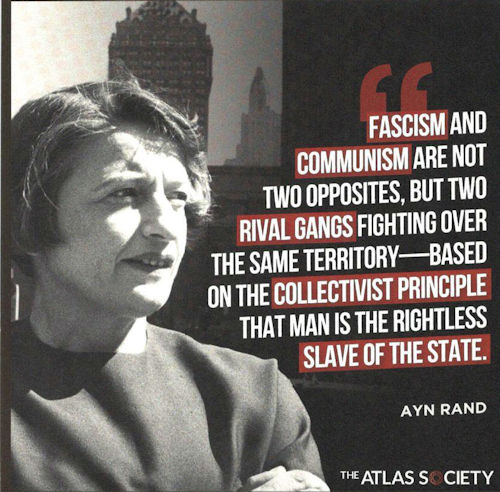





 Posts
Posts